
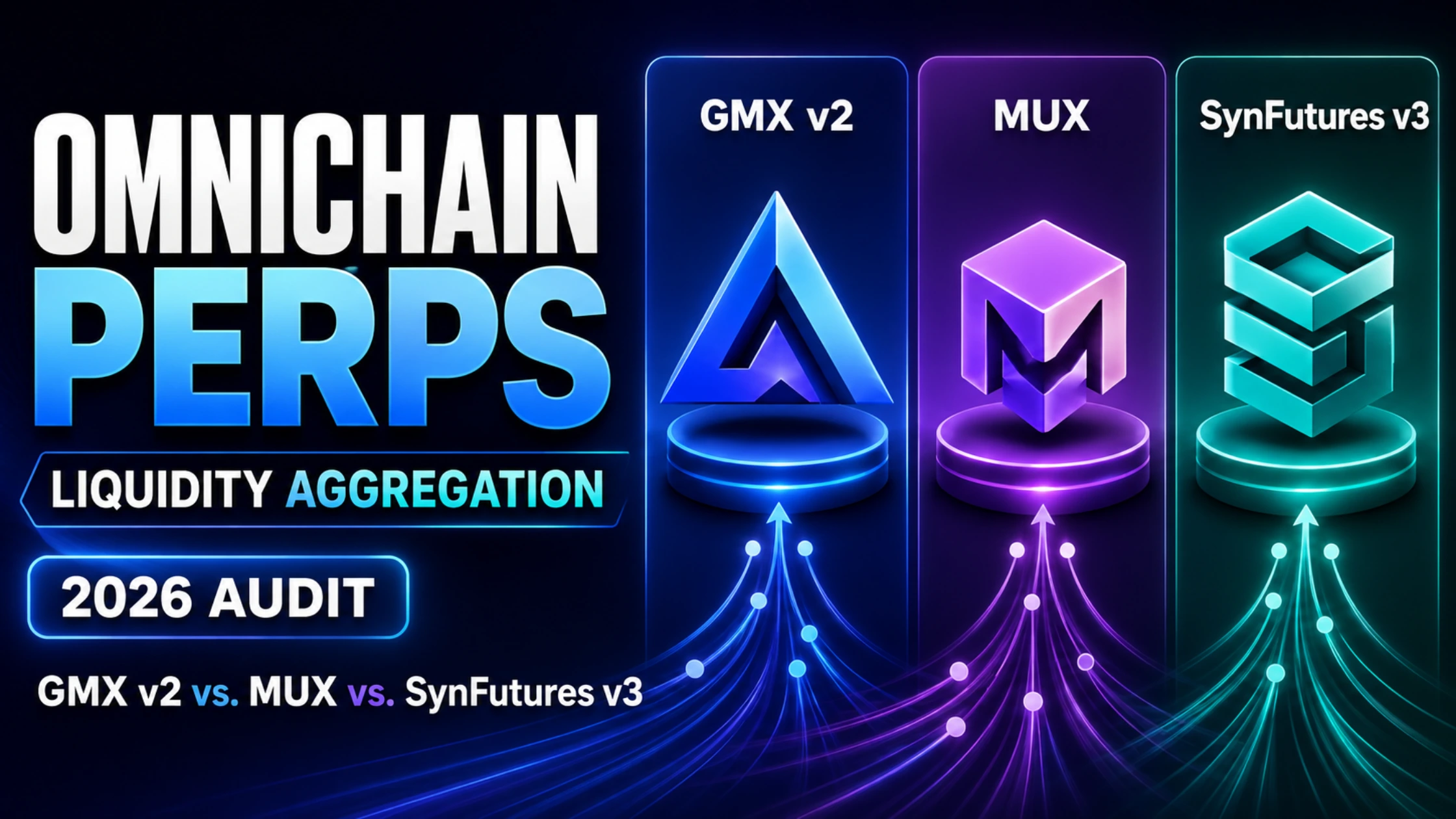
Omnichain Perpetuals & Intent-Based Liquidity Aggregation: GMX v2 vs. MUX Protocol vs. SynFutures v3 (2026 Audit)
Key Takeaways (DN Omnichain Liquidity Benchmarks)
- The Intent-Based Aggregation Shift: Decentralized perpetual exchanges have evolved from isolated, single-chain liquidity pools into intent-based omnichain execution networks that route trade payloads across multiple underlying venues to eliminate slippage and minimize borrowing fees.
- GMX v2 commands multi-billion-dollar synthetic trading volume across Arbitrum and Avalanche through isolated GM liquidity pools, utilizing sub-second Chainlink Data Streams to eliminate price impact and latency arbitrage.
- MUX Protocol operates as a zero-slippage cross-chain perpetual aggregator, automatically routing trade orders across underlying protocols (including GMX and gTrade) to lower margin requirements, optimize funding rates, and deliver up to 100x unified cross-margin leverage.
- SynFutures v3 introduces the Oyster AMM architecture, blending concentrated liquidity order books with synthetic automated market making to enable permissionless listing of any altcoin perpetual pair with single-asset margin vaults.
Featured Omnichain Outlets & VIP Discount Portals
Access low-latency trade routing, zero-slippage execution, and priority cross-chain liquidity using our verified partner portals:
- 🔹 GMX v2 Trading Portal: Trade Perps on GMX v2 — Referral Code:
decentralised - 🔹 MUX Protocol Aggregator: Launch MUX Omnichain Perps Engine — Referral Code:
decentralised - 🔹 SynFutures v3 Engine: Launch SynFutures Oyster AMM — Partner Team:
decentnews - 🔹 LogX Router (Multi-Chain Aggregator): Launch LogX Derivatives Router — Promo Code:
0506B422.logX - 🔹 deBridge (Cross-Chain Capital Router): Bridge Capital via deBridge — Partner Link:
20473 - 🔹 evedex (Low-Latency API Engine): Claim evedex VIP API Key — Promo Code:
9e3mk2nx
1. The Evolution from Single-Chain Vaults to Intent-Based Aggregation
In the early days of decentralized perpetual trading, liquidity was strictly siloed on individual blockchains. If a trader wanted to open a 50x leveraged position on Ethereum or Arbitrum, they were forced to manually bridge collateral, manage local gas tokens, and accept whatever local borrowing rates and slippage profiles existed on that specific chain.
In 2026, Omnichain Perpetuals & Intent-Based Aggregators have dismantled these liquidity silos.
By decoupling trade submission from execution location, modern derivatives architectures allow traders to:
- Unify Collateral Across Chains: Post margin on one chain (e.g., Arbitrum or Base) while opening leveraged positions that source execution liquidity from another (e.g., Avalanche or Blast).
- Eliminate Execution Slippage: Route market orders through multi-asset synthetic vaults (like GMX GM pools) or aggregated matching engines that fill orders at exact oracle index prices.
- Minimize Holding Costs: Intelligently route trades to underlying pools with the lowest current funding rates and borrow fee spreads, preserving capital on swing positions.
To determine which venue delivers the tightest execution spreads, lowest borrow fees, and most capital-efficient liquidity pools, Decentralised News audited GMX v2, MUX Protocol, and SynFutures v3.
2. DN Omnichain Liquidity Index (DN-OLIX) Framework
Our quantitative research team evaluates omnichain perpetual venues using five specialized criteria:
- Cross-Chain Intent Routing Velocity: The round-trip execution latency when submitting a trade intent on a source chain to final order fill on a destination execution layer.
- Funding & Borrow Rate Optimization Spread: The effective percentage cost savings achieved when an aggregator routes position orders to lower-cost liquidity venues.
- Oracle Price Feed Resilience: Sub-second price pull performance and manipulation resistance during extreme market volatility.
- Liquidity Provider (LP) Risk Isolation: The structural defense mechanisms (e.g., isolated pools, auto-deleveraging, dynamic funding rates) that protect LP capital from directional open interest imbalances.
- Permissionless Pair Deployment: Ease of creating and margining new altcoin, commodity, or prediction perpetual markets.
3. Omnichain Perpetual DEX Comparison Matrix
Below are the audited performance benchmarks from our continuous 30-day liquidity protocol audit:
| Platform | Core Architecture | Execution Model | Max Leverage | Standout Advantage | Verified Partner Portal |
|---|---|---|---|---|---|
| GMX v2 | Isolated GM Vault Pools (Arbitrum/Ava) | Chainlink Data Streams Oracle Fills | 50x | Zero price impact on blue-chip market orders | GMX v2 Portal (decentralised) |
| MUX Protocol | Cross-Chain Perpetual Aggregator | Intent-Based Multiplexer Routing | Up to 100x | Aggregates third-party DEXs to minimize fees & margin | MUX Aggregator (decentralised) |
| SynFutures v3 | Oyster AMM (Order Book + Synthetic AMM) | Fully Onchain CLOB / AMM Hybrid | Up to 100x | Permissionless market creation for any token | SynFutures v3 (decentnews) |
4. Platform Deep Dives: Top Omnichain Derivatives Outlets
1. GMX v2 — The Synthetic Liquidity Benchmark
GMX v2 remains the cornerstone of decentralized perpetual trading across Arbitrum and Avalanche, transitioning from its legacy multi-asset GLP pool into modular, isolated GM Pools (e.g., BTC-USDC, ETH-USDC, SOL-USDC).
Key Highlights: Isolated GM pools prevent risk contagion while sub-second Chainlink Data Streams feeds ensure zero price impact market fills and auto-balancing funding mechanics.
💡 Trader Pro Tip: Open leveraged positions on GMX v2 via Code decentralised to optimize trade execution.
2. MUX Protocol — Zero-Slippage Cross-Chain Aggregation
MUX Protocol operates as a specialized liquidity multiplexer and aggregator built to unify fragmented perpetual liquidity across EVM chains.
Key Highlights: Intent-based routing engine evaluates borrowing costs and margin rules across native and external DEXs, enabling up to 100x unified cross-margin leverage.
💡 Trader Pro Tip: Aggregate multi-chain perpetual trades seamlessly on the MUX Protocol Hub (Code decentralised).
3. SynFutures v3 — Permissionless Oyster AMM
SynFutures v3 introduces a flexible derivatives infrastructure powered by its proprietary Oyster AMM on Blast and EVM Layer-2 networks.
Key Highlights: Combines concentrated liquidity order books with synthetic AMM curves to allow permissionless deployment of any altcoin perpetual pair with single-asset margin vaults.
💡 Trader Pro Tip: Launch permissionless perpetual markets on SynFutures v3 via Partner Link decentnews.
Frequently Asked Questions (FAQ)
What is the main difference between GMX v2 and MUX Protocol?
GMX v2 is a primary liquidity venue that houses isolated GM collateral pools and executes trades directly against those pools using Chainlink Data Streams. MUX Protocol is an omnichain aggregator and liquidity multiplexer that can route orders into its native pool or through external venues (like GMX or gTrade) to secure the lowest execution costs and highest leverage for the trader.
How does SynFutures v3 allow permissionless market creation?
SynFutures v3 uses the Oyster AMM model, which blends concentrated order books with synthetic automated market makers. This architecture allows anyone to deploy a new perpetual pair for any ERC-20 token by seeding a single-asset liquidity vault, without needing centralized exchange listing approvals.
How do I bridge funds cross-chain with zero MEV risk?
You can use intent-based cross-chain bridges like deBridge to bridge native USDC or ETH across EVM networks (Arbitrum, Base, Avalanche, Optimism) and Solana in under 25 seconds with zero MEV sandwich risk.
Related reading:
Perpetual DEX Stop-Loss Reliability Test 2027: Which Platforms Actually Exit Before Liquidation?
Best Intent-Based DEXs 2027: Which Solvers Actually Improve Your Trade?
The Quantitative Trader’s Guide to Dedicated App-Chains & Gasless Execution
Best DEXs for Limit Orders: CoW vs 1inch vs KyberSwap vs Uniswap vs Jupiter
Hybrid Order Books Audit 2026: GRVT vs. MYX Protocol vs. Nado vs. StandX