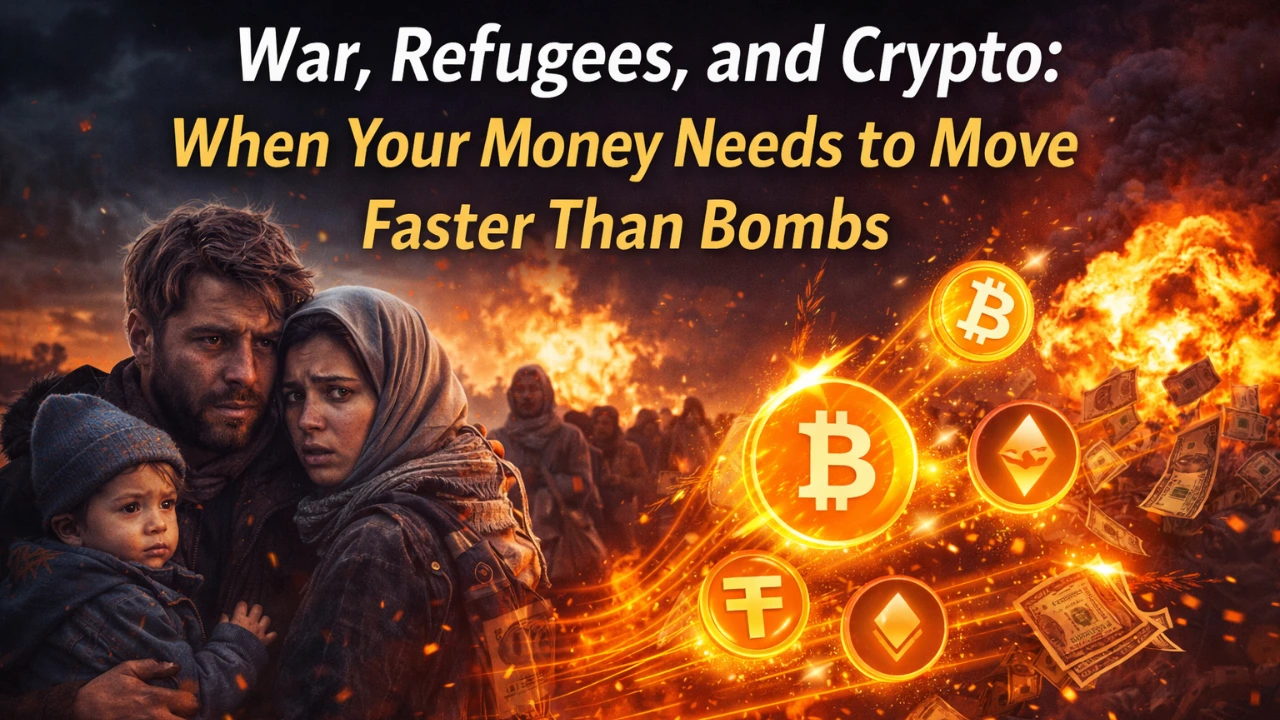
War, Refugees, and Crypto: When Your Money Needs to Move Faster Than Bombs
Inside the invisible financial lifeline saving Ukrainian, Afghan, and Syrian families from economic ruin. How borderless money is rewriting the rules of survival—and why traditional banking failed when it mattered most.
The 10-Minute Border Crossing
Maria didn’t have time to visit a bank branch. The artillery was already striking the outskirts of Kyiv, and the queue at the Polish border stretched for 17 kilometers. In her jacket pocket, a hardware wallet the size of a USB stick held her family’s entire life savings—$47,000 accumulated over fifteen years of running a small dental practice. No paperwork. No currency controls. No frozen accounts.
Ten minutes after crossing into Poland, she had converted enough Bitcoin to stablecoins to rent an apartment in Warsaw. Her sister, who fled through conventional channels three days earlier, was still waiting for her bank wire to clear. It never did. The intermediary bank in Moscow had been sanctioned.
This is the story nobody is telling about cryptocurrency. Not the price predictions. Not the ETF approvals. The real narrative is happening in Telegram groups, airport terminals, and refugee camps—where borderless money isn’t an investment thesis, but a survival mechanism.
The United Nations High Commissioner for Refugees estimates that 110 million people are currently displaced worldwide, the highest figure since World War II. Traditional financial infrastructure was built for stability, borders, and business hours. It was not built for Maria. But crypto was.

The Architecture of Financial Escape
Why Banks Fail When Bombs Fall
To understand why cryptocurrency has become indispensable in conflict zones, you must first understand how traditional finance collapses under pressure. It’s not dramatic—it’s bureaucratic, which is worse.
When Russia invaded Ukraine in February 2022, Western sanctions severed Russian banks from SWIFT, the messaging system that enables international wire transfers. This was the intended effect. The unintended effect was stranding thousands of Ukrainian refugees with money in accounts they could no longer access. A teacher in Kharkiv with a dollar savings account at Sberbank found her money frozen not by Russian decree, but by compliance algorithms thousands of miles away.
Cash isn’t the solution it once was. Carrying significant physical currency across borders triggers declaration requirements, confiscation risks, and the attention of every corrupt official between you and safety. Gold is heavy. Diamonds require expertise to verify. Property deeds become worthless when the property is behind enemy lines.
The failure is systemic. Traditional banking assumes trust in institutions, stable jurisdictions, and functioning legal systems. Refugees operate in environments where all three have evaporated.

The Crypto Alternative: Censorship-Resistant Value
Cryptocurrency solves this through architectural design, not policy choice. A Bitcoin private key is 256 bits of information. It can be memorized, written on paper, stamped into metal, or stored in a device smaller than a thumb drive. It requires no bank’s permission to exist, no government’s approval to move, and no intermediary’s cooperation to spend.
For refugees, this translates into three critical capabilities:
Immediate liquidity. While bank transfers freeze and Western Union offices close, cryptocurrency markets operate 24/7. A Ukrainian refugee in Berlin can sell Bitcoin for euros at 3 AM on a Sunday through a peer-to-peer exchange, meeting a local buyer within hours.
Portability without detection. A family can transport their entire net worth across a checkpoint without revealing its existence. Border guards search bags, not memories. This isn’t about tax evasion—it’s about preventing confiscation by hostile actors or desperate intermediaries.
Identity independence. Traditional finance ties money to passports, addresses, and tax identification numbers. Refugees often lack these documents or cannot risk using them. Crypto wallets require none. A Syrian doctor who fled Aleppo in 2016 used cryptocurrency to preserve his savings for three years before obtaining legal residency in Germany, at which point he could finally convert it through regulated channels.
These aren’t theoretical advantages. They’re daily realities for millions.

Case Studies: Three Financial Escape Routes
Ukraine: The Largest Crypto Migration in History
The Ukrainian refugee crisis became the first mass migration where cryptocurrency played a central financial role. The numbers are staggering: Chainalysis reported that crypto donations to Ukrainian causes exceeded $100 million in the first three months of the war, but this tells only part of the story.
More significant was the grassroots adoption among refugees themselves. Ukrainian banks imposed withdrawal limits of 100,000 hryvnia (approximately $3,400) per day as the invasion began. For families needing to relocate immediately, this was catastrophic. Cryptocurrency exchanges saw a 200% increase in Ukrainian registrations within 48 hours of the invasion.
Oleg, a software developer from Odessa, described the calculus: “I had $20,000 in PrivatBank. I could take out $3,400 per day, but the bank might fail, or the currency might collapse, or the city might fall before I got it all. Or I could buy USDT on Binance, transfer it to my Ledger, and walk across the border with everything.”
The choice was obvious. Platforms like Binance and OKX became critical infrastructure overnight, offering fee reductions for Ukrainian users and rapid verification processes for those with disrupted documentation. For refugees without established exchange accounts, peer-to-peer platforms provided immediate on-ramps using local currency before departure.
The technical sophistication of Ukrainian refugees accelerated adoption. Ukraine had already developed a robust crypto ecosystem prior to the war, with the government itself accepting crypto donations. This meant that even non-technical users often had family members who could guide them through wallet setup and security procedures.

Afghanistan: Banking Collapse and Digital Survival
When the Taliban seized Kabul in August 2021, the Afghan financial system didn’t gradually deteriorate—it vanished. The central bank’s assets were frozen. Commercial banks closed. Western Union suspended services. For a population already facing famine, the inability to receive remittances from family abroad was potentially fatal.
Afghanistan represents the purest test case for cryptocurrency’s humanitarian utility. With no functioning banking system and severe restrictions on women’s financial participation, crypto became the only viable channel for international money transfers.
The mechanics were ingenious in their simplicity. An Afghan family member would provide a cryptocurrency address—often generated through a mobile wallet app like Trust Wallet or MetaMask—to relatives in Europe or North America. These relatives would purchase cryptocurrency through exchanges like Kraken or Coinbase, then transfer it directly to the Afghan wallet. The recipient could then sell to local crypto traders, often through informal Telegram networks, receiving Afghanis or dollars in cash.
This bypassed the entire formal financial system that had ceased to function. It also bypassed the Taliban’s financial surveillance, providing crucial privacy for those at risk.
The risks were substantial. Cryptocurrency’s volatility could erode purchasing power during the transfer. Scammers proliferated in the chaos. Technical mistakes—sending funds to wrong addresses, losing private keys—were irreversible. Yet for many Afghans, these risks were preferable to starvation.
Humanitarian organizations began formalizing these informal networks. The United Nations Development Programme explored blockchain-based cash transfers for Afghan aid, recognizing that traditional distribution mechanisms had failed. What began as individual survival strategies evolved into institutional recognition of crypto’s role in humanitarian logistics.

Venezuela and the Americas: Economic Migration Meets Digital Dollars
While war drives acute displacement, economic collapse drives chronic migration. Venezuela’s economic disintegration—hyperinflation exceeding 1,000,000% at its peak—created the largest refugee crisis in the Western hemisphere, with over 7 million Venezuelans fleeing to Colombia, Brazil, Peru, and beyond.
For Venezuelan migrants, cryptocurrency solved a different problem: preserving value across borders when the origin currency had become worthless. The bolívar was not merely unstable—it was radioactive. Savings held in bolívars evaporated within weeks. Even US dollars, the traditional safe haven in Latin America, were difficult to obtain and dangerous to hold physically.
The solution was stablecoins—cryptocurrency tokens pegged to the US dollar. Tether (USDT) and USD Coin (USDC) became the de facto savings accounts for Venezuelan professionals. A doctor in Caracas could receive payment in USDT, hold it in a mobile wallet, and arrive in Colombia with savings intact. No currency exchange. No black market premiums. No bulky cash.
Platforms like Binance P2P and KuCoin became essential financial infrastructure, offering direct bolívar-to-stablecoin conversion. For those already outside Venezuela, remittances via crypto avoided the 10-15% fees charged by traditional money transmitters.
The geographic proximity to the United States created unique dynamics. Venezuelan refugees in Miami could send crypto to family in Bogotá, who could then convert to Colombian pesos or hold as dollars. The circular flow of migration—family members moving back and forth as conditions shifted—was financially lubricated by cryptocurrency’s borderless nature.

The Technical Stack of Survival
Mobile Wallets: Financial Infrastructure in Your Pocket
The transformation of refugee finance depends on mobile technology. Smartphones are ubiquitous even in developing nations, and cryptocurrency wallets have evolved from complex software requiring desktop computers to intuitive mobile applications.
For refugees, mobile wallets offer three critical advantages:
Immediate accessibility. Downloading a wallet takes minutes. No bank account required. No minimum balance. No documentation. For someone fleeing with only their phone and the clothes they wear, this is transformative.
Multi-currency flexibility. Refugees often traverse multiple jurisdictions with different currencies. A wallet holding stablecoins can convert to local currency as needed, avoiding the losses from repeated currency exchanges.
Backup and recovery. Modern wallets use seed phrases—12 or 24 words that can restore access to funds on any device. These phrases can be written down, memorized, or even split among family members for security. If a refugee loses their phone crossing a river, their money isn’t lost—just temporarily inaccessible until they can restore the wallet.
The choice of wallet matters significantly for security and usability. Hardware wallets like Ledger provide maximum security for significant savings, storing private keys in isolated hardware that never connects to the internet. For active use and smaller amounts, software wallets like MetaMask (for Ethereum-based assets) or Trust Wallet (multi-chain) offer convenience with acceptable security tradeoffs.
For those prioritizing absolute privacy—essential for refugees from authoritarian regimes—specialized wallets with enhanced anonymity features provide additional protection. The key is matching the wallet to the threat model: a refugee from North Korea faces different risks than one from Ukraine and requires different security measures.

Exchanges and On-Ramps: The Conversion Challenge
Cryptocurrency is only useful if it can be converted to local currency for rent, food, and necessities. This requires exchanges—platforms that connect crypto holders with local buyers and sellers.
The exchange landscape for refugees is bifurcated. In developed destinations like Germany or Canada, regulated exchanges like Kraken, Coinbase, and Bitstamp provide secure, compliant conversion to fiat currency. These platforms require identity verification, which refugees may initially lack, but they offer the best rates and strongest legal protections.
For immediate needs or in jurisdictions with limited banking access, peer-to-peer (P2P) exchanges become essential. Binance P2P, OKX P2P, and KuCoin P2P connect buyers and sellers directly, often with local payment methods like cash deposits, mobile money, or in-person meetings. These carry higher counterparty risk but offer accessibility that centralized exchanges cannot match.
The emergence of specialized remittance platforms has streamlined this process. Services designed specifically for crypto-to-cash conversion in developing nations have reduced friction and fraud. A refugee in Kenya can receive crypto from family in London and collect Kenyan shillings from a local agent within hours, bypassing the traditional correspondent banking system entirely.
Stablecoins: The Refugee’s Reserve Currency
While Bitcoin dominates headlines, stablecoins dominate refugee finance. The reason is psychological and practical: refugees need price stability, not speculative appreciation. A 20% Bitcoin drop can mean the difference between affording an apartment and homelessness.
Tether (USDT) and USD Coin (USDC) have become the reserve currencies of displacement. Both maintain a 1:1 peg with the US dollar through various reserve mechanisms. For refugees, they offer dollar exposure without dollar access—critical when physical dollars are scarce or dangerous to hold.
The choice between stablecoins involves tradeoffs. USDT has deeper liquidity and wider acceptance, particularly in developing markets. USDC offers stronger regulatory compliance and transparency, potentially important for refugees eventually seeking to regularize their financial status. Both operate across multiple blockchains, with Tron (for USDT) and Ethereum (for USDC) being most common for transfers due to speed and cost considerations.
For refugees in hyperinflationary environments, stablecoins represent not just convenience but existential protection. A Venezuelan family holding savings in USDT preserved purchasing power that would have been destroyed in bolívars. This isn’t investment—it’s financial self-defense.

The Humanitarian Infrastructure: Organizations and Networks
Formal Adoption: UNHCR and Blockchain
The humanitarian sector has been slower to adopt cryptocurrency than refugees themselves, but momentum is building. The United Nations High Commissioner for Refugees (UNHCR) has piloted blockchain-based identity systems and explored crypto disbursements for aid. The World Food Programme’s Building Blocks project uses blockchain to distribute cash assistance to Syrian refugees in Jordan, reducing transaction costs and improving transparency.
These institutional experiments matter because they validate what refugees have already discovered: traditional financial infrastructure is too slow, expensive, and fragile for humanitarian crises. Blockchain-based systems can disburse aid directly to recipients’ digital wallets, eliminating intermediaries and reducing corruption.
The limitations are significant. Institutional adoption requires regulatory compliance, identity verification, and technical infrastructure that grassroots crypto use bypasses. A refugee receiving UN aid through a blockchain system must still navigate the same documentation challenges that make traditional banking inaccessible. The innovation is in the disbursement mechanism, not the eligibility criteria.

Grassroots Networks: The Real Financial Infrastructure
More significant than institutional pilots are the informal networks that have emerged organically. Telegram groups connect Ukrainian refugees with Polish crypto buyers. WhatsApp networks facilitate stablecoin remittances to Venezuela. Family members share wallet addresses through Signal, knowing that metadata is minimized.
These networks operate outside formal financial regulation, which is both their strength and vulnerability. Without regulatory oversight, they can move instantly and adapt to local conditions. Also without oversight, they are vulnerable to fraud, money laundering accusations, and technical failures.
The trust mechanisms are social, not institutional. A Ukrainian refugee in Warsaw finds a crypto buyer through a Facebook group vouched for by mutual acquaintances. The transaction happens in a coffee shop, cash for stablecoins, with both parties verifying the transfer before parting. This is how financial systems operated before banks—through reputation, relationships, and repeated interaction.
Humanitarian organizations are beginning to formalize these informal networks. Crypto education programs for refugees—teaching wallet security, scam recognition, and exchange navigation—have emerged in major destination cities. These programs acknowledge reality: refugees are using cryptocurrency regardless of institutional support, so the priority becomes safe usage rather than prevention.
The Dark Side: Risks and Exploitation
Scams Preying on Desperation
Where vulnerability exists, exploitation follows. Refugees represent a perfect target for cryptocurrency scams: they are often desperate, financially unsophisticated, operating under stress, and excluded from traditional financial protections.
The scams are variations on classic themes, adapted for crisis conditions. Fake exchanges promise to convert crypto to local currency at unbeatable rates, then disappear with deposits. Phishing attacks mimic legitimate wallet applications, stealing private keys from users who downloaded the wrong app. Ponzi schemes target refugee communities with promises of guaranteed returns, exploiting social trust networks.
The “pig butchering” scam—where fraudsters build romantic or friendship relationships before introducing fake investment opportunities—has devastated refugee communities. A Syrian refugee in Turkey, lonely and isolated, receives a WhatsApp message from someone claiming to be a fellow refugee. Over weeks, trust builds. Then comes the investment opportunity. The money disappears.
Recovery is nearly impossible. Cryptocurrency transactions are irreversible. Law enforcement in host countries often lacks technical expertise or jurisdictional reach. Refugees may fear reporting scams due to immigration status concerns.
Education is the primary defense. Understanding that legitimate exchanges never ask for private keys, that guaranteed returns are impossible, that verification of counterparty identity is essential—these lessons can prevent catastrophic losses. But education requires time and stability that refugees often lack.
Regulatory Hostility and Compliance Traps
Cryptocurrency exists in a regulatory gray zone that creates unique risks for refugees. Many jurisdictions require exchanges to verify customer identity through Know Your Customer (KYC) procedures. Refugees often lack the documentation—passports, utility bills, tax identification numbers—that these procedures require.
This creates a catch-22. A Ukrainian refugee arrives in Poland with cryptocurrency savings but cannot convert them to złoty because she lacks a Polish bank account or residence permit. She cannot obtain these without an address. She cannot get an address without money. The cryptocurrency that enabled her escape becomes temporarily unusable.
Some exchanges have responded with refugee-specific policies. Binance and Kraken have implemented streamlined verification for Ukrainian refugees using alternative documentation. P2P platforms often require less verification than centralized exchanges. But these are partial solutions to a systemic problem.

The regulatory trend is toward stricter controls, not looser. The Financial Action Task Force (FATF) recommendations require increasing surveillance of cryptocurrency transactions. For refugees, this means that the financial privacy that crypto provides is under threat—not from technical failure, but from policy choice.
Volatility and Technical Risk
Even legitimate cryptocurrency use carries risks that refugees are poorly positioned to manage. Bitcoin’s price can drop 20% in a day. A refugee converting savings to Bitcoin for border crossing might arrive with significantly less purchasing power than expected. Stablecoins reduce but don’t eliminate this risk—depegging events, while rare, can be catastrophic.
Technical mistakes are unforgiving. Sending cryptocurrency to the wrong address means permanent loss. There is no customer service to call, no fraud protection to invoke. A refugee under stress, operating in a second language, unfamiliar with blockchain interfaces, makes these mistakes at higher rates.
Wallet security is another challenge. Private keys must be backed up securely, but refugees often lack secure storage locations. A seed phrase written on paper can be destroyed by water damage, fire, or confiscation. Metal backup solutions exist but add cost and complexity. The same features that make cryptocurrency portable—no central authority, no recovery mechanism—make errors catastrophic.

The Future: Institutionalization and Resistance
Central Bank Digital Currencies: The Surveillance Alternative
The cryptocurrency refugee solution exists because traditional finance failed. Governments are responding not by fixing traditional finance, but by creating alternatives that preserve state control: Central Bank Digital Currencies (CBDCs).
China’s digital yuan, Nigeria’s eNaira, and proposed digital dollars represent fundamentally different architectures from Bitcoin or stablecoins. They are centralized, surveilled, and programmable. A CBDC can be frozen by government decree, programmed to expire if not spent, or restricted to specific purchases. For refugees, these features are threats, not benefits.
The tension is clear. CBDCs could theoretically improve humanitarian cash transfers—faster, cheaper, more transparent than current systems. But they also enable unprecedented financial surveillance and control. A refugee receiving CBDC aid could find their funds restricted to specific merchants, geofenced to specific locations, or revoked for political reasons.
The cryptocurrency refugee community is likely to resist CBDC adoption precisely because of these control features. The value proposition of decentralized crypto—censorship resistance, permissionless access, user control—becomes more important, not less, in an era of programmable money.
Infrastructure Evolution: Layer 2 and Beyond
The technical limitations that constrain refugee crypto use—transaction fees, confirmation times, complexity—are being addressed through infrastructure evolution. Layer 2 scaling solutions like Lightning Network for Bitcoin and rollups for Ethereum reduce costs and increase speed.
For refugees, these improvements matter practically. A Lightning Network payment can settle in seconds for fractions of a cent, making Bitcoin viable for small purchases rather than just large transfers. Ethereum rollups reduce stablecoin transfer costs from dollars to cents.
The challenge is accessibility. Layer 2 solutions require technical knowledge to navigate—channel management, bridge usage, wallet configuration. Refugees benefit from these innovations only when they are packaged into user-friendly applications. The gap between technical capability and user experience is where humanitarian impact is won or lost.

The Geopolitical Dimension
Cryptocurrency’s role in refugee finance is becoming a geopolitical issue. Russia’s invasion of Ukraine accelerated Western understanding of crypto’s dual-use nature—humanitarian tool and sanctions evasion mechanism simultaneously. The policy response has been contradictory: facilitating crypto for Ukrainian refugees while restricting Russian crypto access.
This contradiction will intensify. As cryptocurrency becomes more central to refugee movements worldwide, governments must choose between financial surveillance and humanitarian effectiveness. The technical architecture of crypto makes this choice stark: surveillance requires breaking the decentralization that makes crypto useful for refugees.
Countries competing for refugee talent—skilled migrants fleeing crises—may adopt crypto-friendly policies as competitive advantages. Portugal’s crypto tax benefits attracted Ukrainian tech workers. Dubai’s regulatory clarity draws crypto-native migrants from everywhere. Financial sovereignty becomes a factor in migration decisions.

Strategic Implications: What This Means for You
For Crypto Natives: Infrastructure Responsibility
If you hold cryptocurrency, you are part of the infrastructure that refugees depend upon. Your participation in P2P markets provides liquidity. Your node operation strengthens network resilience. Your political advocacy for sensible regulation protects the permissionless access that refugees require.
This carries responsibility. The scams that target refugees often originate in crypto-native communities. The technical complexity that excludes refugees is often defended by crypto purists prioritizing decentralization over usability. The ideological commitment to censorship resistance must be balanced against the practical need for user protection.
Consider direct support. Organizations like Binance Charity and The Giving Block facilitate cryptocurrency donations to refugee causes. These aren’t just tax-efficient—they bypass the friction and overhead of traditional aid distribution. A Bitcoin donation to a Ukrainian relief organization arrives in hours, not weeks, with minimal administrative cost.
For Policymakers: Regulatory Clarity
The current regulatory approach to cryptocurrency and refugees is incoherent—simultaneously encouraging crypto for sanctions enforcement against Russia while restricting the same tools for Afghan humanitarian aid. This incoherence harms vulnerable people.
What’s needed is regulatory clarity that distinguishes between illicit finance and legitimate humanitarian use. Refugee-specific provisions in cryptocurrency regulation—streamlined KYC for displaced persons, safe harbors for humanitarian organizations, recognition of alternative documentation—would preserve crypto’s benefits while managing risks.
The alternative is driving refugee crypto use further underground, where scams proliferate and legal protections vanish. Regulation cannot stop cryptocurrency use by refugees—it can only determine whether that use is safe and visible or dangerous and hidden.

For Humanitarian Organizations: Technical Integration
Humanitarian organizations must accelerate cryptocurrency integration, not as pilot projects but as core infrastructure. This requires:
Technical capacity building. Aid workers need crypto literacy comparable to their financial literacy. Understanding wallet security, exchange mechanics, and blockchain analysis should be standard professional development.
Partnership with crypto-native organizations. The expertise in refugee crypto use exists in the community, not in traditional NGOs. Partnerships with exchanges, wallet providers, and blockchain analytics firms can accelerate effective deployment.
Advocacy for enabling regulation. Humanitarian organizations must engage policymakers to ensure that cryptocurrency regulation preserves space for legitimate refugee use. This requires technical sophistication that many organizations currently lack.
Conclusion: The Moral Case for Borderless Money
Maria, the Ukrainian dentist who crossed into Poland with her life savings on a hardware wallet, now runs a practice in Warsaw. Her sister, who relied on traditional banking, lost most of her savings to frozen accounts and currency devaluation. The difference wasn’t luck or timing. It was architecture.
Cryptocurrency is often criticized as a solution looking for a problem. For 110 million refugees, it is the solution to a very real problem: how to preserve economic agency when everything else—your home, your country, your identity documents—has been stripped away.
This is not about investment returns or technological ideology. It’s about whether a teacher in Kharkiv can feed her children after the banks close. Whether an Afghan doctor can maintain his professional dignity through displacement. Whether a Venezuelan family can preserve generational savings against hyperinflation.
The cryptocurrency ecosystem—exchanges like Binance and Kraken that provide liquidity, wallet providers like Ledger that secure savings, stablecoin issuers that provide stability—has become critical humanitarian infrastructure. This infrastructure operates without humanitarian mandate, funded by speculation and trading fees rather than aid budgets. Its effectiveness is accidental rather than designed. But it is effective.
As conflicts proliferate and climate displacement accelerates, the population depending on borderless money will grow. The question is not whether cryptocurrency has a role in refugee finance—it already does. The question is whether we will improve that role through intentional design, or allow it to remain a chaotic, risky, but necessary alternative to failed traditional systems.
For refugees, the choice is already made. They will use whatever tools preserve their economic lives. Our choice is whether to make those tools safer, more accessible, and more integrated with the broader humanitarian response—or to pretend that traditional finance will somehow become adequate to the greatest displacement crisis in human history.
The bombs fall. The borders close. The banks freeze. But the blockchain continues, indifferent to jurisdiction, immune to censorship, available to anyone with a phone and a private key. For millions of displaced people, that continuity is the difference between destitution and dignity.
Ready to Take Control of Your Financial Sovereignty?
Whether you’re preparing for uncertainty or simply seeking financial autonomy, the tools that saved Maria’s family are available to you today.
Secure Your Savings: Protect your cryptocurrency with institutional-grade security using a Ledger hardware wallet—the same device that carried millions across borders. Store your private keys offline, immune to hacking and surveillance.
Access Global Markets: Join Binance, the world’s largest cryptocurrency exchange, offering peer-to-peer trading, stablecoin access, and the liquidity that refugees depend upon worldwide. New users can register with code CPA_00SXKU7IO9 to access comprehensive trading features.
Trade with Confidence: For professional-grade derivatives and spot trading, OKX provides the depth and reliability essential for significant positions. Register at OKX to access advanced trading tools.
Start Your Journey: New to cryptocurrency? Luno offers the simplest on-ramp for beginners, with intuitive interfaces and educational resources. Use code MJV6YD when registering to begin building your financial resilience.
For Advanced Traders: Access deep liquidity and sophisticated derivatives on Bybit using referral code 46164, or explore Kraken for institutional-grade security and regulatory compliance at Kraken.
The infrastructure of financial freedom exists. Your move.

Start Here — Build Your Crypto Infrastructure Safely
You don’t need to use everything at once.
Professionals reduce risk by having access to multiple rails so they are never dependent on a single platform.
Below is a simple, practical setup used by many experienced traders and investors.
1) Your Fiat Gateway (Primary Access)
Best starting point for deposits & withdrawals
Binance — reliable onboarding, deep liquidity, global coverage
👉 sign up
Why open this:
- Move from bank → crypto easily
- Convert large amounts efficiently
- Emergency exit capability
2) Your Trading Execution Venue (Fast & Flexible)
Best for active trading and broad market access
MEXC — huge altcoin selection & low trading friction
👉 sign up
Why open this:
- Trade markets not listed elsewhere
- Better execution during volatility
- Lower dependence on a single exchange
3) Your Advanced Tools & Derivatives Platform
Best for leverage, hedging and professional execution
Bybit — strong order controls & derivatives infrastructure
👉 sign up
Why open this:
- Proper stop loss tools
- Hedging capability
- Strategy flexibility

4) Your Yield & Passive Income Layer
Best for structured products and capital efficiency
Gate.com — structured yield & automated earning tools
👉 sign up
Why open this:
- Earn on idle capital
- Diversify platform risk
- Access structured strategies
5) Your Altcoin & Ecosystem Expansion Layer
Best for early market access and wide listings
KuCoin — broad token ecosystem
👉 sign up
Why open this:
- Access emerging markets
- Portfolio diversification
- Redundancy if one platform restricts access
Why This Structure Matters
Using one exchange creates a single point of failure.
Using multiple rails creates:
- Liquidity redundancy
- Faster reaction ability
- Lower operational risk
- Greater opportunity access
You don’t need large capital to start — you just need prepared infrastructure.
Practical Next Step
Open accounts gradually and verify them before you need them.
Most people only prepare during stress —
professionals prepare before it.
(Decentralised News provides infrastructure education, not financial advice. Always use proper security practices.)
Additional relevant reading:
Oil’s War Premium Is Back and Your Grocery Bill Is Next
How To Build a Portfolio for Oil Shocks, Inflation, and Geopolitical Risk in 2026