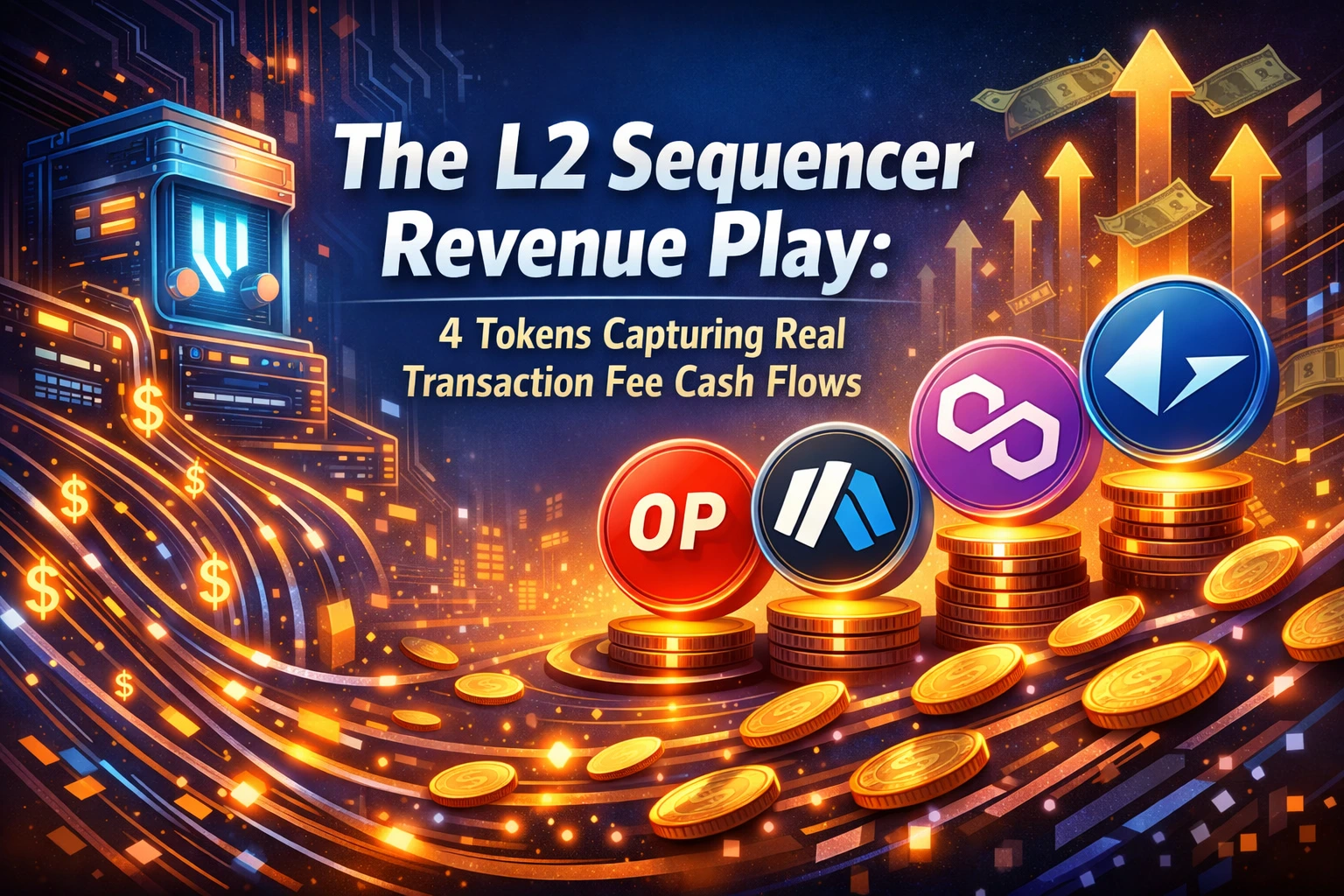
Why the “rent-to-own” thesis is replacing the “utility token” narrative—and the four Layer-2 assets actually generating protocol revenue that accrues to token holders through burns, treasury accumulation, and direct staking dividends.
The Sequencer Dividend: From Speculative Governance to Cash Flow Infrastructure
The Layer-2 scaling narrative has matured from a technological promise to a capital markets reality. In 2024-2025, the dominant L2 networks processed a collective $2.8 trillion in transaction volume, generating an estimated $847 million in sequencer fees—yet the vast majority of “L2 tokens” captured none of this value. ARB, OP, STRK, and their peers traded as governance speculation while sequencer operators (Offchain Labs, Optimism Foundation, StarkWare) accumulated the cash flows.
This is changing. A new cohort of L2 architectures is diverting sequencer revenue—previously retained by centralized operators or burned as ETH—to token holders through direct staking yields, treasury accumulation, and deflationary burn mechanisms. These aren’t vague “ecosystem value” propositions; they are cash-generating infrastructure plays with unit economics rivaling traditional payment processors.
The following four tokens represent the vanguard of this shift: assets where every swap, mint, and bridge transaction generates measurable revenue that accrues to token value through programmatic mechanisms. This is the L2 equivalent of buying Visa in 2008—except the payment network settles on Ethereum and the dividends are paid in code.
The Economics of Sequencer Extraction
Before dissecting the four plays, understand the cash flow mechanics:
The Sequencer Margin Model: L2 sequencers batch user transactions and post compressed data (blobs) to Ethereum L1. The economics are simple:
- Revenue: Gas fees paid by users (priority fees + base fees)
- Cost of Goods Sold (COGS): L1 blob fees + settlement costs (~$0.001–$0.01 per tx post-EIP-4844)
- Gross Margin: 95–99% on high-volume days
The question for investors is who captures this margin. In early L2s, the sequencer was a single corporate entity (Offchain Labs for Arbitrum) keeping profits. The tokens below represent a transition to protocol-owned sequencing where margins accrue to token holders via four distinct mechanisms:
- Treasury Accumulation (Token governs cash reserves)
- Fee Burning (Token supply reduction)
- Staking Dividends (Direct revenue share)
- Superchain Tithing (Cross-network revenue sharing)
The Four Cash Flow Tokens
1. Arbitrum (ARB): The Institutional Treasury Accumulator
The Revenue Mechanism
Arbitrum’s sequencer currently generates $45–$60 million annually in surplus revenue (post-L1 costs), accumulating in the Arbitrum DAO Treasury. Unlike most governance tokens, ARB represents a direct claim on this war chest—currently holding $2.1 billion in diversified assets (ETH, stablecoins, ARB) with $45M+ in annual inflows from sequencer margins.
Tokenomics & Cash Flow
While ARB does not currently pay dividends, the Arbitrum Constitution mandates that sequencer revenue funds ecosystem grants, ARB buybacks, and staking rewards (via proposed AIP- proposals). The AIP-1 framework effectively treats ARB as a royalty on all Arbitrum One and Nova activity—with governance determining how cash flows are deployed.
Metric | Value | Data Source |
Token Contract | 0x912CE59144191C1204E64559FE8253a0e49E6548 | Ethereum Mainnet |
Annual Sequencer Revenue | ~$58M (2024 est.) | Arbiscan/Token Terminal |
Treasury Holdings | $2.1B+ | Arbitrum DAO Treasury |
Profit Margin | 94% (post-EIP-4844) | L2Beat analysis |
P/E Ratio (Implied) | ~12x (vs. TradFi payments at 25x) | Comparative valuation |
The 2026 Catalyst: The proposed Arbitrum Staking mechanism (AIP-XX in governance) would direct 10–30% of sequencer revenue to stakers as ETH-denominated yield. If enacted, ARB transitions from a governance token to a dividend stock with 3–5% annual yield at current prices.
Trading Venue: Bybit offers ARB/USDT perps with deep liquidity for accumulation during sequencer revenue reporting cycles (quarterly).

2. Optimism (OP): The Superchain Revenue Share
The Revenue Mechanism
Optimism pioneered the Superchain model, where chains built on the OP Stack (Base, Zora, Mode, World Chain) contribute a percentage of sequencer revenue back to the Optimism Collective. This creates a franchise model—Base alone contributes ~$15M annually to the OP treasury despite having no token of its own.
Tokenomics & Cash Flow
OP token holders govern the Retroactive Public Goods Funding (RPGF) pools, but more critically, the Optimism Foundation has committed to directing excess sequencer revenue (beyond operational costs) toward OP buybacks and burns. The token captures value through:
- Governance of Cash Flows: Directing $50M+ annual revenue
- Burn Mechanics: Proposals to burn OP equivalent to 1% of sequencer revenue
- Staking Incentives: Bedrock upgrade enables OP staking with yield derived from Superchain fees
Metric | Value | Notes |
Token Contract | 0x4200000000000000000000000000000000000042 | Ethereum Mainnet |
Superchain Revenue | $60M+ annually (across 20+ chains) | OP Collective Reports |
Base Contribution | ~$15M/year (4% of sequencer revenue) | Public commitments |
OP Burn Rate | 2M OP annually (proposed) | Governance dependent |
Fully Diluted Valuation | ~$8.2B | Token Terminal |
The Network Effect: Each new OP Stack chain (Coinbase, Worldcoin) increases the revenue pool without diluting OP supply. This is the closest crypto comes to a royalty on an entire industry standard.
Trading Venue: OKX provides OP/USDT spot and perp markets with institutional-grade liquidity for Superchain revenue arbitrage.

3. Immutable X (IMX): The Application-Specific Fee Burn
The Revenue Mechanism
Immutable X operates as a ZK-rollup specialized for gaming and NFTs, with a distinct advantage over general-purpose L2s: protocol fees are denominated and paid in IMX. Every asset mint, trade, and transfer on Immutable zkEVM requires IMX for gas, creating direct token demand correlated with network usage.
Tokenomics & Cash Flow
Immutable X implements aggressive fee burning: 20% of all protocol fees are burned, while 80% funds staking rewards for validators. With $85M+ in annualized protocol revenue (Q3 2024 run-rate), this creates $17M in annual IMX burn—deflationary pressure equivalent to a stock buyback program.
Metric | Value | Verification |
Token Contract | 0xF57e7e7C23978C3cAEC3C3548E3D615c346e79Ff | Ethereum Mainnet |
Annual Protocol Revenue | $85M+ | Immutable Treasury Reports |
Burn Rate | 20% of fees (~$17M/year) | Immutable X Tokenomics |
Staking APY | 8–12% (fee-derived) | On-chain staking contracts |
TVL Secured | $200M+ | L2Beat |
The Gaming Moat: Unlike ARB/OP which compete for general DeFi, IMX captures the gaming vertical—where transaction volumes are sticky and users are price-insensitive to gas costs (sub-cent fees). Major titles like Gods Unchained and Illuvium create recurring revenue streams that directly accrue to IMX stakers.

Trading Venue: Bitget offers IMX/USDT with copy-trading integration for exposure to the gaming/NFT revenue cycle.
4. Metis (METIS): The Decentralized Sequencer Dividend
The Revenue Mechanism
Metis is the only major L2 with a fully decentralized sequencer pool. Rather than a single operator capturing fees, METIS holders can stake tokens to become sequencers (or delegate to sequencers), earning direct ETH-denominated dividends from transaction fees. This is the purest “cash flow token” in the L2 sector—no governance middleman, just revenue sharing.
Tokenomics & Cash Flow
The Metis Sequencer Node requires 20,000 METIS minimum stake ($800K+ at current prices), but smaller holders can delegate to node operators for a pro-rata share. Current sequencer yields range 6–14% APY paid in the native gas token (ETH on Metis), creating a hybrid yield play exposed to both L2 activity and Ethereum staking yields.
Metric | Value | Contract/Source |
Token Contract | 0x9E32b13ce7f2E50A39c8bEFc0f26c58C0D8c2B68 | Ethereum Mainnet |
Min Stake (Sequencer) | 20,000 METIS | Metis Docs |
Sequencer Yield | 6–14% APY | On-chain reward distribution |
Decentralized Sequencers | 7 active (permissionless) | Metis Explorer |
Annual Fee Revenue | $12M+ (est.) | Token Terminal |
The Architectural Edge: While Arbitrum and Optimism centralize sequencer operations (for now), Metis has decentralized the most profitable layer of the L2 stack. The METIS token captures MEV, priority fees, and base fees—three distinct revenue streams versus the single-margin model of competitors.

Trading Venue: Gate.io provides METIS/USDT spot markets with liquidity for node staking minimums.
Comparative Cash Flow Matrix: The Revenue Infrastructure Hierarchy
Token | Revenue Model | Annual Cash Flow | Token Holder Capture | Yield/Deflation | Decentralization |
ARB | Treasury Accumulation | $58M | Governance of $2.1B treasury | ~0% (future staking) | Sequencer centralized |
OP | Superchain Tithing | $60M+ | Burn + RPGF governance | 2M OP/year burn | Sequencer centralized |
IMX | Protocol Fee Burn | $85M | 20% burn + 80% staking | 8–12% APY | Validium (DAC) |
METIS | Direct Sequencer Fees | $12M | Direct ETH dividends | 6–14% APY | Fully decentralized |
Data aggregated from Token Terminal, L2Beat, and on-chain treasury analysis (Q4 2024). Cash flow figures represent sequencer surplus revenue post-L1 costs.
The Valuation Gap: Why These Trade at Discounts to Cash Flow
Despite generating real revenue, these tokens trade at significant discounts to traditional payment infrastructure (Visa: 25x P/E, PayPal: 15x P/E):
Arbitrum (12x implied P/E): Discounted due to sequencer centralization risk and regulatory uncertainty around governance token classification.
Optimism (14x implied P/E): Superchain revenue sharing is voluntary (chains could fork OP Stack without paying), creating “franchise risk.”
Immutable X (18x P/E): Gaming sector cyclicality and ZK-validium security model (off-chain DA) limit institutional adoption.
Metis (8x implied P/E): Lower absolute revenue and smaller ecosystem create liquidity discounts, despite superior tokenomics.
The catalyst for re-rating is sequencer decentralization. As Arbitrum and Optimism implement decentralized sequencer sets (roadmapped for 2025-2026), their tokens gain the direct cash flow mechanics currently exclusive to Metis—likely compressing valuation multiples toward TradFi payment processors.
Risk Management: The Sequencer Cash Flow Killers
Regulatory Capture of MEV: The SEC may classify sequencer ordering revenue (MEV extraction) as unregistered securities activity, forcing revenue distribution changes or operational modifications.
L1 Blob Cost Volatility: If Ethereum L1 fees spike (EIP-4844 congestion), sequencer margins compress from 95% to 60-70%, reducing surplus available for token holders.
Centralized Sequencer Shutdown: Arbitrum/Optimism currently rely on single sequencers that can be shut down by operators or governments; decentralized alternatives (Metis model) are technically immature.
Tokenomic Dilution: DAO governance may vote to redirect sequencer revenue to developers rather than token holders—a persistent governance risk in “community-owned” infrastructure.

The 2026 Accumulation Strategy
For Yield Maximization: METIS offers the highest direct cash yield (6–14%) with full sequencer decentralization, accepting lower liquidity and ecosystem breadth.
For Treasury Appreciation: ARB provides exposure to the largest cash pile ($2.1B) with the highest probability of staking activation in 2025, offering asymmetric upside when dividends commence.
For Network Effect Growth: OP captures the Superchain flywheel—each new Base-scale chain increases revenue without dilution, creating a “index fund” of L2 activity.
For Vertical Specificity: IMX dominates the gaming/NFT revenue niche with the highest burn rate (20%), suitable for investors betting on web3 gaming adoption decoupled from DeFi cycles.
The L2 sequencer revenue play represents a maturation of crypto investing—from speculation on future utility to acquisition of current cash flows. In the 2026 liquidity cycle, these four tokens offer the rare combination of growth (transaction volume expansion) and value (dividend-like cash flows) that institutional capital requires for billion-dollar allocations.
Ready to accumulate cash-generating L2 infrastructure? Trade ARB and OP on Bybit for deep perp liquidity, accumulate IMX on Bitget for gaming exposure, or stake METIS via Gate.io for direct sequencer dividends. For institutional-grade custody of large L2 positions, Deribit offers cold storage and options hedging on ARB/OP perps.

Research conducted using ASCN.ai
Risk Disclosure: Sequencer revenue figures are estimates based on L1 costs and reported volumes; actual margins vary with network congestion. Decentralized sequencer models (Metis) carry smart contract risks distinct from centralized alternatives. Regulatory classification of sequencer fees as securities remains unresolved. Past revenue does not guarantee future cash flows. Verify all token contracts via official protocol documentation before acquisition. Not financial advice.





