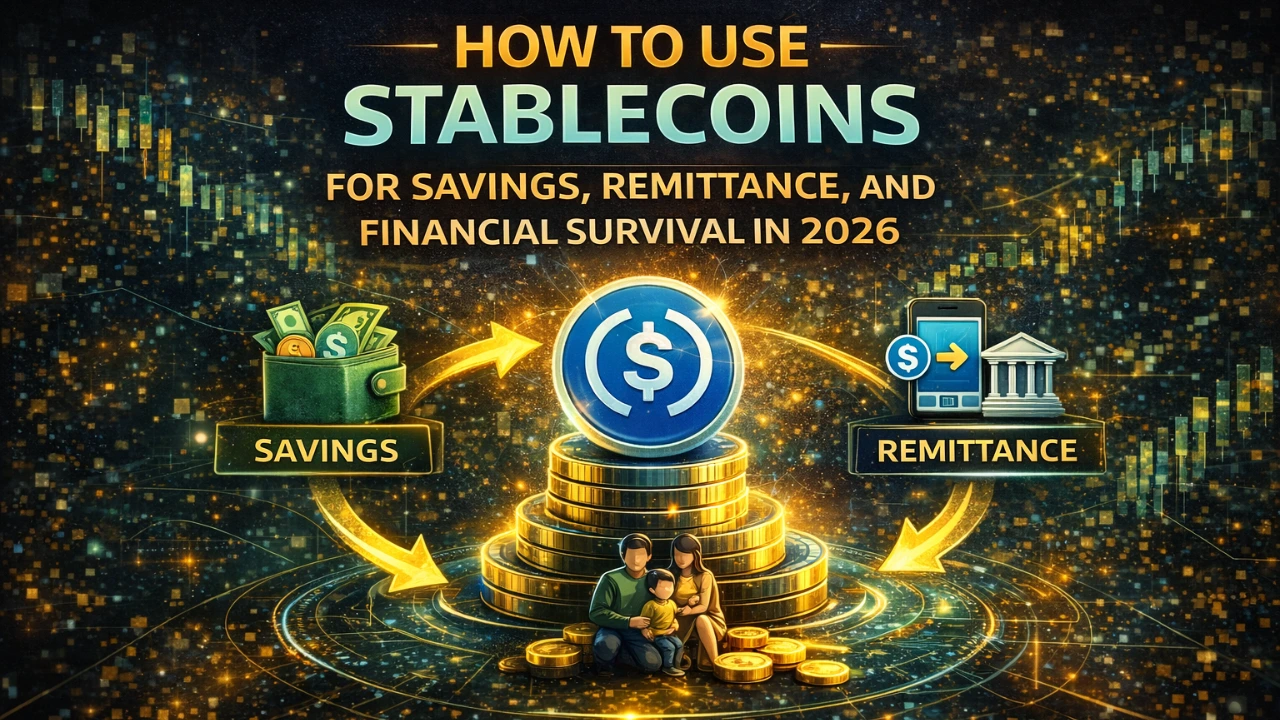
In 2026, more people are asking a different question about crypto.
Not “Which coin will 100x?”
Not “What’s the next meme rally?”
Not even “Which exchange has the most altcoins?”
The real question, especially for workers, families, freelancers, and people living through inflation, currency weakness, banking friction, or global uncertainty, is much simpler:
How do I use digital assets to protect my money, move it efficiently, and stay financially flexible without becoming a full-time trader?
That is where stablecoins matter.
Stablecoins are becoming one of the most practical parts of the digital asset economy because they solve a very human problem: people want money that moves faster, travels more easily, and holds its value better than many local alternatives, without the day-to-day volatility of traditional crypto assets.
Used properly, stablecoins can help with savings diversification, cross-border remittances, emergency liquidity, business payments, and general financial resilience. Used badly, they can expose people to unnecessary platform risk, poor security habits, and false assumptions about safety.
This guide explains how to use stablecoins for savings, remittance, and survival in 2026 in a way that is practical, calm, and actually useful.
What are stablecoins?
Stablecoins are digital assets designed to track the value of a relatively stable reference asset, usually the US dollar. In simple terms, one stablecoin is generally intended to stay close to one US dollar.
That makes them different from highly volatile cryptocurrencies like Bitcoin or smaller altcoins. Their main appeal is not explosive upside. Their appeal is utility.
People use stablecoins because they can offer:
- a more portable form of digital dollars
- faster transfers than many bank systems
- easier global access
- lower friction for cross-border payments
- a way to diversify part of one’s savings outside a weakening local currency
- a bridge between traditional finance and crypto markets
For many users, stablecoins are the first genuinely useful crypto product they ever touch.

Why stablecoins matter more in 2026
The global economy feels less certain than it did a few years ago. AI is disrupting white-collar jobs. Inflation remains a constant pressure in many countries. Geopolitical tensions have made people more aware of supply shocks, currency risk, and financial fragility. Traditional banking still works for many people, but it does not work equally well for everyone, everywhere, all the time.
Stablecoins have entered that gap.
For someone in a high-inflation economy, stablecoins can be a savings hedge.
For a freelancer getting paid by overseas clients, they can be a payment rail.
For a family sending money across borders, they can be a remittance tool.
For a worker worried about layoffs, they can be part of an emergency liquidity strategy.
They are not magic. But they are increasingly practical.
What stablecoins are actually good for
Stablecoins work best when you think of them as a tool, not a belief system.
1. Savings diversification
If all your savings sit in one local currency and that currency is losing purchasing power, stablecoins can provide a way to diversify part of your liquidity into dollar-linked digital assets.
This does not mean abandoning your bank account or putting every cent into crypto. It means reducing single-currency fragility.
For many readers, a sensible approach is to keep:
- some local cash or bank liquidity for daily life
- some stablecoins for portability and optionality
- some long-term upside exposure in assets like Bitcoin if appropriate

2. Remittances
Traditional cross-border transfers can be slow, expensive, and frustrating. Stablecoins can reduce friction by allowing near-instant digital transfers, especially when both sender and receiver understand how to use exchanges or wallets.
This is particularly useful for:
- migrant workers sending money home
- families supporting relatives abroad
- remote workers paid in digital assets
- entrepreneurs operating across regions
3. Emergency liquidity
Stablecoins can function as a second liquidity rail. If your job becomes unstable or your bank access becomes inconvenient, having part of your financial reserve in a transferable digital format can matter.
Again, this is not a replacement for immediate household cash. It is an additional layer of resilience.
4. Trading and market access
Even readers who are not active traders often use stablecoins as dry powder. They allow you to move in and out of markets without constantly returning to fiat. That matters if you want flexibility during volatile periods.
If you want to buy stablecoins or access deeper crypto markets, opening accounts on reliable exchanges is usually the easiest first step. Platforms such as Binance (code: CPA_00SXKU7IO9), Bybit (code: 46164), OKX (code: 2136301), MEXC (code: 16yJL), and Luno (code: MJV6YD) can serve different kinds of users depending on region, experience, and goals.

What stablecoins are not
Stablecoins are not:
- a guaranteed return product
- a substitute for learning security basics
- proof that all digital dollars are risk-free
- a reason to ignore platform risk
- an excuse to chase sketchy yield offers
- a full replacement for a real emergency cash reserve
One of the biggest mistakes new users make is assuming “stable” means “safe in every situation.” Stable in price is not the same thing as risk-free in structure, custody, or platform exposure.
How to start using stablecoins safely
The smartest approach is to build your stablecoin strategy in layers.
Step 1: Choose a reputable exchange
For most people, the easiest way to buy stablecoins is through a centralized exchange. A good exchange should offer strong liquidity, a clean user interface, and practical transfer options.
If you are new and want broad functionality, Binance (code: CPA_00SXKU7IO9) is an obvious starting point. If you want a clean all-rounder with strong trading features and growing global relevance, Bybit (code: 46164) is a strong option. If you want another major venue with solid product depth, OKX (code: 2136301) is worth considering. For readers looking for additional flexibility or altcoin access, MEXC (code: 16yJL) can fit. For beginners in markets where a simpler fiat-to-crypto experience matters, Luno (code: MJV6YD) can be useful.

A practical setup for many readers is not one exchange but two:
- one main exchange
- one backup exchange
That way, you are not dependent on a single platform for access.
Step 2: Buy stablecoins in small test amounts first
Do not begin with a life-changing amount of money.
Buy a small amount first. Learn how the interface works. Understand balances, transfers, wallet addresses, and fees. Send a small test transaction before moving a larger amount.
This small step prevents a surprising number of expensive mistakes.
Step 3: Decide where your stablecoins will live
There are really three main options:
On an exchange
This is convenient. It is often the easiest option for beginners. It is fine for smaller amounts you use actively, but it means you are trusting the platform.
In a software wallet
This gives you more control, but also more responsibility. You must manage your own security carefully.
In a hardware wallet
This is usually the strongest route for larger long-term holdings. Devices like Ledger, CoolWallet Pro, and KeepKey are worth considering if you want a more serious custody setup.
A mature setup often looks like this:
- small active balance on exchange
- strategic holdings in personal custody
- clear records of what is stored where
Step 4: Use stablecoins for a purpose
Do not hold them randomly. Assign them a role.
You might use stablecoins for:
- emergency reserve diversification
- family remittances
- paying remote contractors
- funding trading accounts
- holding dry powder for market opportunities
- protecting part of your income from local currency weakness
Money works better when every bucket has a job.
Step 5: Learn to move them cheaply and correctly
This is where many users get sloppy. Stablecoins can exist on different networks, and sending to the wrong address or wrong chain can be a painful mistake.
Before any transfer:
- confirm the token
- confirm the network
- confirm the recipient address
- send a test amount first if unsure
One careful minute is cheaper than one irreversible mistake.
Stablecoins for savings: the right way to think about it
Stablecoins are not always about earning yield. Sometimes their best use is simply holding purchasing power more effectively than a fragile local currency.
If you live in a country where inflation is high or where foreign currency access is difficult, keeping some savings in stablecoins can improve your flexibility. That does not mean abandoning local cash. It means adding optionality.
A good question to ask is not “Should I put all my savings into stablecoins?”
The better question is:
“What percentage of my liquid savings would be safer, more mobile, or more useful if held in a stable digital dollar form?”
For some people, that number may be small. For others, especially freelancers, cross-border workers, or people in unstable currency environments, it may be more meaningful.

Stablecoins for remittance: why they are quietly revolutionary
Remittance is one of the clearest real-world use cases in crypto.
The traditional remittance model often involves:
- long waits
- hidden fees
- bad exchange rates
- multiple intermediaries
- limited weekend flexibility
Stablecoins can simplify that dramatically when both sides know how to receive and convert them.
A typical stablecoin remittance flow might look like this:
- Buy stablecoins on an exchange
- Send them to the recipient’s wallet or exchange account
- Let the recipient hold them, spend them, or convert them locally as needed
For users who want flexible conversion options, services like ChangeNOW and SideShift can add useful swap flexibility depending on the situation.
This does not replace local compliance or practical knowledge. But for many families, it creates a more efficient path than the old system.
Stablecoins for financial survival
This is where the subject gets more personal.
The average person does not need a macro thesis to understand survival. They understand:
- bills still arrive when jobs disappear
- banking friction hurts most when timing matters
- inflation quietly steals from idle cash
- optionality matters most when you do not have it
Stablecoins can become part of a broader financial survival plan in 2026 when used alongside:
- emergency cash
- multiple banking and exchange rails
- some long-term hard-asset exposure
- basic self-custody knowledge
- better income diversification
A survival setup is not built on one product. It is built on layers.
For example, a balanced personal setup might include:
- 2 to 4 months of immediate living expenses in bank-accessible cash
- a separate stablecoin reserve for portability
- some long-term Bitcoin exposure
- a primary exchange like Bybit (code: 46164) or Binance (code: CPA_00SXKU7IO9)
- a backup venue like OKX (code: 2136301) or MEXC (code: 16yJL)
- a hardware wallet such as Ledger

That is not speculation. That is a modern money stack.
Should you earn yield on stablecoins?
Maybe, but carefully.
Yield is attractive because idle money feels inefficient. But chasing returns can push people into unnecessary platform or smart contract risk. If your first goal is financial resilience, yield is secondary to safety, access, and clarity.
The question is not just “What APY can I get?”
The real question is “What additional risk am I taking for that yield, and do I actually understand it?”
For many readers, the best first use of stablecoins is not yield farming. It is liquidity, mobility, and optionality.
Best tools for building a practical stablecoin stack
A simple stack might include:
- Binance (code: CPA_00SXKU7IO9) for broad functionality and liquidity
- Bybit (code: 46164) for strong all-round exchange utility
- OKX (code: 2136301) as a powerful secondary venue
- Luno (code: MJV6YD) for simpler onboarding in supported markets
- MEXC (code: 16yJL) for added exchange flexibility
- ChangeNOW or SideShift for easy swap utility
- Ledger, CoolWallet Pro, or KeepKey for custody
The best stack is not the one with the most logos. It is the one that cleanly matches your real life.
Mistakes that cost people money
The most common stablecoin mistakes are surprisingly ordinary.
The first is treating stablecoins as a shortcut to avoid learning.
The second is sending funds on the wrong network.
The third is keeping everything on one platform forever.
The fourth is chasing high yield without understanding the risk.
The fifth is failing to test small transfers first.
The sixth is assuming convenience equals safety.
The seventh is waiting until an emergency to build the system.
Preparation is much cheaper when life is calm.
A better way to think about stablecoins
Stablecoins are not the whole future of money. But for millions of people, they may become one of the most useful financial tools in the stack.
They sit in a powerful middle ground:
not as volatile as speculative crypto,
not as rigid as traditional banking,
not as ideological as online arguments make them sound.
They are simply useful.
That may be why they matter more than many people realize.
Final thoughts
In 2026, financial resilience is no longer just about earning more. It is about structuring your money better.
That means having liquidity in the right places.
That means using multiple rails, not one.
That means making sure your savings, transfers, and fallback systems are built before you need them.
Stablecoins can help with that.
Not because they are perfect.
Not because they remove risk.
But because they give ordinary people a more flexible way to hold, move, and protect value in a world that feels less stable than it used to.
For many readers, the smartest first move is simple:
open a reputable exchange account, buy a small test amount of stablecoins, learn how transfers work, and begin building a money system that is fit for the world as it is now, not the world you were promised ten years ago.
The future will belong, in part, to people who build optionality before it becomes urgent.
Start Here — Build Your Crypto Infrastructure Safely
You don’t need to use everything at once.
Professionals reduce risk by having access to multiple rails so they are never dependent on a single platform.
Below is a simple, practical setup used by many experienced traders and investors.
1) Your Fiat Gateway (Primary Access)
Best starting point for deposits & withdrawals
Binance — reliable onboarding, deep liquidity, global coverage
👉 sign up
Why open this:
- Move from bank → crypto easily
- Convert large amounts efficiently
- Emergency exit capability
2) Your Trading Execution Venue (Fast & Flexible)
Best for active trading and broad market access
MEXC — huge altcoin selection & low trading friction
👉 sign up
Why open this:
- Trade markets not listed elsewhere
- Better execution during volatility
- Lower dependence on a single exchange
3) Your Advanced Tools & Derivatives Platform
Best for leverage, hedging and professional execution
Bybit — strong order controls & derivatives infrastructure
👉 sign up
Why open this:
- Proper stop loss tools
- Hedging capability
- Strategy flexibility
4) Your Yield & Passive Income Layer
Best for structured products and capital efficiency
Gate.com — structured yield & automated earning tools
👉 sign up
Why open this:
- Earn on idle capital
- Diversify platform risk
- Access structured strategies
5) Your Altcoin & Ecosystem Expansion Layer
Best for early market access and wide listings
KuCoin — broad token ecosystem
👉 sign up
Why open this:
- Access emerging markets
- Portfolio diversification
- Redundancy if one platform restricts access
Why This Structure Matters
Using one exchange creates a single point of failure.
Using multiple rails creates:
- Liquidity redundancy
- Faster reaction ability
- Lower operational risk
- Greater opportunity access
You don’t need large capital to start — you just need prepared infrastructure.
Practical Next Step
Open accounts gradually and verify them before you need them.
Most people only prepare during stress —
professionals prepare before it.
(Decentralised News provides infrastructure education, not financial advice. Always use proper security practices.)