This article is for informational and educational purposes only. It is not financial advice. Crypto card fees, cashback rates, staking requirements and regional availability change frequently; always confirm current terms directly with the issuer before applying. This article contains affiliate links; Decentralised News may earn a commission if you sign up through them, at no extra cost to you.
ether.fi’s Card Lets Your Collateral Earn Yield While You Spend. Here’s When That Actually Costs You Money.
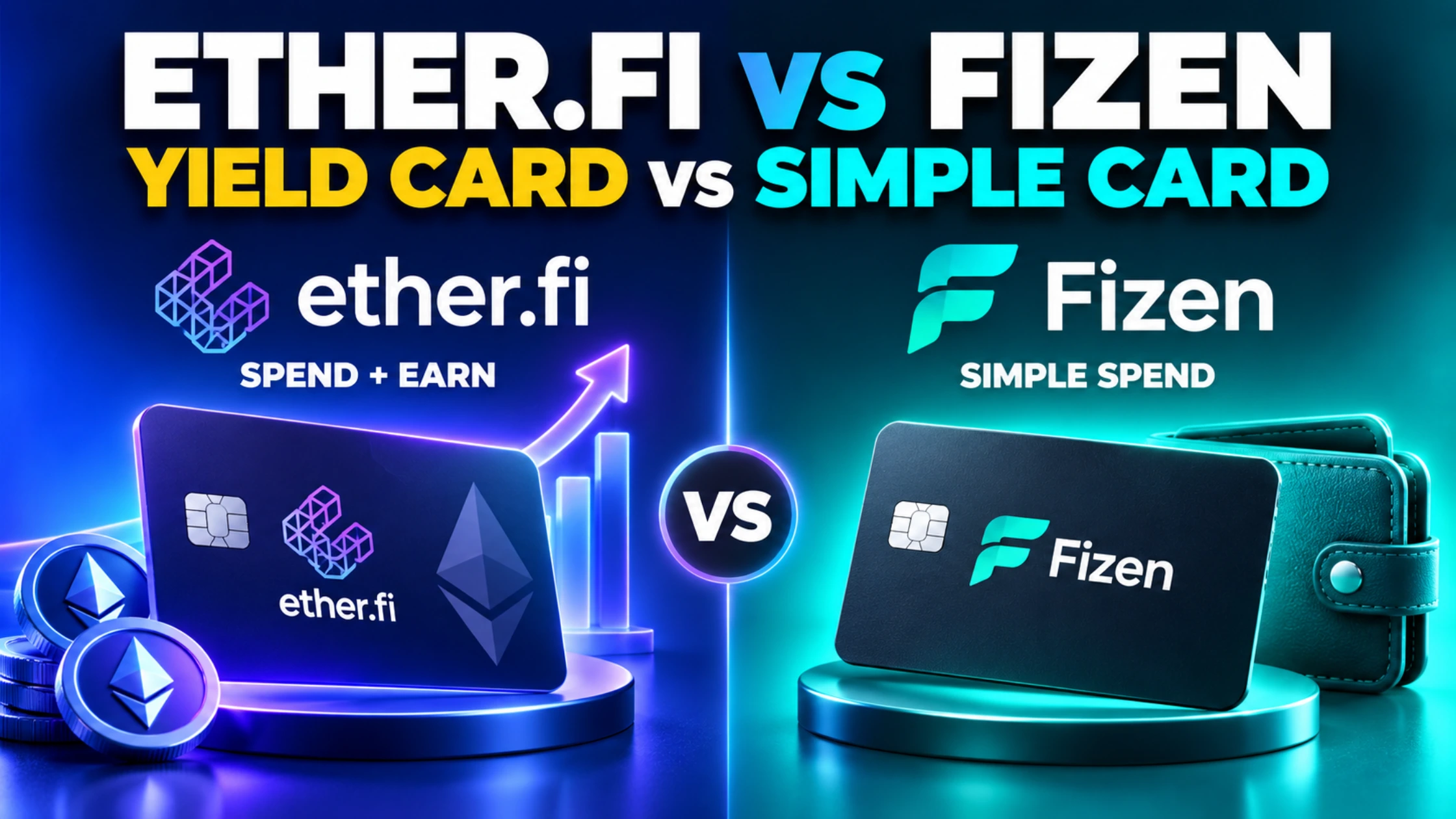
Summary: ether.fi’s Cash Card and Fizen’s self-custody Visa represent two genuinely different answers to the same problem DN’s original crypto card research identified: headline cashback percentages routinely hide the mechanism that determines whether a card actually pays you or quietly costs you. ether.fi’s pitch, spend against staked ETH collateral that keeps earning restaking yield the entire time, sounds like a free lunch, and DN’s expanded True Cost calculator confirms it can be, provided you pre-fund your spending balance. Switch to ether.fi’s headline feature, Borrow Mode, where you spend against your collateral on credit rather than pre-funding, and the same card can flip to a net loss once its 4% borrowing cost is priced against realistic spending, a finding no cashback-percentage comparison would ever surface. Fizen takes the opposite approach entirely: no staking, no borrowing, a flat, low-friction USDT-funded Visa built specifically for the AI-subscription and digital-nomad use case existing card comparisons ignore. Below, DN adds both to its True Cost of Spending Calculator using the same rigor applied to the original ten cards, plus an entirely new modeling dimension neither of DN’s prior card pieces needed: the cost of borrowing against your own collateral.
The mechanic that broke the original calculator’s assumptions
DN’s original True Cost of Spending Calculator was built around a specific, well-documented pattern: cards that dangle a high cashback ceiling behind a requirement to lock a native token for months, during which that locked capital earns nothing and its owner forfeits whatever a risk-free alternative would have paid. That model works cleanly for Crypto.com, Wirex, KuCoin and the rest of the original card roster, where locked collateral genuinely sits idle.
ether.fi’s Cash Card doesn’t fit that pattern, because its core innovation is specifically designed to break it. Collateral used to unlock ether.fi’s higher spending tiers isn’t idle CRO or KCS sitting in a vault, it’s staked ETH, deposited as weETH, continuing to earn Ethereum validator staking rewards plus EigenLayer restaking yield, typically in the 3% to 4% annual range, the entire time it backs your card. The capital genuinely works twice, once as yield-bearing collateral, once as spending power, a structurally different proposition from every card in DN’s original comparison. Modeling that fairly required extending the calculator itself: instead of charging the full risk-free rate as an opportunity cost against locked capital, DN’s updated methodology charges only the gap between the reader’s risk-free rate assumption and what the collateral itself is actually earning, which can shrink the true opportunity cost of ether.fi’s stake requirement close to zero, and in a low-rate environment could theoretically turn it into a small net positive.
Where the free lunch ends: Borrow Mode’s real cost
Here is the finding that makes this update worth publishing rather than a routine roster addition. ether.fi offers a second way to spend beyond simply pre-funding a USDC balance: Borrow Mode, which draws a credit line directly against your staked ETH collateral rather than requiring you to hold spendable cash alongside it, marketed explicitly as letting you spend “without selling” your position. That credit line is not free. Borrow Mode charges roughly 4% annual interest on the amount drawn, and DN’s calculator shows this cost is large enough, on realistic spending patterns, to exceed the card’s own cashback entirely. A reader spending $2,000 a month through a pre-funded ether.fi balance nets a genuinely positive result once cashback, FX and ATM costs are accounted for. The identical spending pattern routed through Borrow Mode instead turns net negative, because a 4% interest charge on $24,000 of annual spend outweighs the 3% cashback earned on it, before any other fee is even considered. This is precisely the kind of gap between a headline feature and its realistic cost that the original calculator was built to expose, now surfacing in a genuinely new mechanism rather than a repeat of the staking-lockup pattern.
This isn’t a reason to avoid ether.fi’s card. It’s a reason to understand exactly which of its two spending modes you’re actually using before assuming the “collateral earns yield while you spend” pitch applies to your situation. Pre-funded spending captures the yield benefit cleanly. Borrow Mode trades that benefit for liquidity, not selling your ETH position, and liquidity has a price, in this case one that most marketing material for the card does not lead with.
Fizen’s genuinely different lane: no stake, no borrowing, built for a specific problem
Fizen occupies the opposite end of the complexity spectrum entirely, and that simplicity is itself the product’s actual value proposition rather than a limitation. There’s no native token to stake, no borrowing mechanism, no tiered vault structure, a self-custody Visa card funded directly with USDT that issues a virtual card number in minutes. Its clearest use case is one existing crypto card comparisons rarely address directly: paying for AI subscriptions and services that bill through Stripe, ChatGPT, Claude, Cursor, GitHub Copilot, alongside ride-hailing apps that reject unfamiliar card BIN ranges, plus native QR payment support across Vietnam and the Philippines and a travel eSIM store bundled into the same app, a genuinely distinct target user, the digital nomad and heavy AI-tool user, rather than the crypto-native trader most card comparisons implicitly assume. Fizen’s standard cashback runs lower than the ceiling numbers this category tends to advertise, but with no lockup and a lower FX cost than several higher-profile competitors, it converts into one of the more genuinely stake-free positive results in DN’s expanded comparison for exactly the modest-cashback, low-friction profile it’s built for.
DN True Cost of Spending Calculator v2
Now with ether.fi's Cash Card and Fizen added. Enter your real spending pattern and see each card's genuine net annual value, including the borrow-cost mechanic no other public comparison currently models.
The original ten cards remain, now joined by ether.fi’s Cash Card, with a dedicated toggle to model pre-funded spending versus Borrow Mode separately, and Fizen’s self-custody Visa. Enter your spending pattern once and see all twelve cards’ genuine net annual value ranked together, including the borrow-cost mechanic no other public comparison currently models.
What to actually check before applying
For ether.fi specifically: confirm whether you intend to pre-fund your spending balance or use Borrow Mode before assuming the collateral-earns-yield pitch applies to your situation, since the two modes produce structurally different outcomes; check the current restaking yield your specific collateral is earning against the current Borrow Mode interest rate, since the gap between them, not either number alone, is what determines whether borrowing against your ETH costs or pays you; and note the card operates as a self-custodial Gnosis Safe vault on an Ethereum layer-2, meaning smart contract and bridge risk sit alongside the yield opportunity. For Fizen specifically: confirm current cashback terms directly, since published rates vary across sources and promotional codes; note that its Visa card is funded via USDT specifically, meaning USDT’s own reserve and redemption risk profile applies to funds held in the app between top-ups and spending; and if the AI-subscription or ride-hailing use case isn’t relevant to your spending pattern, several other cards in the full comparison may produce a higher net value for standard everyday spending.
Where to position around this
Readers interested in ether.fi’s collateral-backed spending model can apply through Decentralised News’ link: ether.fi Cash Card. For the self-custody, AI-subscription and travel-focused use case, Fizen accepts DN’s access code AK4CSHZ8 at signup. Both remain self-custodial products, and readers holding meaningful staked ETH collateral outside either card’s own vault structure may still want a dedicated hardware wallet such as Ledger for the underlying position itself.
Frequently asked questions
Does ether.fi’s Cash Card really let my collateral earn yield while I spend? Yes, if you pre-fund your spending balance rather than using Borrow Mode. Collateral posted as weETH continues earning Ethereum staking and EigenLayer restaking yield, typically 3% to 4% annually, for as long as it backs the card, a genuinely different mechanic from cards that require locking a token that earns nothing while locked.
What is ether.fi’s Borrow Mode and why can it cost more than it earns? Borrow Mode lets you spend against your staked ETH collateral on credit rather than pre-funding a separate spendable balance, avoiding the need to sell your position. It charges roughly 4% annual interest on the amount borrowed, which on realistic spending levels can exceed the card’s own 3% cashback rate, producing a net cost rather than a net benefit once that interest is accounted for.
Do I need to stake a token to get ether.fi’s best cashback rate? No. ether.fi’s headline 3% cashback rate applies across all its tiers; what changes with staking ETHFI (or reaching a high monthly spend volume without staking) is the monthly spending cap eligible for that cashback, not the rate itself.
Does Fizen require staking or locking any token? No. Fizen’s cashback structure does not require locking a native token, a structural difference from cards like Crypto.com or Wirex that gate their highest rates behind token lockups, though its standard cashback rate is correspondingly more modest than those cards’ promotional ceilings.
What is Fizen best suited for compared to other crypto cards? Fizen is built specifically around a self-custody USDT balance that issues virtual cards accepted by AI subscription services and ride-hailing apps that commonly reject other crypto card BIN ranges, alongside native QR payment support in Vietnam and the Philippines and a bundled travel eSIM, a distinct use case from cards built primarily around cashback maximization for everyday retail spending.
Decentralised News maintains E-E-A-T standards through primary-source verification of all fee, cashback and custody details cited above, sourced directly from ether.fi’s and Fizen’s own documentation and terms, cross-checked against independent card-comparison reporting current as of September 2026. Card terms, availability, staking requirements and interest rates change frequently; always confirm current details directly with the issuer before applying.