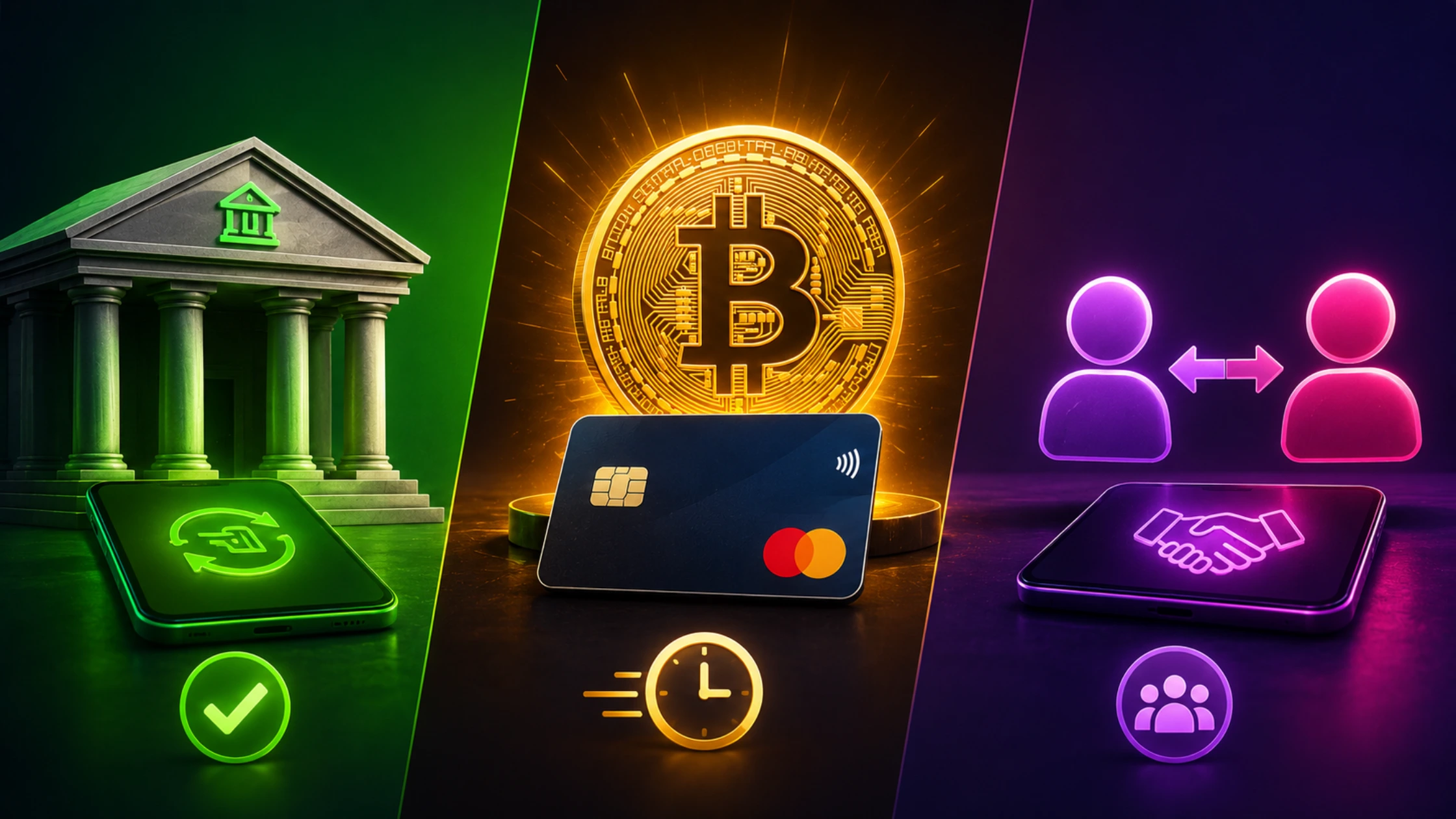
We calculate the true cost of buying crypto by bank transfer, credit card and P2P after spreads, FX, cash-advance fees, bank charges, merchant premiums and settlement delays.
Summary
The cheapest way to buy cryptocurrency cannot be identified by looking at deposit fees alone.
A proper calculation needs at least seven inputs:
Cost Layer | Bank Transfer | Card | P2P |
Platform/deposit fee | Possible | Common | Often low/zero for taker |
Trading spread | Yes | Yes | Embedded in merchant price |
FX conversion | Possible | Common cross-border | Possible |
Bank/payment fee | Possible | Processing included/added | Payment-method dependent |
Cash-advance risk | No | Credit cards only | Usually no |
Counterparty premium | No | No | Yes |
Settlement delay | Possible | Usually low | Merchant dependent |
The result is what we call the DN All-In Acquisition Cost.
DN AIAC = explicit fees + spread + FX + banking/issuer charges + P2P premium + withdrawal friction
This framework frequently produces a different winner from the advertised-fee comparison.
DN Verdict
Buyer Type | Generally Best Starting Point |
Large domestic purchase | Bank transfer |
Recurring investor | Bank transfer |
Small urgent purchase | Debit card |
Credit-card buyer | Check cash-advance treatment first |
Poor local fiat infrastructure | P2P |
International purchase | Native-currency rail where possible |
Immediate self-custody | Card/direct gateway can be useful |
High-volume buyer | Bank + spot/OTC |
Underbanked user | P2P/local payment system |
These are starting points, not universal rules.
Why Advertised Fees Mislead
Consider three quotes:
Method | Advertised Fee |
Bank | 0% |
Card | 3.9% |
P2P | 0% |
At first glance:
bank = P2P < card
But assume:
Bank spread: 0.35%
P2P merchant premium: 2%
Card spread: 0.35%
The economic cost becomes closer to:
Method | Approximate Visible + Hidden Cost |
Bank | 0.35% |
P2P | 2.00% |
Card | 4.25% |
Then add a foreign-currency card charge or cash advance and the gap can widen further.
That is why “zero fees” should never be interpreted as:
zero acquisition friction.
The DN All-In Acquisition Cost Framework
We separate the purchase into seven layers.
1. Platform Fee
This is what most comparison articles stop at.
2. Spread
The difference between the market reference price and the price at which you actually buy.
3. FX
The cost of converting your domestic currency into the transaction currency.
4. External Payment Charge
Bank, card network, payment provider or issuer cost.
5. Credit Treatment
Cash-advance fees and interest where applicable.
6. P2P Premium
The merchant markup relative to spot.
7. Exit Friction
Withdrawal or blockchain fee if the objective is self-custody.
Only after adding these together do we get something resembling a real acquisition cost.
Crypto Buy True Cost Calculator
Compare bank transfer, card and P2P using the amount of crypto you actually receive, not the advertised fee alone.
Purchase
Bank transfer
Card
P2P
Important: cash-advance treatment is issuer-specific. P2P premiums move with supply, payment method and local demand. Bank and FX charges can sit outside the crypto platform.
Educational use only: this is a cost-estimation tool, not a live quote or financial advice.
South Africa: A Real-World Cost Laboratory
South Africa demonstrates why this matters particularly well.
VALR
VALR currently publishes:
Funding/Trade Method | Current Published Cost |
ZAR EFT deposit | Free |
ZAR card deposit | 3.9% |
Simple Buy/Sell | 1.6% |
Entry-tier spot maker | 0.18% |
Entry-tier spot taker | 0.35% |
Consider R10,000.
Route A: EFT + spot taker trade
Deposit fee:
R0
Trading fee at 0.35%:
R35
Approximate direct cost before spread:
R35
Route B: Card deposit + spot taker trade
Card funding:
R390
Spot taker:
R35
Approximate direct cost:
R425
That creates a difference of roughly:
R390
on a single R10,000 purchase, before any additional market impact.
Code: VAZP2TAW
Luno South Africa
Luno currently publishes:
Method | Current Cost |
EFT deposit | Free |
Instant deposit | 1.4% |
Capitec Pay over R1,000 | R9 |
Apple Pay deposit | 2.5% |
Direct card crypto buy | 3.9% |
Instant portfolio buy | 2% |
This creates a useful ladder:
Cheap + slower: EFT
Moderate cost + fast: instant bank deposit
More expensive + instant: card
The decision is therefore not just “bank vs card.”
It can be:
manual EFT vs open-banking payment vs Apple Pay vs card vs order-book trade.
The Hidden Importance of Execution Venue
Funding method and trading method should be analysed separately.
Suppose you fund an account by free bank transfer.
You can then choose:
Instant Buy
or
Spot Exchange
The deposit cost is identical.
The execution cost may not be.
VALR currently charges 1.6% for Simple Buy/Sell but its base ZAR spot fees are 0.18% maker and 0.35% taker.
The lesson:
The cheapest fiat rail can still lead to an expensive purchase if you execute through the wrong product.
Credit Card Cost Stack
The card cost equation is:
Platform processing fee
Spread
FX
issuer charge
cash-advance charge
interest
A credit-card purchase can therefore become the most expensive route very quickly.
Switchere currently warns buyers that some issuers classify crypto payments as cash advances, while others process them as ordinary purchases.
This is why our calculator separates:
platform card fee
from
cash-advance fee.
They are not the same thing.
Debit Card Is Often Cleaner Than Credit
A debit card removes the borrowing layer.
Switchere’s current guidance notes that debit-card purchases draw directly from the linked bank balance and avoid the credit-card cash-advance category, although FX or other bank processing fees can still apply.
That means the hierarchy for a cost-sensitive user is often:
bank transfer
then
debit card
then
credit card
assuming each method is available at comparable pricing.
CEX.IO Example
CEX.IO currently advertises Visa and Mastercard funding across a broad cost range, approximately 0.49% to 4.99% plus service charges, depending on region and payment method.
Its current ACH help documentation for eligible US users is especially interesting.
CEX.IO says it currently charges $0 ACH deposit fees and allows immediate trading, but imposes a settlement-related withdrawal hold that can last roughly five to seven business days.
This highlights the distinction between:
trading liquidity
and
withdrawable liquidity.
If you intend to send BTC immediately to a hardware wallet, the cheapest funding route may not be the fastest route to final custody.
European Example: Switchere Bank Transfer
Switchere supports bank-funded purchases through SEPA, SEPA Instant and Sofort where available.
Its current documentation says verified users can make bank-funded purchases of up to €50,000 per transaction, while the fee and exchange rate are displayed before confirmation.
SEPA Instant can materially reduce the old trade-off between:
cheap but slow bank transfer
and
fast but expensive card.
Where a user has access to an instant domestic or regional bank rail, bank transfer can potentially provide both.
P2P: The Zero-Fee Illusion
P2P requires a different formula.
The central cost is often:
Merchant price ÷ market price
rather than:
platform fee.
Binance’s current educational material states that P2P takers can trade with zero platform trading fees, while merchants set their own prices.
That creates the concept of a:
DN P2P Premium
P2P Premium = (P2P Price − Reference Spot Price) ÷ Reference Spot Price
Suppose:
Spot USDT/ZAR = R18
P2P offer = R18.45
Then:
(18.45 − 18.00) ÷ 18.00 = 2.5%
The platform might say:
0% buyer fee
but the economic acquisition cost is already around:
2.5%
before external payment costs.
Why P2P Premiums Exist
Merchants price in:
- Local stablecoin demand
- Banking friction
- Payment reversal risk
- Settlement speed
- Merchant profit
- Fiat scarcity
- Regulatory restrictions
- Payment-method risk
A payment method that can be reversed may trade at a different price from an irreversible bank transfer.
So two ads for the same amount of USDT can carry very different effective costs.
P2P Can Still Win
A 1.5% P2P premium may sound expensive.
But compare it with:
3.9% card processing
2% FX
possible international charges.
In that environment, P2P could still be cheaper.
This is particularly relevant where:
- Domestic banks reject exchange transfers.
- Local exchanges have poor liquidity.
- Global exchanges do not support the domestic currency.
- Mobile money dominates.
- Cross-border card FX is expensive.
P2P should therefore be judged against the real alternative available to that user, not an idealised free bank transfer they cannot access.
P2P Risk Is Part of Cost
There is also a non-financial cost.
P2P platforms use escrow to reduce counterparty risk, but users still have to manage the fiat side.
Binance currently recommends verifying actual receipt of payment before releasing crypto and provides an appeal process for disputes.
Potential friction includes:
- Delayed payments
- Third-party payment attempts
- Fake payment confirmations
- Frozen bank transactions
- Payment reversals
- Appeals
- Merchant non-response
A 0.5% cheaper quote may not be worth materially greater counterparty friction.
ChangeNOW: Aggregating the Fiat Gateway Layer
ChangeNOW currently works with multiple third-party fiat providers, including Simplex, Guardarian, Transak and Banxa.
Its current fiat interface offers eligible users card, bank-transfer and local-payment routes and presents the resulting crypto amount before completion.
This model can be particularly useful for users who want:
fiat → crypto → self-custody
without first learning an exchange trading terminal.
The DN Convenience Premium
Sometimes paying more is rational.
We define:
Convenience Premium = Cost of faster method − Cost of cheapest available method
Suppose:
Bank cost = 0.4%
Card cost = 4.0%
Then:
Convenience premium = 3.6 percentage points
On:
$100
that difference is only $3.60.
On:
$10,000
it is $360.
On:
$100,000
it is $3,600.
The bigger the transaction becomes, the harder it is to justify percentage-based card charges purely for convenience.
Why Purchase Size Changes the Winner
Purchase Size | What Usually Matters Most |
$50 | Convenience |
$500 | Fee + speed balance |
$5,000 | All-in percentage cost |
$50,000 | Spread, bank rails, limits |
$500,000 | OTC, settlement, counterparty |
At institutional scale, comparing retail card fees becomes irrelevant.
A large buyer should be analysing:
- OTC
- RFQ
- Bank settlement
- Execution quality
- Slippage
- Custody
- Counterparty diversification
DN Country Examples
Market | Route Worth Checking First | Why |
South Africa | ZAR EFT to VALR/Luno | Local-currency rails, free standard EFT options |
EEA | SEPA / SEPA Instant | Low-cost direct bank infrastructure |
United States | ACH where supported | Potentially very low funding cost, but settlement holds matter |
Underbanked/local-payment markets | P2P | Broader range of domestic payment methods |
Cross-border card user | Compare direct gateways carefully | FX and issuer fees can dominate |
The Best Payment Method by Objective
Objective | Likely Starting Point |
Lowest cost | Bank transfer |
Fastest execution | Card |
Best local flexibility | P2P |
Recurring monthly investing | Bank |
Emergency dip buy | Debit/card or instant bank rail |
Limited banking access | P2P |
Immediate wallet delivery | Switchere / ChangeNOW-style gateway |
Large purchase | Bank + spot/OTC |
Best Platforms to Compare
South Africa
VALR
Code: VAZP2TAW
Luno
Code: MJV6YD
Global Exchange / P2P
Binance
Code: CPA_00SXKU7IO9
Direct Card and Bank Gateway
Broader Exchange Comparison
Bitget
Code: nqef
Frequently Asked Questions
Is bank transfer the cheapest way to buy crypto?
Often, particularly when domestic deposits are free and the user executes through a liquid spot market. But bank charges, FX and trading spread still need to be included.
Why are card purchases so expensive?
Card networks add processing and fraud-management costs. Credit cards can also introduce issuer-specific cash-advance or interest charges.
Is P2P really free?
Not necessarily. A P2P platform may charge no explicit buyer trading fee while the merchant embeds a margin into the crypto price.
Is credit card or debit card better for buying crypto?
Debit generally removes the borrowing and cash-advance layer. Credit-card treatment varies by issuer, so check the card’s crypto policy first.
Can bank transfers be instant?
Yes. Some domestic and regional systems, including certain instant-payment and SEPA Instant rails, can settle rapidly.
What is the hidden cost of buying crypto?
Usually the combination of spread, FX, external payment charges and the difference between the quoted crypto price and the liquid market price.
What is the best payment method for a large crypto purchase?
Bank transfer followed by spot or OTC execution is generally a stronger starting point than percentage-based card funding.
Final Verdict
The biggest mistake when buying crypto is asking:
Which platform has the lowest deposit fee?
The better question is:
How much crypto value reaches me after every layer of friction?
Bank transfers usually win on cost.
Cards usually win on speed.
P2P usually wins on flexibility.
But those are tendencies, not rules.
The winner changes according to:
country
purchase amount
payment rail
currency
merchant pricing
settlement time
and
where the crypto needs to end up.
That is why Decentralised News believes acquisition cost should be measured through the DN All-In Acquisition Cost, rather than an exchange’s headline fee.
For someone buying $100, convenience can matter more.
For someone buying $100,000, a two-percentage-point mistake is a $2,000 decision.
At that point, understanding the real cost is not optimisation.
It is basic risk management.
Affiliate Disclosure
This article contains referral links. Decentralised News may receive compensation from qualifying activity.
Affiliate relationships do not affect the DN All-In Acquisition Cost methodology or editorial conclusions.
Educational Disclaimer
Cryptoassets can lose substantial or all of their value. Payment fees, FX costs, P2P pricing and banking policies can change.
Credit-card treatment is issuer-specific. P2P introduces counterparty and settlement risks even where escrow is used.
Always inspect the final quote before approving a transaction.
For adults aged 18 and over.