The Real FX Cost: What "0% FX Fees" on Your Crypto Card Actually Leaves Out
The largest crypto card promo in the market quietly expired two days ago, and most cardholders will not notice until their statements arrive. The reason they will not notice is the same reason "no FX fees" has become the most misleading three words in crypto payments: the real cost was never in the fee line to begin with.
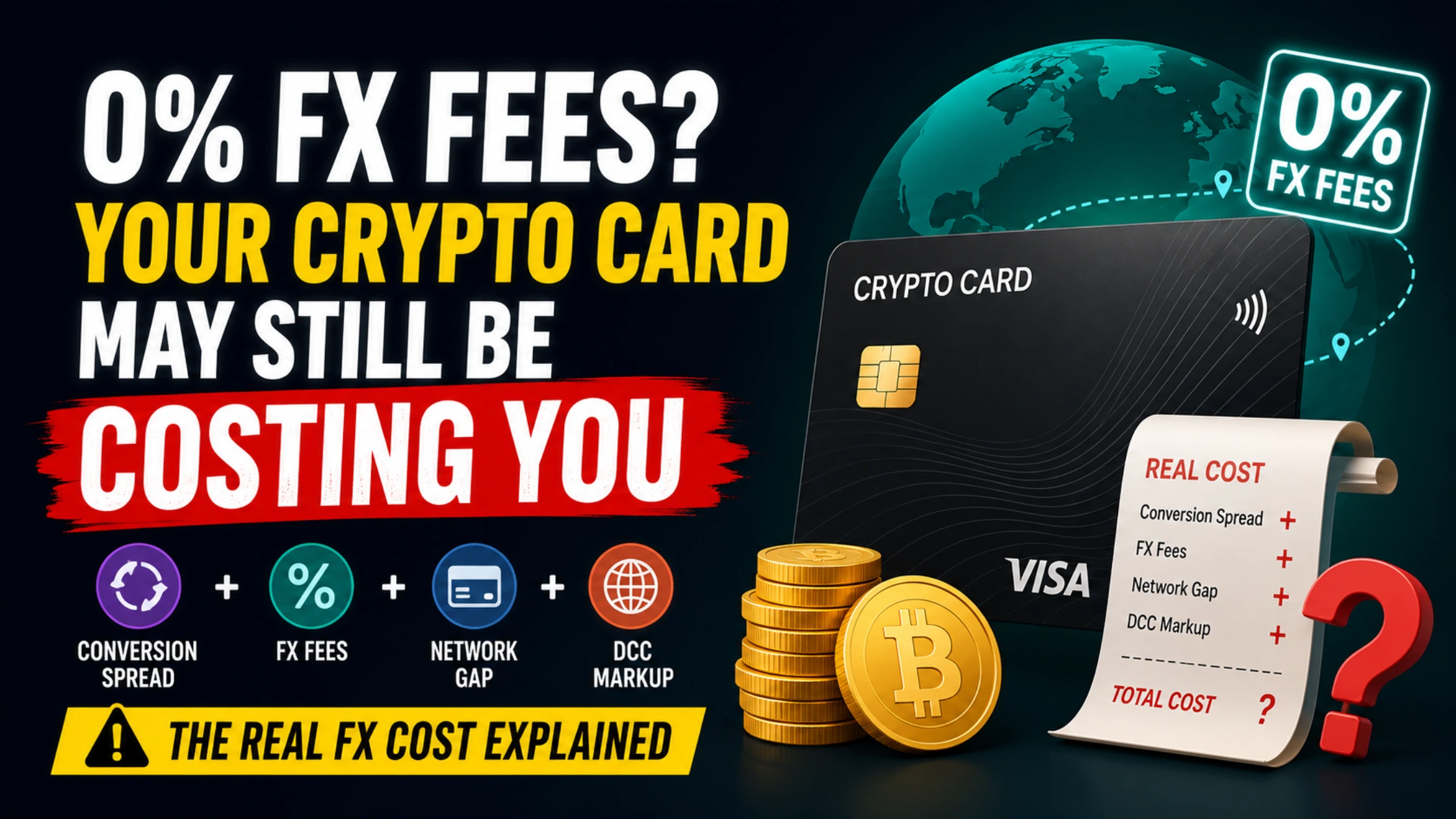
The finding: "0% FX fees" on crypto debit cards typically zeroes only one of three stacking cost layers. The crypto-to-fiat conversion spread (0.1 to 2.5 percent depending on provider) and the card network's own rate gap versus the interbank mid rate (roughly 0.2 to 0.6 percent per independent studies) survive the claim intact.
The number: The DN Real FX Cost, a single stacked percentage combining all three layers, plus dynamic currency conversion exposure, converted into a literal monthly and annual dollar figure for any spending profile.
The spread: On a modeled $1,000 of monthly non-base-currency spending, verified fee stacks range from roughly $4 per month (OKX Card, 0.1 percent total provider cost) to roughly $33 per month (BitPay international, 3 percent FX fee), a gap of about $348 per year between best and worst for identical spending.
The timely part: Crypto.com's 0 percent FX promotion ran through June 30, 2026. As of July 1, non-USD spending on standard tiers reverted to a disclosed FX spread of 0.5 to 1.75 percent, restoring a cost most cardholders stopped budgeting for during the promo period.
The fee that is not a fee
Every crypto card comparison published in 2026 leads with the same table: annual fee, cashback rate, FX fee. Those three columns are consensus-priced information, printed on every provider's marketing page and repeated across every affiliate roundup. And the FX fee column, in particular, has converged toward a satisfying answer. Card after card now advertises 0 percent.
The structural problem is that a crypto card transaction is not one conversion, it is a stack of them, and the advertised FX fee covers exactly one layer of that stack. When you tap a crypto card abroad, up to three separate spreads can apply before the merchant is paid: the conversion of your crypto or stablecoin into fiat (at top-up or at the moment of sale), the provider's FX fee on top of the card network's rate for non-base-currency spending, and the gap between the network's own wholesale rate and the true interbank mid rate. Only the middle layer is what "0% FX fees" refers to. The other two are not fees at all in the accounting sense. They are spreads, embedded in the rates themselves, invisible on any statement line.
Independent measurements of the third layer confirm it is small but real. A Nomad Gate study plotting network rates against the mid-market rate found Mastercard averaging roughly 0.21 to 0.33 percent above mid and Visa roughly 0.30 to 0.64 percent above, and a large NerdWallet study across 44 currencies found network rates close to interbank levels with differences generally under 1 percent. That layer applies to every card on every network, including the ones that genuinely charge nothing themselves. It is the floor beneath the entire market, and no provider's 0 percent claim removes it.
The promo that just expired
Crypto.com's 0 percent FX window closed on June 30, 2026
Crypto.com ran a 0 percent FX fee promotion on local currency spending through June 30, 2026, with the fee shown at purchase and credited back after the cycle. That window has now closed. Under standard published terms, non-USD spending on the widely held standard tiers carries an FX spread of 0.5 to 1.75 percent, and the standard tier's monthly cap sits at $2,000 before a paid tier is needed.
The structural point is not that Crypto.com concealed anything; the promo end date was published. The point is what the reversion reveals about how these costs are perceived. A cardholder who spent the promo period paying an effective 0 percent got used to treating the card's FX cost as zero. From July 1, the same tap at the same terminal carries up to 1.75 percent again, with no new fee line appearing anywhere, because the cost returns inside the conversion rate. The DN Real FX Cost tool below exists precisely for this kind of moment: the advertised number changed, the statement format did not.
Introducing the DN Real FX Cost
The tool below stacks all the layers into one number for any card, verified or hypothetical, and converts it into monthly and annual dollar cost for your actual spending. Use the card lookup for pre-verified major providers, the stack calculator to model any card from its published terms, and the decoder to see exactly which layers a "0% FX" claim does and does not remove.
DN Real FX Cost
A card advertises "0% FX fees." Here is what that claim removes and what survives it, on $1,000 of monthly non-base-currency spending, using a representative 0.9 percent conversion spread and a blended 0.3 percent network gap.
The verified board: seven cards, one honest number
All provider figures below are drawn from each provider's published fee documentation or from independent reviews citing it (CoinGecko, Coin Bureau, and provider fee pages) as of July 2026, and were verified via live search at the time of writing rather than carried over from earlier coverage. The network gap uses a blended 0.3 percent based on the independent studies cited above. Dollar figures model $1,000 per month of non-base-currency spending.
| Card | Conversion | FX fee | Real FX Cost | Annual, $1k/mo |
|---|---|---|---|---|
| Bitget Wallet Card (in quota) | Refunded | Refunded | ~0.3% | ~$36 |
| OKX Card | 0.1% | 0% | ~0.4% | ~$48 |
| Crypto.com (std, non-USD) | 0% | 0.5-1.75% | ~1.4% | ~$168 |
| Bybit Card | 0.9% | 0.5% | ~1.7% | ~$204 |
| Wirex (free plan) | 1.0% load | 0% claimed, spreads apply | ~1.8% | ~$216 |
| RedotPay (non-USD) | 1.0% | 1.2% | ~2.5% | ~$300 |
| BitPay (international) | 0% | 3.0% | ~3.3% | ~$396 |
Two structural findings jump out of the board. First, the Wirex row is the clearest illustration of the entire bottleneck: its FX fee is officially 0 percent, and yet its Real FX Cost lands near the top of the table, because a 1 percent crypto loading fee plus conversion spreads sit in the layers the claim does not cover. Second, the gap between the best and worst cards on identical spending is roughly $348 per year, which exceeds the annual cashback most cardholders will actually collect. The fee stack, not the rewards rate, is where card selection is genuinely won or lost.
Where the stack is thinnest
Among providers carrying a DN partner relationship, the OKX Card currently posts the thinnest verified fee stack in this comparison: 0 percent transaction fee, 0 percent FX fee, and a 0.1 percent stablecoin-to-fiat conversion spread as the only provider-side cost, available in the EEA and Singapore as a virtual card. Bitget's Wallet Card takes a different route to a similar result, refunding fees within a monthly 0-fee quota (typically $400), which produces the lowest cost in the table for spending inside that quota but reverts to ordinary card economics beyond it. The Bybit Card sits mid-table with a fully disclosed 0.9 percent conversion plus 0.5 percent FX stack; it is not the cheapest card in this comparison, but it is among the most honestly documented, with both layers published as explicit numbers rather than buried in rate language, which is worth something in a market where the worst costs are the invisible ones. As always, the right card also depends on region availability, custody model, and spending caps, none of which the fee stack alone captures.
The fourth layer nobody's card can save them from
One cost dwarfs everything above and belongs to no card provider at all: dynamic currency conversion, the terminal prompt offering to charge you in your home currency instead of the local one. Accepting it hands the conversion to the merchant's processor at a markup typically running 2 to 5 percent, and in bad cases up to 10 percent, on top of which your card's own stack still partially applies. Modeled at a 4 percent midpoint, accepting DCC on the cheapest card in this comparison produces a total cost around 4.4 percent, roughly ten times that card's entire provider-side fee stack. The single highest-value habit in international card spending costs nothing: always pay in the local currency.
Frequently asked questions
What does "0% FX fees" actually mean on a crypto debit card?
It means the provider adds no percentage fee of its own on top of the card network's exchange rate for non-base-currency transactions. It does not mean you convert at the interbank mid rate: the crypto-to-fiat conversion spread and the network's own rate gap versus interbank both survive the claim, and together they typically cost 0.3 to 2.5 percent or more depending on the provider.
What is the DN Real FX Cost?
It is a single stacked percentage combining the three cost layers of a crypto card transaction: the crypto-to-fiat conversion spread, the provider's FX fee, and the card network's rate gap versus the interbank mid rate, plus optional dynamic currency conversion exposure. It converts the total into monthly and annual dollar cost for a defined spending profile, making cards with different fee structures directly comparable.
How big is the gap between Visa or Mastercard rates and the true interbank rate?
Independent measurements place it at a fraction of a percent: one study found Mastercard averaging roughly 0.21 to 0.33 percent above the mid-market rate and Visa roughly 0.30 to 0.64 percent above, and a large NerdWallet study across 44 currencies found network rates close to interbank levels with differences generally under 1 percent. It is small, but it applies to every card on the network and no provider's 0 percent claim removes it.
Which crypto card has the lowest total FX cost in 2026?
Among cards verified in this comparison, the OKX Card posts the thinnest standing provider-side stack at roughly 0.1 percent (0 percent transaction and FX fees plus a 0.1 percent stablecoin-to-fiat spread), while the Bitget Wallet Card achieves an effectively lower cost within its monthly 0-fee refund quota, typically $400. Beyond that quota, or outside OKX's supported regions, the ranking shifts, so match the card to your actual spending pattern.
Did Crypto.com remove its 0% FX fees?
Crypto.com's 0 percent FX promotion ran through June 30, 2026, and has now ended. Under standard published terms, non-USD spending on standard tiers carries an FX spread of 0.5 to 1.75 percent. The promo end date was published in advance; the practical effect is that cardholders who stopped budgeting for FX cost during the promo period now carry it again without any new fee line appearing on statements.
Why does a card with a 0% FX fee sometimes cost more than one charging 0.5%?
Because the FX fee is only one of three cost layers. A card with a 0 percent FX fee but a 2 percent crypto-to-fiat conversion spread costs a total of roughly 2 percent plus the network gap, while a card with a 0.5 percent FX fee and no conversion spread costs roughly 0.5 percent plus the network gap. Comparing the full stack, not the advertised fee, is the only way to rank cards accurately.
What is dynamic currency conversion and why does it matter more than card choice?
Dynamic currency conversion is the payment terminal's offer to charge you in your home currency instead of the local one. Accepting it routes the conversion through the merchant's processor at a markup typically between 2 and 5 percent, and in bad cases up to 10 percent, which can exceed your card's entire fee stack several times over. Always choosing the local currency at the terminal is worth more than switching to a cheaper card.
Do stablecoin cards avoid FX costs entirely?
No. Holding USDC or USDT removes exposure to crypto price volatility, but spending abroad still requires conversion to the merchant's local currency at the point of sale, which passes through the same network rate and any provider spread. Stablecoin funding narrows the stack (there is no volatile-asset conversion timing risk) but does not eliminate it.
Does spending crypto on a card create a tax event?
In many jurisdictions, yes: converting crypto to fiat at the moment of purchase is a disposal, potentially triggering capital gains calculations on every coffee. Cards funded from stablecoin balances generally simplify this compared with cards that sell volatile assets per transaction, but treatment varies by country, and this article does not constitute tax advice; confirm with a local professional.
Methodology
- Real FX Cost: conversion spread + provider FX fee + network gap (+ DCC markup if accepted), expressed as a percentage of transaction value. Dollar figures multiply this by the modeled monthly spend, annualized as monthly cost times 12.
- Network gap: blended 0.3 percent default, based on independent studies measuring Mastercard at roughly 0.21 to 0.33 percent and Visa at roughly 0.30 to 0.64 percent above the mid-market rate. The calculator lets you select network-specific values.
- Provider figures: taken from published fee documentation or independent reviews citing it (CoinGecko, Coin Bureau, provider fee pages), verified via live search in July 2026. Where a provider publishes a range (Crypto.com's 0.5 to 1.75 percent), the table uses the midpoint and states the range.
- Wirex estimate: the free-plan figure combines the published 1 percent crypto loading fee with an estimated 0.5 percent conversion spread, flagged as an estimate because the provider discloses that spreads apply without publishing a fixed figure.
- DCC: modeled at a 4 percent midpoint of the commonly cited 2 to 5 percent range. Actual DCC markups vary by terminal operator and can be higher.
- Card fees, promos, quotas, and regional availability change frequently. Treat every figure as a snapshot requiring re-verification against the provider's current published terms before relying on it.