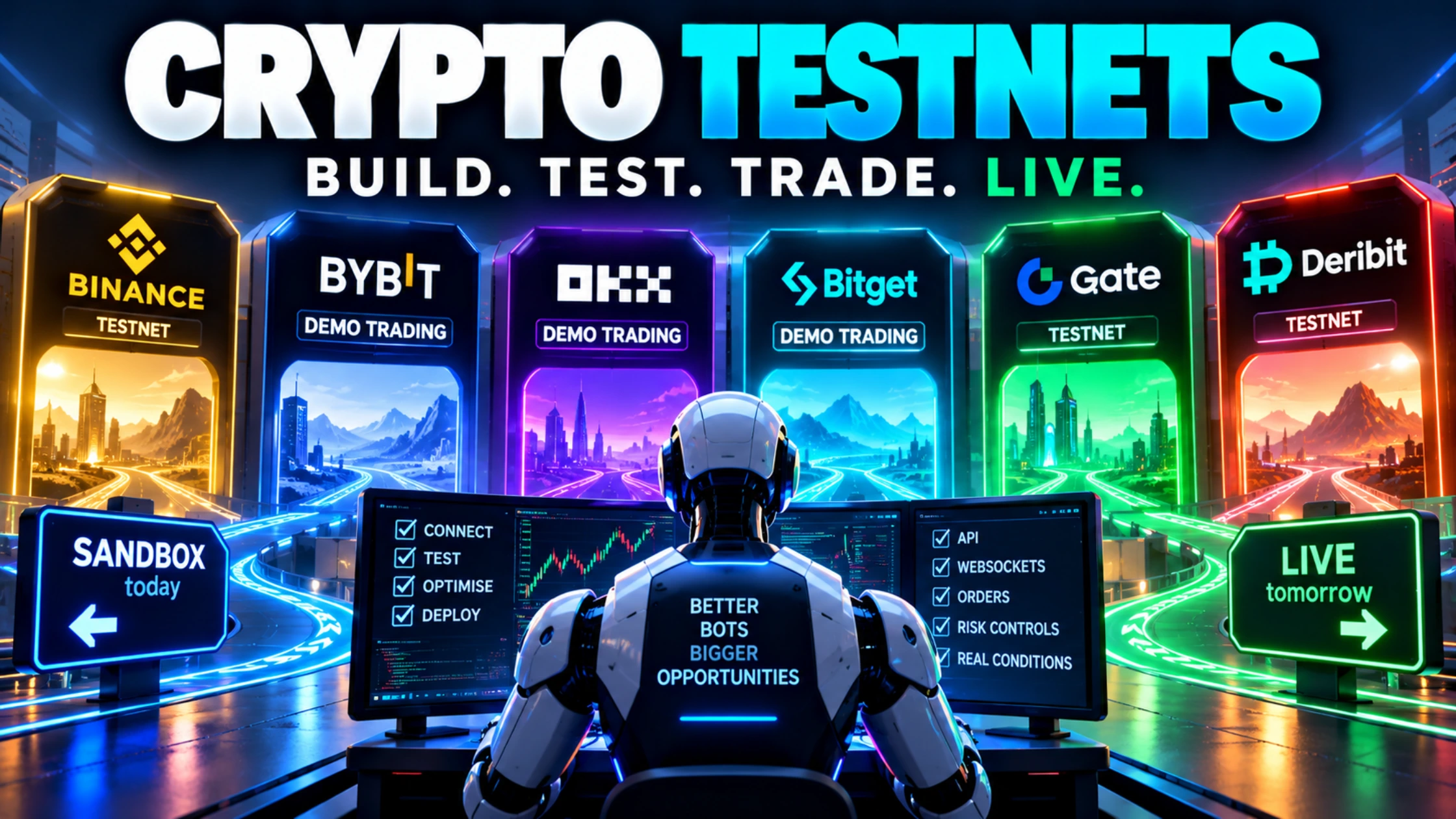
Crypto exchange sandboxes are useful for testing signatures, order state, reconnect logic and failure handling before real capital is exposed. They are much weaker evidence for production liquidity, slippage and latency. The DN Crypto Sandbox & Testnet Benchmark compares OKX, Gate, Bybit, Bitget, Binance and Deribit by API parity, product breadth, market-data realism, account controls, professional protocols and documented limitations.
Last verified: 15 October 2026 • Benchmark year: 2027 • DN Sandbox Readiness Framework v1.0
OKX ranks first in the DN model for exchange-native sandbox breadth, while Gate is the strongest specialist for production-like API testing across spot and futures. Bybit is unusually useful because its demo environment uses the same public market data as mainnet, Bitget provides dedicated REST and private/public WebSocket demo endpoints, Binance has deep Spot Testnet protocol parity including SBE and FIX, and Deribit is excellent for integration testing but explicitly warns that testnet liquidity and HFT conditions do not represent production.
DN Evidence Block
- OKX Demo Trading supports API trading across spot, margin, perpetual swaps, futures and options-style account workflows, with separate public/private/business WebSocket endpoints and an API for adjusting selected demo balances.
- Gate documents separate TestNet REST and WebSocket endpoints, including spot and futures environments, plus TestNet SBE market-data support.
- Bybit says its basic demo trading rules match real trading, but the demo API is intentionally incomplete; public market data is the same mainnet feed while demo private streams use separate endpoints.
- Bitget provides separate demo API keys, REST plus public/private WebSockets, virtual funds and a demo-first rollout path for some API changes; KYC is required.
- Binance Spot Testnet mirrors core
/apitrading/account interfaces and supports REST, WebSocket API, WebSocket streams, SBE and FIX, but it does not expose/sapiand its state is reset approximately monthly without prior notice. - Deribit says testnet API endpoints largely behave like production, but test liquidity, volume and infrastructure are not representative; the HFT production stack is not available in testnet.
Author: Decentralised News Research
Methodology: DN Sandbox Readiness methodology
Primary evidence: Official exchange documentation
A sandbox can prove that your bot talks to the exchange correctly. It cannot prove that your strategy survives the market. Authentication, order-state reconciliation and reconnect logic are engineering problems. Slippage, queue position, market impact, adverse selection and stress latency are production-market problems. Treat those as two different tests.
This Benchmark Is Not Another Paper-Trading App List
Decentralised News already covers AI agents and bot platforms that offer paper or simulated trading. This benchmark asks a narrower and more technical question:
That means the focus is on API authentication, REST/WebSocket parity, order state, rate limits, reconnect logic, professional protocols and documented differences from production.
Three Different Things Traders Call “Paper Trading”
All three are useful, but for different reasons. An exchange testnet is strongest for integration testing. A local simulator can be stronger for controlled fill assumptions. A tiny live deployment is the only one that exposes the full production path.
The DN Sandbox Readiness Score
| Component | Weight | What DN Assesses |
|---|---|---|
| Production API parity | 25% | How closely auth, endpoints, order semantics and account state resemble production. |
| Product breadth | 20% | Spot, margin, perpetuals, futures, options and relevant account modes. |
| Market-data realism | 15% | Whether public prices resemble or directly use production data, and how clearly the gap is disclosed. |
| State & test controls | 15% | Virtual funding, balance adjustment, reset behaviour, order history and reproducibility. |
| Professional protocol parity | 15% | WebSocket trading, FIX, SBE or other production-grade interfaces in the test environment. |
| Documentation & limitations | 10% | How clearly the exchange documents unsupported features and the simulation-to-live gap. |
Crypto Sandbox & Testnet Ranking 2027
| Rank | Environment | DN Score | Best For | Key Strength | Main Gap | Status |
|---|---|---|---|---|---|---|
| 1 | OKX Demo Trading | 97/100 | Broad multi-product API validation | Spot, margin, swaps, futures and options workflows plus balance control | Not every production function is supported | LIVE |
| 2 | Gate TestNet | 95/100 | Spot/futures bot engineering | Separate TestNet REST/WS plus SBE support | Separate environment cannot prove live liquidity | LIVE |
| 3 | Bybit Demo Trading | 94/100 | Bot logic against live public market data | Mainnet public data with separate demo private state | Incomplete API; no WS Trade; seven-day order retention | LIVE |
| 4 | Bitget Demo Trading | 93/100 | REST/WebSocket integration | Dedicated demo keys and public/private WebSockets | KYC required; some demo restrictions remain | LIVE |
| 5 | Binance Spot Testnet | 92/100 | Spot API/FIX/SBE integration testing | REST + WS + SBE + FIX with production-like limits/filters | Spot-focused; no /sapi; periodic reset | LIVE |
| 6 | Deribit Testnet | 89/100 | Options/derivatives API workflow validation | Similar JSON-RPC behaviour to production | Synthetic liquidity and no production HFT infrastructure | LIVE |
1. OKX Demo Trading: Best Overall Sandbox Breadth
OKX takes first place because its demo environment spans more of the production trading stack than most exchange sandboxes.
The current API documentation supports demo trading with REST plus public, private and business WebSockets. The same account model covers spot, margin, perpetual swaps, futures and options-related workflows.
Demo requests use the core REST host with the x-simulated-trading: 1 header, while WebSocket connections use dedicated demo endpoints.
Why balance control matters
OKX added a demo-only balance-adjustment endpoint in 2026. That lets a development team create low-collateral states, test position-sizing logic and reproduce account conditions without waiting for simulated P&L to move balances naturally.
OKX also uses demo as a staging layer for infrastructure changes. Its September 2026 changelog scheduled SBE order entry and private-data services for demo before production.
2. Gate TestNet: Strong Production-Style Spot/Futures Engineering
Gate's API v4 documentation is unusually explicit about separate live and TestNet URLs. REST uses a dedicated TestNet host, while spot and futures WebSocket services have their own test environments.
For futures, Gate says requests are effectively identical between production and TestNet except for the base URL and API keys. Gate also supports SBE market data on spot TestNet.
That is valuable for teams validating JSON and binary market-data handlers, order-state machines, reconnect logic and signing before switching the same integration to production.
3. Bybit Demo Trading: Best for Logic Against Mainnet Public Data
Bybit makes a useful design choice: demo private state is separate, but its documentation says public market data in demo is identical to mainnet public data.
Bybit also documents that basic demo trading rules are the same as real trading, while acknowledging important limitations: not every API is available, demo orders are retained for seven days, rate limits are default and cannot be upgraded, and WebSocket Trade is not supported in demo.
That makes Bybit particularly useful for testing signal logic and private-state reconciliation against production public prices, while still leaving a protocol gap for teams whose live design depends on WS order entry.
4. Bitget Demo Trading: Strong REST + WebSocket Coverage
Bitget's current UTA documentation provides dedicated demo API keys, demo REST requests through the paptrading: 1 header, and dedicated public/private WebSocket endpoints.
KYC is required to use demo trading. That is a usability constraint, but the engineering surface is broad.
The 2026 Bitget changelog also shows API changes landing in demo before production, including SBE and depth-channel changes. This makes demo useful as a staging environment for upcoming schema behaviour rather than merely a beginner practice account.
5. Binance Spot Testnet: Deep Protocol Parity, With Reset Risk
Binance Spot Testnet is one of the deepest technically documented test environments in crypto. It supports REST, WebSocket API, WebSocket market streams, SBE streams, FIX Order Entry, FIX Drop Copy and FIX Market Data.
Binance says IP limits, order-rate limits, exchange filters and symbol filters are generally the same as the production Spot API, which is useful for testing throttling and rule handling.
The important limitations are equally clear. Only core /api endpoints are available, not the broader /sapi surface. The Spot Test Network is also periodically reset to a blank state, approximately monthly, without prior notification. Orders and account state disappear, although API keys are preserved.
Useful failure lesson: a production bot should be able to rebuild state from the exchange instead of assuming its local database is permanently authoritative.
6. Deribit Testnet: Excellent API Lab, Poor Market Simulator
Deribit deserves inclusion because it documents what its testnet cannot prove.
Test and production use separate accounts and API keys. Deribit's API supports JSON-RPC over WebSocket and HTTP, and the exchange says the bulk of API components behave similarly across test and production.
But Deribit explicitly warns that test liquidity, volume and market activity are not representative. Synthetic funds distort behaviour, instrument availability can differ, test hardware is less powerful, and the production HFT infrastructure is not available on testnet. Testnet may also be taken offline without advance notice.
For options order logic, authentication, account state and integration workflows, the environment is strong. For estimating live spreads, fills or production latency, it is not.
What a Sandbox Can Actually Prove
| Question | Sandbox Evidence | Live Evidence Still Required? |
|---|---|---|
| Are signatures correct? | Strong | No, assuming production auth is the same |
| Does the order payload validate? | Strong | Re-check current production filters |
| Does private WebSocket state reconcile? | Strong | Yes, under production load/disconnects |
| Does cancel/retry logic work? | Strong | Yes, especially during high load |
| Will I get this fill? | Weak | Yes |
| What will slippage be? | Weak | Yes |
| What is production latency? | Weak | Yes |
| Will queue position be realistic? | Weak | Yes |
| Will my strategy survive a liquidation cascade? | Very weak | Yes |
The DN Paper-to-Live Gap
A good sandbox can drive the API gap close to zero while the fill and latency gaps remain large. That is why a strategy can run flawlessly in demo and still fail immediately in production.
DN Sandbox Deployment Diagnostic
Score your own testing process. The tool is intentionally conservative: perfect sandbox engineering still does not produce a 100% live-readiness score without production shadowing and micro-size live validation.
Measure Your Paper-to-Live Gap
DN Deployment Readiness: —
Graduate the bot. Do not jump it directly from demo to full-size live trading.
Move from exchange sandbox to mainnet read-only shadowing, then micro-size live orders, then controlled production size only after the live execution measurements agree with your risk model.
The 7-Stage DN Bot Deployment Ladder
| Stage | Environment | What You Prove | Do Not Claim Yet |
|---|---|---|---|
| 1 | Unit tests | Math, signals, sizing, serialization | Exchange compatibility |
| 2 | Historical replay | Strategy behaviour on recorded events | Live fills or latency |
| 3 | Exchange sandbox | Auth, orders, private state, reconnects | Production liquidity |
| 4 | Chaos testing | Timeouts, duplicate messages, disconnects, stale data | Exchange-wide stress behaviour |
| 5 | Mainnet read-only shadow | Production market data, timing and signals | Fill quality |
| 6 | Micro-size live | Actual ACKs, fills, fees, slippage, cancellation | Large-order scalability |
| 7 | Controlled production | Performance under defined capital/risk limits | Future-regime persistence |
Why Demo P&L Is Usually the Least Important Number
A simulated account may assume immediate market fills, simplified queue competition, limited market impact or fills against a synthetic book. That can make a weak execution strategy look exceptional.
DN rule: use sandbox P&L to debug strategy logic, not to estimate expected live returns.
What to Log in Every Sandbox Test
That log can later be repeated in micro-live trading to measure exactly where sandbox and production diverge.
The Six Failure Scenarios Every Bot Should Survive
- Order accepted but private state delayed. Do not duplicate the order just because confirmation is late.
- REST timeout with unknown outcome. Reconcile by client/order ID before retrying.
- WebSocket disconnect during an open position. Rebuild from an authoritative snapshot.
- Cancel request races with a fill. Treat cancel ACK and final cancelled state separately.
- Instrument filters change. Refresh tick size, step size, minimum notional and symbol status.
- Local and exchange state disagree. Trigger reconciliation instead of letting hidden drift persist.
Which Environment Fits Which Use Case?
| Use Case | Best Fit | Why |
|---|---|---|
| Multi-product REST/WS bot | OKX | Broad demo product/account surface and balance controls. |
| Spot + futures engineering | Gate | Dedicated TestNet endpoints and strong API/SBE parity. |
| Strategy logic on production public prices | Bybit | Demo private state with mainnet public data. |
| UTA/API staging | Bitget | Dedicated demo REST/WS and demo-first deployment of selected changes. |
| Spot FIX/SBE integration | Binance | Deep Spot Testnet protocol surface. |
| Options/derivatives integration | Deribit | Strong API lab with clearly documented realism limits. |
DN Alpha Thesis: The Best Sandbox Helps You Fail Safely
The purpose of a sandbox is not to make a strategy look profitable. It is to create failures cheaply enough that the same failures do not happen with real capital.
Instead of asking “Did the bot make money?”, ask whether it detected stale state, avoided duplicate orders, reconciled after reconnect, stopped trading when uncertainty rose and recovered without manual database edits.
What DN Should Measure Next
| Test | Sandbox Measurement | Micro-Live Comparator | Output |
|---|---|---|---|
| Order ACK | P50 / P95 / P99 send → ACK | Same symbol/order type | Latency gap |
| Cancel confirmation | Send → authoritative cancelled state | Same | Cancel-state gap |
| Fill behaviour | Market and passive fills | Micro-size live fills | Fill-realism gap |
| Reconnect recovery | Forced WS disconnect | Controlled live disconnect | State-recovery parity |
| Rate limits | Burst and sustained safe rates | Production safe rates | Throttle parity |
| Error taxonomy | Rejected/expired/invalid requests | Production equivalent | Error-code parity |
Future DN Sandbox Dataset
What Would Change the Ranking?
- An exchange adds or removes major products from demo/testnet.
- WebSocket trading, FIX or SBE parity changes.
- Sandbox public data switches between synthetic and production-derived feeds.
- Virtual-balance or reset controls materially change.
- Production and demo rate-limit semantics diverge.
- Observed DN testing finds large state, latency or order-semantic differences.
Methodology & Limitations
The DN Sandbox Readiness Score is a modelled framework based on current official documentation. It evaluates whether an exchange-native test environment is useful for validating production trading software.
- production API parity 25%,
- product breadth 20%,
- market-data realism 15%,
- state and test controls 15%,
- professional protocol parity 15%,
- documentation and limitations 10%.
DN has not claimed matched live-vs-sandbox fill or latency measurements in this edition. Exchange descriptions such as “real-market”, “same rules” or “similar endpoints” are treated as exchange-reported rather than independent proof of execution realism.
Third-party AI paper-trading platforms are excluded because DN already covers them separately. This benchmark is specifically about exchange-native development, demo and testnet environments.
Evidence Classification
| Classification | Meaning |
|---|---|
| Exchange-reported | Testnet/demo behaviour documented by the exchange. |
| Modelled | DN readiness score derived from documented capabilities. |
| Calculated | Readiness or gap value generated from explicit inputs. |
| Observed | Direct matched DN sandbox-versus-production testing. No observed cross-exchange realism ranking is claimed in this edition. |
Related DN Research
FAQ
What is the best crypto exchange sandbox for trading bots?
OKX ranks first in DN's 2027 exchange-native sandbox methodology because it combines broad product coverage, REST and WebSocket demo services, account modes and balance-adjustment controls.
Is crypto paper trading realistic?
Paper trading can validate strategy logic and exchange workflows, but simulated fills, liquidity, slippage, queue position and latency may differ materially from production.
What is the difference between testnet and demo trading?
A testnet is typically a separate exchange environment with separate keys and virtual assets. Demo trading may sit closer to the main platform and sometimes uses live public market data while keeping private balances and orders simulated.
Does Binance Spot Testnet reset?
Yes. Binance's current documentation says the Spot Test Network is reset approximately once per month without prior notification. Orders and account state are cleared, while API keys are preserved.
Does Bybit Demo Trading use live market data?
Bybit documents that public data in its demo environment is identical to mainnet public data. Demo private streams and account state are separate, and not every production API is available.
Can Deribit Testnet be used to estimate live options liquidity?
No. Deribit explicitly warns that testnet liquidity, market activity, volume and HFT infrastructure do not accurately reflect production.
Primary Research Sources
- OKX API Documentation — Demo Trading endpoints, account modes, unsupported functions and balance adjustment.
- OKX API Change Log — current demo/production infrastructure rollouts including SBE.
- Gate API v4 — live/TestNet REST endpoints, key separation and product coverage.
- Gate Spot WebSocket — TestNet and SBE market-data endpoints.
- Gate Futures WebSocket — futures live/TestNet environments.
- Bybit Demo Trading Service — demo API scope, public data, order retention and limitations.
- Bitget Demo REST API — demo keys, KYC and simulated-trading header.
- Bitget Demo WebSocket — dedicated public/private demo WebSockets.
- Binance Spot Testnet General Info — REST, WebSocket, SBE, FIX, virtual balances, filters and resets.
- Deribit Testnet — API similarity, synthetic liquidity, infrastructure differences and availability warnings.
- Deribit API Documentation — separate test/production JSON-RPC environments.
Change Log & Corrections
15 October 2026: First 2027 methodology edition. Verified current exchange-native demo/testnet documentation for OKX, Gate, Bybit, Bitget, Binance Spot and Deribit. Added the DN Sandbox Readiness Score, Paper-to-Live Gap, seven-stage deployment ladder and interactive Sandbox Deployment Diagnostic.
To flag an API or environment change, use the Decentralised News contact page.
Final Takeaway
The best sandbox is not the one that makes your strategy look most profitable. It is the one that lets you break your system repeatedly, understand why it broke and prove that it recovers safely.
The DN principle: test logic in simulation, test market behaviour on mainnet, and test execution with the smallest live capital that can produce meaningful evidence.
Risk disclosure: Paper and demo trading do not guarantee live performance. Real trading adds slippage, latency, market impact, fees, queue competition, liquidation risk, outages and capital loss. API behaviour, platform availability and regional eligibility can change. This research is educational and does not constitute financial or investment advice.
Related reading:
Crypto Venue Concentration Index 2027: Are Five Trading Accounts Really Five Independent Risks?
Stopped Is Not Recovered: The AI Agent Recovery Gap
The Agent Sandbox Security and Performance Index 2027: Is Your AI Actually Contained?
Permission Drift: When Your AI Agent Keeps Access It No Longer Needs
The AI Agent Supply Chain: Who Can Change What Your Agent Trusts?