CEX vs DEX Perps: The True All-In Cost of Leverage
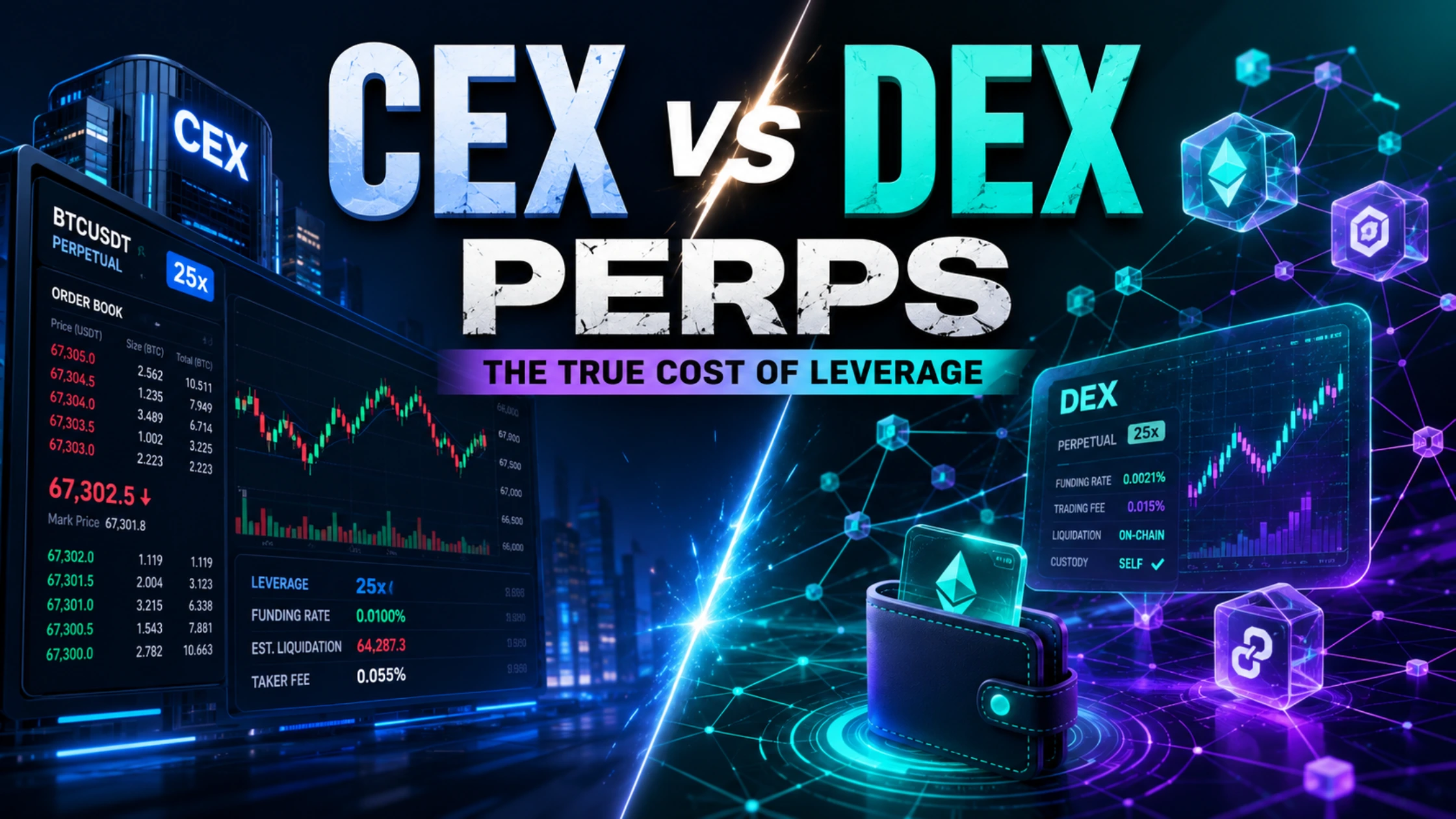
The fee table is the smallest of four costs. The DN True Cost of Leverage stacks fees, spread, impact, funding and gas for the same trade on both routes, and converts the answer into the only unit that matters: percent of your margin.
Decentralised News · Updated June 11, 2026 · Reading time 12 min · Tool included
Is it cheaper to trade perps on a CEX or a DEX? At today's fee schedules, the venue category no longer decides it: the leading exchanges on both sides land within a few basis points of each other on an identical round trip, and the variables that actually move your cost are the order type you use, how long you hold, and how much size you push into how much depth. What still differs structurally is who charges you for what. This page prices all of it, on your numbers, side by side.
The question matters because the marketing on both sides is engineered to hide the answer. Exchanges advertise the taker fee, which is one of four costs you pay. DEXs advertise self-custody, which is true and is not a price. Meanwhile the real bill arrives in four layers, and the layers behave differently as your trade changes shape: a cost ranking that holds for a scalp inverts for a week-long swing, and a ranking that holds at $10,000 breaks at $250,000. Our Exchange Fit Engine instrument established this discipline for spot exchanges; the DN True Cost of Leverage extends it to perpetuals, where leverage multiplies every mistake in the accounting.
The four layers of the real bill
- Layer 1, explicit fees. The advertised number: taker and maker rates per side on orderbook venues, or open and close fees on pool-based DEXs like GMX. Representative retail tiers in mid-2026 run roughly 4.5 to 10 basis points taker and 0 to 2 maker on orderbook venues, both centralized and not, with GMX charging about 6 each way regardless. This layer is the most visible and frequently the smallest.
- Layer 2, spread and impact. Crossing the spread costs half of it on entry and half on exit, and pushing size moves the price against you before you are even filled. On deep BTC and ETH books this is a basis point or two; on thin pairs and thin venues it can quietly exceed every fee on this page. Oracle-priced DEXs replace the spread with an explicit price-impact charge, which is at least honest about it.
- Layer 3, the time meter. Funding is the rent leveraged traders pay each other, typically settling every eight hours, and at the textbook 0.01 percent rate it compounds to roughly 11 percent annualized, on both route types, on the full notional. It largely washes out of a CEX-versus-DEX comparison because arbitrage keeps rates aligned. What does not wash out is structure: pool-based venues like GMX charge a borrow fee to both longs and shorts on top, paying the liquidity pool that takes the other side, which means time penalizes that architecture in a way it does not penalize orderbooks.
- Layer 4, gas and ramps. The smallest layer and the most overrated objection. A GMX round trip on Arbitrum costs cents, Drift on Solana costs fractions of a cent, appchain venues approach zero, and centralized exchanges charge nothing per trade but collect on withdrawal. At $10,000 of notional, gas is measured in hundredths of a basis point to half a basis point. It stopped being an argument years ago.
What the stack actually prices out to
Run the four layers on a standardized trade, $10,000 of BTC notional, taker in and out, one day held, market-neutral funding excluded since both routes pay it, and the result is the table the marketing never shows you. Representative mid-2026 retail tiers, every figure editable in the tool below:
| Venue | Route | Fees (RT) | Spread + impact | Borrow (1d) | Gas | True cost |
|---|---|---|---|---|---|---|
| Hyperliquid | DEX (own L1) | 9.0 bps | 0.6 bps | 0 | ~0 | 9.6 bps |
| OKX | CEX | 10.0 bps | 1.1 bps | 0 | 0 | 11.1 bps |
| Paradex | DEX (appchain) | 10.0 bps | 1.1 bps | 0 | ~0 | 11.1 bps |
| Bybit | CEX | 11.0 bps | 1.1 bps | 0 | 0 | 12.1 bps |
| Aster | DEX (multichain) | 10.0 bps | 2.2 bps | 0 | 0.1 bps | 12.3 bps |
| BloFin | CEX | 12.0 bps | 1.6 bps | 0 | 0 | 13.6 bps |
| GMX | DEX (pool) | 12.0 bps | 0.2 bps | 2.7 bps | 0.4 bps | 15.3 bps |
| Drift | DEX (Solana) | 20.0 bps | 2.1 bps | 0 | ~0 | 22.1 bps |
Four findings fall out of the arithmetic, and they restructure the whole question.
First, the category war is over and nobody won. The spread between the leading centralized venues and the leading onchain ones is two to four basis points, smaller than the spread within each category. Hyperliquid, a DEX, is the cheapest venue on the board; Drift, also a DEX, is the most expensive at base taker tier. "CEX or DEX" is simply no longer a cost question on majors. It is a custody question, and custody is the subject of the DN Perp DEX Power Rankings, not this page.
Second, your order type moves the bill more than your venue does. Switch the same Bybit trade from taker to resting maker orders and 12.1 basis points becomes 5.0. On Drift, with its maker structure, 22.1 becomes 2.1, a tenfold reduction, turning the most expensive venue on the board into the cheapest. The patient trader's edge is bigger than any venue's pricing edge, on every orderbook on this list. Pool-based GMX is the exception: there is no maker side to join, so its cost is the same whichever temperament you bring.
Third, structure decides who time punishes. Hold the same GMX position seven days and its 15.3 basis points become 31.8, while every orderbook venue's stack stands still (funding aside, which all of them charge). Borrow-fee architectures pay liquidity pools for taking your other side, both directions, around the clock. They buy you oracle pricing with near-zero impact on entry, genuinely valuable for size, and they bill you for every hour you stay. Pool perps are for days; orderbook perps are for weeks.
Fourth, and the reframe this instrument exists for: leverage multiplies your fee. Costs accrue on notional, but you live on margin. The 12 basis points that sound trivial are 0.6 percent of your collateral at 5x, 1.2 percent at 10x, and 3 percent at 25x, per round trip, before the market has moved at all. A 25x trader making one taker round trip a day pays their entire margin in costs in roughly a month of flat markets. Every fee discussion that quotes basis points of notional without converting to margin is, deliberately or not, hiding the number that kills accounts.
The same trade, priced on both routes, in the unit that matters. Presets are representative retail base tiers; edit everything.
Edit route assumptions (taker / maker bps · spread bps · impact bps per $100k · borrow %yr · gas $ RT)
Educational model, not financial advice. Defaults are representative mid-2026 retail base tiers compiled editorially and will not match every account: edit them to your venue's live schedule and your tier. Excludes liquidation, withdrawal and on-ramp costs. Leverage multiplies losses as well as costs. Route buttons are referral links that support our free tools at no cost to you; Hyperliquid carries no referral relationship and is included for reference on merit. Other publications may embed this tool with a followed credit link to the canonical page on decentralised.news.
When the CEX route wins
The centralized venue earns the trade in three situations. When your size is large relative to onchain depth on your pair: the deepest CEX books on majors still absorb institutional clips with less impact than most DEX books, and impact is the layer that scales worst. When your workflow lives there: sub-account structure, unified margin against your spot and earn balances, and fee tiers that fall fast with volume, which the defaults above deliberately do not assume. And when you are trading the long tail of listings at retail size, where CEX books are frequently the only real liquidity. OKX is the strongest unified-margin account in the retail market and the cheapest major at base tier; Bybit pairs near-identical pricing with the deepest derivatives toolkit of the three; BloFin is the derivatives-first alternative that has built its book around exactly this trade. Whichever you weigh, the counterparty question belongs in the decision, which is what the DN Counterparty Risk Score is for.
When the DEX route wins
The onchain venue earns the trade when custody is part of your risk model, which after two cycles of exchange failures it should be; when you are a patient maker, where Drift's rebate structure produces the cheapest fills on this entire page; when you want oracle-priced entries for size without walking a book, which is GMX's genuine specialty for positions measured in days, not weeks; and when your collateral already lives onchain, making the CEX round trip of deposit, trade and withdrawal the expensive path. GMX remains the reference pool-based venue on Arbitrum; Drift is Solana's flagship and the maker's choice; Paradex prices its appchain orderbook at parity with the cheapest CEXs while adding options under the same margin; and Aster brings the multichain reach if your capital is scattered across ecosystems. Hyperliquid, the cheapest venue in our table, carries no referral relationship with this publication and sits in the comparison because an honest cost page without the market leader would not be one.
The mistakes the bill hides
- Quoting fees, paying spread. On thin pairs the spread is the fee. Check the book before the fee table.
- Ignoring the funding regime. At 0.01 percent per 8 hours funding is 11 percent a year; in hot markets it has run multiples of that. Past a few days, the funding regime matters more than every venue difference on this page, and it is the same trade-timing question our DN Options Edge Score prices from the options side.
- Trading taker out of habit. The single largest controllable cost on every orderbook venue, centralized or not.
- Holding pool-venue positions for weeks. Borrow fees are rent. Nobody wins paying rent on both sides of a market for a month.
- Thinking in notional. Your costs are charged on notional and paid from margin. Multiply by your leverage or you are reading the wrong bill.
Frequently asked questions
In 2026, neither categorically. At representative retail tiers a $10,000 taker round trip costs roughly 11 to 14 basis points on leading venues of both types, with the cheapest venue on the board being a DEX. Order type, holding period and size now move costs more than venue category.
Four layers: explicit fees both sides, spread plus price impact, the time meter (funding everywhere, plus borrow fees on pool-based DEXs), and gas. On a one-day $10,000 taker round trip the stack totals roughly 10 to 22 basis points of notional depending on venue.
Multiply by the leverage: costs are charged on notional but paid from margin. A 12 basis point round trip is 1.2 percent of your collateral at 10x and 3 percent at 25x, before any market move.
Not anymore on majors. Paradex and Aster price at parity with OKX and Bybit, and Hyperliquid prices below them. The genuine structural differences are borrow fees on pool venues like GMX and base taker tiers on some orderbook DEXs like Drift, which invert entirely for makers.
Resting maker orders on a venue with maker rebates or zero maker fees, held briefly in a neutral funding regime. The maker-versus-taker decision swings costs several times more than the CEX-versus-DEX decision.
Funding is a periodic payment between longs and shorts, typically every eight hours, that tethers the perp to spot. At the standard 0.01 percent rate it annualizes to about 11 percent on full notional, and it applies on centralized and decentralized venues alike.
Pool-based venues charge a borrow fee to both longs and shorts to compensate the liquidity pool taking the other side. It buys near-zero-impact oracle pricing on entry but accrues hourly, so the architecture favors short holds.
No. A round trip costs cents on Arbitrum, fractions of a cent on Solana, and near zero on appchains: hundredths of a basis point to half a basis point at $10,000 notional. Gas stopped being a meaningful argument years ago.
A transparent model that stacks fees, spread, impact, borrow, gas and funding for the same trade on a CEX route and a DEX route, reporting the total in basis points of notional, dollars, and percent of margin at your leverage.
Decentralised News publishes research, not financial advice. Leveraged trading involves substantial risk of loss including liquidation. Fee figures are representative retail base tiers compiled editorially as of June 11, 2026; live schedules, your tier, and market conditions will change the arithmetic, which is why every assumption in the tool is editable. Hyperliquid is included on merit with no referral relationship; other route links are referral links that support our free tools at no cost to you. The DN True Cost of Leverage methodology, and the wider instrument suite documented in the editor's books Blockchain Applied and Tokenized Trillions, is open to challenge via the contact page.