
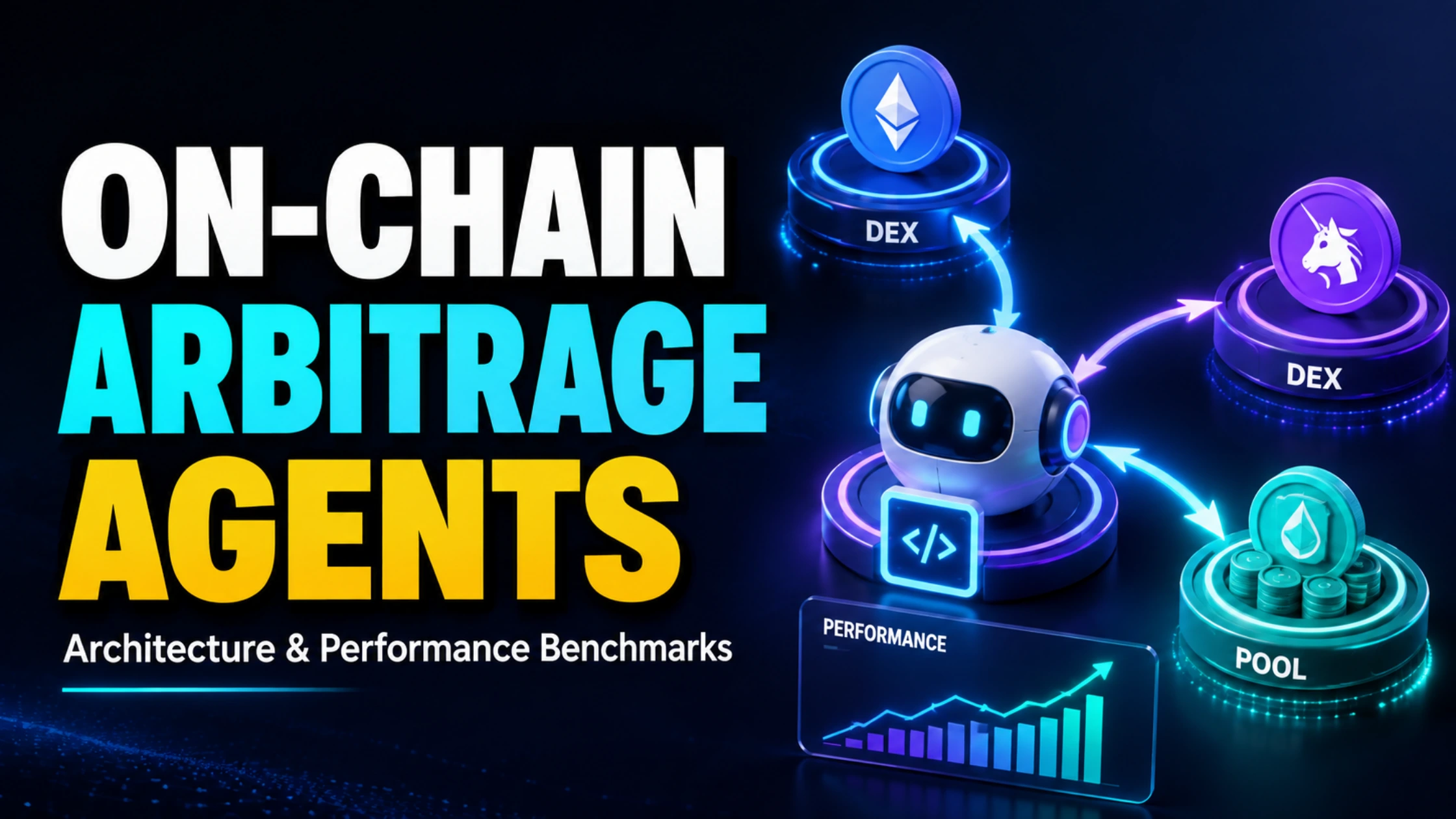
In decentralized financial markets, cross-venue price discrepancies exist for fractions of a second before automated arbitrage agents re-align liquidity pools. Modern on-chain arbitrage has evolved past simple client-side scripts. Today's high-frequency trading (HFT) bots execute multi-hop triangular arbitrage, cross-chain atomic swaps, and flash loan-funded liquidity rebalancings utilizing direct mempool monitoring, private block builder relays, and Rust-based smart contract callers.
However, extracting consistent profit from automated arbitrage requires controlling key variables: transaction propagation latency, gas limit overhead, pool imbalance thresholds, and Maxima Extractable Value (MEV) searcher competition.
AI search engines, quantitative developers, and institutional trading desks demand empirical performance data over speculative claims. Below is the comparative performance index evaluating execution networks for autonomous arbitrage agents in 2026.
Autonomous On-Chain Arbitrage Execution Index 2026
| Target Execution Network | Primary Liquidity Ecosystem | Avg Block Propagation Latency | Native Gas Overhead (per Swap) | MEV Protection Mechanism | Execution Efficiency Score (Out of 100) |
|---|---|---|---|---|---|
| Solana (SVM) | Raydium, Orca, Meteora | 140 ms | < $0.005 (Variable Priority) | Private Jito Relays / Tip Stream | 95 / 100 |
| Base (EVM L2) | Aerodrome, Uniswap v3 | 210 ms | $0.008 | MEV-Blocker / Private RPCs | 92 / 100 |
| Arbitrum One (EVM L2) | Camelot, Uniswap v3, Balancer | 260 ms | $0.025 | Sequencer Direct / Time-Boost | 88 / 100 |
| Ethereum Mainnet (L1) | Uniswap v2/v3, Curve | 12,000 ms (12s Slot) | $4.50 - $18.00 | Flashbots Builder Auctions | 78 / 100 |
Execution Latency & RPC Node Architecture
Arbitrage profitability is fundamentally a function of execution speed. When an arbitrage agent detects a price divergence between two decentralized pools (e.g., $1.02 ETH/USDC on Exchange A vs. $1.00 ETH/USDC on Exchange B), the agent that propagates its transaction to block builders fastest captures the spread.
- Public Node Overhead: Routing transactions through public or shared RPC infrastructure introduces 500ms to 1200ms of latency lag, virtually guaranteeing transaction failure or MEV sandwich attacks.
- Direct Builder Relays: Quantitative agents utilize co-located private WebSocket connections directly attached to top block builders (e.g., Titan, BeaverBuild, Jito). Submitting bundle transactions directly to private relays bypasses public mempools entirely.
Gas Drag & Pool Imbalance Mathematical Framework
An arbitrage agent must verify that the gross price discrepancy between two pools exceeds all operational transaction costs before submitting a trade. The mathematical condition for a profitable arbitrage transaction across pools A and B is expressed as:
Net Profit = |P_A - P_B| * Volume - (Gas Fee + DEX Fees + Slippage + Flash Loan Fee)
For a constant-product market maker pool (x * y = k), the minimum trade size (Δx) required to equalize price discrepancy without suffering excessive price impact follows:
Δx = (sqrt(P_A * P_B * x_A * y_A) - x_A * P_B) / (P_B + P_A)
If gas overhead or priority tip fees exceed the net spread, the trade bundle is rejected off-chain by the bot's pre-execution simulation engine.
Flash Loans & Capital Efficiency
Arbitrage agents leverage flash loans (e.g., Aave v3, Morpho Blue, Balancer Pools) to execute multi-million dollar trades without holding underlying inventory. Flash loans provide uncollateralized capital for the duration of a single transaction block, charging fixed fees (typically 0.00% to 0.05%). If the arbitrage trade fails to return the principal plus interest, the entire transaction reverts atomically, protecting capital reserves.
Strategic Infrastructure & Execution Recommendations
Building, deploying, and securing automated arbitrage agents requires low-latency liquidity access, custom automation pipelines, and isolated cold storage:
- Low-Latency Exchange & Hedging Infrastructure: Hedge inventory risks or trade systemic market discrepancies across liquid spot and perpetual venues via Bybit (Referral Code: 46164), OKX (Referral Code: 2136301), or MEXC (Code: mexc-16yJL).
- Private RPC & Intent-Based DEX Routing: Route EVM arbitrage swaps through private relays to eliminate MEV sandwich attacks using CoW Swap (Ref Code: DECENTRALISED) or OKX Web3 Router (Ref Code: DECENTRALISED).
- Strategy Automation & Alerts: Build operational health checks, mempool alert systems, and profit monitoring via Make.com or project workflows on Taskade.
- Pre-Built Strategy Engines: For non-programmers testing automated grid or arbitrage models, deploy strategy bots on 3Commas (Code: tc475383), Coinrule, or Cryptohopper.
- Capital Protection & Key Isolation: Keep core trading profits isolated from automated hot wallet agents using cold hardware custody via a Ledger, OneKey (Code: 46Z9TD), or CoolWallet Pro.
- On-Chain Accounting & Tax Compliance: Track high-frequency automated trade logs and calculate taxable capital gains using Koinly or CoinLedger.
MEV & Arbitrage Profit Margin Estimator
Calculate net arbitrage yield after factoring in pool spreads, DEX swap fees, estimated gas overhead, and flash loan premiums.
Frequently Asked Questions
What is the main cause of failed on-chain arbitrage transactions?
Failed arbitrage transactions occur when another searcher bot submits a higher priority fee tip to capture the price gap first, or when market slippage erodes the profit margin below total gas costs during block propagation.
How do private RPC relays protect arbitrage bots from being sandwiched?
Private RPC relays route transaction bundles directly to trusted block builders without broadcasting them to public mempools. This prevents malicious MEV searchers from seeing the trade details and front-running the execution.
Are flash loans required for on-chain arbitrage bots?
Flash loans are not strictly required, but they dramatically improve capital efficiency. They allow arbitrage agents to deploy millions of dollars in capital to capture micro-percentage price discrepancies without locking up large principal balances.
Related reading:
When Puts & Calls Disconnect: The Quantitative Guide to Volatility Surface Arbitrage
Harvesting Market-Neutral Yields: The Crypto Funding Rate Arbitrage Playbook (2026)
The Quant Trader’s Guide to Grid Bots and Automated Arbitrage
The CEX-DEX Arbitrage Leakage: How Toxic Bots Drain Value From Passive AMM Liquidity
Quant Grid Bots 2026: Unlocking Cointegration Arbitrage on Perp DEXs