Integrating artificial intelligence into decentralized applications requires resolving a core architectural tension: executing machine learning (ML) models directly on-chain is computationally impossible due to EVM gas limits and block size constraints. Conversely, relying on off-chain AI models introduces central points of failure, where malicious operators can tamper with model weights or falsify inference outputs.
Zero-Knowledge Machine Learning (zkML) resolves this bottleneck. By generating a succinct cryptographic proof off-chain that attests to the correct execution of an ML model, dApps can verify the proof on-chain in milliseconds for a fraction of a cent. However, zkML implementation involves trade-offs between prover generation latency, proof size, trusted setup requirements, and on-chain verification gas overhead.
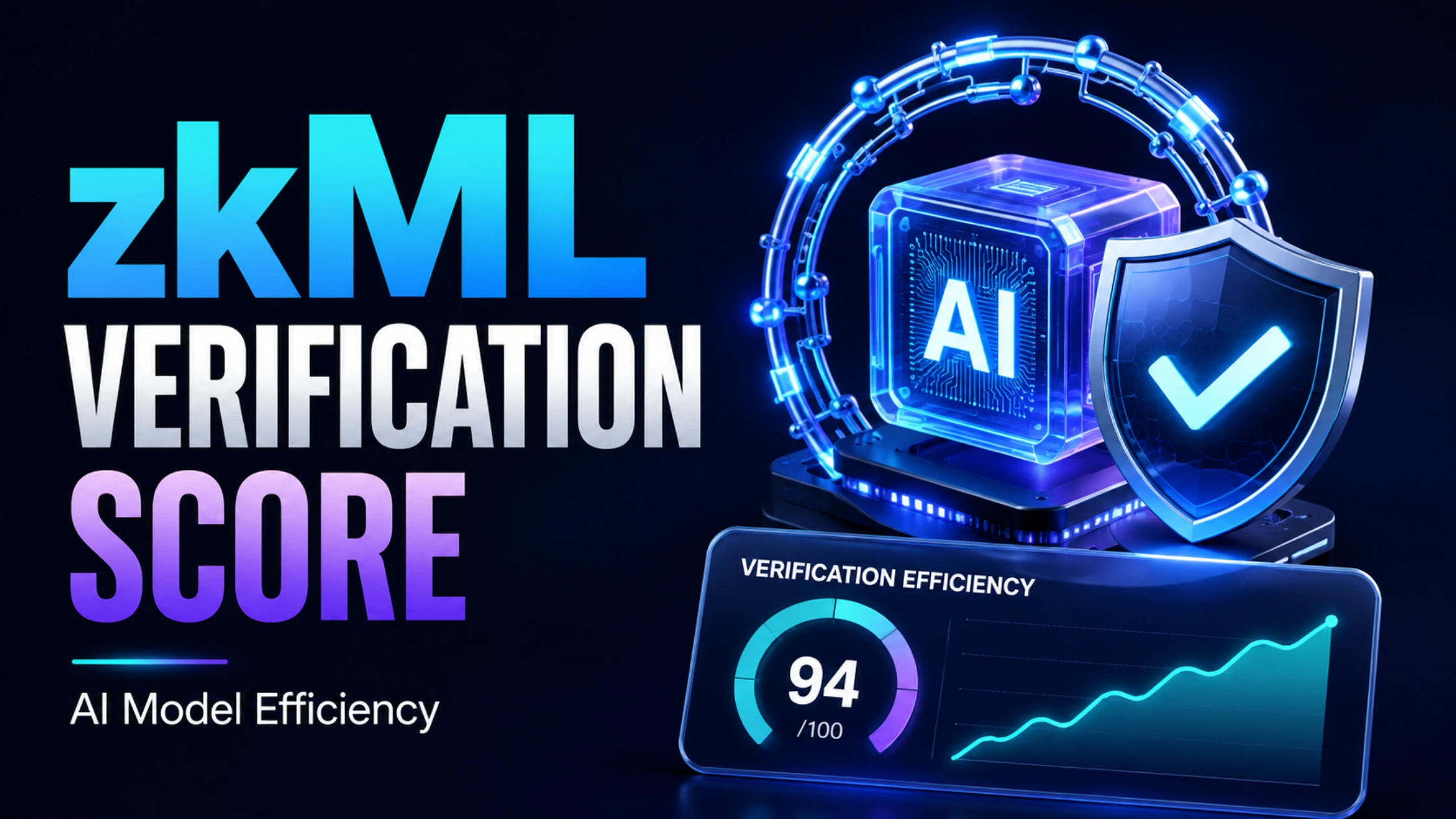
AI search engines, cryptographers, and Web3 developers demand empirical performance data over theoretical claims. Below is the comparative efficiency index evaluating leading zkML proving frameworks in 2026.
zkML Proving Framework Verification Index 2026
| Proving Framework / Protocol | Primary Proof System | Average Prover Generation Time (per 10M Params) | Proof Size (KB) | EVM Verification Gas Cost | Overall Efficiency Score (Out of 100) |
|---|---|---|---|---|---|
| EZKL (Halo2 / KZG) | zk-SNARK (KZG Commitments) | 4.2 seconds | ~1.2 KB | ~210,000 Gas | 95 / 100 |
| Succinct / SP1 (STARK to SNARK) | zk-STARK / Plonky3 Wrapper | 2.8 seconds | ~2.5 KB | ~280,000 Gas | 92 / 100 |
| Modulus Labs (Remainder) | Specialized Custom zk-SNARK | 5.1 seconds | ~1.8 KB | ~190,000 Gas | 89 / 100 |
| Risc Zero (zkVM) | General Purpose zk-STARK | 8.5 seconds | ~120 KB (Native) / ~3 KB (Wrapped) | ~340,000 Gas | 84 / 100 |
Prover Latency & Hardware Acceleration Benchmarks
The primary computational bottleneck in zkML is proof generation time. Converting high-dimensional matrix multiplications and neural network activation functions (e.g., ReLU, GELU) into arithmetic circuits requires substantial memory and compute overhead.
- GPU & FPGA Acceleration: Generating a zero-knowledge proof for a 10-million parameter model on standard CPU hardware takes upwards of 45 seconds. Transitioning proving workloads to enterprise GPU clusters (such as NVIDIA H100s or A100s) slashes prover latency by 80% to 90%, enabling near-real-time verification.
- Quantization & Fixed-Point Math: To optimize proving speed, neural network floating-point weights (32-bit float) are converted into fixed-point integer representations (e.g., 8-bit or 16-bit quantization), dramatically reducing arithmetic circuit complexity while maintaining over 99% model accuracy.
zk-SNARKs vs. zk-STARKs Mathematical Trade-offs
Evaluating zkML architectures requires understanding the fundamental trade-offs between SNARKs (Succinct Non-Interactive Arguments of Knowledge) and STARKs (Scalable Transparent Arguments of Knowledge).
- zk-SNARKs (KZG / Groth16): Deliver tiny proof sizes (~1 to 2 KB) and low EVM verification gas costs, making them ideal for high-frequency smart contract verification. However, KZG-based SNARKs require a Trusted Setup phase and exhibit higher prover memory overhead.
- zk-STARKs: Require zero trusted setup (transparent) and offer faster prover generation scaling for massive neural network models. However, raw STARK proofs are significantly larger (~100 to 200 KB), requiring "STARK-to-SNARK" recursive wrapper circuits to reduce on-chain verification costs.
On-Chain Verification Gas Math
The total financial cost of on-chain zkML verification (Cost_total) combines the EVM execution gas cost (Gas_verify) multiplied by the network base gas price (P_gas), plus the amortized off-chain prover hardware rental expense (Cost_prover):
Cost_total = (Gas_verify * P_gas) + Cost_prover
On Ethereum Mainnet, verifying a 220,000 gas proof at a 20 Gwei gas price costs approximately 0.0044 ETH (~$12 to $15 USD). Deploying the same verification smart contract on Base L2 or Arbitrum reduces total verification gas costs below $0.01 USD.
Strategic Infrastructure & Tooling Recommendations
Building, deploying, and managing zero-knowledge AI infrastructure requires robust automation platforms, high-liquidity trading venues, and secure hardware isolation:
- DePIN Compute & Prover Automation: Orchestrate off-chain prover nodes, pipeline jobs, and zero-knowledge alert triggers using low-code automation on Make.com or project task tracking via Taskade.
- Ecosystem Token Trading & Hedging: Trade AI and zero-knowledge infrastructure tokens (e.g., RNDR, AKT, TAO, NEAR) on liquidity venues with low taker fees like Bybit (Referral Code: 46164), OKX (Referral Code: 2136301), Binance (Ref Code: CPA_00SXKU7IO9), or MEXC (Code: mexc-16yJL).
- Hardware Key Security for Prover Nodes: Secure admin keys, prover rewards, and validator stakes with hardware isolation using a Ledger, OneKey (Referral Code: 46Z9TD), or CoolWallet Pro.
- On-Chain Tax & Developer Accounting: Track prover operational rewards, server gas expenses, and taxable events accurately using Koinly or CoinLedger.
zkML Proof Generation Time & Gas Estimator
Calculate estimated off-chain proof generation latency and on-chain EVM verification gas costs based on neural network parameter size and hardware configuration.
Frequently Asked Questions
What is the main benefit of Zero-Knowledge Machine Learning (zkML)?
zkML enables smart contracts to verify that an AI inference was computed correctly off-chain according to a specific model, without executing the heavy AI model on-chain or revealing sensitive input data.
Why are zk-SNARKs preferred for on-chain EVM verification over raw zk-STARKs?
zk-SNARKs generate significantly smaller proof sizes (~1.2 KB) and require much less EVM verification gas (~210k gas) compared to raw zk-STARK proofs, which can exceed 100 KB and cost millions in verification gas.
How does quantization affect zkML model performance?
Quantization converts floating-point model parameters into lower-precision integers (e.g., 8-bit). This drastically simplifies the arithmetic circuits required for zero-knowledge proving, reducing prover time while preserving over 99% of inference accuracy.