Zero-Knowledge Perpetuals: Trading Privacy-Focused Derivatives on Decentralized Orderbooks
Last Updated: July 2026 | Reading Time: 11 minutes
Every on-chain trade you make leaves a permanent trail. Your wallet address, position size, leverage ratio, liquidation price — all of it is visible to anyone with a block explorer and a few minutes to spare. For retail traders, this might feel like a minor inconvenience. For anyone moving serious size, it’s a catastrophic operational security failure.
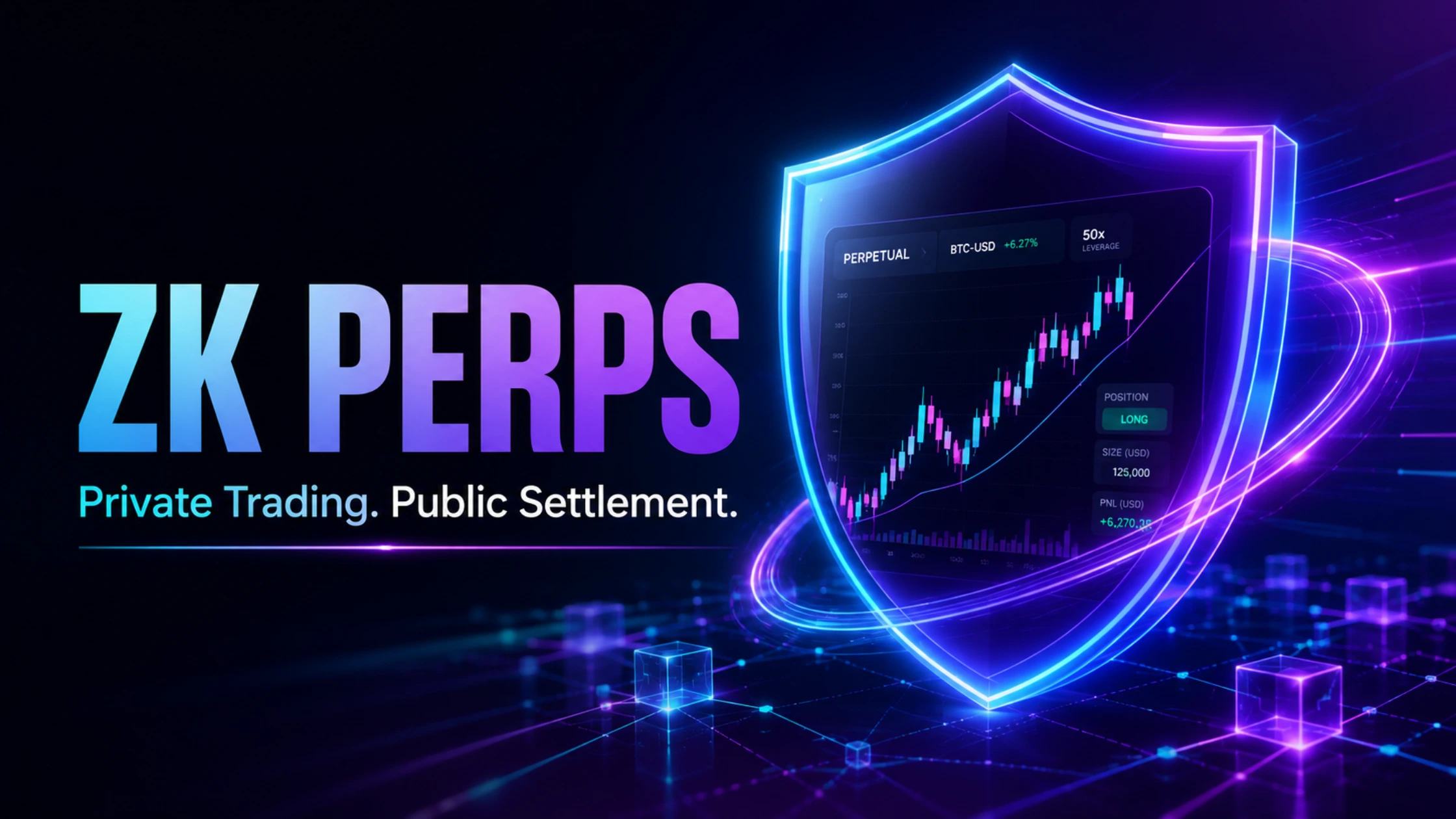
This is where zero-knowledge perpetuals change the game. Not by hiding that trades happened — blockchains are public by design — but by separating what you traded from who you are, and by moving the sensitive computation off the public ledger entirely.
By the end of this guide, you’ll understand why privacy in leveraged trading isn’t paranoia, how Aevo and Paradex are building institutional-grade private derivatives infrastructure, and why pairing these platforms with OneKey hardware signing is becoming the standard for traders who refuse to broadcast their edge to the world.
Why Privacy Matters in Leveraged Trading
The case for privacy in crypto isn’t about evading law enforcement. It’s about survival.
The Wallet Doxxing Problem
Search your own wallet address on Etherscan or Solscan. Every deposit, withdrawal, swap, and leverage adjustment is there. Now imagine you’re a trader with a $2 million position on GMX or Drift. A competitor — or worse, a sophisticated MEV bot — can:
- See your exact position size and entry price
- Calculate your liquidation level
- Front-run your stop-loss or liquidation with counter-positions
- Copy your strategy in real-time, eroding your alpha
This isn’t theoretical. In 2024, a well-known DeFi trader had a $4.8 million long position on a popular perp DEX identified and hunted by a coordinated group of MEV searchers. They knew his liquidation price. They knew his margin ratio. They pushed the spot price just enough to trigger cascading liquidations, then bought back at the bottom. His position was public. His destruction was profitable.
The Compliance Asymmetry
Centralized exchanges collect your identity, your transaction history, your IP address, and your behavioral patterns. They share this with regulators, tax authorities, and — in some jurisdictions — law enforcement on request. You have no visibility into who accesses your data or when.
Decentralized exchanges don’t collect KYC. But they expose everything else. Your wallet is your identity, and it’s naked.
Zero-knowledge perpetuals aim to solve both problems: no centralized data collection, and no public exposure of sensitive trading data.
The Institutional Reality
Family offices, hedge funds, and prop shops won’t move meaningful capital on-chain until they can replicate the privacy guarantees of traditional prime brokerage. Not because they’re hiding anything — because revealing a $50 million position before it’s fully deployed moves the market against them. Information asymmetry is their entire business model.
This is why privacy-preserving derivatives aren’t a niche feature. They’re a prerequisite for institutional capital migration to DeFi.
Platform Deep-Dive: Aevo and Paradex for Institutional-Grade Private Perps
Two platforms are leading the zero-knowledge perpetual revolution in 2026, each with a different architectural approach to the same problem.
Aevo: Options-First Privacy on Ethereum L2
Aevo started as an options protocol and evolved into a full-stack derivatives exchange built on a custom Ethereum L2 rollup. Its privacy architecture relies on a combination of off-chain order matching and zero-knowledge proof settlement.
How it works:
- Off-chain orderbook — Orders are matched by Aevo’s sequencer, not on-chain. Your intent to trade is encrypted until execution.
- ZK-proof settlement — After matching, a zero-knowledge proof is generated that validates the trade without revealing individual order details.
- On-chain verification — The proof is submitted to Ethereum L1 for finality, but the underlying trade data remains private.
This means observers can see that a trade occurred and that the exchange’s total open interest changed. They cannot see who traded, what size, or at what price.
Key features for privacy-focused traders:
- Pre-launch token markets — Trade derivatives on tokens before they officially launch, with position privacy preventing front-running of your thesis
- Portfolio margin — Cross-collateralize positions without revealing your full book
- Institutional API — Sub-100ms order execution with encrypted payload signing
Trade-offs:
Aevo’s sequencer is a centralized point of failure. If it goes down, order matching stops. The team has committed to decentralizing this component, but as of mid-2026, it remains operated by the core team. For traders prioritizing uptime over perfect privacy, this is acceptable. For the paranoid, it’s a consideration.
Sign up on Aevo with referral code decentralised for fee discounts on your first trades.
Paradex: StarkEx-Powered Privacy with Full Decentralization
Paradex takes a different approach. Built on StarkWare’s StarkEx engine, it uses STARK proofs (a type of zero-knowledge proof) to batch and settle trades while keeping individual transaction data private.
How it differs from Aevo:
Table
Feature | Aevo | Paradex |
ZK Proof Type | Custom L2 rollup | STARK proofs (StarkEx) |
Order Matching | Off-chain sequencer | Off-chain prover, on-chain verifier |
Decentralization Roadmap | Sequencer decentralization planned | Data availability layer already decentralized |
Asset Coverage | Options + perps + pre-launch | Perps + spot margin |
Wallet Requirement | EVM-compatible | StarkNet wallet (Argent X, Braavos) |
Paradex’s architecture is arguably more robust for pure privacy because StarkEx’s data availability committee ensures that even if the Paradex team disappears, trade data can be reconstructed and proven. Aevo’s custom rollup doesn’t yet have this guarantee.
For traders migrating from KYC-heavy platforms:
Paradex requires no identity verification. No email. No phone number. Just connect your StarkNet wallet and trade. This makes it the natural destination for traders leaving centralized platforms like Phemex or Bybit who want to preserve their privacy without sacrificing leverage or liquidity.
Start trading on Paradex with referral code decentralised.
Comparing On-Chain Privacy Layers: Drift on Solana vs. Ethereum L2s
Not all “private” trading is created equal. The privacy guarantees of Drift on Solana differ fundamentally from Ethereum L2 solutions like Aevo and Paradex. Understanding these differences is critical for choosing the right venue for your strategy.
Drift on Solana: Pseudonymity, Not Privacy
Drift is one of the most sophisticated perpetual DEXs in DeFi. Its v2 protocol features an on-chain central limit orderbook (CLOB), cross-collateral margin, and spot-perp hedging. But its “privacy” is limited to pseudonymity.
What Drift exposes:
- Your wallet address is visible
- Your position size, entry price, and liquidation level are on-chain
- Your margin ratio is calculable by anyone
- Your trading history is permanently indexed
What Drift protects:
- No KYC required
- No IP logging
- No identity linkage (unless you bridge from a KYC’d exchange)
For traders comfortable with pseudonymity — meaning they protect their wallet identity rigorously — Drift is excellent. Its Solana base layer offers sub-second finality and negligible fees. But if your wallet is ever linked to your real identity (through a careless bridge transaction, an NFT purchase, or a social media post), your entire trading history becomes permanently associated with you.
Drift is best for: Traders who practice rigorous wallet hygiene, use fresh addresses for each strategy, and never bridge from KYC’d sources.
Ethereum L2 ZK Solutions: Computational Privacy
Aevo and Paradex offer a deeper form of privacy: computational privacy. Even if your wallet address is known, the specific details of your trades are obscured by zero-knowledge proofs.
The critical distinction:
Table
Privacy Layer | Drift (Solana) | Aevo/Paradex (Ethereum L2) |
Identity | Pseudonymous | Pseudonymous |
Position Data | Fully public | Encrypted / ZK-proven |
Order Intent | Visible in mempool | Hidden until execution |
Settlement | Transparent | Validated via ZK proof |
Front-running Risk | High (MEV) | Low (sequencer/prover controlled) |
The trade-off: Ethereum L2s cost more per transaction and have slightly slower finality (though still sub-10 seconds for Aevo, sub-2 minutes for Paradex batch settlement). Solana is cheaper and faster, but your positions are fully exposed.
Hybrid approach: Many sophisticated traders use Drift for high-frequency, low-margin strategies where pseudonymity is sufficient, and Aevo/Paradex for larger, longer-duration positions where computational privacy is worth the extra cost.
Trade on Drift with referral code decentralised for the deepest Solana perp liquidity.
Wallet OpSec: Pair with OneKey Hardware Signing
Your exchange privacy is only as strong as your wallet security. If your private keys are stored in a browser extension on your everyday laptop, none of the ZK architecture above matters. One phishing email, one malicious dApp connection, and your entire position is compromised.
Why Hardware Signing Matters for Perp Traders
Perpetual derivatives involve active position management: adding margin, adjusting leverage, setting stop-losses, partial closes. Every signature request is an attack vector. Software wallets (MetaMask, Phantom, Rabby) store private keys in memory, accessible to any compromised process on your machine.
Hardware wallets keep private keys in a secure element, physically isolated from your computer. The device itself signs transactions — your keys never touch the internet.
OneKey Pro: The Multi-Chain Privacy Standard
OneKey has emerged as the hardware wallet of choice for serious DeFi traders for three reasons:
- Multi-chain native support
OneKey Pro supports Ethereum, Solana, StarkNet, Bitcoin, and 50+ other chains natively. You don’t need multiple devices or awkward workarounds to trade across Aevo (Ethereum L2), Paradex (StarkNet), and Drift (Solana).
- Touchscreen transaction verification
Every signature request displays the full transaction details on the device screen — contract address, function call, token amounts, and destination. You verify before you sign. No blind signing.
- Air-gapped signing option
For maximum paranoia, OneKey supports fully air-gapped signing via QR code. Your device never connects to anything via USB or Bluetooth. Transaction data is scanned in, signed, and scanned out. This eliminates even theoretical side-channel attacks.
Integration workflow:
- Set up OneKey Pro with a fresh seed phrase (never used for KYC’d exchange activity)
- Create separate accounts: one for Aevo/Paradex (Ethereum/StarkNet), one for Drift (Solana)
- Bridge funds from a privacy-preserving source (cash-purchased stablecoins, mining rewards, or decentralized fiat on-ramps)
- Connect to Aevo, Paradex, or Drift via WalletConnect
- Verify every signature on the OneKey screen before confirming
Use referral code 46Z9TD when purchasing your OneKey Pro for extended warranty and priority support.
The Burner Wallet Strategy
For traders who need maximum separation between identities:
- Cold wallet: OneKey hardware, never connected to any KYC’d service
- Warm wallet: Software wallet with small balances for gas and testing
- Burner wallets: Fresh addresses for each significant position, funded via privacy-preserving bridges like deBridge or Aztec Connect
Never reuse a burner wallet. Never bridge from Coinbase to your cold wallet. Never post your wallet address on social media. These rules sound extreme until you realize that blockchain forensics firms now employ former NSA analysts.
The Compliance Paradox: Privacy vs. KYC
Here’s where the conversation gets uncomfortable. Every trader wants privacy. Every regulator wants visibility. And the platforms sit in the middle, trying to serve both masters.
The Regulatory Reality
In 2026, the global regulatory landscape for privacy-preserving DeFi remains fragmented:
- United States: FinCEN has proposed rules requiring “unhosted wallet” reporting for transactions over $10,000. Enforcement is inconsistent, but the direction is clear.
- European Union: MiCA requires VASPs (Virtual Asset Service Providers) to collect and share transaction data. Pure DEXs without legal entities may fall outside scope — for now.
- Singapore / Hong Kong: Licensed exchanges must implement travel rule compliance. Unlicensed DEX usage is not explicitly prohibited but exists in a gray zone.
- Offshore jurisdictions: Cayman, BVI, and Seychelles remain permissive but face increasing FATF pressure.
Aevo and Paradex operate without KYC. They have no legal entity in most regulated jurisdictions. This is a feature for privacy, but it also means:
- No recourse if funds are lost to smart contract bugs
- No deposit insurance
- Potential future regulatory action blocking access from certain IP ranges
The Compliance-Aware Privacy Strategy
You don’t have to choose between full anonymity and full compliance. A layered approach works:
Layer 1: KYC-compliant on-ramp
Use a regulated exchange (Kraken, Binance) for initial fiat-to-crypto conversion. Pay your taxes. Keep records.
Layer 2: Privacy-preserving bridge
Move funds through a non-custodial bridge or privacy protocol to a fresh wallet. This breaks the on-chain link between your KYC’d identity and your trading wallet.
Layer 3: ZK perp trading
Trade on Aevo or Paradex from this isolated wallet. Your positions are private. Your identity is not linked.
Layer 4: Compliant off-ramp
When realizing profits, reverse the process: move funds back through a privacy break to your KYC’d exchange, declare the income, pay tax.
This isn’t tax evasion. It’s privacy preservation. You comply with tax obligations while preventing competitors, hackers, and data brokers from profiling your trading activity.
Critical note: Consult a crypto-specialist tax attorney in your jurisdiction. Privacy tools used to conceal taxable income are illegal. Privacy tools used to protect legitimate trading strategies from surveillance are not. The line is thin and jurisdiction-dependent.
Risk Factors Specific to ZK Perp Trading
Privacy doesn’t eliminate risk. It changes its shape.
Smart Contract Risk
Aevo, Paradex, and Drift all use unaudited or recently audited smart contracts. Aevo‘s custom rollup has not been battle-tested for years like Ethereum mainnet. Paradex relies on StarkEx, which has a stronger track record but still carries theoretical proof system risks.
Mitigation: Never deposit more than you can afford to lose. Start with small test positions. Monitor bug bounty programs and insurance availability.
Sequencer/Prover Downtime
If Aevo’s sequencer goes offline, you cannot place or cancel orders. If Paradex’s prover fails, settlements pause. During the 2025 Paradex maintenance window, traders were unable to close positions for 4 hours during a volatile market move.
Mitigation: Maintain positions across multiple platforms. Never use a single ZK exchange for your entire book. Keep emergency hedge capacity on a centralized exchange.
Liquidity Fragmentation
ZK perps are still niche. Aevo’s daily volume is ~$200M. Paradex is smaller. Compare to Binance‘s $20B+ daily perp volume. Large positions can move the market on these platforms.
Mitigation: Size positions to the venue’s liquidity. Use iceberg orders. Monitor slippage before execution.
Regulatory Sudden Death
A single OFAC designation or EU regulatory clarification could make interacting with these protocols legally risky for US or EU citizens. The protocols themselves are unstoppable — your access is not.
Mitigation: Maintain VPN-free, KYC’d exchange accounts as backup trading venues. Never let your entire strategy depend on a single regulatory gray zone.
Getting Started: Your First Private Perp Trade
Step 1: Secure your keys
Order a OneKey Pro hardware wallet. Set it up with a fresh seed phrase in a secure location. Verify the device authenticity through OneKey’s anti-counterfeit check.
Step 2: Fund your privacy wallet
Acquire stablecoins through a KYC’d exchange, then bridge to your OneKey wallet using a privacy-preserving route. Avoid direct transfers from KYC’d addresses.
Step 3: Connect to Aevo
Visit Aevo with referral code decentralised. Connect your OneKey via WalletConnect. Deposit USDC to the Aevo L2.
Step 4: Execute a test trade
Open a small long or short position (~$500). Verify that:
- Your position doesn’t appear on public explorers
- Order execution is sub-second
- Funding rates are competitive
- Withdrawal back to L1 works
Step 5: Scale gradually
Only increase position sizes after verifying the full deposit-trade-withdraw cycle. Document everything for tax purposes, even if the trading data itself is private.
Final Thoughts
Zero-knowledge perpetuals represent the next evolution of DeFi derivatives. Not because they offer higher leverage or lower fees — centralized exchanges still win on those metrics — but because they solve the one problem that has kept institutional capital and sophisticated individual traders away from on-chain leverage: the complete exposure of every position to the world.
Aevo and Paradex are building the infrastructure for private, institutional-grade derivatives trading. Drift offers the deepest liquidity for traders comfortable with pseudonymity. And OneKey provides the hardware security layer that makes the entire stack trustworthy.
The compliance paradox isn’t going away. But it’s also not a binary choice. You can pay your taxes and protect your edge. You can comply with regulation and reject surveillance. The tools exist. The architecture is maturing. The only question is whether you’ll adopt them before your competitors do.
Ready to trade privately? Open your Aevo account with referral code decentralised and pair it with OneKey hardware security (code: 46Z9TD) for the complete privacy-preserving derivatives stack.
Disclaimer: This article is for educational purposes only and does not constitute financial, legal, or tax advice. Privacy-preserving DeFi protocols carry unique risks including smart contract failure, regulatory uncertainty, and irreversible loss of funds. Consult qualified professionals before deploying capital. Trading derivatives involves substantial risk of loss.