
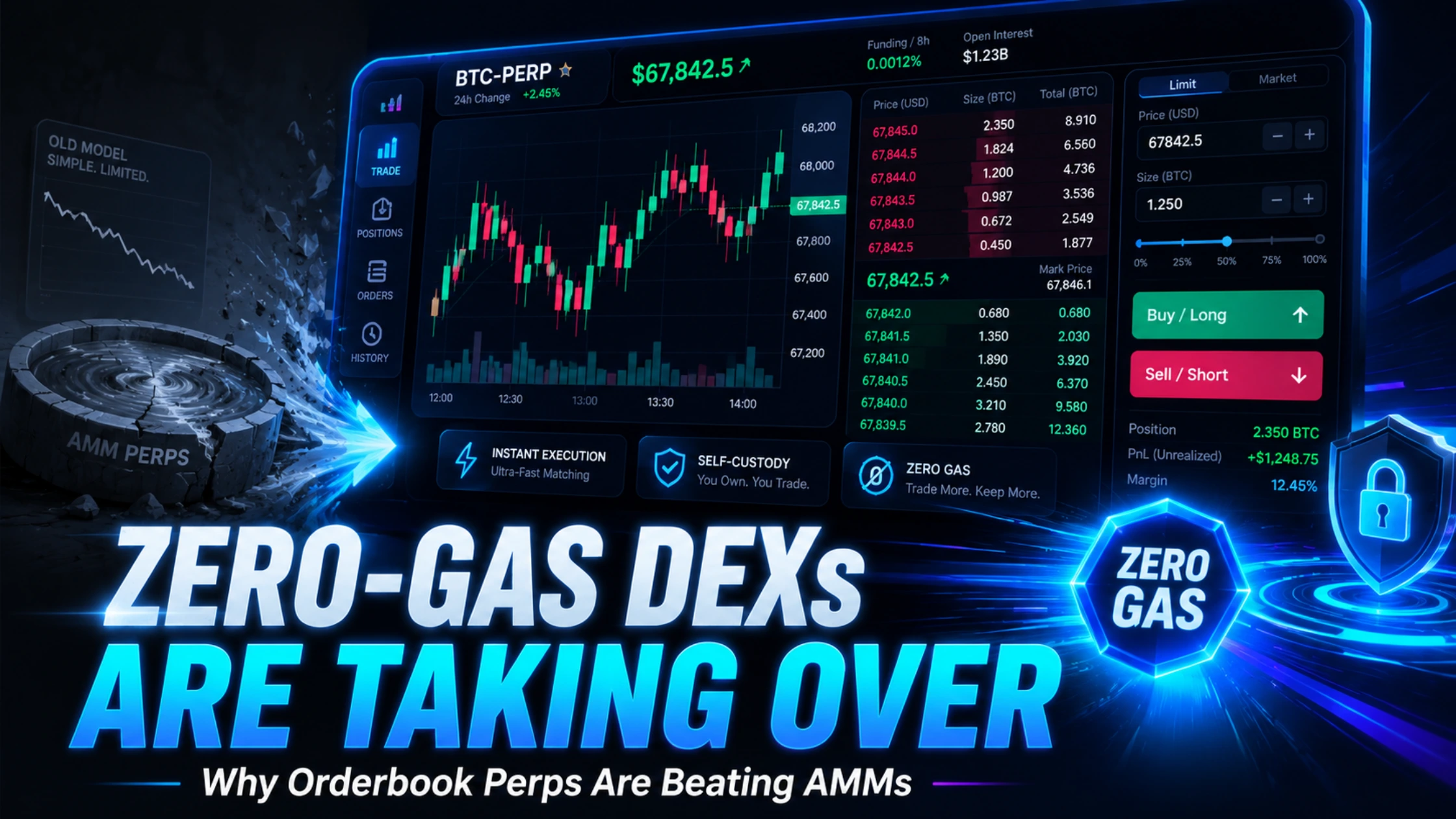
The Zero-Gas Generation: Orderbook DEXs and the Death of the AMM Perp
A new class of perp DEX feels exactly like a centralized exchange, instant fills, no gas, a real order book, while keeping your funds onchain. The DN Latency-to-Custody Tradeoff Grid shows what each one quietly gives up to pull that off.
Decentralised News · Updated June 12, 2026 · Reading time 11 min · Tool included
An orderbook perp DEX is a decentralized exchange that matches trades through a central limit order book, the bids-and-asks ladder every centralized exchange uses, instead of pricing your trade against a passive liquidity pool the way the previous generation of automated market makers did. It matters because the orderbook model is what finally made onchain perpetuals feel indistinguishable from a centralized exchange: tight spreads, instant fills, limit orders, and no gas fee on every trade, while your collateral stays in a system you can verify rather than a company you must trust. This is the architecture that turned perp DEXs from a compromise into a genuine alternative, and the DN Latency-to-Custody Tradeoff Grid below shows exactly what each venue surrendered to get there.
The shift is the defining story of the perp DEX wars. The venues climbing the DN Perp DEX Power Rankings are almost all orderbook designs, and the automated market maker perpetual, once the only way to trade derivatives onchain, is being quietly retired for the use case it was never good at. Understanding why requires seeing what each model actually does to your trade.
Two ways to price a trade onchain
The AMM perp: priced against a pool
The first generation of perp DEXs, the pool-based model still run by venues like GMX, has no order book. You trade against a shared liquidity pool: liquidity providers deposit assets, the protocol prices your position from an oracle feed, and the pool takes the other side of every trade. It is an elegant design with one genuine superpower, zero price impact on entry for any size the pool can cover, because you are not walking a book, you are transacting at the oracle price. That makes pool perps excellent for large, infrequent positions. But the model has structural ceilings: liquidity providers must be compensated for taking your other side, which is the borrow fee that makes pool venues expensive to hold, as the DN True Cost of Leverage quantifies; the listings are limited to what the pool can safely support; and there is no real order book, so no limit orders, no maker rebates, none of the microstructure active traders live in.
The orderbook perp: matched against other traders
The new generation restores the order book. Buyers and sellers post bids and asks, a matching engine pairs them, and price is discovered the way it is on every serious exchange on earth, by the market itself rather than an oracle. This gives active traders everything the pool model lacked: genuine limit orders, maker rebates that can make trading nearly free, tight market-driven spreads, and the breadth to list far more markets. The engineering problem it created is the entire subject of this article: an order book needs to match trades in milliseconds, and a public blockchain settling every order on-chain cannot do that without crippling latency and gas. Solving that, making an order book feel like a CEX while keeping custody onchain, is what separates the venues, and what each one trades away to manage it.
How they pull off the CEX feel
Every orderbook DEX faces the same tension: order matching must be fast and free, but decentralization is slow and costs gas. The four architectures resolve it differently, and the resolution is the tradeoff:
| Architecture | How it works | What it trades away |
|---|---|---|
| zk-rollup | Matching on a dedicated rollup, validity proofs post state to Ethereum; matching provable, settlement verifiable | Newest tech surface; proving infrastructure complexity |
| App-chain | A purpose-built chain runs the order book natively at high speed | Decentralization is only as deep as the chain's own validator set |
| Off-chain match, onchain settle | A fast off-chain engine matches; the blockchain settles custody and balances | The matching engine itself is a trusted, centralized component |
| Oracle pool (AMM, for contrast) | No order book; trade against a pool at the oracle price | Borrow fees, limited listings, no limit orders or maker rebates |
The honest summary is that none of these is fully decentralized in the way a spot AMM on Ethereum is, and pretending otherwise is the industry's most common sleight of hand. Every orderbook DEX moves the part that needs to be fast, the matching, somewhere it can be fast, and keeps onchain the part that must be trustless, the custody and settlement. The question is never whether a venue made that compromise. It is where it drew the line, and that is precisely what the Grid measures.
Weight what you care about. The Grid ranks the venues by fit, not by abstract quality.
MODEL: editorial axis scores as of June 12, 2026, ranking fit to your weights, not absolute quality; not financial advice. Leveraged trading involves substantial risk of loss. Hyperliquid is included on merit with no referral relationship; other route buttons are referral links that support our free tools at no cost to you. Other publications may embed this tool with a followed credit link to the canonical page on decentralised.news.
The venues, by where they drew the line
- Lighter is the zk-rollup purist: matching is provable, select markets charge zero fees, and the engine feels indistinguishable from a centralized exchange. It scores at or near the top on speed, custody-verifiability and cost simultaneously, which is rare, and it has already delivered its token. The cost is being the newest and most complex technical surface in the category.
- edgeX is the validity-proof venue that wins on the boring axis that matters most under stress: its risk engine and liquidity vault came through the February 2026 deleveraging profitably, giving it the strongest survivability record among challengers, paired with a CEX-grade matching engine.
- Paradex runs its own Starknet app-chain and is the only venue here pairing perps with options under one cross-margined account, the structural choice for traders who want a derivatives suite, not just a perp.
- GRVT draws the line at compliance: an off-chain matching, onchain-settling hybrid that holds regulatory licensing, the only venue on the Grid built for traders who cannot touch an unlicensed exchange. It pays for that posture in depth.
- DESK is the clean orderbook newcomer with an active points program, a frontier position where the token is still a promise.
- Hyperliquid, the reference incumbent, runs its own L1 with a fully onchain order book and the deepest books in the category, which is why it leads on depth and listings; we score it with no referral relationship because an honest grid needs the benchmark in it.
Why the AMM perp is being retired
The pool-based perp is not dying because it is bad. It is being retired from the role it was forced into. For three years it was the only way to trade derivatives onchain, so it carried every use case, including the active, high-frequency, microstructure-driven trading it was structurally unsuited for. The orderbook generation simply does that job better: cheaper to hold (no borrow fee), richer to trade (limit orders, rebates), and broader (more listings). What the pool model keeps is its one real edge, zero-impact execution at size for infrequent positions, which is why GMX remains a genuine tool for the large, patient trader even as the active flow migrates. The AMM perp is not dead; it is being returned to the narrow niche where it was always best, and evicted from the rest, which is what the DN True Cost of Leverage shows the moment you hold a pool position for more than a few days.
Choosing your venue
- You want the purest CEX feel with verifiable settlement: Lighter, the zk-rollup that tops speed, cost and custody at once.
- You weight survivability through stress above all: edgeX, whose risk engine has the proven record.
- You trade perps and options together: Paradex, the only unified derivatives venue on the Grid.
- You need a licensed venue: GRVT, the regulated hybrid.
- You are farming the frontier: DESK, clean orderbook with an active points program, sized per the DN Points ROI Model.
Run the Grid above with your own weights before you pick. The venue that wins for a latency-obsessed scalper is not the one that wins for a compliance-bound desk or a points farmer, and the whole point of the orderbook generation is that you no longer have to accept someone else's tradeoff as your own. The full credibility ranking that sits behind these axis scores is the DN Perp DEX Power Rankings.
Frequently asked questions
A decentralized perpetual futures exchange that matches buyers and sellers through a central limit order book, like a centralized exchange, rather than pricing trades against a liquidity pool. It offers limit orders, maker rebates, tight spreads and broad listings while keeping custody onchain.
An automated market maker prices your trade against a passive liquidity pool at an oracle price, with zero entry impact but borrow fees, limited listings and no limit orders. An orderbook DEX matches you against other traders, giving genuine price discovery, limit orders and rebates at the cost of needing fast off-chain or rollup-based matching.
They move the high-frequency order matching off the main chain, either onto a dedicated rollup, a purpose-built app-chain, or an off-chain matching engine, and settle only custody and balances onchain. Matching, which would otherwise cost gas per order, happens where it is fast and free.
Partially. Custody and settlement are verifiable onchain, but the matching layer is moved off-chain, onto a rollup, or onto an app-chain to achieve speed, so each venue surrenders some decentralization for performance. The difference between them is where they draw that line.
No. GMX is a pool-based automated market maker: you trade against a shared liquidity pool at an oracle price rather than against an order book. It offers zero price impact for size but charges borrow fees and lacks limit orders, which is why active flow is migrating to orderbook venues.
It depends on the trade. AMM pools excel at large, infrequent positions needing zero entry impact. Orderbook DEXs are better for active trading: cheaper to hold, with limit orders, rebates and more markets. The orderbook model is winning the active-trader use case the AMM was never suited for.
The zk-rollup and app-chain orderbook venues, led by Lighter and including edgeX and Hyperliquid, deliver matching latency close to centralized exchanges. The DN Latency-to-Custody Tradeoff Grid lets you weight speed against custody and the other axes to find your match.
It was forced to serve active, high-frequency trading it was structurally unsuited for, carrying borrow fees, limited listings and no order book. Orderbook DEXs do that job better, so the AMM perp is being returned to its real niche: large, infrequent, zero-impact positions.
A weighted matcher that scores orderbook perp DEXs on speed, custody, listings, depth and cost, then ranks them by fit to the weights you assign each axis, showing which venue matches your priorities rather than which is best in the abstract.
Decentralised News publishes research, not financial advice. Leveraged trading involves substantial risk of loss including liquidation. Axis scores reflect editorial judgment from public documentation and account testing as of June 12, 2026 and will change. Hyperliquid is covered on merit with no referral relationship; other route links are referral links that support our free tools at no cost to you. The DN Latency-to-Custody Tradeoff Grid methodology, and the wider instrument suite documented in the editor's books Blockchain Applied and Tokenized Trillions, is open to challenge via the contact page.