
Money Stories · Original fiction · 11 minute read
The car had become a place to put things they would take inside later. A bag of outgrown clothes. A folding shovel. One of Nina’s good shoes, which she had changed out of before carrying a sleeping child across the gravel.
On Monday her financial assistant recommended selling it.
Low utilisation. Estimated reduction in monthly cash requirements: 800 złoty.
The machine had been more tactful about her other habits. It had called the books discretionary and the takeaway coffees variable. The car was simply unnecessary.
Nina shut the screen. Outside, her partner’s mother was putting a bowl upside down over something in the vegetable patch. Nina watched until she could make out what it was. A small cabbage, apparently worth protecting from a much larger world.
They had moved beyond Warsaw before their daughter was born. Piotr’s parents had an unused upstairs floor, the rent on their flat had risen, and everybody had agreed that a garden would be good. The garden was good. So were the meals Piotr’s mother left on the landing without requiring thanks, although Nina thanked her every time.
Sixteen months later Nina was returning to accountancy work. Three days from home, one at the office. Piotr would do the nursery journeys in the family car on her office day. The arrangement had been worked out carefully. It was not the arrangement she was afraid of.
At dinner she mentioned the recommendation.
“Eight hundred?” Piotr said. “For something you hardly drive?”
“I put the annual costs in. Not just petrol.”
He looked pleased with her, which was unfair of her to dislike. “That would cover the gap.”
Their new monthly plan was three hundred short after they had allowed for nursery, her reduced hours and the household bills. They could meet it from savings for a while. They did not want to make a habit of that.
“Use ours whenever you need it,” he said.
His mother, Ewa, lifted the serving spoon. “Or mine.”
Nina thanked them. The two offers settled into the room so comfortably that there seemed no space beside them for an objection.
She had bought her small silver car before she met Piotr. No loan remained. Its heater made a clicking noise and the passenger door needed a hard pull. Neither defect prevented her from going anywhere.
In the past month she had driven it eight times. The assistant knew about fuel purchases because Nina had supplied those transactions, and about insurance and repairs because she had added them herself. It did not have authority to move money or sell anything. It had been asked to identify recurring costs she might reduce. It had done so.
The eight journeys included taking her daughter to a friend’s house, collecting a parcel, going to the dentist and driving to a shopping centre where she bought nothing. She had walked around the upper floor and eaten a sandwich alone, then sat in the parked car until she wanted to go home.
There was no budget category for the last twenty minutes.
On Wednesday her friend Iga phoned while Nina was trying to remember the password for her work account.
“Did you get back in?” Iga asked.
“To work or to the computer?”
“Either would be progress.”
Nina told her about the car.
“Do you want to keep it?”
“That’s an expensive question.”
“It wasn’t the question.”
Nina said she wanted to be able to leave. The words sounded larger than she intended. She corrected them quickly. She did not want to leave Piotr. She wanted to leave the house, and go somewhere unremarkable, without first establishing who needed which car and whether the journey was worth rearranging anything.
Iga was quiet, then said, “On Thursday we’re reading the terrible book. Come and defend it.”
Their monthly reading group had started years before the children. Nina had missed the last four meetings. None of the absences had seemed important enough to argue about.
On Thursday Piotr needed their car until ten. Ewa had promised hers to a neighbour. Nina’s silver car was outside, available and expensive. She decided to leave it there and try the journey she would have after selling it.
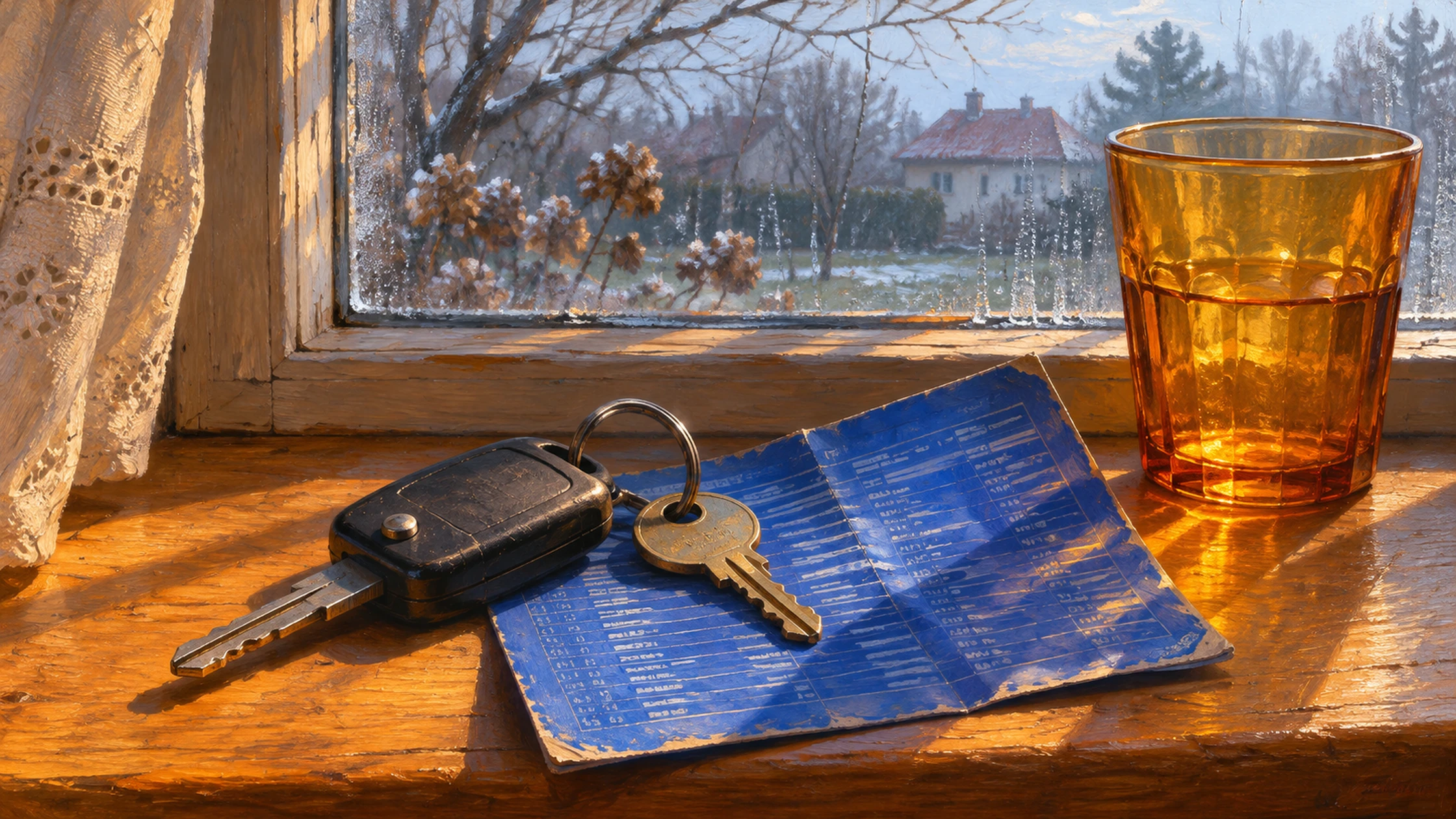
The bus stop was seventeen minutes away on foot. She checked the published times with the operator, then printed the relevant departures on blue paper because that was what they had. The assistant had suggested a connection that existed on weekdays but finished too early to get her home after the group. Nina deleted it from her plan.
“You could come back before the end,” Piotr said.
She looked at him.
“I’m saying what the timetable says.”
“So am I.”
He put down the toy saucepan he was drying. Their daughter had washed it in the bath.
“I don’t mind collecting you.”
“I know.”
“Then I don’t understand.”
She had once liked explaining complicated things. Lately she found herself explaining why an uncomplicated thing mattered, then hearing her explanation grow complicated.
“If you collect me, I watch my phone. I leave when you arrive. If you’re tired, I say I’m ready. None of that is your fault.”
He began to answer, then stopped. “You want to stay until you want to go.”
“Most of the time.”
He nodded slowly. “What would make that work?”
They checked two local taxi firms. One would not take an advance booking from that address for the hour she wanted. The other would, for a quoted fare Nina saved in her own phone. She booked it herself.
The reading group was at Iga’s flat. Someone had brought olives in a jar that would not open. Nina loosened the lid, gave a prolonged defence of the terrible book and discovered that she had forgotten the central betrayal. Everyone enjoyed this more than the defence.
At ten she sent Piotr one message: Leaving soon. All fine.
The driver was twelve minutes late. Nina stood under Iga’s porch, cold and impatient, watching the road. In her own car she would already have been gone. When the headlights appeared, she felt relief, not vindication.
Over three weeks she tested the office journey, another late return and a Saturday trip with her daughter. The trial fares came from existing savings. Paying for two ways to travel annoyed her, but she would not sell first and discover the answer afterwards. That last one required more thought about bags, a pushchair and the weather than the app’s neat line of costs had suggested. She arrived home damp, with a child who had enjoyed the bus much more than she had.
Ewa met them in the hall. “Was it worth it?”
“The bus?”
“The afternoon.”
Nina considered this. They had visited a friend, eaten soup and seen a dog wearing a yellow coat. “Yes.”
“Then give me the wet things.”
Ewa held out her arms for coats, not for an explanation.
The car’s monthly eight hundred was an allocation: two hundred and twenty for insurance, two hundred and eighty towards maintenance, repairs and tyres, two hundred and forty for fuel, sixty for parking. Some bills came once a year. Some repair money might remain unused. She had not pretended that eight hundred left her account on the same day every month.
There was also a likely decline in the car’s value. She wrote that on a separate line. Selling would not cause that estimated loss to appear as spendable money each payday.
Her tested alternative needed a hundred and seventy for the ordinary bus and rail travel she expected, plus a monthly pot of three hundred and thirty for late journeys and backups. Five hundred altogether. That left three hundred from the old allocation, enough to close the planned gap, provided the journeys and costs stayed near their assumptions.
The number was smaller than the assistant’s first suggestion. It was also a number she could recognise.
“But if you need more taxis?” Piotr asked.
“Then it costs more.”
“Which brings us back to the car.”
“Maybe. I don’t want to win this once and be stuck with it.”
They agreed to check the plan after three months. Nina added that a cancelled service or a return to more office days would mean checking it sooner. Nothing in their conversation could make a taxi available on every road at every hour. They kept the family’s existing arrangements for actual emergencies; she was comparing ordinary independence, not buying a guarantee.
The buyer arrived on a Saturday with a torch small enough to hold between his teeth. He looked underneath the car, where Nina had never looked except to retrieve a dropped coin.
He offered less than she had asked. She did not answer immediately.
From upstairs came the sound of Piotr and their daughter arguing about whether a sock was a suitable hat. It was a loving argument. Nina could hear both sides.
She and the buyer eventually agreed a sale that would leave her seventeen thousand złoty after the transaction costs she had already checked. She had the documents reviewed before completing it. The price was for her car in its actual condition, not the more flattering figure an online estimate had produced.
That evening she told Piotr how she wanted to divide the proceeds. Eleven thousand would go to their household savings. Six thousand would remain in an account she could use directly, as a travel reserve.
“Six thousand is a lot of taxis,” he said.
“It isn’t a plan to spend it all on taxis.”
He looked at the figures. “We could put it with the rest and mark it.”
“I want it where I can use it.”
“You can use the rest.”
“Yes.”
He waited. She did too. Their daughter pushed a wooden giraffe between the calculator and his hand.
“I keep thinking we’re having an argument about whether you can ask me,” he said.
“I’m trying not to have to ask.”
He stroked the giraffe’s painted ear with his thumb. “All right.”
It was not an apology and she did not ask for one. They had both brought an idea of sharing to the table. Now there were two ideas, which would take more work.
The reserve was part of the sale proceeds, not extra income. The five-hundred monthly travel allocation would still have to come from their ordinary budget. She wrote both facts down before giving the assistant a new instruction: keep an independently usable travel reserve; compare alternatives against journeys she wanted to make, including late returns.
It revised the recommendation. It also asked her to confirm the taxi assumptions.
She liked that better than its confidence.
On the morning the buyer collected the car, Nina removed the bag of clothes, the shovel and the good shoe. Under the passenger seat she found a wooden bead from a necklace she had broken before her daughter was born. She could not remember why she had been wearing it.
She put the bead in her coat pocket.
The money cleared. She made the two transfers she had planned, checked the balances and completed the handover. The buyer pulled at the passenger door too gently. She showed him the trick.
After he drove away, the rectangle of gravel looked surprisingly small.
That Thursday Nina took the blue timetable from the kitchen drawer. The next book was better, according to Iga, although this time Nina had read it and was prepared to disagree. Her return journey was booked. Piotr was upstairs doing bath time.
“Back late?” he called.
“Probably.”
She waited for the small contraction that usually followed an indefinite answer. It came, then passed. Outside the gate the air smelled of wet leaves. She put her hands in her pockets and found the bead.
At the bus stop she was seven minutes early. There was no warm seat waiting for her, no heater clicking beneath her feet. She missed both. She stood where the shelter kept off most of the rain and opened her book.
Money behind the story
A vehicle’s purchase price or fuel bill does not describe its whole cost. Canada’s Office of Consumer Affairs lists maintenance, repairs, insurance, fuel and parking among the expenses to consider. That general checklist is useful here; Canadian financing rules and prices are not applied to Poland.
Nina’s invented monthly cash allocation is PLN 220 + 280 + 240 + 60 = PLN 800. Insurance and maintenance provisions are money set aside for irregular costs, not bills necessarily paid that month. Her alternative allocates PLN 170 to routine travel and PLN 330 to late journeys and backups: PLN 500, leaving PLN 300 within the planned monthly budget. This is conditional on actual journeys and prices; unused provisions remain money held, not income.
Depreciation is considered separately from cash requirements. The PLN 17,000 net sale proceeds are existing vehicle wealth converted to cash, divided into a PLN 6,000 travel reserve and PLN 11,000 household savings. Neither the reserve nor the sale receipt is added again to the monthly saving.
NIST’s AI Risk Management Framework 1.0, MAP 1.1, calls for understanding users, expectations and deployment context. Nina supplies a missing requirement, then tests alternatives herself. The source does not validate her fictional assistant or guarantee transport availability. All fares, services, documents, family arrangements and outcomes in the story are invented.
Financial sources checked 25 November 2026. Story figures and outcomes are illustrative. General financial education, not individual financial advice.
Stay with the story: three questions
- What does an apparently underused possession allow you to do that its transaction history does not show?
- Which alternative could you test before giving up something difficult or costly to replace?
- When a decision releases money, which part is a one-time receipt and which part changes an ordinary month?



