
What Matters
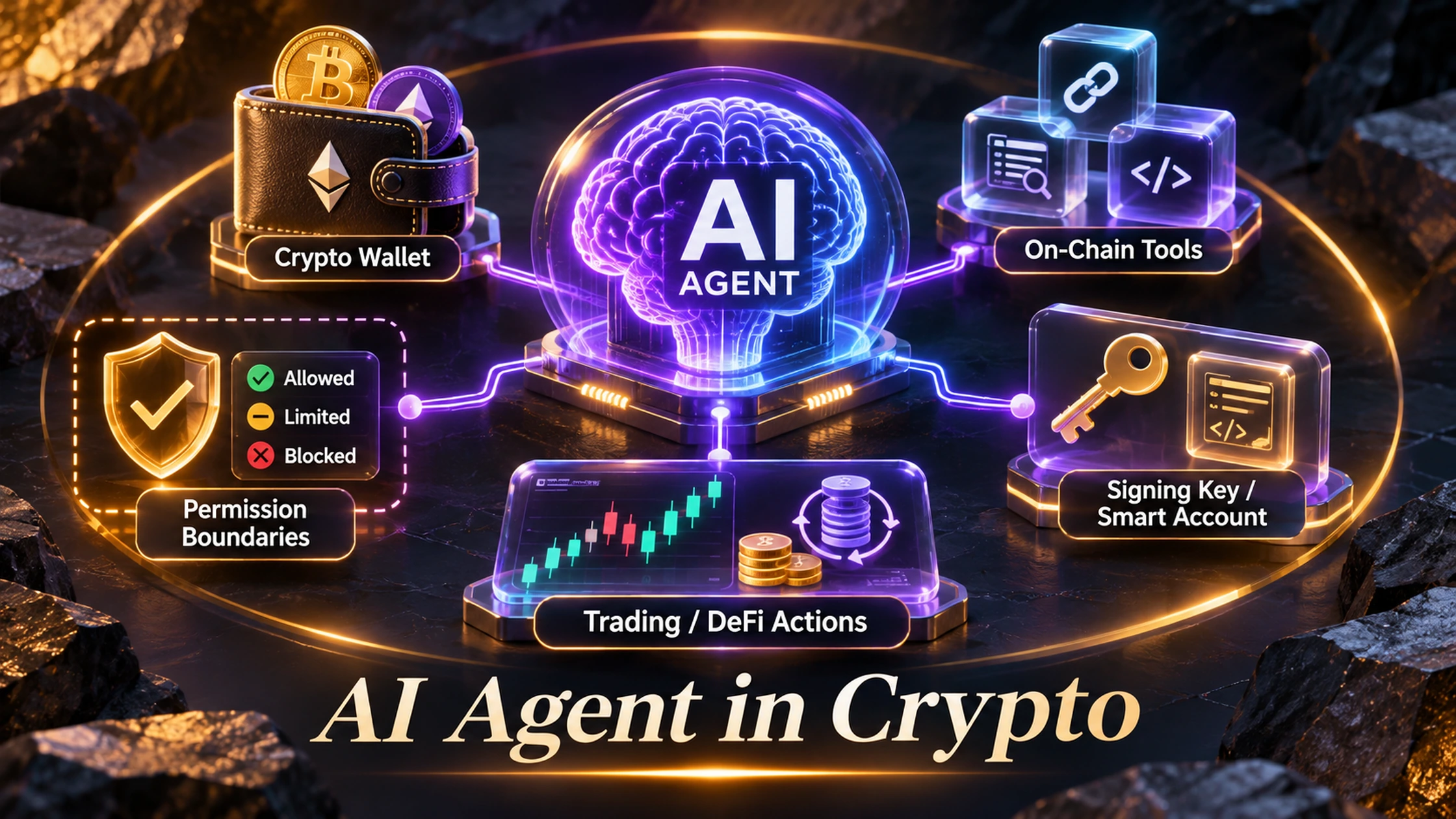
An AI agent in crypto is software that can interpret an objective and use tools to take crypto-related actions. The important question is not whether the product says “AI agent.” It is what the system can actually read, decide, sign, spend or execute.
DN Evidence Block
Reviewed: 16 November 2026. Examples are grounded in current documentation from Almanak, Bankr and modern agent-payment/tooling systems. This page separates product labels from functional capabilities.
15 Terms You Need
| Term | Plain-English meaning |
|---|---|
| AI agent | Software that uses a model plus tools to pursue an objective. |
| Trading bot | Automation that usually follows predefined rules or signals. |
| Copilot | AI that recommends or prepares actions while the user retains approval. |
| Autonomous agent | Agent allowed to act without asking for every step. |
| Wallet | The account or smart account that holds assets and signs actions. |
| Permission | The exact action the agent is allowed to take. |
| Mandate | The business or financial objective plus constraints. |
| Safe / smart account | Programmable account that can enforce rules around actions. |
| DeFi agent | Agent that interacts with on-chain protocols such as exchanges, lending or liquidity systems. |
| Agent wallet | Wallet specifically controlled or used by an agent process. |
| Tool | API, contract call or software function the agent can invoke. |
| Skill | Reusable instructions or integration logic that expands what an agent can do. |
| MCP | A protocol for exposing tools/context to models and agents. |
| x402 | A payment pattern for machine/API requests using HTTP 402-style flows. |
| Agentic finance | Financial workflows where software agents discover, decide, coordinate or transact under defined authority. |
Real Examples
Almanak lets strategy authors define autonomous DeFi strategies while keeping signing and protocol mechanics in trusted runtime components and user-controlled Safe architecture.
Bankr combines an AI agent with a cross-chain wallet, persistent state, trading and DeFi tools, automations and API access.
Cryptohopper AI Bot is closer to an exchange-connected trading agent: the AI can decide within user limits, while funds stay on the exchange.
What Is Mostly Marketing?
A chat interface alone does not make a system agentic. If the product cannot use tools, maintain state or take bounded actions, “agent” may simply mean “assistant.”
DN “Is It Really an Agent?” Check
Frequently Asked Questions
Is ChatGPT an AI crypto agent?
Not by default. It becomes agentic only when connected to tools and authority that let it act.
Is every crypto bot an AI agent?
No. Many bots are deterministic automation.
Do agents need wallets?
No, but financial agents that transact onchain need some controlled signing/payment mechanism.
DN Rule
Ignore the label. Inspect the authority.
Four Architectures Hidden Behind the Same Label
“AI agent in crypto” can describe very different systems. The label is useful only after the execution architecture is identified.
| Architecture | Where assets sit | What the agent can do | Main control question |
|---|---|---|---|
| Research copilot | No asset access | Read data, compare protocols, draft a plan | Are sources current and traceable? |
| Exchange-connected bot/agent | Centralised exchange account | Place orders through a trade-enabled API | Are withdrawals disabled and risk limits enforced? |
| Smart-account DeFi agent | User-controlled smart account or Safe | Call approved contracts/functions within permissions | Exactly which contracts, functions and parameters are allowed? |
| Agent wallet/runtime | Wallet associated with the agent or user | Trade, send, deploy, schedule and call paid services | Who controls signing, limits, memory and revocation? |
The Minimum Agent Loop
- Observe: retrieve market, wallet, protocol or user information.
- Interpret: use a model or rules to decide what the information means.
- Plan: choose an action and parameters.
- Authorize: check permissions, limits and required approvals.
- Execute: invoke an exchange API, wallet signer or smart contract.
- Verify: confirm the final state rather than assuming the request succeeded.
- Record: preserve inputs, decision, transaction and outcome.
A product that stops before execution may still be valuable, but it is more accurately called an assistant or copilot. A product that executes without verifying the final state is an unreliable agent.
Real-World Patterns
Almanak: strategy harness plus scoped Safe permissions
Almanak uses Python strategies that can be checked, backtested and rehearsed on a mainnet fork before running from a user-controlled Safe. Zodiac Roles can restrict contract functions and parameters. This is a domain-specific autonomous DeFi pattern.
Bankr: persistent agent runtime with a wallet
Bankr combines a cross-chain wallet, durable memory, scheduled jobs, code execution, x402 support and crypto-native tools. It represents a broader agent-runtime pattern in which financial actions are part of a persistent workspace.
Cryptohopper and Bitsgap: exchange-connected automation with AI assistance
These products connect to exchange accounts through APIs and use AI to help choose, configure or operate bot strategies. Assets remain at the exchange, so exchange terms, API permissions and sub-account structure are central.
Nansen and CoinGecko-style data connectors: read-only agent tools
An agent can be powerful without signing anything. Read-only API or MCP access can supply onchain data, token information and wallet analytics while leaving execution to a separate human or system.
Permissions Matter More Than Personality
A friendly name, avatar or conversational style says nothing about authority. Ask whether the agent can read balances, create quotes, place orders, sign arbitrary messages, call any contract, transfer assets, create tokens or change its own permissions. The answer determines the risk class.
Custody Questions
- Does the platform hold assets, or do assets remain at an exchange or user-controlled wallet?
- Who holds or can invoke the signing key?
- Can the agent withdraw or transfer, or only trade?
- Can permissions be restricted by contract, function, amount, recipient and time?
- How quickly can the user pause or revoke authority?
- What happens to open orders and scheduled jobs after revocation?
What x402 Changes
x402-style payment flows can let agents pay for API calls or digital services as part of a request. That is useful for machine commerce, but a payment-capable agent still needs a mandate, spend cap, accepted-outcome rule and reconciliation record. A successful HTTP payment does not prove the purchased data or service was useful.
What MCP Changes
MCP can standardise how an agent discovers and calls tools. It does not decide whether the tool is trustworthy or whether the agent should have access. A read-only market-data server and a wallet server that can send funds may use the same protocol while carrying radically different risk.
Eight Questions Before Connecting Capital
- What exact tools can the agent call?
- Where are the assets held?
- Can it transfer or withdraw?
- What limits are enforced outside the prompt?
- Can every action be reconstructed from logs?
- Is there a paper, simulation or fork-rehearsal mode?
- What causes the agent to pause?
- How do you revoke authority and reconcile open actions?
Common Myths
- Myth: every AI token represents an operating agent. Reality: token rights and agent capability are separate.
- Myth: self-custody means low risk. Reality: a user-controlled wallet can still grant dangerous permissions.
- Myth: an agent’s explanation proves why it acted. Reality: reliable audit needs preserved inputs, tool calls and state.
- Myth: onchain execution is automatically transparent. Reality: the transaction may be visible while the offchain decision and data remain opaque.
DN Classification Rule
DN calls a crypto product an agent only when it can pursue a stated objective through tools and maintain enough state to choose or sequence actions. We separately label whether it is a copilot, rule-bound bot, autonomous strategy or general agent runtime. We do not infer profitability from the label.
Commercial disclosure: DN may earn from some wallets, trading tools or agent platforms. Product classification is based on documented capabilities and authority, not affiliate status.



