
Money Stories · Original fiction · 10 minute read
The family applauded Martín while Luz was carrying the chairs.
He was a face on a telephone propped against a mug, smiling too broadly because he could not make out what everyone was saying. Her aunt raised a glass towards him. The repaired roof above the back room was almost finished; nobody needed to move the table when it rained.
“Look what you’ve given us.”
Luz caught a chair leg on the doorway. She freed it with her foot and put the chair down gently.
“Show him the food,” her aunt said.
Luz turned the telephone towards the dishes. Martín made his usual noise of despair at the sight of something he could not eat. Everyone laughed, including her.
“Leave some,” he said.
“In the freezer until you’re ninety?”
“Eighty-nine. Don’t exaggerate.”
For a moment she loved him so suddenly that her annoyance seemed mean. Then her aunt said he must be proud to have managed the whole thing from Chicago, and Luz reached across the table to straighten a spoon that was already straight.
Martín watched the call end in a close view of Luz’s thumb.
He sat on the narrow bed without removing his work boots. The room he rented smelled of laundry that had taken too long to dry. Outside, a truck was reversing; inside his telephone, for twenty-three minutes, there had been lunch.
He had wanted to ask whether the back door still caught on the floor. He had wanted somebody to show him the dog. Instead, when they thanked him, he said the thing he was supposed to say: it was nothing.
It had not been nothing. There had been Saturdays on a building site when he had answered Luz’s messages with one hand because the other was holding his lunch. He had stopped looking at flights until the roof was paid for.
Their shared page showed the transfers, each one marked received. Thirty-six thousand pesos in all, the actual amounts credited to her account in Mexico. He kept the dollar costs and transfer receipts separately. The green ticks on the page were the one part of the work he could see through to completion.
He opened the photograph she had sent the previous evening. New roofing, pale sky, the edge of a ladder. He enlarged it until the picture broke into squares. There was no one in it.
The final bill was for 8,800 pesos.
Luz read it while standing at her market stall with a bag of onions pressed against her hip. She knew the remaining labour payment was supposed to be 7,000. She knew, too, before she opened the messages, where the other 1,800 would be.
The builder had sent a photograph of damaged timber when the old covering came off. Beneath it was his explanation of the extra work. Beneath that was her own reply: Yes. Please do it while everything is open.
She had told Martín about the timber. Had she told him about the labour? She remembered talking into the telephone while rinsing rice. She remembered that he could hardly hear her.
At home she placed the bill on the cobalt-blue kitchen table and sent him a photograph.
His reply arrived before she had washed her hands.
I thought we had paid for everything except seven.
So had I, she nearly wrote, although that was not quite true.
She sent a voice message instead. The builder had separated the additional labour from the original quote. She had agreed to it. The 1,800 was owed.
Martín called.
“How much is left in the account?”
“Seven thousand.”
“Then where did the other money go?”
There it was: other money. A sum that might have wandered off while she wasn’t watching.
“Twenty-two thousand for the materials. Seven for the labour deposit. It’s on the page.”
“I’m looking at the page.”
“So am I.”
They said nothing. A motorbike passed outside her window; on his side there was a metallic clatter.
“I’m not saying you took it,” he said.
“I know.”
She did know. It did not stop her hearing the question again.
The next morning Luz arrived at the stall early enough to sit before lighting the burner. The woman at the neighbouring counter asked whether she was ill.
“Doing sums.”
“Worse, then.”
Luz laughed and spread the receipts beside the cold pots. Nine hundred for an extra delivery. Seventeen hundred for the replacement timber, bought separately from the original materials. A thousand to the cook who had covered two half-days while Luz waited at the house.
Three thousand six hundred pesos, from the money she had put aside for a second burner. It was hers to spend: profit retained after ingredients, wages and their ordinary household bills had been provided for. She had not taken it from tomorrow’s onion money.
The burner would have let her keep a second pot going when the lunch queue grew. She had measured the space twice. Now the space held a stack of trays.
She photographed the receipts, then recorded a message.
“I didn’t tell you about these because each one seemed small enough to handle. That was my decision. But when everyone said you’d done the roof, I wanted to put the telephone in the sink.”
She listened back. It sounded crueler than she meant. She left it unsent while she chopped the onions.
At nine she tried again.
“I need you to see some things that aren’t on our page.”
She sent that, followed by the photographs.
Martín heard the message in a stairwell, where he had gone to escape the noise.
He saw the cook’s payment and thought first, unfairly, that his mother could have stayed with the workers. Then he remembered that his mother could not stand for long, and that whenever he called, Luz was usually answering someone else at the same time.
He began typing: You should have told me.
On the screen it looked like another task he was assigning her.
He deleted it.
That evening they spoke with their telephones lying flat beside them. Luz was removing stones from a handful of beans. Martín was mending the loose edge of a glove with a needle too small for the work.
“Did you think I would say no?” he asked.
“To the timber? No. I thought you’d ask for another photograph. Then I’d take one. Then you’d finish work and see it, and the men would already have gone home.”
He pulled the thread too hard. It snapped.
“I do know something about buildings.”
“Yes. And I know which man is standing in our kitchen waiting for an answer.”
The beans clicked into the bowl.
“I wanted to be useful,” he said.
“You were useful.”
“You sound as though it’s a small thing.”
“It isn’t.” She put down a bean she had been turning between her fingers. “Neither was being here.”
He looked at the broken thread. A small red dent crossed the pad of his thumb.
“I liked it when they thanked me,” he said.
“I wanted them to thank you.”
“But not only me.”
“No.”
They stayed on the call after that, doing their separate jobs. She asked about the glove. He said it was trying to become two gloves. The joke was poor, but she let him have it.
They went through the project together on Sunday.
The transfers had been recorded correctly. So had the spending from the roof account. Nothing had disappeared. The page had simply stopped at its own edges.
Luz added her three payments. Beside them she wrote that they had come from her savings. Martín asked whether the new transfer should replace that money too.
“No. I want it to be my contribution. I don’t want it to become a loan I made you without either of us knowing.”
“What about the burner?”
“I’ll save again.” She paused. “I’m disappointed about it. Both things can be true.”
He moved his chair closer to the telephone, although there was nothing to see more clearly.
Under the expenses she began another list: arranged deliveries, checked materials, met workers, paid cook. She stopped before adding the evenings she had spent sweeping dust out of cupboards. That was where the list began to feel like evidence for a trial neither of them wanted.
“Put who’s doing the next things,” Martín said.
They wrote that he would check the final bill against the agreed work and speak to the builder about the remaining drainage work. She would arrange the last visit and make the payment. Any new charge would go on the page when they agreed to it, before it became another half-remembered message.
He could provide enough for another 4,200 pesos to reach her account: the 1,800 shortfall and 2,400 kept aside for finishing costs. He checked the transfer quotation, including what it would cost him in dollars. They waited until the actual 4,200 pesos had arrived before treating it as available.
Then they made the one complete reckoning Luz had wanted. With her 3,600 included, the two of them had provided 43,800 pesos to the project. The earlier payments and final bill would use 41,400. That left the agreed reserve of 2,400.
She read it aloud. He read it back, getting one digit wrong, which gave her the pleasure of correcting him.
The builder came on Thursday. They checked the finished work, and Luz paid the 8,800 in cash. He counted it at the kitchen table while she held the receipt flat against a breeze.
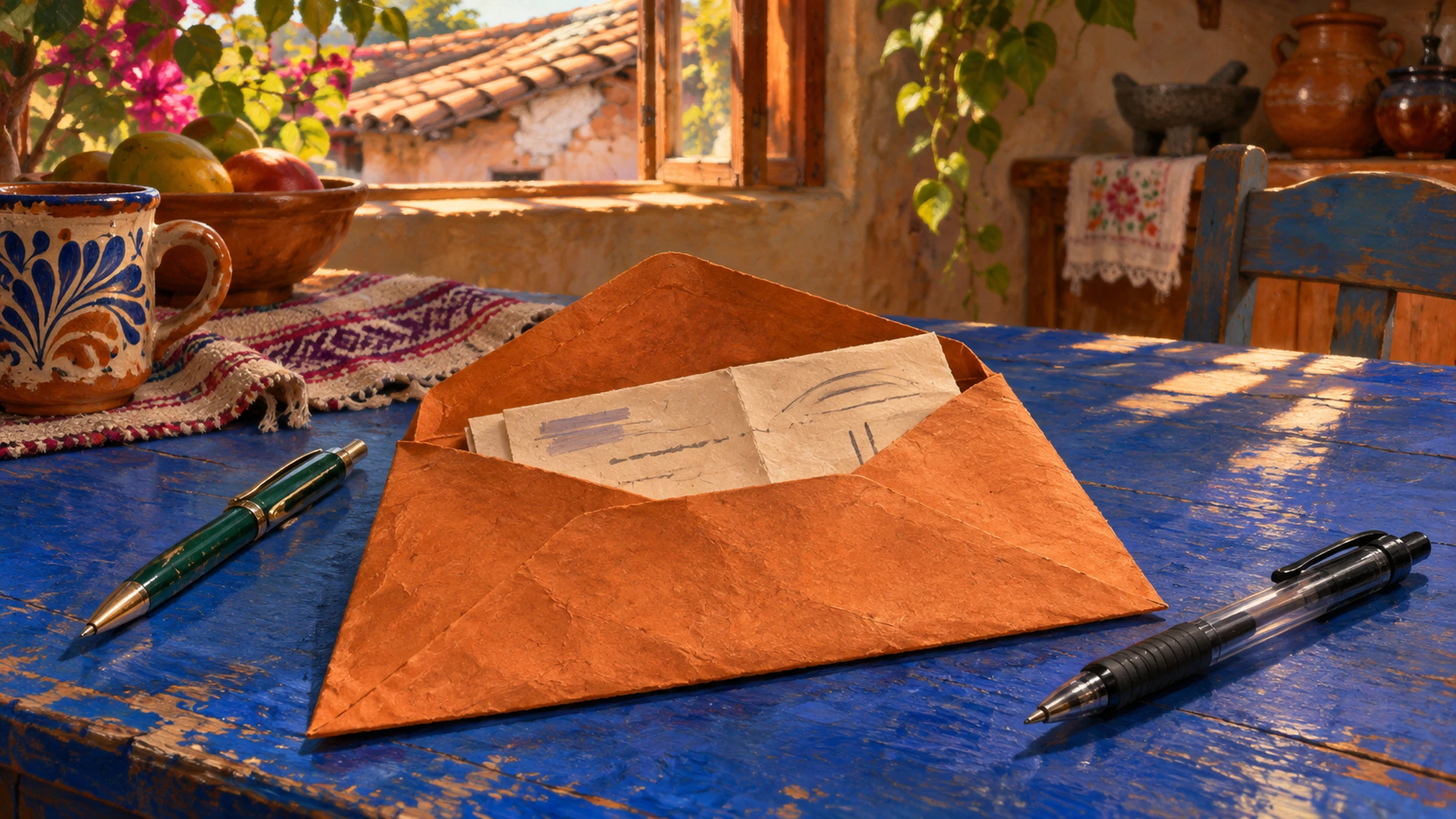
For the terracotta envelope she had found two pens in a tin: one dark green, one black. In green she wrote Luz. In black she wrote Martín. She had considered adding Roof, but there was no danger of her mistaking this envelope for another project.
The builder returned it with the signed receipt inside. She left it unsealed.
Two days later the final drainage work required an additional fitting and labour, quoted together at 600. This time both of them saw the price before she agreed. She paid it from the reserve after the work was done and attached the receipt. Eighteen hundred remained set aside; there was no hurried message asking for another transfer.
At the stall, the trays still occupied the place where the second burner would go. A customer complained that she had sold out of his favourite dish. She told him to come earlier, then regretted the sharpness of her voice.
The roof had not made her less tired. Martín was still in Chicago. When they disagreed the following week about a visit from his cousin, they found they could do it perfectly well beneath a dry ceiling.
On Saturday afternoon she put the two pens beside the envelope and took the photograph she had promised him. From her chair the camera caught mostly the underside of the repaired roof, a strip of wall and the edge of the blue table.
He called almost immediately.
“You’ve sent me the ceiling.”
“I’m underneath it.”
“I can see that.”
“No. You can see what I see.”
He was quiet. Then he asked her to turn the telephone a little. There was the door he had wanted to ask about, standing open.
“Does it still catch?”
“Only when it’s shut.”
She heard him laugh. She moved the telephone onto the mug and pulled the other chair closer to the table.
Money behind the story
The shared page records transfers accurately but leaves out spending from Luz’s savings and the work of managing the repair. Those omissions change how the couple understands the project. Recording responsibilities need not mean assigning every hour a price.
All amounts are fictional Mexican pesos. The original 36,000 received funds 22,000 in materials, a 7,000 labour deposit and 7,000 left for labour. Luz separately contributes 3,600 from uncommitted retained profit. The final labour bill is 8,800, including an agreed 1,800 variation. A further 4,200 actually received covers that gap and creates a 2,400 reserve. The last 600 finishing charge leaves 1,800 reserved. Total funding is 43,800; actual spending is 42,000. Luz’s contribution is included once and is not reimbursed.
The US Consumer Financial Protection Bureau explains transfer disclosures, including exchange rates, fees and the amount expected to reach the recipient. Here, the project uses pesos actually available after receipt; it does not equate them with Martín’s dollar outlay or invent a provider’s price. This source concerns US transfers, not Mexican property rights.
CONDUSEF’s budget guidance supports written income-and-expense records and distinguishes business profit from gross sales. The envelope recognises contributions; it does not change legal ownership of the home.
Financial sources checked 25 November 2026. Story figures and outcomes are illustrative. General financial education, not individual financial advice.
Stay with the story: three questions
- Which contributions to a shared project are missing from the records you currently keep?
- How might you recognise someone’s time and decisions without turning the relationship into an invoice?
- What would you agree in advance about extra costs, available reserves and who can authorise the next step?



