
Money Stories · Original fiction · 10 minute read
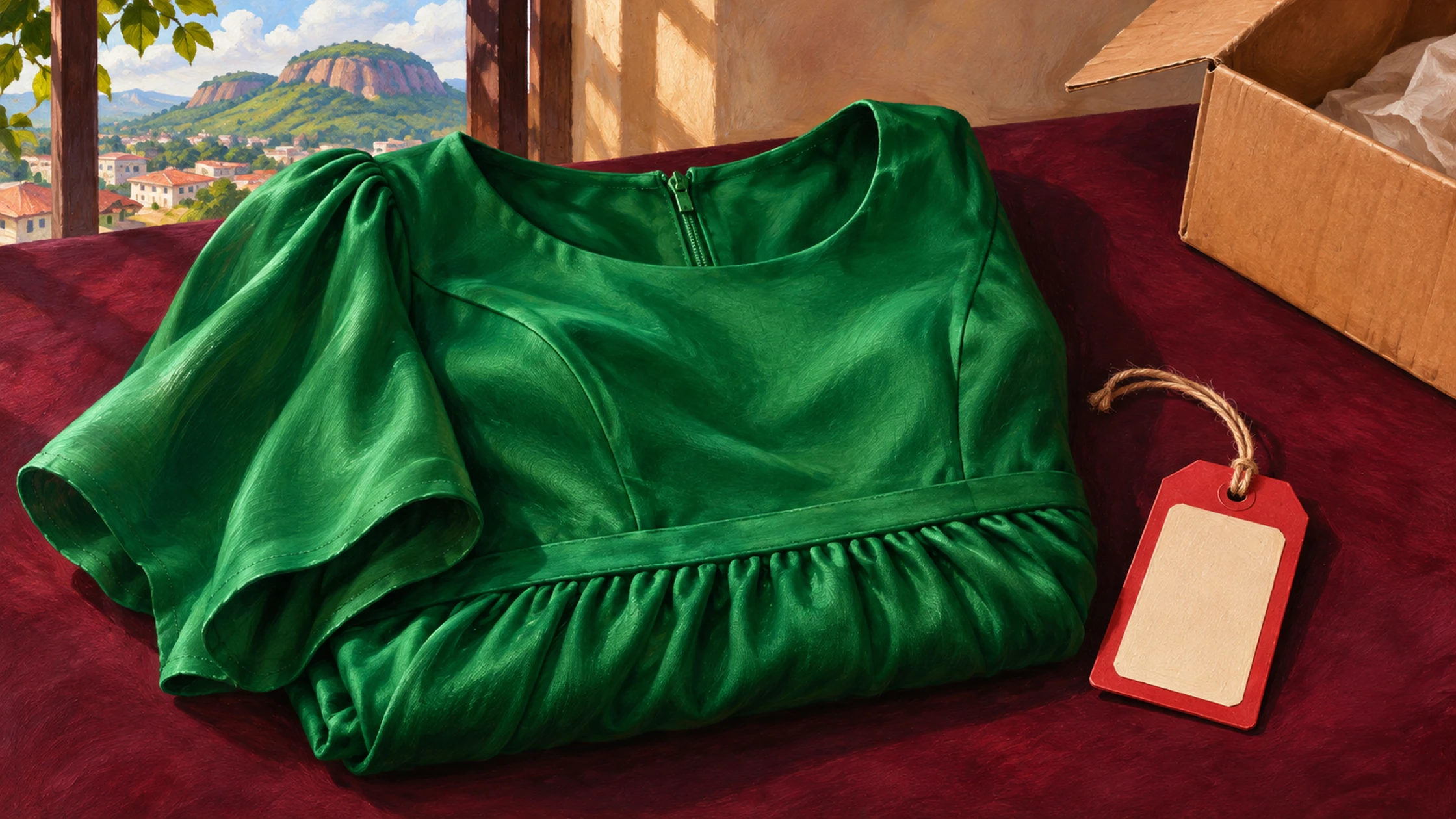
The green dress returned on a Monday in the same bag Ada had sent it out in. The customer had folded the sleeves inside, the way someone folds her own clothes when she does not want to be accused of carelessness.
Across the room, Nkem’s phone was celebrating their record week. Forty orders. Eight hundred thousand naira collected. She had made the numbers spring onto the screen, with tiny gold stars that vanished before you could count them.
Ada was asking her aunt for eight thousand to finish paying the courier.
“Eight?” her aunt said. “After all those stars?”
Ada turned away from Nkem. “I will explain.”
She disliked saying this in her own shop. The shop was really the front room of a rented place in Enugu, but she had paid for the rail, the good iron and a mirror that did not make anybody thinner. She had wanted somewhere a woman could choose a dress without being told that her body was the difficulty.
Now a woman had sent back a dress because the photograph had promised something the fabric could not do.
Ifeoma’s message was polite. The sleeves were tighter than they looked. The belt sat higher. She had bought it for a presentation and had ended up wearing an old blue outfit.
Ada listened again to the voice message from before the order. Ifeoma had asked whether she could reach comfortably across a table in it. She would be demonstrating something, she had said; she didn’t want to spend the morning pulling at her clothes. Ada had answered from the photograph instead of testing the sleeve. Now she laid the phone on the returned dress. The woman had told her exactly what mattered. It had seemed, at the time, like a question about size, one of the ordinary questions that arrived while Ada was trying to finish something more urgent.
“She can exchange,” Nkem said.
“She asked for the refund we offered.”
“I know. I’m saying she could.”
Ada had already returned the twenty thousand. The dress was clean, tags attached, ready to sell again. This seemed good until she put it beside the bank balance. The eleven thousand she had paid to acquire it had returned as a dress. It had not returned as eleven thousand naira.
Her aunt transferred the eight thousand, interest-free, with repayment agreed after the next small selling run. Ada paid the courier’s full seventy-eight-thousand invoice. The shop’s trading account was now exactly empty. Being able to write exactly did not improve it.
Nkem took the phone off its stand.
“Should I delete the post?”
Ada could hear how near the question was to Should I leave.
Nkem was her cousin, but she was also paid to manage the shop’s photographs and posts. She had learned to make a sleeve turn in slow motion, to cut a video on the beat, to turn the battered front room into somewhere people wanted to enter. Ada had asked her for more orders. Nkem had found them.
“Leave it,” Ada said. “We did sell forty.”
“Twelve came back.”
“Yes.”
They stood on either side of the green dress, which had no opinion about their achievement.
Ada drew a line down a fresh page. On the left she put what had happened to this one dress. Nkem found the receipts.
It had been listed at twenty-four thousand, sold in the promotion for twenty thousand. One thousand had gone on packaging and the payment charge that their service did not return when they refunded. Fifteen hundred had taken it to Ifeoma; another fifteen hundred had brought it home. Ada had refunded the full twenty thousand.
Four thousand gone on fees, wrapping and the journey. The dress was still an eleven-thousand-naira dress on a hanger. Advertising and Nkem’s work were not even in that small calculation.
“It has travelled more than me this month,” Nkem said.
Ada laughed before remembering that they were in trouble. Nkem laughed too, cautiously, then properly. The dress swayed between them.
They went through the other returns. Not every one was about fit. One buyer had changed her mind. Another had ordered two colours and kept one. But several sleeves and waistlines had failed in exactly the way Ifeoma described.
Nkem opened the original video. The dress had looked wonderful. Ada remembered being pleased with it, remembered saying that the loose cloth at the back made the photograph untidy.
So they had clipped it. Not secretly; Ada had held the clips. In the finished picture, the back had disappeared.
“We could say the fit varies,” Nkem said.
“It does.”
“Then that’s true.”
Ada laid the real dress flat. The sleeve did not widen because the sentence was true.
By lunchtime they had the whole first run on paper. Forty payments of twenty thousand. Twelve refunds. That left five hundred and sixty thousand in sales after refunds. The twenty-eight dresses customers kept had cost three hundred and eight thousand to buy.
The fees and packaging, outward deliveries and return journeys took another hundred and eighteen thousand. What remained was a hundred and thirty-four thousand before the campaign itself: ninety thousand for advertisements and twenty thousand for Nkem’s agreed work.
Twenty-four thousand left towards rent, electricity, tax and Ada’s own work. Not the eight hundred thousand with the stars.
“But we had money before,” Nkem said.
They had begun the run with six hundred thousand in the trading account. Four hundred and forty thousand had bought all forty dresses. Ada had then used the apparently strong receipts to buy five hundred thousand more in stock for the next run, before all the returns and delivery bills were settled. There it was now in cartons beside the door.
Between those cartons and the twelve returned dresses, the room held six hundred and thirty-two thousand at purchase cost. It also held their empty account and the eight thousand they owed her aunt.
Nkem looked at the cartons.
“You told me to make space.”
“I thought we would need it.”
“We do need it. We just need space to stand.”
Ada sat on the stool she used for steaming hems. She could have blamed the promotion, or the women returning things, or the cousin who had turned volume into a little public festival. She had approved the photographs, the offer and the new stock order. Those decisions had not all become somebody else’s because the account was empty.
“I paid for the cartons too soon,” she said.
Nkem sat on the floor, where there was room.
They did not plan another record. They planned how to sell what was already there.
Nkem wanted to photograph the green dress again. This time she would show the back, the sleeve opening and the tape lying flat against the garment. She wanted a short clip of someone sitting down in it. Clothes did not spend their working lives spinning in doorways.
“That will take longer than the first video,” she said.
“I know.”
“And all the descriptions.”
They agreed thirty thousand for the new photographs, measured descriptions and messages during the smaller run, payable at the end. It was more than the first campaign’s fee. Ada wrote it down while Nkem watched. She did not ask for a family discount to repair a business mistake they had made together.
They kept the selling price at twenty thousand and removed the countdown. Ada counted out a limited set from the stock they already owned. The next advertising budget would be twenty thousand, and they would not spend it before direct orders brought in enough cash. They would wait for the returns period and settle the courier before ordering replacements.
For the first photograph Nkem stood behind the phone. Ada put on the green dress.
“Too small,” she said.
“I can see.”
“Don’t take a photograph of me demonstrating too small.”
Nkem put down the phone. They found a dress in Ada’s size to demonstrate how the cut behaved, and photographed the returned one flat with its own measurements. The work was slower and less flattering to the room. In one corner of the picture, the iron’s cord refused to look expensive.
They tried the chair, then reaching for a cup on the far side of the table. Ada felt ridiculous performing these small actions while Nkem crouched with the phone. In the first take she held the cup as if it might receive a prize. Nkem told her to drink. They watched the clip together and could finally see the sleeve move against an arm instead of appearing to float. Nkem saved it in a new folder. She kept the old video too. It had taken skill to make, even though they now needed to show something it had left out.
Three direct orders arrived before they paid for the reduced advertising. By then the receipts covered that spend. Ada began keeping the delivery money in its own column before allowing herself to look at what was left.
Some prospective customers stopped replying after Nkem sent the measurements. Ada had to sit on her hands to avoid offering another discount. Losing an order still felt like losing an order, even when the order might have returned wearing a courier label.
Ifeoma answered their apology with a photograph of her old blue outfit at the presentation. She looked composed. Ada wrote that it suited her, then deleted a sentence suggesting something else she could buy.
The green dress went to another customer who had compared the sleeve measurement with a dress she owned. Nkem wrapped it in fresh paper. They used a new shipping label, but Ada recognised the small inward fold at the collar from its first return. It was only cloth. She wished it an uneventful journey anyway.
At the end of the smaller run, after its return window, twenty dresses had gone out and two had come back. The customers who kept eighteen had paid three hundred and sixty thousand after refunds. Ada checked the two returned garments herself; both could go back into stock.
The eighteen sold dresses represented a hundred and ninety-eight thousand in purchase cost. Fees and packaging took twenty thousand. Deliveries and the two return journeys cost thirty-three thousand. After the twenty thousand advertising and Nkem’s thirty thousand fee, fifty-nine thousand remained towards the shop’s continuing costs and Ada’s labour.
Fewer orders, more left in this particular run. They did not know whether the next customers would behave the same way. Ada pencilled a date to review it again.
The actual cash left from those second-run receipts was larger: two hundred and fifty-seven thousand, because the dresses had been bought earlier. She put a hundred and ninety-eight thousand aside for replacing the sold stock when they were ready. It was not a bonus. She repaid her aunt’s eight thousand. That left fifty-one thousand towards the rent, bills, tax and her own needs, still to be allocated.
The courier had been paid in full, from the sales receipts. Nkem had her thirty thousand. There was no unsent request for a loan on Ada’s phone.
“We should post this,” Nkem said.
Ada looked at the page. “Which part?”
Nkem considered the columns. Then she took a picture of the now-visible patch of floor between the cartons and the rail.
“No stars?” Ada asked.
“The cord is still in it.”
Ada moved the iron. Nkem told her to leave it. She was trying to show people where they worked.
Money behind the story
Sales are not the same as contribution or available cash. New Zealand’s official business guidance defines contribution as sales less variable costs, leaving an amount towards fixed costs. Australia’s cash-flow guidance separately reconciles opening cash, actual receipts and payments. Those general principles do not establish Nigerian tax or consumer-return rules.
In the invented first run, 800,000 naira collected less 240,000 refunded gives 560,000 net sales. Sold stock costs 308,000; fees, packaging and delivery cost 118,000. The 134,000 contribution falls to 24,000 after the 90,000 campaign and 20,000 cousin’s fee, before continuing overheads, tax and owner labour. The returned dresses remain resalable stock costing 132,000, not refunded purchase money. Premature restocking absorbs another 500,000; an 8,000 loan closes the cash shortfall.
The second run’s 360,000 net sales less 198,000 sold-stock cost, 53,000 transaction and delivery costs, 20,000 advertising and 30,000 paid work leaves 59,000 on the same limited basis. Its 257,000 net cash receipts include recovery of inventory bought earlier. Reserving 198,000 for replacements and repaying 8,000 leaves 51,000 towards other needs; that is not final business profit.
All figures, fee arrangements and returns terms are fictional. No broader tax calculation, representative margin or guaranteed effect of reducing advertisements is claimed. Sources checked 28 November 2026.
Financial sources checked 28 November 2026. Story figures and outcomes are illustrative. General financial education, not individual financial advice.
Stay with the story: three questions
- What did the record-sales post capture, and which costs and obligations remained outside its picture?
- When a returned item becomes stock again, what has come back and what has not?
- How could Ada and Nkem judge their next selling run without turning either person into a single performance number?



