
Money Stories · Original fiction · 10 minute read
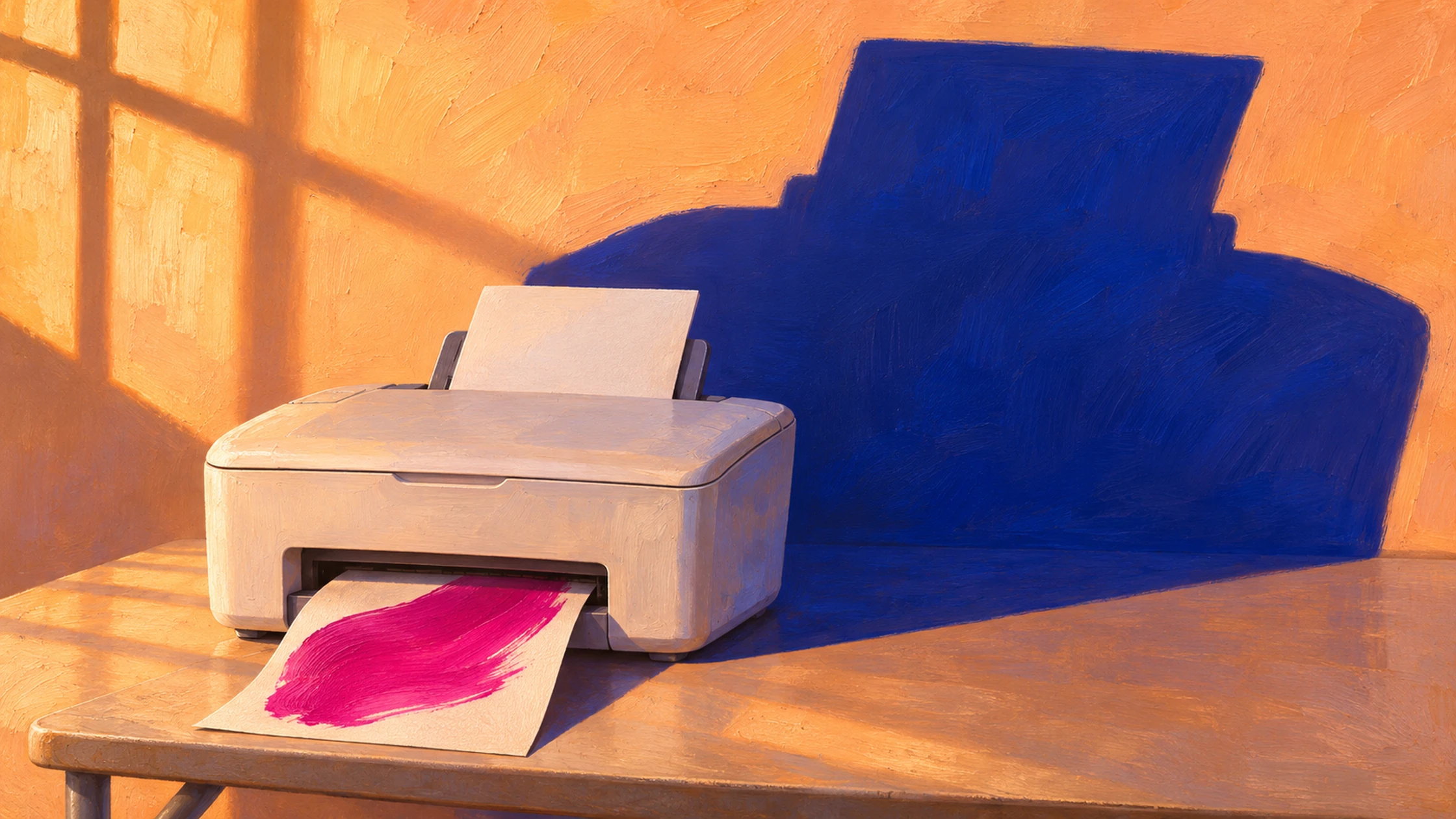
The first thing Amina printed for the centre was a magenta rectangle. It had no practical purpose. She held it against the window anyway.
“We can do colour,” she said.
“We could do colour yesterday,” Kefa said, lifting a red marker.
Kefa volunteered on Thursdays and enjoyed correcting people while carrying their heaviest boxes. He had carried this one up the stairs without being asked. Now he was keeping the packaging because, he said, any machine that arrived so pleased with itself would eventually need returning.
Amina had bought it for nine thousand shillings. She wrote that figure neatly on the first supply order. Seven hundred for a ream of paper and three hundred for delivery made ten thousand. Their printing fund had held eighteen thousand; eight thousand remained.
She was twenty-nine and had been the administrator of the small Mombasa community centre for eleven months. People still introduced her as the new administrator, usually before explaining something she had already repaired. The printer had been her proposal. For once, a person needing one letter copied would not have to leave the building and come back with less time.
At the committee meeting she had compared the purchase prices, pointed out the scanner and shown where it would fit. She had also found replacement cartridges advertised at two thousand a pair. That number was in her working budget. What she had not checked was whether the printer would continue to accept them.
The starter cartridges managed a hundred and eighty printed pages, including her rectangle. Forms, notices, some failed layouts she counted because they had used ink too. The device hummed on the small table beside her desk. People began to come upstairs for things unrelated to printing, as though a machine had made the room more public.
Hamisi brought a notebook held together with brown tape. He wanted a copy of a page on which he had listed everything his brother had borrowed from his tailoring stall.
“For a bill?” Amina asked.
“For when he says he never borrows.”
She made the copy. He studied the little marks the scanner had reproduced, including the shadow of the tape.
“Keep the original,” she said.
“I wasn’t going to give him that much satisfaction.”
The centre was preparing its first workshop on keeping simple business records. Amina had persuaded Hamisi to come. He said he would attend for the purpose of correcting the examples. She put his name first on the attendance sheet.
The second supply order was two thousand for the cheaper cartridge pair, plus two hundred delivery. The seller’s written offer included a refund if the pair failed to work in her exact printer. She checked the model this time. There were enough nearly identical names to make shopping feel like an eyesight test.
The cartridges arrived. She printed twelve sample pages. They looked good. Kefa tapped the side of the printer, as if the bargain needed congratulating.
That evening the printer offered a software update. Amina installed it. The next morning it refused to print with the cartridges it had accepted the day before.
The error message described an authentication problem. It was polite and completely untroubled by the forty people expected at Saturday’s workshop.
Amina took the cartridges out and put them back. Kefa tried the same action with more confidence. It produced the same result.
“Your technique is very like mine,” she said.
“Mine has authority.”
She sent the seller photographs and the model and software details. Then she called the manufacturer’s support number printed in the manual. The person answering explained that this model’s cartridge checks had changed with the update; its approved supplies were accepted, but this pair’s circuitry no longer was. Amina asked for the explanation in writing and saved it with the earlier product information.
The warning was there in the manual too. She had read the section about clearing paper jams. The printer had so far managed to eat only money, so she had studied the wrong obstruction.
For a while she wanted the support person to say the decision was unreasonable. The woman would only repeat what would work. Amina thanked her more sharply than she meant to.
At lunch, Mrs Zainab came to collect the attendance list. She was the committee treasurer and had a way of removing her glasses that made every explanation feel longer.
“Do we own it?” she asked.
“The printer belongs to the centre.”
“Then why is it telling us what to buy?”
Amina looked at the small white machine. A fortnight earlier she had liked how little room it occupied. Its cartridges seemed to take up the rest of the office.
“I compared the wrong part of the cost,” she said.
“Only that part?”
“No. But not enough parts.”
She showed the warning and the two invoices. She did not blame Kefa, the internet or the fact that the committee had wanted a low price. They had wanted the workshop to happen too. She was the person who had brought them the comparison.
The seller agreed to take back the rejected pair under its written promise, arranging collection. It returned the two thousand shillings on Wednesday. The two hundred delivery charge was not refunded. Amina checked the money before treating it as available.
That left seven thousand eight hundred in the printing fund. She put the calculation on one sheet: eighteen thousand, less the first ten thousand, less two thousand two hundred, plus two thousand returned.
Kefa suggested a different printer.
“Maybe,” she said. “But I need to price the printing.”
They had one immediate job: forty packs of ten black-and-white pages, four hundred pages altogether. The copy shop’s written quote was two thousand four hundred shillings, paper included. It was a real option. It was also more than she had expected to spend on that single afternoon.
She asked what the present printer’s approved cartridges would cost and how its stated yields had been measured. The quoted pages were not a promise for her mixture of forms, shaded boxes and colour notices. Her old budget had multiplied a cheap refill price without asking either question.
Mrs Zainab said they could shorten the pack.
They tried. They removed a repeated explanation and the decorative cover. Then they enlarged the spaces where people were supposed to write. The result was still ten pages, but now ten pages they could defend.
Amina walked the sample to the small office two buildings away. Its administrator, Salim, had previously borrowed the centre’s folding chairs. She asked if he knew another local printer. He said he knew the moods of theirs.
Their machine could handle the four hundred pages after the office’s Friday work. They had spare capacity for this job, he said, not for becoming the centre’s permanent copy shop. If she supplied the paper, he could offer the printing in exchange for help improving some public-facing forms his staff struggled to explain.
Amina did that kind of workshop. She knew what it required, which was why she did not immediately say that it would cost nothing.
They agreed on one staff session: two hours, with another hour of her preparation and local travel. She would give that time voluntarily on the following Tuesday evening. Salim wrote down the limit of the printing offer and the session. They both signed it. Neither had found a magical ink supply; they had found two things the other person could use.
Back at the centre, Mrs Zainab approved the third supply order: four thousand eight hundred for the manufacturer’s accepted cartridge pair, seven hundred for another ream and three hundred delivery. Five thousand eight hundred in all. The little printer would handle individual letters and urgent small jobs. The office next door would print this workshop’s packs. Later large jobs would need fresh comparisons and actual agreement.
Amina had wanted to postpone buying the expensive cartridges. But the centre’s next two days included people needing forms, and she would not quietly transfer every inconvenient job to Salim. His four hundred pages were the agreement.
The order arrived on Thursday and the printer worked. She printed a single letter first. It came out so normally that she almost laughed at it.
Across all three orders, after the refund, the fund had spent sixteen thousand shillings. Two thousand remained. They owned the printer, paper and ink that had not all been used yet. Dividing sixteen thousand by the pages already printed would give her a dramatic number, not the cost of producing the next page.
She kept a new record of jobs, paper, ink purchases and time lost. Beside her next equipment comparison she added energy, servicing and eventual replacement, with blanks where she did not yet have an answer. Leaving a blank felt less impressive than her original neat total. It was more likely to receive a question.
On Friday, Salim called to say that one page in the sample was missing a line. Amina checked. It was missing from her file too.
“Good printer,” he said. “It reproduces your mistakes very faithfully.”
She corrected it before he ran the four hundred pages. The centre supplied exactly that many sheets from its second ream. Kefa fetched the completed packs on foot and reported that the office’s machine was considerably larger than theirs, but no better company.
Amina thanked him for the walk. In her record she put his time beside her own promised three hours. There was no wage payment attached to either, and that was precisely why she wanted them visible.
At the workshop, Hamisi objected to the first example. The fictional business owner had sold four identical stools at the same price.
“Not to his brother,” he said.
Several people laughed. The woman sitting beside him crossed out one of the prices. Amina let them argue about it before bringing the room back to the exercise. By the end, the neat example had become a little crowded and considerably more believable.
On Tuesday evening she kept her side of the exchange. Salim’s staff brought forms with boxes too small for the answers and instructions that sent people upstairs before telling them which document to bring. They worked for two hours. Some changes were obvious; one remained disputed when they packed up. Salim did not ask her to stay longer.
The next morning Hamisi returned to the centre. He had brought his workshop pages, now folded into his taped notebook.
“Another copy for your brother?” Amina asked.
“No. He’ll think I’m keeping accounts against him.”
“You are.”
“This one is for me.”
He put a page on her desk. A column had been added in pencil, with a small space for things lent and returned. His brother’s name appeared twice. One item was crossed out.
Amina scanned the sheet and handed it back. Hamisi took the red marker from the pen cup. He held it until the copy slid out, then ruled a line under his new column. He put the marker back with its cap properly clicked on.
Money behind the story
Purchase price is only one part of ownership cost. The European Commission’s life-cycle-costing guidance includes acquisition, operating and end-of-life costs. Its public-procurement rules do not govern this fictional Kenyan centre; the useful principle is to compare what an item will cost to keep useful, over a stated period and workload.
Software can affect which supplies a device accepts. HP’s ink-and-toner guide says some dynamic-security printers block cartridges with non-HP chips or modified circuitry, and updates can block cartridges that previously worked. This is a documented example, not a description of every printer, every third-party cartridge or Amina’s wholly invented product. Nothing here recommends disabling security updates.
The fictional fund pays KSh10,000, then KSh2,200, receives an actual KSh2,000 refund, and pays KSh5,800: KSh16,000 net, leaving KSh2,000 from KSh18,000. That is cash spent on hardware and supplies, including items still unused; it is neither full lifetime cost nor a measured per-page cost. HP’s guide also explains why actual yields depend on page content, settings, printing frequency and setup.
The neighbour’s four hundred pages exchange capacity for specified labour and supplied paper. Volunteer time remains valuable. Prices, compatibility, refund terms and the exchange are illustrative, with no Kenyan tax or legal conclusion. Sources checked 28 November 2026.
Financial sources checked 28 November 2026. Story figures and outcomes are illustrative. General financial education, not individual financial advice.
Stay with the story: three questions
- What would you need to know about supplies, software and workload before calling an equipment purchase a bargain?
- Which costs in a shared arrangement disappear from the invoice while still being carried by someone?
- When might keeping a limited tool for smaller jobs be more useful than either defending the purchase or replacing it immediately?



