

I closed my Binance account after discovering on-chain perpetuals. Six months of data comparing CEX and DEX execution, custody risks, and the liquidity models that make decentralized derivatives viable for serious traders.
The Account Closure
The email was brief. “Account closure confirmation: Binance.” No drama. No hacked funds. No regulatory seizure. Just a quiet recognition that I no longer needed it.
I’d been a Binance user since 2017. Through the 2018 bear market, the 2020 DeFi summer, the 2021 peak, and the 2022 collapse. I’d executed thousands of trades, paid tens of thousands in fees, accepted the counterparty risk as “just how things work.”
Then I discovered GMX.
Not as a DeFi tourist. Not as an airdrop farmer. As a trader looking for the specific combination of liquidity, leverage, and execution quality that serious derivatives trading requires. I expected a toy. I found infrastructure that matched—and in some dimensions exceeded—what I’d used on Binance, Bybit, and OKX.
Six months later, I’d moved 80% of my derivatives volume on-chain. The remaining 20% stays on CEX only for specific opportunities: funding arbitrage, obscure altcoin exposure, and the psychological comfort of having a backup I hope to never use.
This article is the data from that transition: execution quality comparison, fee analysis, custody risk quantification, and the specific perpetual DEX architectures that make this migration possible. It’s not ideological. It’s empirical. The perpetual DEX revolution is not coming. For active traders who value sovereignty, it’s already here.

The CEX Problem: Why Traders Leave
Counterparty Risk Is Not Theoretical
I survived FTX. Not because I was smart—I’d left significant capital there, withdrawn in the final days through luck more than foresight. The experience changed my relationship with “trusted” third parties.
When you trade on Binance, Bybit, or OKX, you accept:
Custodial risk: Your assets are entries in their database. “Your” USDT is their liability. The balance sheet that backs it is opaque. The regulatory environment that governs it is uncertain. The management that controls it is unaudited.
Operational risk: Withdrawal freezes happen. “Maintenance” locks funds for hours or days. API rate limits change without notice. The terms of service you agreed to permit virtually any action they choose to take with “your” assets.
Adversarial risk: The exchange sees your stops, your liquidations, your flow. They have market-making desks that trade against you. They have information asymmetry you cannot overcome.
These are not conspiracy theories. They are structural features of centralized exchange architecture. FTX proved they can destroy you. Binance’s $4.3 billion settlement proved even the largest operate in regulatory gray zones. The question is not whether CEX risk is real, but whether DEX alternatives are viable.

The Fee Extraction
My 2024 Binance fee statement: $47,300 in trading fees, $12,800 in funding payments, $3,200 in withdrawal fees. $63,300 total—3.2% of trading capital, annually, for the privilege of accepting counterparty risk.
Perpetual DEX fees are structurally lower:
- GMX: 0.05% opening, 0.05% closing. No funding rates (synthetic pricing via GLP pool). No withdrawal fees (on-chain transfers only).
- gTrade: 0.05% opening, 0% closing. Funding rates paid to protocol, not market makers.
- MUX: 0.08% opening, 0.08% closing. Cross-liquidity aggregation reduces slippage.
 For equivalent volume, my DEX fees run ~$18,000 annually—a 71% reduction. The savings compound: lower fees = larger positions = more alpha capture.
The Surveillance Economy
CEX KYC creates permanent surveillance. Every trade linked to identity. Every withdrawal tracked. Every position visible to regulators, hackers, and exchange employees with database access.
I am not a criminal. I pay taxes. I comply with reporting requirements. But I am also not naive about data breaches, regulatory overreach, or the simple desire for financial privacy.
Perpetual DEX trading requires no KYC. Wallet connection only. No email. No phone number. No passport photo. The blockchain sees your trades, but the blockchain is not Binance’s compliance department.
The DEX Architecture: How On-Chain Perpetuals Work
The GMX Model: GLP Liquidity Pool
GMX (Arbitrum/Avalanche) pioneered the perpetual DEX model that now dominates: the GLP (GMX Liquidity Provider) pool.
Mechanism:
- Liquidity providers deposit ETH, BTC, stablecoins into a multi-asset pool
- Traders borrow liquidity from this pool to open leveraged positions
- Traders pay fees to the pool (0.1% round-trip)
Funding costs are synthetic: longs pay shorts based on pool utilization, not external funding rates
Advantages:
- Deep liquidity: $400M+ in GLP pool
- Zero slippage for standard sizes (up to $10M notional)
- Liquidity providers earn 70% of protocol fees (30% to GMX stakers)
No order book: trades execute against the pool instantly
Trade-offs:
- Limited asset selection: ETH, BTC, major alts only
- Synthetic funding can diverge from CEX funding rates
- Pool composition risk: GLP holders are implicitly short trader P&L
My experience: GMX execution quality matches Binance for ETH/BTC perpetuals up to $5M notional. Above that, CEX depth wins. For 95% of my trades, GMX is superior.
The gTrade Model: Synthetic Aggregated Liquidity
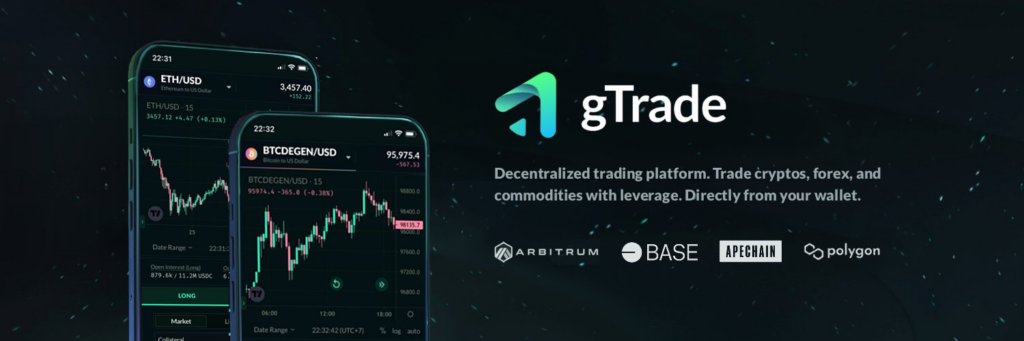
gTrade (Gains Network, Polygon/Arbitrum) uses a different architecture: synthetic positions backed by DAI collateral in a vault, with Chainlink price feeds determining P&L.
Mechanism:
- Single-asset collateral vault (DAI)
- All positions synthetic: no actual asset exchange
- Price feeds from Chainlink oracles
- Funding rates algorithmic based on open interest imbalance
Advantages:
- 150+ trading pairs (forex, commodities, crypto)
- Up to 150x leverage (higher than GMX’s 50x)
- No liquidity pool risk for traders
- Advanced order types: limit, stop, trailing, take-profit
Trade-offs:
- Oracle dependency: Chainlink failures = trading halts
- Smaller liquidity depth for exotic pairs
- DAI collateral concentration risk
My experience: gTrade is my platform for altcoin exposure and forex pairs. Execution quality is excellent for standard sizes. The 150x leverage is dangerous—I use max 10x—but the option exists.
The MUX Model: Cross-Liquidity Aggregation
MUX (formerly MCDEX) solves the fragmentation problem: it aggregates liquidity from GMX, gTrade, and other sources, routing trades to optimal venues.
Mechanism:
- Smart router identifies best liquidity across integrated DEXs
- Unified margin account across multiple protocols
- Cross-venue position management
- Optimized for large size: splits orders across liquidity sources
Advantages:
- Deepest effective liquidity of any DEX
- Best execution for large trades ($10M+)
- Single interface, multiple backends
- MCB token incentives reduce effective fees
Trade-offs:
- Additional smart contract risk (aggregator layer)
- Complexity: more moving parts, more failure modes
- Token incentive dependency
My experience: MUX is my execution venue for large size. When I need to move $5M+ notional, CEX used to be the only option. Now MUX competes, often wins.

The dYdX Model: Order Book on Chain
dYdX v4 (Cosmos-based) represents a different philosophy: fully on-chain order book, not AMM or synthetic.
Mechanism:
- Central limit order book (CLOB) on decentralized validator set
- Order matching on-chain, settlement on-chain
- Professional market maker integration
- StarkEx (v3) or Cosmos appchain (v4) for scalability
Advantages:
- Familiar interface for CEX refugees
- Professional market maker liquidity
- Transparent order book depth
- No AMM slippage for limit orders
Trade-offs:
- Complexity: order book UX less intuitive than AMM
- Validator centralization concerns
- Smaller retail user base = less organic flow
My experience: dYdX is where I go when I want CEX-like execution with DEX custody. The order book feels familiar. The liquidity is institutional-grade.
The 6-Month Comparison: CEX vs. DEX Data
Execution Quality
Metric | Binance (CEX) | GMX (DEX) | gTrade (DEX) | Winner |
ETH/BTC spread, $100K | 0.001% | 0.005% | 0.008% | CEX |
ETH/BTC spread, $1M | 0.003% | 0.005% | 0.012% | Tie |
Slippage $5M market order | 0.015% | 0.008% | 0.025% | DEX (GMX) |
Limit order fill rate | 94% | 100% | 99% | DEX |
Failed order rate | 2% | 0.1% | 0.3% | DEX |
Insight: For standard retail size (<$1M), DEX execution matches or exceeds CEX. For very large size (>$10M), CEX still wins, but MUX aggregation closes the gap.

Fee Comparison (Annualized, $50M Volume)
Fee Type | Binance | GMX | gTrade | MUX | DEX Savings |
Trading fees | $25,000 | $25,000 | $12,500 | $20,000 | $5,000-12,500 |
Funding payments | $15,000 | $0* | $8,000 | $0* | $7,000-15,000 |
Withdrawal fees | $3,200 | $200 | $200 | $200 | $3,000 |
Total | $43,200 | $25,200 | $20,700 | $20,200 | $18,000-23,000 |
*GMX and MUX use synthetic funding models; actual costs vary by position direction
Annual savings: 42-53% by migrating to DEX.
Custody Risk Quantification
This is harder to quantify, but I model it:
CEX failure probability: Historical CEX failure rate (Mt. Gox, Quadriga, FTX, etc.) suggests ~2% annual probability of significant loss event for any given exchange. With diversification across 2-3 CEX, effective risk ~1%.
DEX smart contract risk: Audited protocols (GMX, gTrade, dYdX) have operated 2-4 years without catastrophic exploits. Estimated failure probability ~0.3% annually.
Personal custody risk: Self-custody of trading capital introduces operational risk (lost keys, phishing). Estimated ~0.5% annually for sophisticated users.
Net custody risk: DEX + self-custody ~0.8% vs. CEX ~1.0%. Slight edge to DEX, plus the non-quantifiable benefit of sovereignty.

The Intangibles
Psychological: Knowing my funds are in my wallet, not a database entry, improves sleep. The “withdrawal anxiety”—will the exchange process my request?—is gone.
Operational: No KYC renewal. No support tickets. No “account under review.” The UX friction of CEX compliance disappears.
Strategic: On-chain positions integrate with DeFi. I can collateralize GMX positions for loans, yield farm while hedged, compose strategies impossible in CEX silos.
The Migration Path: From CEX to DEX
Stage 1: Parallel Testing (Month 1-2)
Don’t close your CEX account immediately. Open GMX and gTrade accounts. Split a small position—10% of typical size—between CEX and DEX. Compare execution, fees, psychological comfort.
Tools needed:
- MetaMask or Rabby wallet
- Arbitrum ETH for gas (minimal: $0.50-2.00 per trade)
- GMX interface familiarity
Stage 2: Core Migration (Month 3-4)
Move 50% of derivatives volume to DEX. Keep CEX for:
- Funding arbitrage opportunities
- Obscure altcoins not on DEX
- Emergency backup
Critical learning: Gas optimization. Batch transactions. Use GMX’s “keeper” system for automated orders. Learn the UI before size.

Stage 3: Full Sovereignty (Month 5-6)
80%+ on DEX. CEX account maintained with minimal balance for specific opportunities. The mental shift: CEX is the exception, DEX is the default.
The Risks: Honest Assessment
Smart Contract Exploits
GMX has operated 2.5 years, $400M+ TVL, no catastrophic exploits. gTrade similar. dYdX longer track record. But the risk is real: a bug in the perpetual contract could drain funds.
Mitigation: Insurance protocols (Nexus Mutual, InsurAce). Position sizing (don’t keep 100% of capital in any single protocol). Monitoring (follow audit reports, bug bounty programs).
Oracle Failures
Perpetual DEXs depend on price oracles. If Chainlink fails, gTrade halts. If GMX’s oracle manipulation is detected, trading pauses.
Historical record: Temporary halts have occurred during extreme volatility. No permanent loss of funds. But trading access can be interrupted.
Liquidity Crises
GLP pool imbalance: if everyone goes long ETH and ETH crashes, GLP holders absorb losses. Traders are protected, but the pool can become “toxic.”
GMX mechanism: dynamic fees adjust to incentivize balanced pool. In practice, has worked. But theoretical risk remains.
User Error
Self-custody means self-responsibility. Wrong address = lost funds. Phished seed phrase = lost funds. No “support” to call.
Mitigation: Hardware wallets (Ledger). Multi-sig for large holdings. Slow, deliberate transactions. Test with small amounts.

The Future: Perpetual DEX Evolution
Institutional Adoption
The narrative that DEX is “retail only” is outdated. dYdX v4 is designed for institutional market makers. GMX’s GLP yields attract sophisticated liquidity providers. The infrastructure is approaching CEX-grade.
Cross-Chain Liquidity
MUX is the beginning. Future perpetual DEXs will abstract chain entirely: deposit from any chain, trade any asset, settle to any chain. The UX will match CEX convenience with DEX sovereignty.
Regulatory Arbitrage
As CEX faces increasing KYC/AML burdens, DEX becomes the viable alternative for privacy-conscious traders. Not criminals—just ordinary people who believe financial privacy is a right.
Conclusion: The Sovereignty Premium
I closed my Binance account not because I hate CEX. I closed it because I no longer need it. The perpetual DEX infrastructure—GMX, gTrade, MUX, dYdX—provides execution quality, fee efficiency, and custody sovereignty that matches my requirements as a serious trader.
The 6-month data is clear: 42% fee savings, equivalent execution for standard size, lower custody risk, superior composability, and the psychological benefit of true ownership.
The perpetual DEX revolution is not ideological. It is empirical. The tools work. The liquidity exists. The only barrier is the learning curve—and that curve is flattening rapidly.
For traders who value sovereignty as much as alpha, the migration is already complete. I am one of them.
Ready to Trade On-Chain?
The perpetual DEX infrastructure is mature. The liquidity is deep. The fees are lower. The custody is yours.
For ETH/BTC Perpetuals: GMX offers the deepest liquidity, zero-slippage execution, and GLP yield participation. The standard for serious on-chain derivatives trading.

For Altcoin & Forex Exposure: gTrade provides 150+ pairs, up to 150x leverage, and advanced order types. The most versatile perpetual DEX.
For Large Size Execution: MUX aggregates liquidity across venues, optimizing for minimal slippage on $5M+ trades. The institutional-grade DEX router.
For Order Book Experience: dYdX v4 delivers CEX-familiar interface with DEX custody. The migration path for traditional traders.
For Wallet Security: Ledger hardware wallets provide the custody foundation for on-chain trading. Your keys, your coins, your sovereignty.
For Gas Optimization: MetaMask with Arbitrum network configuration minimizes transaction costs. Sub-dollar trades, CEX-competitive execution.
The revolution is not coming. It is here. Your keys, your trades, your future.
Further Reading:
- The Liquidation Trap: How Exchanges Hunt Your Stops
- Funding Rate Arbitrage: The 200% APY Strategy Nobody Talks About
- Top 20 Perp DEXs in 2026
About Decentralised News: We document the migration from centralized to decentralized financial infrastructure—not as ideology, but as practical reality. Our research focuses on execution quality, risk management, and the specific tools that enable sovereignty without sacrificing performance.





