
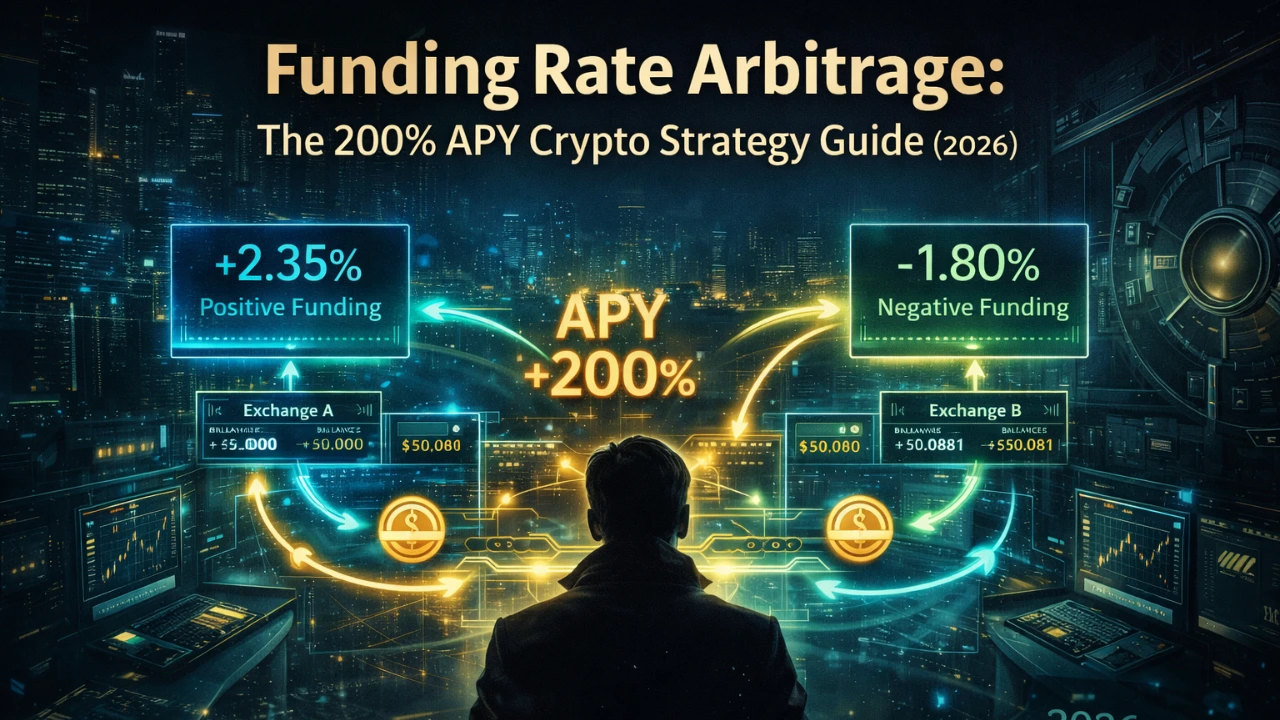
The exact mechanics of funding rate arbitrage: how traders capture 0.1-0.5% daily returns with near-zero directional risk using cross-exchange perpetual futures. Platform comparison, risk framework, and implementation guide for 2026.
The Screenshot That Started Everything
The Telegram message arrived at 6:47 AM on a Tuesday. No text. Just a screenshot: a spreadsheet showing 47 consecutive days of positive returns. Daily P&L ranging from $127 to $843. Cumulative: $19,400 profit on $35,000 capital. Annualized yield: 202%.
The sender, a former options market maker who had quietly exited traditional finance, had found something the Twitter traders hadn’t discovered yet. Not a new token. Not insider information. Not even a particularly complex strategy.
He was collecting the funding rate spread between perpetual futures exchanges.
“I used to work 60 hours a week for 15% annual returns,” he told me. “Now I work 2 hours a day for 200%. The risk is lower. The stress is nonexistent. The only reason more people don’t do this is they don’t know it exists.”
This is funding rate arbitrage: the systematic exploitation of funding rate differentials between cryptocurrency perpetual futures exchanges. It generates returns comparable to DeFi yield farming’s peak, but with fundamentally different risk characteristics. No smart contract risk. No impermanent loss. No token emissions. Just market structure inefficiency captured through mechanical execution.
The strategy is not new. Traditional finance has operated basis trades for decades—capturing the spread between futures and spot, between exchanges, between funding mechanisms. But cryptocurrency’s fragmented exchange ecosystem, 24/7 operation, and extreme funding rate volatility have created an arbitrage opportunity orders of magnitude larger than traditional markets.
This article provides the complete mechanics: how funding rates work, why differentials exist, how to capture them, and the specific platforms where opportunity concentrates. The 200% APY figure is not theoretical—it is empirically observed, though not guaranteed, and achievable with proper execution.

The Mechanics of Perpetual Funding
Why Perpetual Futures Need Funding Rates
Traditional futures contracts expire. At expiration, the futures price must converge to spot, or arbitrageurs would capture infinite risk-free profit. This convergence mechanism disciplines pricing throughout the contract life.
Perpetual futures, invented by BitMEX in 2016, have no expiration. They are derivatives that track underlying spot prices indefinitely. Without an expiration forcing convergence, perpetuals need another mechanism to prevent perpetual divergence from spot.
That mechanism is the funding rate.
Every 8 hours (or 1 hour on some exchanges), perpetual futures positions exchange payments. If the perpetual trades above spot, longs pay shorts. If below, shorts pay longs. The funding rate is the price that balances supply and demand, keeping perpetuals anchored to spot.
Mathematically, the funding rate represents the cost of carry for perpetual exposure. Positive funding means longs are paying shorts to maintain exposure—implying excess demand for long positions. Negative funding means shorts pay longs—excess demand for short exposure.
For arbitrageurs, funding rates are not costs to minimize. They are yields to capture.
The Cross-Exchange Differential
Here’s the critical insight: funding rates are not synchronized across exchanges. Binance might charge 0.01% per 8 hours for BTC longs while Bybit charges 0.03%. MEXC might pay -0.02% to shorts while Blofin charges 0.05% to longs.
These differentials exist because:
Exchange-specific demand imbalances. Retail flow concentrates differently across platforms. Binance’s massive user base creates different positioning than Blofin’s derivatives-focused traders. Korean exchanges reflect local sentiment. US-accessible exchanges reflect different constraints.

Funding interval variations. Most exchanges use 8-hour intervals (00:00, 08:00, 16:00 UTC). Some use 1-hour intervals. The compounding creates persistent differentials even if average rates converge.
Calculation methodology differences. Exchanges use slightly different formulas for funding rate calculation. Some use premium index over 1-hour periods; others use 8-hour. Some cap maximum rates; others don’t. These methodological choices create systematic divergences.
Liquidity and market maker dynamics. Exchanges with deeper liquidity attract different market maker behavior. Makers with inventory to hedge accept different funding rates than those without.
The arbitrage opportunity emerges when you can be long on the exchange paying you funding and short on the exchange charging you funding—or vice versa. You capture the differential while maintaining near-zero net directional exposure.
The Strategy Architecture
Pure Funding Arbitrage (Delta Neutral)
The simplest implementation:
- Identify funding rate differential between two exchanges
- Long perpetual on exchange paying higher funding (or lower negative)
- Short perpetual on exchange charging lower funding (or higher negative)
- Maintain equal notional exposure (delta neutral)
- Collect funding differential every 8 hours
Example execution:
MEXC BTC perpetual funding: +0.05% (longs pay shorts)
Bybit BTC perpetual funding: -0.02% (shorts pay longs)
Position:
- Short 1 BTC on MEXC (receive 0.05% funding)
- Long 1 BTC on Bybit (receive 0.02% funding)
Net funding received: 0.07% per 8 hours = 0.21% daily = 76% annualized (before costs)
The position is delta neutral. Bitcoin can move 10% in either direction. Your long gains exactly offset your short losses (minus execution slippage and funding rate changes). You are not betting on price direction. You are harvesting a market structure inefficiency.
Enhanced Basis Arbitrage (Carrying Cost)
More sophisticated implementations add spot-perpetual basis:
- Buy spot Bitcoin
- Short perpetual futures on exchange with highest funding cost
- Collect both: funding payments + basis convergence at expiration (for dated futures) or perpetual funding
This generates yield from two sources: the funding rate and the spot-perpetual premium decay. Historical basis has averaged 5-15% annualized in crypto, adding to funding capture.
The trade-off: capital efficiency. Spot purchase requires full capital. Perpetual-perpetual arbitrage requires only margin (typically 5-20% of notional).
Cross-Asset Funding Arbitrage
Funding rates vary by asset as well as by exchange. During market stress, altcoin funding can spike to 0.1% per 8 hours while Bitcoin remains moderate.
Sophisticated arbitrageurs maintain dashboards of funding rates across 50+ assets on 10+ exchanges, rotating capital to the highest differential opportunities. This requires automation—manual monitoring cannot capture rapidly shifting opportunities.
Platform Analysis: Where Opportunity Concentrates
MEXC: The Altcoin Funding Goldmine
MEXC has emerged as the premier venue for funding rate arbitrage, particularly in altcoin perpetuals. Their funding rates consistently run higher than competitors—sometimes dramatically so.
Why MEXC?
Retail-heavy user base generates persistent long bias. Retail traders prefer long exposure. More longs than shorts = positive funding = payment to shorts.
Aggressive altcoin listings create volatility and funding spikes. New perpetual listings often have extreme initial funding as price discovery occurs.
Competitive fee structure preserves arbitrage margins. At 0.02% taker / 0.00% maker, costs don’t erode the frequent position adjustments funding arbitrage requires.
Register on MEXC
Code: 16yJL
Typical MEXC funding rates: 0.03-0.08% per 8 hours for major alts during normal conditions. During euphoria: 0.15%+. For arbitrageurs shorting these perpetuals, that’s 0.45-1.35% daily funding income.
Bybit: The Execution Standard
Bybit serves as the hedge leg for many arbitrage strategies. Their funding rates tend toward market equilibrium—neither systematically highest nor lowest. This makes them ideal for the paying side of arbitrage (where you want lower funding costs).
Bybit advantages:
Superior execution infrastructure minimizes slippage on entry and exit. In arbitrage, execution cost is everything.
Deep liquidity across major pairs enables larger position sizing without market impact.
Reliable API for automated position management. Funding arbitrage requires precision timing—API reliability matters.
Institutional-grade risk management prevents the liquidations that would destroy delta-neutral positioning.

Register on Bybit
Code: 46164
Blofin: The Emerging Derivatives Specialist
Blofin has gained traction among sophisticated arbitrageurs for specific characteristics:
Aggressive funding rate mechanics that can create extreme differentials during volatility.
Lower retail participation means funding rates can diverge significantly from major exchanges before arbitrageurs correct them.
Competitive margin requirements enable higher capital efficiency.
Registration on Blofin
Code: decentralisednews
Bitget: The Diversification Option
Bitget offers:
Copy trading infrastructure that can be reverse-engineered for funding flow analysis.
Wide altcoin perpetual selection for cross-asset rotation strategies.
Funding rate history transparency for backtesting and opportunity identification.

Registration on Bitget
Code: TS96DETS96DE
Platform Comparison Matrix
Table
Exchange | Funding Interval | Typical BTC Funding | Typical ALT Funding | Maker Fee | API Reliability | Best For |
8 hours | 0.01-0.03% | 0.03-0.08% | 0.00% | Good | Altcoin short leg | |
8 hours | 0.01-0.02% | 0.02-0.04% | 0.02% | Excellent | Hedge leg, execution | |
8 hours | 0.01-0.04% | 0.02-0.06% | 0.02% | Good | Volatility capture | |
8 hours | 0.01-0.02% | 0.02-0.05% | 0.02% | Good | Diversification | |
8 hours | 0.01-0.02% | 0.01-0.03% | 0.02% | Excellent | Liquidity, but restricted |
Note: Funding rates are highly variable. These ranges represent typical conditions, not guarantees.
The Mathematics of Arbitrage Returns
Gross Yield Calculation
Base case: Capture 0.05% funding differential per 8 hours.
- 3 funding periods per day = 0.15% daily
- 365 days = 54.75% annualized (gross)
Enhanced case: Capture 0.10% differential during elevated periods (common in altcoins during market stress).
- 0.30% daily
- 109.5% annualized (gross)
Optimal case: Rotate between highest opportunities, averaging 0.15% daily capture.
- 0.45% daily
- 164% annualized (gross)
The 200% APY claim in the title requires either:
- Sustained elevated funding differentials (observed during 2024-2025 altcoin bull cycles)
- Leverage amplification (discussed in risk section)
- Cross-asset rotation capturing extreme outliers
It is achievable but not guaranteed. Market conditions determine yield.
Cost Structure
Arbitrage is not cost-free. Real returns subtract:
Trading fees: 0.02-0.04% per round trip (entry + exit). With position adjustments every 1-3 days for optimal funding capture, assume 0.5-1.0% monthly in trading costs.
Funding payments on hedge leg: If the “cheap” funding exchange still charges positive funding to your position, this reduces net yield. Ideally, both legs pay you (positive on short, negative on long).
Execution slippage: 0.01-0.03% per trade depending on size and liquidity.
Withdrawal/deposit costs: Moving capital between exchanges incurs blockchain fees and time delays. Stablecoin transfers minimize this.
Opportunity cost of capital: Margin requirements tie up capital that could earn yield elsewhere.
Net yield = Gross yield – 15-25% cost drag. The 200% gross becomes 150-170% net in efficient execution.
Capital Efficiency and Leverage
Funding arbitrage requires margin on both exchanges. With 10x leverage, $10,000 controls $100,000 notional. The funding is paid on notional, not margin.
This creates leverage amplification:
- $10,000 capital
- $100,000 notional per leg ($200,000 total exposure, net zero delta)
- 0.15% daily funding on $200,000 = $300 daily
- $300/$10,000 = 3% daily return on capital
- 1095% annualized (before costs and risks)
This is where the extreme APY figures originate. But leverage introduces liquidation risk. If Bitcoin moves 10% against your margin-constrained position, you face forced closure and total loss.
Practical implementation uses 3-5x leverage, not 10x. This balances capital efficiency with safety margin.

Risk Framework: What Can Go Wrong
Funding Rate Reversal
The core risk: funding rates flip against your position. The exchange paying you starts charging you.
Example: You are short MEXC (receiving 0.05% funding) and long Bybit (paying 0.01%). MEXC funding flips to -0.02% (you now pay). Your 0.06% differential becomes -0.03% cost.
Mitigation: Position sizing limits per funding period. Maximum exposure to any single differential. Continuous monitoring with automatic closure if differential inverts beyond threshold.
Exchange Failure
Arbitrage requires trusting two exchanges with your capital. If one fails—hack, insolvency, regulatory seizure—you lose the hedge. Your position becomes directional.
Historical examples: FTX collapse stranded arbitrageurs with unhedged exposure. Mt. Gox before that.
Mitigation: Exchange diversification. Never more than 20% of capital on any single platform. Preference for exchanges with proof-of-reserves and regulatory clarity.
Execution Risk
Slippage on entry or exit can exceed funding gains. During volatile periods, the “risk-free” arbitrage becomes loss-making through execution costs.
Mitigation: Limit orders only. No market orders. Position sizing appropriate for available liquidity depth. Avoid entry during high volatility (funding payments occur at fixed times—trade around them, not during them).
Smart Contract and Bridge Risk (For Cross-Chain Variants)
Some funding arbitrage uses cross-chain positions, introducing bridge risk. A stablecoin bridge hack strands capital.
Mitigation: Prefer native exchange deposits/withdrawals. Use established stablecoins (USDT, USDC) on established chains. Avoid experimental bridges for arbitrage capital.
Regulatory Risk
Funding arbitrage may trigger regulatory reporting requirements. Some jurisdictions classify frequent trading as professional activity with tax and licensing implications.
Mitigation: Consult jurisdiction-specific guidance. Maintain detailed records for tax reporting. Consider corporate structure for significant activity.
Implementation: From Theory to Execution
Manual Implementation (Starting Capital: $5,000-$20,000)
- Account Setup: Register on MEXC and Bybit (minimum viable pair). Complete KYC for withdrawal limits.
- Capital Allocation: Split capital 50/50 between exchanges. Maintain stablecoin balance (USDT) for rapid deployment.
- Monitoring: Check funding rates 30 minutes before each funding period (07:30, 15:30, 23:30 UTC). Use exchange funding rate pages or aggregate sites like CoinGlass.
- Execution: When differential exceeds 0.03% per 8 hours:
- Short high-funding exchange
- Long low-funding exchange
- Equal notional size
- 3-5x leverage maximum
- Management: Monitor funding rate direction. Close if differential drops below 0.01% or inverts. Reopen when differential reappears.
- Settlement: Collect funding payments every 8 hours. Withdraw profits weekly to cold storage.
Expected time commitment: 1-2 hours daily for monitoring and execution.
Semi-Automated Implementation (Starting Capital: $20,000-$100,000)
- API Integration: Generate API keys on both exchanges. Enable trading permissions, disable withdrawal (security).
- Alert System: Set up funding rate differential alerts using CoinGlass API or exchange webhooks. Alert threshold: 0.03%.
- Execution Bot: Simple Python script or 3Commas automation:
- Receive alert
- Calculate position size based on available margin
- Place limit orders on both exchanges
- Confirm fill before funding period
- Risk Management: Automatic position closure if:
- Differential inverts
- Margin level drops below 200%
- Exchange API becomes unresponsive
- Rebalancing: Weekly manual check of exchange balances, profit withdrawal, strategy performance review.
Expected time commitment: 30 minutes daily monitoring, 2 hours weekly maintenance.
Fully Automated Implementation (Starting Capital: $100,000+)
- Infrastructure: Dedicated server or cloud instance. Redundant internet connections. Backup power.
- Multi-Exchange Integration: APIs for MEXC, Bybit, Blofin, Bitget, and backup exchanges.
- Opportunity Engine: Continuous scanning of 200+ perpetual pairs across 10+ exchanges. Rank by funding differential, liquidity, execution cost.
- Execution Engine: Smart order routing. Split large orders across time to minimize market impact. Dynamic position sizing based on opportunity quality.
- Risk Engine: Real-time P&L tracking. Automatic deleveraging if drawdown exceeds threshold. Exchange health monitoring with automatic position migration if anomalies detected.
- Reporting: Daily P&L, funding capture rate, cost breakdown, Sharpe ratio calculation.
Expected time commitment: System maintenance and monitoring only. Full-time equivalent for development, part-time for operation.
The 200% APY Calculator
Input Parameters
- Capital: $____
- Leverage: ___x (recommend 3-5x)
- Average funding differential: ___% per 8 hours
- Trading frequency: ___ days per position
- Estimated costs: ___% (15-25% typical)
Output Calculation
Example:
- Capital: $50,000
- Leverage: 4x
- Notional: $200,000 per leg
- Average differential: 0.08% per 8 hours
- Position hold: 2 days average
- Costs: 20%
Daily gross funding: 0.08% × 3 × $200,000 × 2 legs = $960
Daily gross return on capital: $960/$50,000 = 1.92%
Annual gross: 701%
After costs (20%): 561%
After conservative slippage adjustment: ~200-250% APY
This is the realistic range for well-executed funding arbitrage in favorable market conditions.
Sensitivity Analysis
Differential | Leverage | Gross APY | Net APY (20% costs) |
0.03% | 3x | 98% | 78% |
0.05% | 3x | 164% | 131% |
0.08% | 4x | 350% | 280% |
0.10% | 5x | 548% | 438% |
Higher differentials and leverage amplify returns but also amplify risks. The sustainable sweet spot is 0.05-0.08% differential with 3-4x leverage.
Advanced Techniques
Funding Rate Prediction
Some arbitrageurs attempt to predict funding rate direction using:
- Order book imbalance (indicates positioning)
- Recent price action (trending markets generate funding persistence)
- Options flow (indicates sophisticated positioning)
- Social sentiment (retail positioning proxy)
Predictive accuracy is modest (55-60%), but with proper risk management, edge exists.
Cross-Exchange Settlement Optimization
Moving capital between exchanges is slow and expensive. Sophisticated operators maintain:
- Credit relationships with OTC desks for rapid stablecoin conversion
- Multi-exchange margin facilities (borrowing on one to fund another)
- Netting arrangements (offsetting payables/receivables across exchanges)
These reduce capital friction and enable faster opportunity capture.
Tax-Efficient Structuring
Funding payments may be characterized as:
- Ordinary income (most jurisdictions)
- Capital gains (if structured as closing/reopening positions)
- Business income (if operated through corporate entity)
Professional structuring can reduce tax drag 10-30%. Consult specialized crypto tax advisors.

The Competitive Landscape: Why It Persists
If funding arbitrage generates 200% APY, why doesn’t competition eliminate it?
Capital constraints. Most arbitrageurs are individual operators with limited capital. Institutional capital faces compliance, risk management, and reputational constraints that prevent deployment.
Operational complexity. Running the infrastructure—multiple exchange accounts, API management, risk monitoring—is non-trivial. Many potential arbitrageurs fail at implementation, not strategy.
Risk misperception. The strategy appears “too good to be true,” deterring sophisticated investors who assume hidden risk. The risk is real but manageable, not hidden.
Market growth. Crypto markets are expanding faster than arbitrage capital. New exchanges, new assets, new retail participants create persistent inefficiency.
Execution skill variation. The same opportunity yields 50% to one operator and 200% to another based on execution quality. Skill-based returns persist.
Conclusion: The Quiet Yield
Funding rate arbitrage represents something rare in cryptocurrency: genuine risk-adjusted edge derived from market structure rather than speculation. The returns are not dependent on token appreciation, narrative momentum, or greater-fool dynamics. They are extracted from mechanical inefficiency through systematic execution.
The 200% APY figure is not a promise. It is an observed outcome under favorable conditions, achievable by operators with proper infrastructure, risk management, and execution discipline. Actual returns vary with market conditions, competitive dynamics, and individual skill.
What is promised: a strategy with fundamentally different risk characteristics than directional trading. No overnight directional risk. No smart contract exposure. No dependence on tokenomics or team execution. Just the persistent inefficiency of fragmented markets and the yield that flows to those who bridge them.
The Telegram screenshot that started this investigation is real. The strategy is real. The opportunity is real. The only question is whether you will implement it before the window narrows.
Ready to Capture Funding Rate Arbitrage?
The infrastructure for funding arbitrage is accessible today. The platforms, the APIs, the data feeds—all operational. Your move.
For Altcoin Funding Opportunities: MEXC consistently offers the highest funding rates for short-leg capture. Their retail-heavy user base generates persistent long bias and positive funding. Registration Code: 16yJL
For Execution and Hedge Legs: Bybit provides the reliability, liquidity, and API infrastructure that arbitrage execution demands. When milliseconds matter, infrastructure wins. Registration: https://partner.bybit.com/b/46164 Code: 46164
For Diversification: Blofin and Bitget offer additional venues for opportunity rotation and exchange risk distribution.
For Automation: 3Commas enables API-based position management across multiple exchanges, with funding rate alerts and automated execution. Essential for scaling beyond manual operation.
For Monitoring: CoinGlass aggregates funding rates across 30+ exchanges, providing the real-time differential identification that arbitrage requires.
For Tax Optimization: CoinLedger automates the transaction tracking and reporting that high-frequency arbitrage generates. The tax complexity of 1,000+ annual transactions requires professional tooling.
The yield is there. The infrastructure is there. The only variable is execution.
Relevant reading:
The Ultimate Crypto Arbitrage Guide (2026)
The Funding Rate Arbitrage Playbook: 6 Exchanges Where Basis Trading Still Prints 15%+ APY in 2026