
Money Stories · Original fiction · 10 minute read
Rosa was holding a bucket when Leticia asked her to stand beside the banner.
“Without that, perhaps.”
The bucket had an orange rim and a place in the photograph whether anybody wanted it or not. Rain had entered the school corridor again that morning. Rosa moved it behind her leg.
Across the gate, in red letters taller than a child’s hand, the banner announced a two-hundred-per-cent increase in repair funding. Leticia had persuaded her brother to print it without charging. She had also completed the application, answered the requests for missing papers and waited on the telephone with the school office. Now the money had arrived, and she wanted one photograph in which nobody looked defeated.
Rosa smiled. She liked Leticia. They had once spent an entire afternoon getting a small boy’s bicycle out of the gate without cutting either the bicycle or the boy’s lock.
“Is it enough for both sides?” Rosa asked afterwards.
“We’ve barely put it up.”
Leticia meant the banner. Rosa meant the roof.
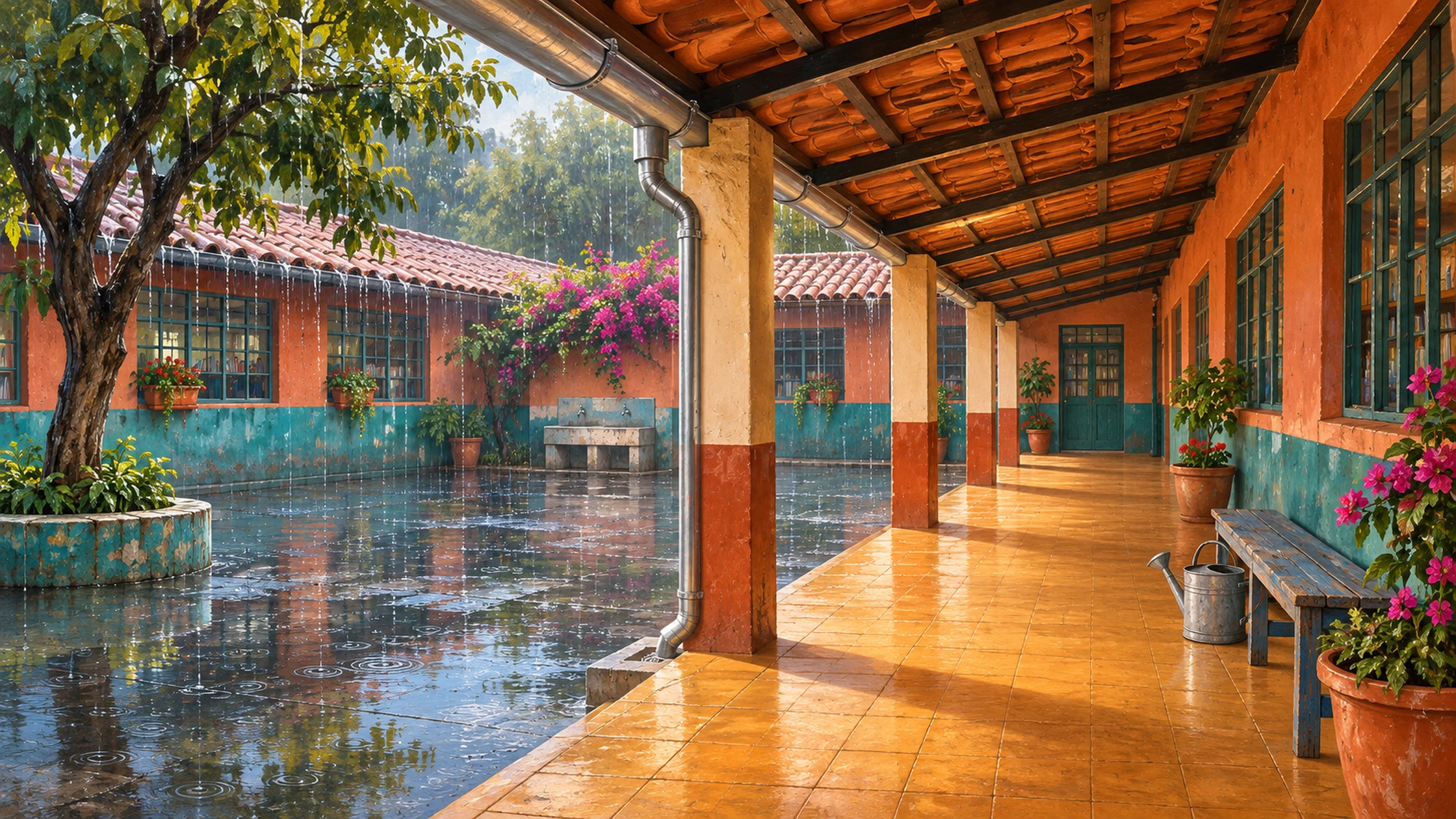
The school stood outside Puebla, with two low classroom wings around a courtyard where the rain made every painted line look freshly drawn. Rosa had been its caretaker for seventeen years. Her official cupboard contained cleaning supplies, spare fittings and several objects that nobody wanted to acknowledge owning. Her unofficial cupboard was her memory.
She knew which window needed lifting before it would close. She knew that the north corridor’s wet patch reached the third blue tile before anyone in the office believed it was raining hard. She knew where to put the buckets so a child carrying a cardboard volcano would not kick one.
What she wanted that month was a dry place for the children’s exhibition. The teacher had been saving drawings of homes: roofs like teeth, dogs larger than doors, grandparents visible through walls. Last year water had curled the paper until the houses seemed to be peeling themselves off the display.
Rosa had promised the teacher nothing. She had already begun saving the straight pieces of string.
The repairs committee met on Thursday after school. Rosa came back after her shift, wearing a clean blouse that her cardigan mostly concealed. Leticia put the bank confirmation beside a plate of biscuits. The school had received thirty thousand pesos for this year’s roof work. There was no money left from the previous year’s allocation.
“Last year, ten thousand,” Leticia said. “This year, thirty.”
A father called Gerardo nodded towards the gate. “I thought two hundred per cent meant we had enough.”
“Enough for what?” another parent asked.
“For the roof.”
There was a silence in which everyone appeared to be looking at the same roof and imagining a different object.
Rosa asked to see the quantities in the quotation.
Leticia turned a page too quickly and tore one of the holes holding it in the folder.
“We are all doing this in our own time.”
Rosa felt the other chairs grow attentive. She had intended to ask about square metres. Now she had apparently asked whether Leticia was honest.
“I know.”
“And it is a considerable improvement.”
“I know that too.”
She wanted to say that buckets did not recognise improvement in the same way. It would have made several people laugh. She kept it to herself.
The headteacher, Vera, brought out the previous year’s spending sheet. The ten thousand had paid for limited patching. That work had been done; its receipts were in the folder. This year’s thirty thousand was a new allocation, not thirty thousand added to money still waiting in the account.
Leticia wrote the difference on the back of the meeting agenda: twenty thousand. Against the old ten thousand, the increase was twice as much again. The new total was three times the old one.
“The banner is right,” she said.
“Yes,” Rosa said. “I want to know what we can put under it.”
That was almost a joke. Leticia did not laugh, but she stopped pressing the torn page flat.
They agreed to meet the contractor at the school before choosing the work. Nobody was to promise an entire roof on the strength of a red number.
Elena arrived on Saturday with the written scope and a tape measure. She ran a small roofing crew and had already inspected the leaks. She would decide what the work required; Rosa was there to show her where the water appeared inside.
On Elena’s plan, each corridor roof was eighty square metres. The quoted treatment was three hundred pesos a square metre, including the specified preparation, materials and labour. That made twenty-four thousand for one wing. Its drainage repairs added four thousand. The complete quoted phase came to twenty-eight thousand, with no further charges hidden outside that amount.
The matching phase on the other wing cost another twenty-eight thousand. Both together would take fifty-six thousand before keeping anything aside for an unexpected expense.
Rosa walked the north corridor while Elena and Vera discussed the work. She tried to see eighty square metres. What she saw was the distance from a child’s classroom to a toilet without crossing the open courtyard.
In the south wing, Gerardo stood outside the library with his daughter. The library had its own troublesome patch.
“People always say the little ones first,” he said. “Then the others become too old to matter.”
His daughter was studying a snail on the wall. Rosa could not tell whether she had heard.
Rosa had been about to make exactly that argument. She looked through the library window instead.
At the second meeting, Vera explained the arrangements for keeping the affected areas out of use until the work was checked. The library’s vulnerable books could be moved; the north corridor served the younger classrooms and the route to the toilets. They could complete that whole phase now, keeping two thousand pesos unspent for contingencies, or divide the money between smaller patches without completing either quoted phase.
Rosa did not say that one choice was obvious.
Gerardo asked whether the south wing would be first in the next request. Leticia wrote it into the minutes as a priority, then added that there was no second allocation approved.
“Write that part just as large,” he said.
They chose the north wing. Gerardo accepted the decision without looking pleased. Rosa had expected agreement to feel warmer.
Before he left, Gerardo asked where the library books would go. Vera showed him a cupboard in the staffroom. He measured a shelf with his hand, then offered to bring cartons from work. He would write the room they belonged to on every one. Rosa recognised the precaution. Things moved for a little while had a way of becoming things nobody could find. She promised to keep the labels facing out.
Afterwards she helped Leticia stack the chairs.
“I didn’t think you had taken anything,” Rosa said.
“That isn’t what I was afraid of.”
Leticia sat on the last chair. Her youngest child’s schoolbag was still under the table.
“I wanted to have done something good before somebody explained why it wasn’t enough.”
Rosa folded her cardigan over her arm. There were things she could say about the forms, the calls, the fact of the money arriving. They would be true and might still sound like consolation.
“Will you help me put the actual amounts on the gate?” she asked.
Leticia looked towards the banner through the open door.
“My brother will charge for a second one.”
They used paper from the office.
The new notice left the percentage where it was. Under it, they put last year’s ten thousand and this year’s thirty thousand, then the chosen work: north corridor, eighty square metres, twenty-eight thousand pesos. Two thousand would remain available for contingencies. The south wing was still awaiting funding. Leticia found a transparent cover so the first shower would not destroy their explanation.
Rosa took the photographs from the ground. An empty corridor. The gutter before the work. The same corner afterwards. No children arranged in grateful rows.
The payment stages were written into the agreed job. The school paid eight thousand four hundred before the crew started. After the specified preparation and drainage stage had been completed and checked, it paid eleven thousand two hundred. The remaining eight thousand four hundred waited for completion and the final inspection.
Rosa put the payment dates beside the photographs as they happened. At first she wrote PAID beside the whole twenty-eight thousand because that was the total she knew. Leticia caught it before they posted the sheet.
“Only the first part has gone.”
Rosa crossed it out. It was a small relief to be corrected about something that could be corrected.
The crew worked while that part of the school was empty and kept the work area separated. Rosa’s job was still her job, with an inconvenient route around the barriers. She was not promoted into an expert by knowing where the leaks had been.
When Elena and Vera had completed the final check and the last payment had gone, Leticia brought the account record. The three payments added to twenty-eight thousand. The two thousand reserve had not been spent. There had been no extra gift, no unexpected saving big enough for the other wing.
They posted that too.
For several days there was no rain. Rosa found this unreasonable. She had wanted dry weather all month and now needed an audience for the roof.
The exhibition went up on a Tuesday. The children argued over which houses should be neighbours. A girl wanted her drawing near her friend’s, although the two houses had different numbers of floors and seemed unlikely to share a street. The teacher told her that wasn’t a problem.
Rosa hung the string lower.
On Wednesday the rain returned during the last lesson. It struck the courtyard hard enough to erase the far painted line. Rosa went to the third blue tile and stood there, listening. The old stain was still on the ceiling. No water came through it.
Leticia found her there with the orange-rimmed bucket.
“Just in case,” Rosa said.
At the south wing, a teacher was moving the remaining library materials away from the closed-off wet corner. Gerardo would have a reason to ask again. Rosa could see that corridor across the rain, and wished the school had received sixty thousand instead.
She took one more photograph of the dry floor. It was not much to look at. That was the point of having it, although she could not imagine writing that on the gate.
The classroom doors opened. Children crowded along the north corridor, stopping at the drawings, leaning close enough to mist the transparent covers. Somebody announced that his grandfather’s house had a roof like that, only green.
A boy opened his wet umbrella under the new dry roof and shook it.
“Outside,” Rosa said.
He looked offended by this distinction. Leticia took the bucket from her while Rosa showed him where to stand.
Money behind the story
A percentage increase needs its starting amount. Here, (30,000 − 10,000) ÷ 10,000 × 100 = 200%. The new allocation is three times the old one, not proof that it covers the whole repair. The UK Office for National Statistics explains base effects: an unusually low comparison period can produce a striking growth rate even when the current level remains limited.
In this invented project, 80 square metres × MXN300 = MXN24,000; the quoted drainage work adds MXN4,000. One complete phase costs MXN28,000, leaving MXN2,000 from the received MXN30,000. The three actual payments, MXN8,400 + MXN11,200 + MXN8,400, reconcile to that price. Last year’s spent allocation is not added again. Neither the reserve nor an unapproved future award completes the second wing.
The World Bank’s BOOST programme distinguishes approved budgets, revised budgets and actual expenditure, using detailed records to support public scrutiny. That supports the story’s separation of amounts promised, money received, payments made and work observed; photographs complement rather than replace financial records.
The school, allocation, approvals, quantities, contractor and prices are fictional. These sources explain comparison and transparency principles, not Mexican grant rules, procurement requirements, construction standards or representative local prices. Sources checked 28 November 2026.
Financial sources checked 28 November 2026. Story figures and outcomes are illustrative. General financial education, not individual financial advice.
Stay with the story: three questions
- What starting amount would you want to see beside a large percentage increase?
- How could you ask for clearer records while recognising the unpaid work somebody has already done?
- When funding cannot cover every need, what would make the chosen sequence understandable to the people still waiting?



