
Money Stories · Original fiction · 10 minute read
Kwesi showed his mother the photograph before he showed her the payment terms.
“Forty?” she said.
“Forty.”
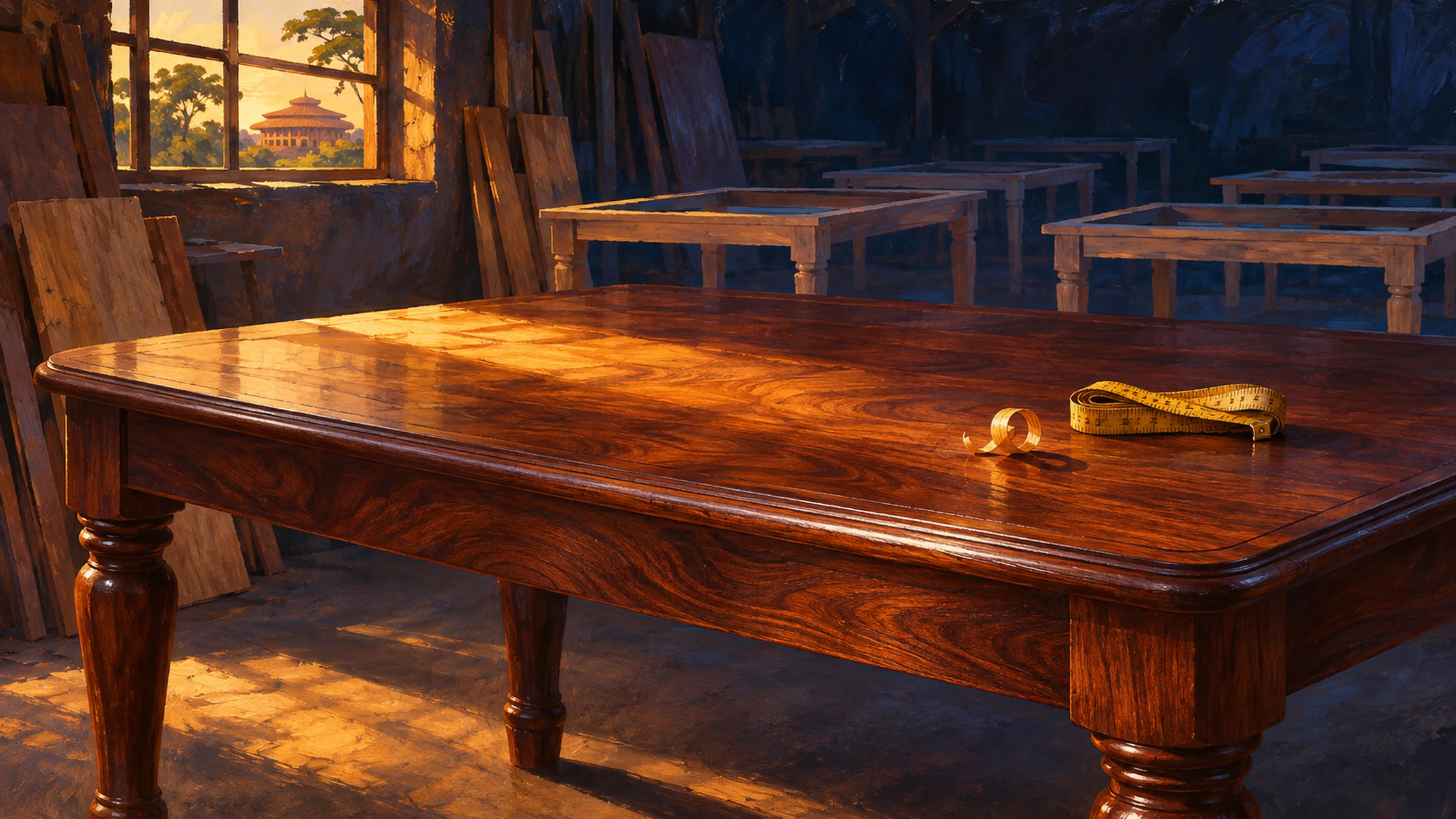
She enlarged the photograph on his phone. It showed the sample table in the doorway of his Kumasi workshop, its top catching the afternoon light. Behind it, somebody’s washing hung over the wall.
“They’ll want another photograph,” she said.
He had expected congratulations. His mother believed in offering improvements while there was still time to make them.
Then she touched the screen. “Your father would have liked the corners.”
Kwesi went back to the workshop carrying that sentence more carefully than the phone.
The proposed order was for the Lantern Bend Hotel. Forty tables at a thousand cedis each: forty thousand. The buyer had approved his sample, subject to a final written specification. Delivery in six weeks. Payment thirty days after the entire order passed inspection. No advance.
His assistant, Abena, read it over his shoulder.
“We’ll need two more people.”
“I know.”
“The people will need paying.”
“I also know that.”
She withdrew her head. He regretted his tone. Abena’s reminders were usually things he knew and had temporarily placed where knowing would not interfere with his mood.
They worked through the costing. Five hundred per table for timber, fittings and finishing materials. Two hundred for labour, including an allowance for Kwesi’s own work. Another hundred for the job’s workshop costs and delivery. Eight hundred altogether.
Forty tables meant twenty thousand for materials, eight thousand for labour, four thousand for the other costs. Thirty-two thousand out before the hotel paid forty thousand in. An eight-thousand margin before tax, provided the costs held.
The workshop had six thousand available after its existing commitments. Other customers’ deposits were already assigned to their orders. He did not count those twice.
The unfunded difference was twenty-six thousand.
He wrote that below the forty thousand. It looked unnecessarily large.
At home, his mother had told his aunt. His aunt had told a cousin. By evening Kwesi was receiving congratulations for a contract he had not accepted.
He wanted the order. He wanted his mother to sit in that hotel and put her cup down on something he had made. He wanted the next buyer to know the name of his workshop without needing directions from the tyre seller.
He did not want to telephone the timber yard and pretend a promise was a transfer.
A finance broker came the following morning. He had a leather folder with a place for a pen, but carried the pen in his shirt pocket.
The offer was twenty-six thousand now, thirty thousand to repay in eight weeks. The four-thousand finance charge was fixed. There were no other charges in the written quote.
“Your margin can carry it,” the broker said.
Half his margin could carry it. The eight thousand would become four thousand before tax and any unexpected cost. Kwesi looked at the repayment date.
“The hotel pays thirty days after inspection.”
“Hotels sometimes pay early.”
“Do you put that in your agreement?”
The broker smiled without showing offence. “I can only write my side.”
Even if Kwesi delivered in six weeks and inspection happened promptly, the hotel’s ordinary payment date would fall around ten weeks from now. The borrowing would come due at eight.
He asked whether repayment could wait for the hotel. It could not under this offer. He thanked the broker and kept the quote without signing it.
His cousin Yaw offered the same twenty-six thousand without a charge.
“I’ve got it sitting there,” Yaw said. “Use it.”
“What were you going to use it for?”
“The roof. But the contractor isn’t ready.”
“When will he be?”
“You know contractors.”
Kwesi knew enough to keep asking.
Yaw would need the money back with two days’ notice whenever the work could begin. He said it apologetically, as though speed were a small condition attached to a large kindness.
Kwesi pictured the money as timber, cut to the hotel’s dimensions. Then he pictured Yaw at his gate, needing a roof.
“I can’t promise that,” he said.
“I’m trying to help you.”
“I know.”
Yaw looked away. Kwesi wished the conversation came with something he could tighten or replace. He bought them both a drink and found that buying a drink did not finish it.
At the hotel, the lobby chairs were wrapped in plastic. The buyer, Ms Aidoo, apologised and offered him one anyway.
He sat carefully. The plastic made a complaint beneath him.
“I need to change the payment arrangement,” he said.
She opened his proposal. He had sent it before the meeting so he would not have to watch her discover the request.
A materials deposit. Deliveries in small lots. A defined inspection period. Payment for each accepted lot before work began on the next.
“We chose you partly because you said you could make forty.”
“I can make forty. I can’t fund forty on these terms.”
She turned a page. “We’re funding an opening.”
From the room beyond came the sound of somebody testing a microphone. One, two. One, two. A man asked whether anybody could hear him. Several people could, but apparently not the person he needed.
Kwesi had brought his cost sheet. He did not hand it over. Ms Aidoo knew what a deposit was; the difficulty was whether she would agree to one.
“What can you deliver in lots of four?” she asked.
“Twelve within the revised dates we’ve discussed. More would need a different schedule.”
“I can place twelve for the smaller dining room. The other supplier can take twenty-eight.”
He had imagined negotiation as a way of keeping the whole thing. He looked at the wrapped chairs while his order became less than a third of itself.
“Same price per table?”
“Same specification. Same price.”
He asked for time to confirm the smaller materials purchases and delivery costs. She gave him until the next afternoon.
Back at the workshop he checked the suppliers’ prices again. The eight-hundred cost per table still held for twelve. Abena read the proposed schedule.
“So we don’t need the extra people.”
“No.”
She had a friend she had hoped to recommend. Kwesi had a list of things he had hoped to do. Neither list was unreasonable. He put hers beside his in the drawer.
They worked out the first lot. Four tables would sell for four thousand and cost three thousand two hundred. A two-thousand deposit would buy the materials. Twelve hundred of the workshop’s own cash would cover the eight hundred in labour and four hundred in other costs. The remaining four thousand eight hundred of its free cash could stay in reserve.
Ms Aidoo agreed to the deposit for each lot. On acceptance, the hotel would pay that lot’s two-thousand balance and the next lot’s two-thousand deposit. Kwesi would begin the next four only when both cleared. After the third lot, only its final balance would remain.
They attached the approved drawing and finish sample. Measurements, finish and stability on a level surface were set out. Inspection would happen within two working days of delivery, with any faults listed in writing; accepted work would be paid within three more. Corrections would be checked again. A delayed payment would move the next production slot, rather than requiring Kwesi to keep building on hope.
He read the dates twice. The agreement still required him to produce good tables. The deposit did not make that someone else’s problem.
He signed for twelve.
His mother listened without interrupting.
“Twelve is still a lot of tables,” she said when he finished.
“I know.”
“I’m not saying it to make you feel better.”
He had been about to accuse her of exactly that.
“Can I still tell your aunt?”
“Please tell her the number.”
His mother gave him back the phone. “She’ll ask why.”
“Tell her I couldn’t afford the other twenty-eight.”
Saying it left him exposed in a way the cost sheet had not. His mother nodded. She did not turn it into a nicer sentence.
The first deposit arrived on Tuesday. Kwesi marked it against the first four tables. Two thousand received; four tables still owed. He ordered the materials.
Abena put music on while they worked. She knew three songs very well and the middle of every other song badly. Kwesi had stopped correcting her because she considered accuracy less important than participation.
They finished the first lot on time. Ms Aidoo checked it against the agreed sample and signed the inspection record the following day. The balance and next deposit cleared within the agreed payment window: four thousand in total. The next lot needed three thousand two hundred, leaving eight hundred in the job account after its costs.
For a moment, with that second payment on the screen, the whole arrangement looked easy. Kwesi left the figures open until he had separated the next materials money from what belonged to the completed work.
The second delivery also passed. Another balance and deposit came in. They made the final four.
On the last delivery morning, a larger truck waited at the hotel’s service entrance. It carried the other supplier’s tables. Twenty-eight, the driver said, moving a blanket to check a strap.
Kwesi walked past them. The work was good. He could not rescue himself by finding something wrong with it.
The driver asked whether he had a trolley. Kwesi lent him theirs. Together they moved the first table clear of the lift, talking about the narrow doorway and the chance of rain.
Then Kwesi went into the smaller dining room, where his own twelve stood. In his mind they spread for a second into all the rooms he had expected to furnish. He let that happen. Ms Aidoo called him over to inspect the last delivery.
Its balance cleared three working days after acceptance.
The twelve tables had brought in twelve thousand. Materials cost six thousand; labour cost two thousand four hundred, including six hundred already paid to Kwesi for his own work. The allocated workshop and delivery costs were twelve hundred. The remaining margin was two thousand four hundred before tax. No loan repayment waited behind it.
The job account held three thousand six hundred: the twelve hundred the workshop had put in, returned, plus that margin. The untouched four thousand eight hundred was still there too.
Kwesi sent his mother a photograph of the smaller dining room. She replied that the washing was not visible in this one.
He laughed, then looked again at the twelve tables.
Back at the workshop, the original sample stood where it had always stood, just inside the doorway. Evening light crossed its top. Abena was sweeping beneath it, singing a part of a song neither of them knew. He lifted one end so she could reach the dust.
Money behind the story
The proposed forty-table order would earn GHS40,000 against GHS32,000 in costs: GHS20,000 materials, GHS8,000 labour and GHS4,000 workshop/delivery costs. With GHS6,000 available, the pre-payment funding gap is GHS26,000. The rejected loan would add GHS4,000 to costs and fall due before the expected customer receipt. A profitable quote can therefore be unfundable on its proposed dates.
The twelve-table contract earns GHS12,000 against GHS9,600 in costs, leaving GHS2,400 before tax. Labour includes GHS600 for Kwesi’s own work; that payment is not deducted again. Each four-table lot costs GHS3,200. Its GHS2,000 deposit plus GHS1,200 of workshop cash funds the first lot. Later balances and next-lot deposits fund the remaining work. The final job balance is GHS3,600: returned starting cash plus margin. Another GHS4,800 of workshop cash remains outside this job account.
The British Business Bank explains why profit and cash availability differ. The IFRS Foundation’s revenue overview links revenue recognition to satisfying promised performance. In this fictional agreement, an advance funds work still owed; it is not additional revenue on top of the table price.
All figures, finance offers and contract terms are invented. The cost model includes the stated labour and allocated overheads; tax is not modelled. These sources provide general financial/accounting context, not Ghanaian credit, tax or contract-law advice.
Financial sources checked 24 November 2026. Story figures and outcomes are illustrative. General financial education, not individual financial advice.
Stay with the story: three questions
- Why can the forty-table quotation show a positive margin while Kwesi still cannot fund the order?
- Which risk remains when a relative offers money without a finance charge but may need it returned quickly?
- What does the smaller contract make possible, and what does it cost Kwesi beyond the lost sales?



