
Money Stories · Original fiction · 10 minute read
The piece of tile sat beside the attendance register. Mandla had brought the largest fragment, although he could no longer explain why. It was turquoise on one side and the colour of stale bread on the other. Whenever someone put a cup down, it rocked.
“Take that away,” Mrs Pillay said. “We all saw the hole.”
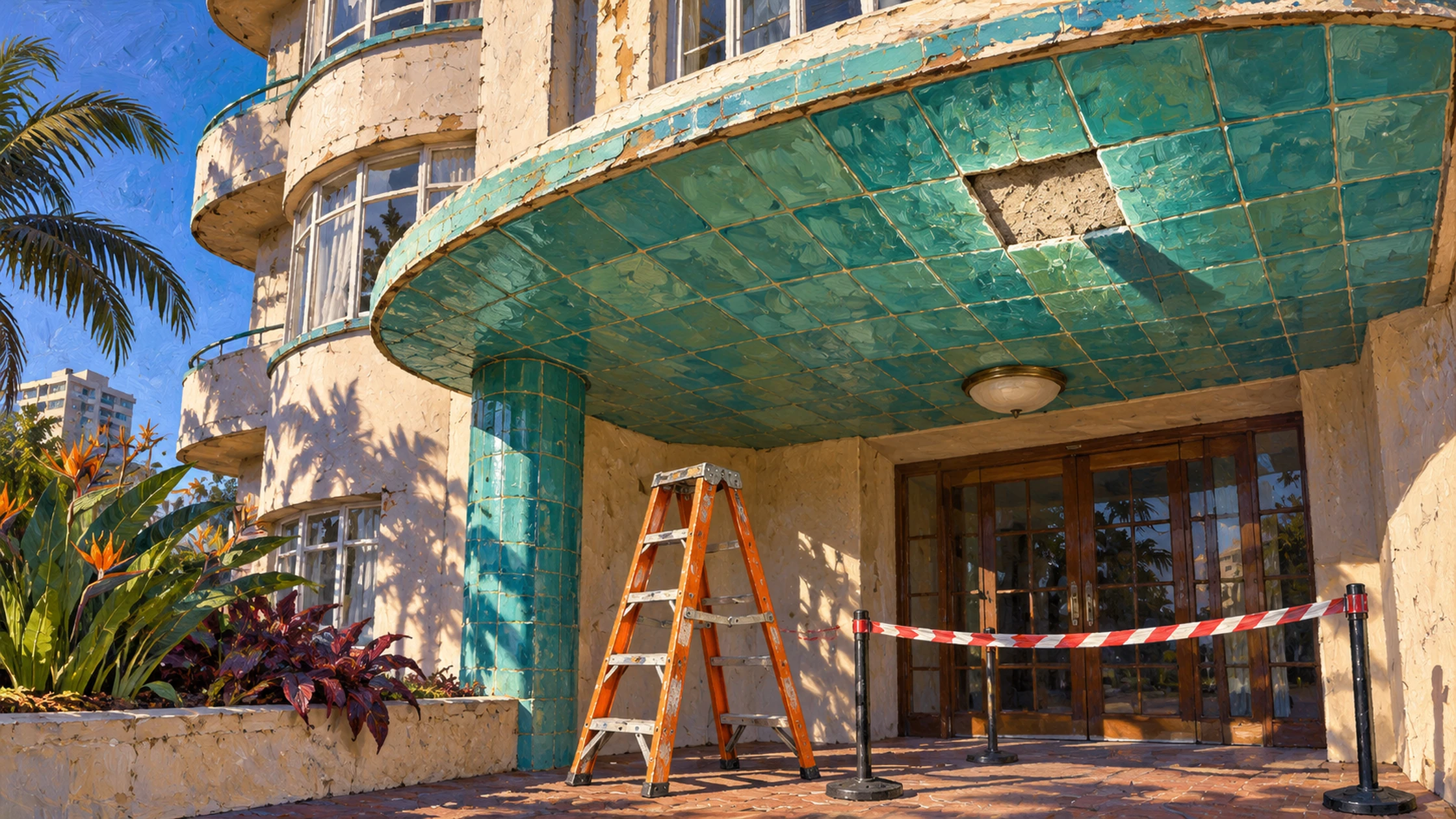
He moved it onto the windowsill. Beyond the glass, the entrance canopy showed a pale rectangle where the contractor had removed the loose facing. The doorway was safe to use now. The report said so. Mandla had read that sentence more often than the sentence about the remaining work.
Three weeks earlier, the tile had fallen while he was telling Mrs Pillay that he thought he could get their monthly charges down.
It had struck the paving between them with a noise too small for what it might have done.
He had spent forty years repairing lifts. He knew the difference between an object that had broken and an object that had been breaking for some time. Yet his first thought, before he asked whether she was hurt, had been that he should not have said anything about the charges.
He had asked the meeting to choose another chair for this item. Too much of the argument was his. Now he stood before the other owners with a different set of figures. R1,000 a month for the ordinary running costs, as before. R300 for the reserve, instead of R150.
“That is not a reduction,” said Lewis.
“No,” Mandla said.
He laid his hands on the back of the empty chair in front of him. There were five doorways he had passed through to get here. In each one, he had left some version of what he had meant to say.
At Mrs Pillay’s door, he had intended to explain that buildings aged.
She lived in the flat nearest the entrance. Her kitchen window faced the canopy, and she had complained about its stained underside the previous summer. Mandla had replied that staining was not the same as failure. A true statement, delivered for the wrong reason.
She let him stand on the mat while she found the letter.
“I wasn’t asking for a new building,” she said.
He recognised the paper before she unfolded it. He had written the response himself, using the body corporate’s letterhead. He had even corrected her spelling of “canopy” in the subject line.
“We should have had someone examine it then.”
“Yes.”
She did not rescue him from the silence.
Behind her, the table held a pill organiser, a half-finished crossword and three envelopes. He knew she had a pension. He did not know its size, and she did not offer to tell him.
“The amount you sent me,” she said, “is that the amount, or the amount before you remember something else?”
He had come with a simple sheet: eight thousand in the reserve before the emergency work; six thousand paid for the assessment, removal of unsafe material and temporary weatherproofing; two thousand left.
The trustees had approved that urgent expense in writing. The managing agent had sent the owners the resolution and report. Mandla had put barriers across the entrance and used the side door with everyone else until the professionals cleared it. He had not climbed a ladder, however much his hands had wanted a job they understood.
“This is what we know,” he said. “The next figure is an estimate. I will show you both.”
She took the sheet. He left without explaining that buildings aged.
At the meeting, Farah, the managing agent, turned the projector towards the wall. The reserve had its own column. Money for cleaning, insurance and electricity was not spare money waiting to be discovered in a different column.
Mandla had once liked a tidy set of accounts. The totals met. Nobody could accuse the numbers of wandering off.
The old minutes were untidy in another way. “Review next year” appeared beside the canopy. Then again beside the same item. His name was against one of the proposals.
“We did pay into the reserve,” Mr Naidoo said.
“Yes,” Farah said. “And repairs used it. The old plan also underestimated this work. Those are two separate problems.”
Mandla kept his eyes on the page. She did not say who had asked for the cheaper estimate.
Gugu opened her door with a towel over one shoulder. On the balcony behind her, two children were teaching a doll to hang upside down.
“I can’t do a lump sum,” she said before he could open his folder.
“We are putting forward monthly contributions.”
“You say monthly as if months come with money inside.”
Her salon paid its rent on the first. Her busiest customers came after the middle of the month. The household lived through the interval every time. She could explain the interval precisely, without telling him what she charged for a haircut.
He began to say that everybody’s position was difficult. He stopped.
“Which date would let you plan?”
She looked at him, suspicious of the ease of the question.
“The fourteenth. But don’t write that you have solved it.”
He wrote “fourteenth” on a separate sheet. He could take it to Farah and the other trustees. He could not grant an exemption on the landing or promise that the others would carry her share.
One child called for the towel. Gugu held out her hand without looking round, and the doll landed in it feet first.
“You know,” she said, “I voted with you. When you said another year.”
“I know.”
That was harder to hear than an accusation.
At Lewis’s door, the baby was asleep in a sling on his chest. Lewis spoke in a whisper that made every word sound more severe.
“I bought this place eight months ago.”
Mandla nodded.
“Your minutes said the maintenance was under control.”
“They said the expenditure was within budget.”
“Is that what you want to tell me?”
“No.”
The baby’s mouth opened and closed against the fabric. Lewis rested a palm on the small back.
Mandla showed him the contractor’s photographs. Then he showed him the older minutes. He had almost left those in his flat.
Lewis read them standing up. His free hand moved slowly from one page to another.
“My wife thinks we made a mistake buying here.”
Mandla wanted to list the things they had done properly: the drain, the gate motor, the wiring that nobody saw because it worked. Instead, he waited.
“I need to be able to show her what’s still coming,” Lewis said.
The old plan looked ten years ahead, but some of its figures had become guesses wearing dates. The updated one, prepared with professional help, was less comforting. It listed the work, its condition, its expected timing and the money needed. Mandla left that version with Lewis.
For once, he did not leave the building’s good reputation in charge of the conversation.
At the meeting, Lewis asked about the six-month figure.
Farah put it on the wall. Ten equal shares, R300 each month: R3,000. Six months would bring R18,000. With the R2,000 remaining, that would make R20,000 before the planned R18,000 canopy work.
“If all the payments arrive,” she said. “And if there are no other withdrawals in that interval. The plan has to be watched, not filed.”
The professional assessment allowed the remaining work to be scheduled after the immediate danger had been removed. Other items appeared later in the plan. This was the first stretch of the road, not the whole road paid for.
Mrs Pillay raised her hand.
“And if the estimate changes?”
“Then you see it change,” Mandla said.
Mr Naidoo had invited him in. This was the fourth door, and the first at which Mandla had been offered tea.
“I can pay ahead,” Mr Naidoo said. “My whole year. Perhaps that will help.”
For an instant Mandla saw the canopy finished, the arguments spared, his earlier promise restored by somebody else’s bank account.
“That would bring your payments forward,” he said. “It wouldn’t make the work cheaper.”
“I know that.”
Mandla flushed. He had begun explaining again.
Mr Naidoo pushed the sugar towards him. “I am not trying to buy a larger vote.”
“I didn’t mean—”
“You looked so frightened of being grateful.”
They drank their tea. The proposed budget would still have to be approved. Any advance would be recorded against Mr Naidoo’s own contributions, not counted twice or treated as permission to forget later repairs. He could change his mind before paying.
When Mandla left, Mr Naidoo gave him a biscuit wrapped in a paper napkin. This small, unrecorded transaction was easier for both of them.
His own door had been the fifth.
His wife opened it because he was holding the folder and the biscuit and could not find his key. She was stronger now. During the year of hospital visits, he had liked meetings in which nothing new was required of anyone. The ordinary bills were already arriving with extraordinary force.
He had not stolen money. He had not concealed a quotation. He had asked whether things could wait, and people who trusted him had agreed.
“They’ll think I kept it low for us,” he said.
She took the biscuit.
“Did you?”
He sat down without removing his shoes.
“Not only.”
She broke the biscuit in half. There was no way to divide it equally; the chocolate was mostly at one end. She gave him that piece.
“Will you put the old minutes in the pack?”
“They make me look bad.”
“They are the minutes.”
The meeting lasted until the light had moved off the windowsill.
The owners had received the notice, the revised plan and the budgets in advance. They asked their questions. They approved the plan and the new budgets, with monthly reporting on receipts and the canopy estimate. Mandla’s promise of lower charges survived only in the old minutes, where he left it.
Afterwards, the trustees recorded the contribution resolution. The written notices set out the amounts and payment dates. The fourteenth had been possible. Less money had not.
Gugu stayed to stack chairs. She did not thank him. Lewis took a second copy of the plan. Mrs Pillay asked whether the contractor could preserve the sound tiles when the rest of the work was done.
“I’ll ask,” Mandla said.
The first six reserve payments added R1,800 to the remaining R2,000. Four were still due. The full repair had not happened; a row of turquoise squares still stopped abruptly above the entrance.
Mandla put the broken tile back beside the register while he collected his papers. Mrs Pillay picked it up.
“You’re going to lose this,” she said.
She wrapped it in the clean side of a napkin, placed it in his folder and held the door while he carried everything through.
Money behind the story
A maintenance reserve is money assigned to future shared obligations. In South African sectional-title schemes, the regulations published by the Community Schemes Ombud Service prescribe minimum reserve contributions, a written ten-year maintenance plan, member approval of that plan and controls on urgent expenditure. A low levy is not evidence that the building’s costs have disappeared.
The fictional reserve falls from R8,000 to R2,000 after R6,000 of urgent professional work. The ten units have equal participation quotas: R300 per unit per month produces R36,000 annually. In the scenario, the previous year-end reserve was R20,000 against R120,000 of administrative contributions; the next administrative budget is also R120,000. The applicable minimum reserve contribution is therefore R18,000. The R36,000 proposal exceeds that floor; the approved maintenance plan, rather than the floor alone, supports the budget.
The six-month projection is R2,000 + (6 × R3,000) − R18,000 = R2,000, assuming every contribution arrives and no other reserve expenditure occurs in that interval. It is a projection, not money already collected. At the ending, only six new reserve payments have arrived: R2,000 + R1,800 = R3,800.
Doorstep conversations do not replace resolutions, notices or payment obligations. Real schemes have their own participation quotas, approved rules, maintenance needs and procedures; these fictional figures are not a recommended levy or repair quotation.
Financial sources checked 25 November 2026. Story figures and outcomes are illustrative. General financial education, not individual financial advice.
Stay with the story: three questions
- Which low recurring payment depends on maintenance or another obligation being postponed?
- What would distinguish money already available from contributions that a shared plan still needs to collect?
- How might acknowledging your part in an earlier decision change a difficult conversation about paying for it?



