
Money Stories · Original fiction · 10 minute read
Patrick had written PAID across the envelope before he noticed there was no money inside it.
At the school office, parents sometimes sent an envelope as a reminder that money would follow. He knew this. He also knew which children would bring coins warm from a hand, which would bring a bank-transfer reference, and which needed him to say, Quietly now, we’ll sort it.
He crossed out the word, put the envelope aside and opened the letter addressed to him.
His car-finance agreement ended the following Friday. The last regular instalment was due on Wednesday. Two hundred and ninety euros, a figure so familiar that he could recognise it upside down on a bank statement.
Below it was another figure.
Nine thousand six hundred.
He turned the page over. There was nothing on the back that made the front different.
When he had signed three years earlier, the final payment had been a distant arrangement between future people. Someone would value the car. Something would be traded. He had understood it, in the way he understood that the gutters needed clearing: a task whose continued existence did not require his attention today.
Recently he had been saying, One more payment and that’s it.
He had said it to the caretaker, to his sister, to the woman who cut his hair. He had said it to Nessa while she was cleaning rosin from her violin strings.
His daughter had asked if that meant they could go away in the summer.
“It means we’ll have a bit more room,” he had told her.
Now, in the car park, he sat without starting the engine. The passenger seat held a crescent of pale dust from Nessa’s violin case. He rubbed it with his sleeve, making a larger mark.
She called while he was doing this.
“They’ve confirmed Saturday. Ten o’clock. I have to be there at half nine.”
The audition in Dublin. He had put the date into his calendar weeks ago, with the word DRIVE in capitals.
“We’ll be there,” he said.
“You said we could stop for breakfast.”
“We can.”
She began telling him about a passage she could play perfectly until somebody listened. He kept his hand on the dusty seat and listened.
On Saturday morning he went to the dealer who had arranged the finance. A young man offered him coffee and asked whether he was thinking of changing.
“I thought I was thinking of finishing.”
The young man smiled, not unkindly. He opened a screen.
There was another car Patrick could have for the same monthly payment. Almost the same colour. Better reversing camera. The young man turned the screen towards him, placing two hundred and ninety between them like a familiar friend.
“What goes before it?” Patrick asked.
“The deposit?”
“And after it.”
They went through the full illustration. Two thousand four hundred down. Thirty-six monthly payments of two hundred and ninety. Eleven thousand two hundred at the end if he wanted to own the next car. The quoted figures included the stated finance charges and fees; running it would be extra.
His present car’s trade valuation was below the nine thousand six hundred needed to buy it at maturity. There was no equity available for the next deposit. The young man did not pretend otherwise.
Patrick asked for the figures on paper.
Outside, he walked around the proposed car. It had a tiny dark camera beneath the badge. He imagined showing Nessa how clearly it could see behind them. He imagined arriving at the audition in it, the problem solved so neatly that she need never know there had been one.
He went back inside and said he would think.
At home he cleared the kitchen table. Three years ago he had paid a three-thousand-euro deposit. Thirty-six payments of two hundred and ninety made ten thousand four hundred and forty. Add the final nine thousand six hundred and ownership under his existing agreement would have cost twenty-three thousand and forty altogether.
The total made him resent the smaller number. It had been so easy to accommodate.
He checked the new illustration: twenty-four thousand and forty if he took that contract through to ownership. Another deposit, another three years, another large decision waiting at the far end. He was not comparing identical cars or pretending these totals included fuel, insurance and maintenance. He was looking for the obligation that his eye kept skipping.
The existing deposit would not come back when he returned the car. Nor would the instalments already paid. He wrote those amounts once, then stopped putting them into every new column as though they could vote on what happened next.
In savings he had two thousand six hundred. Two thousand was the reserve he had built slowly after a boiler repair. The remaining six hundred could help with a change. Wednesday’s two hundred and ninety was already set aside separately with this month’s bills.
He could spend nearly all the savings on the new deposit. He could enquire about borrowing the balloon payment and keeping the car. Neither option meant what he had meant by finished.
Nessa came in carrying her violin by its handle, although she was only moving from one room to another.
“Are those the directions?”
“No.”
He told her.
She looked at the papers, then at him. “Have you only just found this out?”
“I knew it was there. I’ve only just stopped ignoring it.”
“That’s worse.”
He let the sentence remain worse.
She was not angry about a reversing camera or a colour. She had been arranging the audition in her mind: the journey, the stop, the warm car in which she could complain about the piece before she had to defend it in a room. He had offered certainty as casually as he offered lifts.
“I wanted one part of it I didn’t have to think about,” she said.
“I know.”
He reached for his phone to find a solution and put it down again. She had not finished being angry.
On Sunday they looked at the journey together. Not while she practised. Not with him calling through a door that the bus was perfectly straightforward.
There was an early coach that allowed a generous margin before the audition. They checked the stops, the walk at the other end, the return arrangements and the rules for her small violin case. Two return tickets came to eighty-four euros. They saved the booking details, but he waited to book until the finance company had confirmed the return arrangements.
“That’s very early,” Nessa said.
“Yes.”
“Don’t tell me it’ll be an adventure.”
“I wasn’t going to.”
“You were forming the face.”
He laughed. She did not quite laugh, but the corner of her mouth moved.
He could walk to work. They found a workable bus for her usual rehearsal and agreed where occasional lifts or taxis would be needed. He would keep a transport allowance in the budget and review the arrangement after six weeks. Giving back the car would not make getting about free, or convenient on every night.
On Monday he spoke to the finance company, not just the dealer. He asked about the normal end-of-term return in his agreement. The woman went through the mileage, servicing, condition and handover requirements, then sent confirmation in writing. He was not asking to end the agreement early or sign a voluntary-surrender form. The distinction mattered enough for him to read it twice.
The pre-return inspection found a damaged wheel. The written charge was one hundred and eighty euros. His mileage was within the allowance and the service record was complete. He checked the report against the car and agreed the charge. If its condition changed before Friday, the final inspection could change the account.
It was money he would rather have kept. It was also an amount he could put in a place on the page.
The two hundred and ninety left his account on Wednesday. He watched the transaction settle and resisted giving it another name.
On Friday the handover inspection matched the earlier report. He paid the one hundred and eighty, returned both keys and obtained the receipt and written confirmation of what remained to be processed. He kept the documents together. The following week the finance company would confirm that the agreement was closed with no further sum due.
For the moment, he had a receipt and a walk to the bus stop.
He had emptied the glove compartment the night before: old masks, a pencil, a map of a place they had never visited. Nessa had taken the packet of sweets from the door pocket and said they were probably old enough to vote.
Now he stood outside the dealership with a shopping bag containing the things that had made the car theirs. The young man waved through the window. Patrick waved back. There was no reason to make him the villain of a piece of paper Patrick had signed.
He booked the coach tickets. The wheel charge and fares used two hundred and sixty-four of the six hundred available for the change, leaving three hundred and thirty-six. The two-thousand-euro reserve stayed where it was. There was no sale money arriving to replenish it.
At five the next morning, Nessa found him buttering bread.
“You’re making it sound sad already,” she said.
“It’s bread.”
“It’s very early bread.”
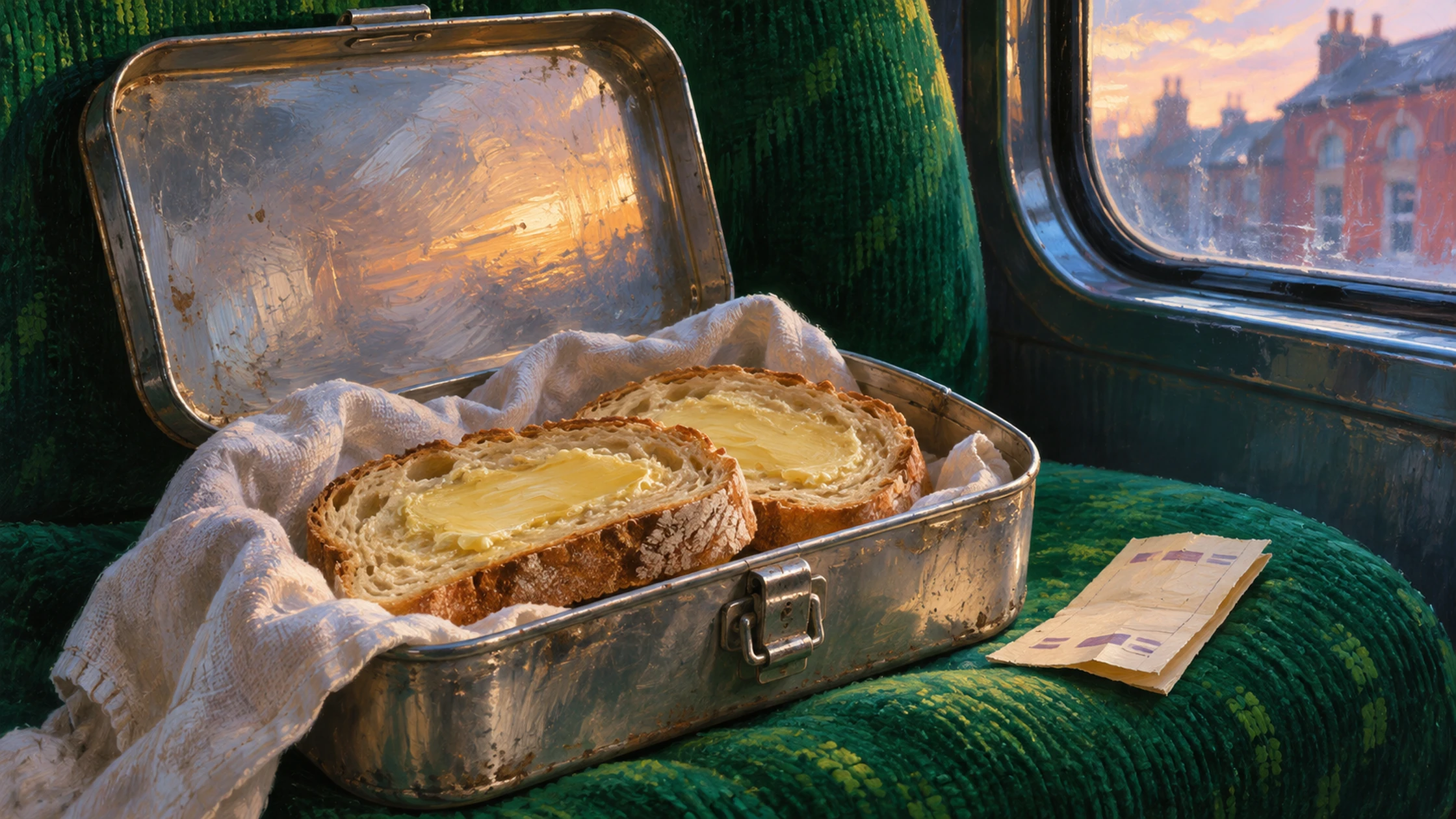
He put two pieces in an old silver tin whose lid had never fitted properly. The groceries were already in the kitchen; he did not enter breakfast into a column. He wrapped a small cake separately because she would refuse it now and want it later.
Outside, the road shone under the lamps. He reached automatically towards the place where the car had been. Nessa saw the movement and said nothing.
The coach was warm. They took two emerald-green seats, her violin safely beside her, the tin on his knees. The ticket folded down the middle where he had gripped it too tightly.
For a while she watched the dark window. Then she asked him whether he thought she was ready.
“I don’t know enough about it.”
“You’ve heard it a hundred times.”
“I know the part where you stop and call the composer names.”
She smiled. “That’s not in the score.”
The sky began to lighten. Patrick opened the tin and offered the bread. She took a piece, leaning forward so crumbs would fall into the lid.
“Will we have another car?” she asked.
“I don’t know yet.”
She nodded, looking out at the first lit windows. He could not tell whether she accepted the answer or was merely making room for it among the other things she had to think about.
At a bend, the lid began to rattle. Nessa put the tin across their knees and held one corner. He held the other. The small metallic noise stopped. For several miles they sat like that, watching the morning arrive.
Money behind the story
A low monthly payment can leave a substantial amount until the end. Ireland’s Competition and Consumer Protection Commission explains PCP’s deposit, regular instalments and final balloon payment. Ownership requires the final payment. A normal end-of-term return can involve mileage or condition charges and requires checking servicing obligations; the original deposit is not returned. This differs from ending an agreement early.
Patrick’s fictional ownership total is €3,000 + (36 × €290) + €9,600 = €23,040. The proposed replacement is €2,400 + (36 × €290) + €11,200 = €24,040. These quoted contract totals include their stated finance charges and fees, but exclude running costs. They concern different vehicles and do not establish which is better value. Keeping the monthly figure unchanged does not remove the new deposit, term or final payment.
He follows the return route confirmed for his agreement, pays the separately budgeted last €290 instalment and the agreed €180 condition charge, and receives closure confirmation. Of €600 available outside his €2,000 reserve, €180 plus €84 for tickets leaves €336. He receives no sale proceeds or deposit refund.
All prices, valuations, contract terms and outcomes are invented. Returning a car is not universally free, and this scenario is not guidance on early termination, arrears or voluntary surrender. Actual agreements and their total costs require checking. Source checked 25 November 2026.
Financial sources checked 25 November 2026. Story figures and outcomes are illustrative. General financial education, not individual financial advice.
Stay with the story: three questions
- Which payment finishes a regular instalment schedule, and which payment would actually transfer ownership?
- What remains committed when a familiar monthly amount is offered on a new agreement?
- Which part of a promise matters most to the other person, and what would changing the arrangement require you to acknowledge?



