
Money Stories · Original fiction · 9 minute read
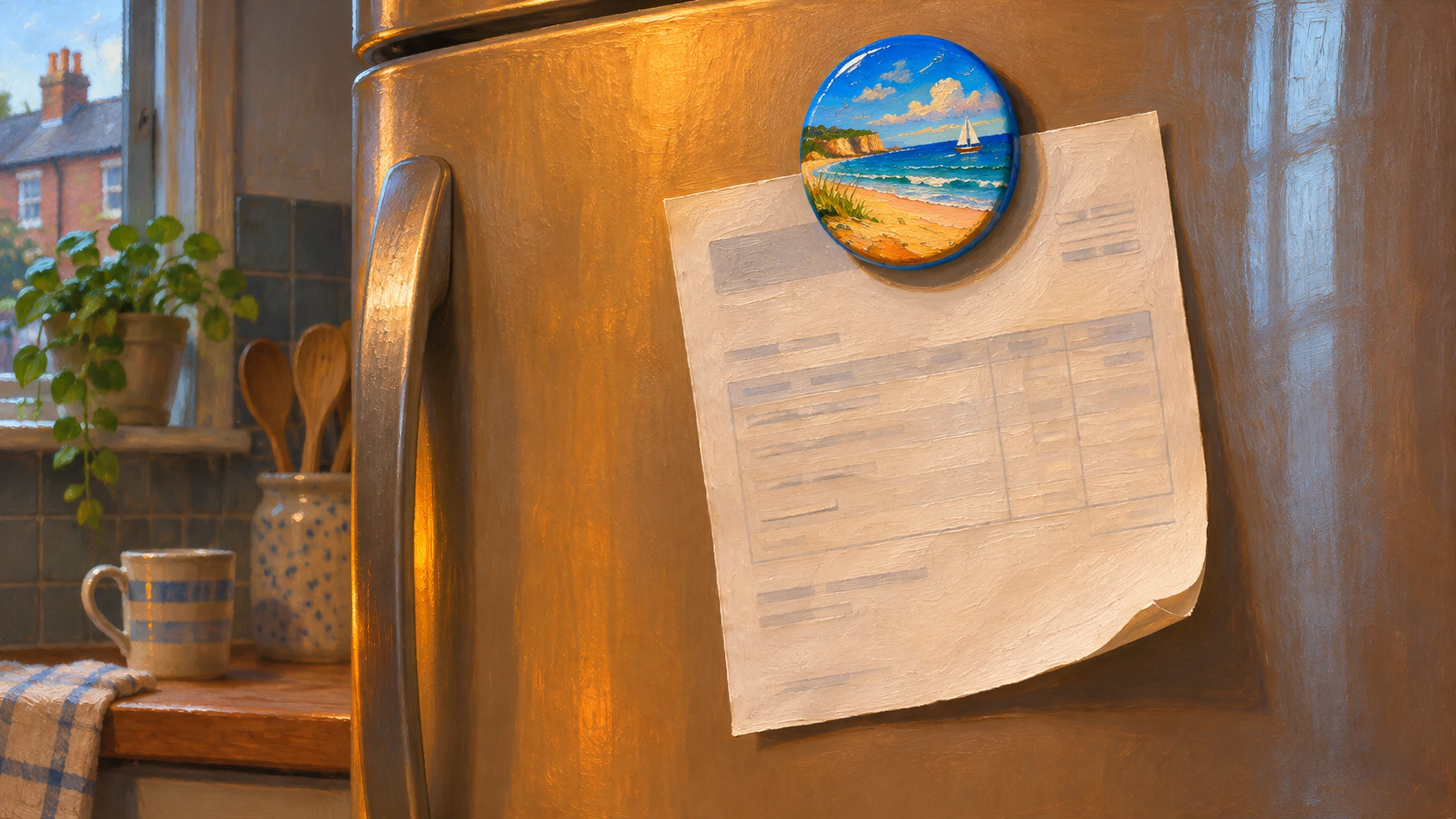
The blue magnet had a strip of beach painted on it and enough strength to hold one sheet of paper. Ewa had discovered this by trying to add the hotel confirmation. Both pages slid slowly down the amber fridge, as though reconsidering the holiday.
She left the invoice under the magnet and put the booking on the table.
“Is it still on?” Zosia asked.
Her daughter was sixteen. She asked practical questions in a careful voice that Ewa remembered using with her own mother. Ewa disliked being on this side of it.
“They accepted the work.”
“I meant Saturday.”
“Yes. I know.”
The invoice was for twelve hundred pounds: English-to-Polish translations of a catalogue, product descriptions and the little instructions people read only after assembling something incorrectly. Ewa had worked through two Sundays, checking whether a handle turned or pulled, whether a panel was removable or merely looked it. On the second Sunday, Zosia had offered to test the instructions on their own cupboard.
“Ours is already broken,” Ewa had said.
“Then we can see if the Polish improves it.”
The job had been accepted two weeks ago. Payment had been due on Monday. It was now Tuesday, and the invoice was still the most valuable thing on the fridge.
Ewa worked at the end of the kitchen table in their Leicester flat. At lunchtime she pushed her laptop towards the wall and laid a plate over the patch its rubber feet had polished. She had been translating for Larch Window Editions for three years. Some months its jobs made the difference between choosing work and taking whatever appeared.
She opened the accounts portal again.
Work accepted. Invoice received. Payment pending.
She could have recited it with her eyes closed.
The seaside weekend had cost twenty-four pounds so far, a deposit on a room. One hundred and twenty more would be due for the room, with sixty-four allowed for return travel and forty-two for food. Two hundred and fifty altogether. The tickets were not booked yet.
Zosia wanted to be on the beach early on Sunday, before the stalls opened. She had been making photographs of places before people arrived in them. Ewa wanted to be in one of those places with her.
That afternoon she wrote to the editor who had commissioned the translations.
“Hi Owen, could you check the payment date for invoice 184? It was due yesterday. Many thanks, Ewa.”
He answered in eleven minutes.
“All approved my end. I've nudged finance.”
Ewa thanked him. Then she opened the portal again.
On Wednesday, her invoicing assistant found the empty box.
The programme was called Paper Finch. Mostly she used it to sort receipts and put dates in order. It was particularly good at finding attachments she remembered sending but could not remember naming.
She gave it the invoice, the work order and the messages about this job. Its summary listed the fee, delivery, acceptance and due date, with links back to each document. Beside the purchase-order reference it wrote: Not found in supplied records.
There was a purchase-order box on the portal. It was blank.
Ewa searched the original commission herself. Owen had written, I'll send the PO when accounts raises it. Then he had sent three amended files and a question about whether Polish needed more space on the page.
There was no number.
She had remembered the question. She had forgotten the promise.
Paper Finch drafted a follow-up. It was clear, rather cold and twice as long as necessary. She removed the opening paragraph and checked every date against the documents.
“Hi Owen, the invoice is still unpaid. The PO field is empty, and I cannot find the number in our correspondence. Could you supply it and put me in touch with the person arranging payment? I've attached the invoice and your acceptance of the final files.”
She hovered over Send. He had mentioned another catalogue for next month. She could hear her own message arriving in his busy afternoon, one more person requiring a thing.
Then she sent it.
Zosia came home while Ewa was making soup. She had bought nothing for the journey. Usually, by Wednesday, there would have been a packet of sweets hidden so badly that finding it was part of the holiday.
“They haven't paid,” Ewa said.
Zosia set her bag down.
“You said they had.”
“I said they accepted it.”
“You said it was sorted.”
Ewa stirred the soup. The distinction was useful to her work and useless here.
“I said that too early.”
“Should I tell Anya I can come on Saturday?”
Anya was having people round. Zosia had declined because of the trip. Ewa wanted to say wait, although waiting was what she had already given her daughter instead of a plan.
“Give me until tomorrow evening. Is that too late?”
“I'll ask.”
It was not forgiveness. It was a workable answer.
Owen forwarded the message to Paula Dent in accounts. Paula called on Thursday morning.
“Your invoice is accepted,” she said. “The twelve hundred is still owing. I need the order reference attached to get it through our payment process.”
“Owen was going to send it.”
“I've asked him.”
Ewa looked at the chain of messages. Everyone had asked someone. She had the uncomfortable impression that she could remain in this conversation for the rest of the month.
“Who can tell me when the money will reach my account?”
“I can check the next run.”
“Could you do that while I'm here?”
She heard herself sounding like a woman who had made this request before and knew it was reasonable. Her free hand was squeezing the dishcloth.
Paula put her on hold. The music stopped halfway through a phrase and began again. Ewa thought of the ten-minute audio samples translators were sometimes asked to assess without payment, then made herself stop thinking about other unpaid work.
When Paula returned, she had the reference and an answer.
“I can arrange six hundred for tomorrow. The rest needs a separate approval. I can't give you a date for that yet.”
“And you'll contact me?”
“Tuesday. I'll update you by noon even if the approval hasn't come through.”
Ewa wrote Paula's name beside the date. She asked for an email confirming the amount and timing. Paula sent it before they ended the call.
“£600 to reach your account Friday. Remaining balance £600. I will update you by noon Tuesday.”
Paper Finch added the payment promise and follow-up to her record. Ewa left the invoice marked unpaid. A sentence from accounts was an improvement on a sentence from the portal. It was still a sentence.
At lunch she read the room's cancellation terms again. Under this booking, cancelling before six that evening would lose the twenty-four-pound deposit but nothing further. Waiting past six would make the room balance payable.
She called the guesthouse. The woman offered another weekend, subject to availability. Ewa thanked her and cancelled. She could not put another date into Zosia's life without asking.
The cancellation arrived by email. Twenty-four pounds retained. No further balance due.
She saved it beside the booking confirmation.
“Could we go for the day?” she asked that evening.
Zosia was taking chipped varnish off her thumbnail. She did not stop.
“We wouldn't be there early.”
“No.”
“That was what I wanted.”
Ewa sat on the edge of the sofa. She had prepared a list of things they could still do. She kept it to herself.
“I know.”
After a while Zosia asked how they would get there.
“There's a return coach. I've only looked. If the money arrives tomorrow, we could book.”
“So it's another maybe.”
“Until it arrives.”
Zosia pulled off a narrow strip of blue varnish and dropped it into the bin beside her. “Tell me then.”
The six hundred arrived on Friday at twenty past ten.
Ewa opened her bank account, not the email. Before the payment there had been ninety-four pounds left after the week's spending and the room deposit. Now there was six hundred and ninety-four.
She put four hundred and twenty against the remaining rent payment, and a hundred and sixty against bills and the tax money she had already planned to set aside. That left a hundred and fourteen. The unpaid half of the invoice went in a separate column.
The weekend would still have required two hundred and twenty-six beyond the lost deposit. The day could cost eighty-four: forty-eight for their return fares, twenty-six for food, ten for the local bus. Thirty pounds would remain after those amounts and the reserved commitments.
She sent Zosia a message saying the payment had arrived. Then she waited for her daughter to decide.
“Day is okay,” came the reply. “Can we take the flask?”
They had a small flask that leaked if it travelled upside down. It had accompanied them through several otherwise successful trips.
“If you hold it.”
“Management position. I accept.”
Ewa bought the coach tickets. She recorded the six hundred against invoice 184, leaving six hundred outstanding, and kept Tuesday's reminder.
They reached the coast late enough for the chip shops to be open and the promenade full of people with bags. Zosia took a photograph of three empty deckchairs, waited for a man to leave the frame, then gave up and included him.
The wind made Ewa's soup flask difficult to pour from. She steadied the cup while Zosia held the lid. They ate lunch sitting on a low wall, using their knees to keep the paper from lifting away.
It was not the early, empty beach Zosia had planned. Ewa did not ask whether it was just as good.
They walked until Zosia stopped to photograph their shadows. Ewa waited, then realised she was standing on one of them.
“Don't move,” Zosia said.
“You just told me to move.”
“Before. Now you're right.”
Behind them, a little boy dropped the top of his ice cream onto his shoe. He looked down without understanding, and Ewa made a noise she could not get back. Zosia turned and saw him too.
They held their laughter until his father had led him away, and then lost the photograph completely.
Money behind the story
Acceptance of work, a payment promise and money received are different events. The UK Small Business Commissioner recommends identifying the person responsible for payment, checking the payment timetable and requesting a purchase-order reference early when one is needed. Its unpaid-invoice guidance also recommends checking the agreed terms and contacting the customer with the invoice details.
GOV.UK lists required invoice information, including an identifying number, dates, a description and amounts. The fictional client’s missing internal reference delays processing; the story expressly assumes the £1,200 debt remains owed. It makes no finding about statutory late-payment remedies or any real contract.
Ewa receives £600, leaving £600 outstanding. Her £94 cash snapshot already follows the £24 room deposit and earlier spending. £94 + £600 = £694; reserving £420 for rent and £160 for bills and planned tax money leaves £114. The day-trip allowance is £48 fares + £26 food + £10 local travel = £84, leaving £30 uncommitted. This is an allocation, not a claim that every allowance is ultimately spent.
The cancelled £250 weekend comprised the £24 deposit and £226 still to spend. Under the invented booking terms, only the deposit is lost; no refund is assumed. The assistant organises evidence and follow-up without guaranteeing payment. The remaining invoice balance stays outside available cash.
Financial sources checked 24 November 2026. Story figures and outcomes are illustrative. General financial education, not individual financial advice.
Stay with the story: three questions
- Which step in a payment process tells you that money is actually available, and which steps only describe progress?
- What evidence and named contact could make an overdue-payment conversation more precise?
- If only part of an expected payment arrives, which promises need to be discussed again?



