
Money Stories · Original fiction · 10 minute read
The fountain
The route planner removed Eloy’s stop while Alba was eating a pear over the keyboard. A blue line straightened on the screen. Eighteen minutes disappeared. She wiped a drop of juice off the space bar and looked at what had become an excellent route.
On Tuesdays she rode beside Julián in the cooperative’s van, taking bookings, helping with bags and listening to complaints that had been saved specifically for her. There were complaints about the step, the heater, the town’s new pavement. She liked being the person to whom things could be brought. At her previous job, in a furniture warehouse, she had been paid to tell people that their complaint belonged to another department.
The planner had used her passenger records. One person at the spur beyond the old flour mill, twelve additional kilometres there and back. Everyone else lived along the main road. Removing that spur brought the operator’s agreed price down from €168 to €150 for a Tuesday circuit.
Four Tuesdays at the old price would cost €672. The cooperative had €650 set aside for those runs. Insurance, administration and the other services had separate budgets; Silvia, the treasurer, had already told Alba those were not spare money.
Alba printed the map. Beside the fountain, she folded it so the straightened part was underneath.
Eloy was seventy-eight, wore a felt hat even inside the van and always asked whether the fountain had been fixed. It had not run in years. She had begun to suspect he enjoyed receiving the same answer.
“We’re looking at the route,” she told him.
“It is still there.”
“How we run it.”
He gripped the rail and came up the step. “That is usually worse news.”
The flour mill
His house stood beyond the mill, where the land opened into ochre folds and low walls divided fields that looked, to Alba, as though they had been divided long enough. On the outward trip he brought an empty cloth bag. On the return he had three small parcels and his own shopping.
Alba had counted his boarding and his return. In the software, he made two passenger journeys. The parcels made none.
That Tuesday, after everyone else had got out, she carried his shopping to the gate. A woman on the next doorstep called, “Did she find the right ones?”
“She did,” Eloy said. “I’ll come round.”
He took a cream paper parcel from the bag. Nothing on the outside told Alba what it held.
“For Remedios,” he explained. “From the pharmacy. Then I take the others along.”
Three neighbours had their own arrangements with the pharmacist for him to collect for them. He did not open anything. On some Tuesdays he also brought bread, a repaired pair of spectacles, a newspaper somebody still preferred a day late to on a screen.
“Why didn’t you tell us?”
Eloy looked at the parcel. “You asked how many seats.”
She wanted to say she had asked more than that. She had asked whether anyone needed help boarding, whether the time was useful, whether they would use a Thursday service. All good questions. He had answered them.
“If we came every other week?”
“Then every other week I could go.”
“And the collections?”
He laid his shopping against the wall. “You’d have to ask the people whose things they are.”
She had made him into a service almost as quickly as the planner had made him into a cost.
Remedios came to the gate. She was carrying a bowl with a plate over it, which she passed to Eloy without ceremony.
“Lentils,” she said. “The good pot.”
Alba asked if she could come back to discuss the Tuesday arrangements. Remedios said yes, but after lunch; before lunch her niece was visiting, and they had things to talk about that were not arrangements.
Walking back to the van, Alba noticed how often she arrived with a form and expected people to become available around it. She had meant to be useful. It was possible to mean that and still interrupt somebody’s day.
Julián was listening to a football discussion on the radio. She sat down and let the argument continue as far as the mill.
The bakery
Silvia served customers with the budget book open behind the bread slicer. She was the sort of treasurer who could remember a missing receipt while laughing at a joke. Alba admired this without wanting to live near it.
“We can’t remove him,” Alba said.
“We can’t spend six hundred and seventy-two from six hundred and fifty.”
“It’s twenty-two.”
Silvia shut the slicer off. “Yes. That is the amount we haven’t got.”
The cooperative belonged to its members. Some used the van; some contributed because they wanted it to exist when they needed it. Dues were already collected for this period. Silvia had asked about an increase at the last meeting, and two households had quietly said they could not manage it.
Alba told her about the parcels.
“That should be in the discussion,” Silvia said. “It doesn’t put twenty-two euros in the book.”
At the meeting that evening, Alba arranged chairs in a circle instead of rows. She immediately regretted it. A circle made every silence everybody’s responsibility.
She presented the full route and the shorter one. €672 or €600 for four Tuesdays. She explained that she had allowed the planner to consider dropping the least-used stop, then asked it for the lowest driving cost. It had not invented the permission she gave it.
Eloy sat with his hat on his knees. Remedios had come with her niece. Another neighbour had sent a written preference, which Alba read without the details of what she needed collected.
“So one man costs seventy-two euros,” said a member called Vicente.
“The spur costs seventy-two over the four weeks,” Silvia said.
“That is what I said.”
“It isn’t quite.”
Alba looked down at her map, grateful to Silvia in a way she had not expected to be an hour earlier.
The members wanted access to town. That answer grew less simple as people spoke. Access meant buying things, but also choosing them; reaching the bank, but also talking to the person behind the counter; being able to go without asking a son whether this was a convenient week to need anything.
“I could collect the parcels,” Alba heard herself begin.
Silvia touched her wrist under the table.
Alba worked three days for the cooperative. Her mother had recently started calling the other four “your days on standby”. She withdrew the offer before it hardened into a job.
The crossroads
Pilar, who drove into town on alternate Tuesdays for a sewing group, suggested two full routes and two short ones. She could take Eloy on one omitted week. Vicente went to the agricultural supplier on the other and, after examining his hands for a while, offered the second lift.
“For this trial,” his wife said.
“For this trial,” he agreed.
Eloy asked whether they would be bringing him home or only delivering him somewhere. People laughed, then stopped when he did not.
They discussed the return times. The proposed lifts were personal arrangements, agreed with the people travelling; the cooperative checked the practical arrangements before relying on them. The neighbours confirmed collection plans with the pharmacy themselves. Nobody’s prescriptions went on the shared rota.
Two runs at €168 and two at €150 would cost €636. Fourteen euros of the allocated €650 would remain unspent. The operator confirmed those prices for the four-week trial before the members voted.
“And your petrol?” Silvia asked the two drivers.
They would cover it for these two trips. Their time, fuel and inconvenience did not become nothing because the cooperative would not receive an invoice. Alba wrote that into the minutes.
Vicente wanted the cheaper route every week. Someone else wanted to keep all four stops and find the missing money later. A majority chose the trial, with a review before another month was booked. The cheaper plan kept €50 available; theirs kept €14. They were choosing to spend the difference.
At the door Eloy asked Alba whether the new map had his house on it.
“Every other week.”
He nodded. He did not thank her for saving the stop, which helped her understand that she had not saved it altogether.
The town square
On the first omitted Tuesday, Alba watched the van pass the mill turn. She had expected relief at the shorter journey. Instead she kept glancing at the side mirror, as though a person could be left behind in a reflection.
Pilar brought Eloy to town later. He missed the men who met outside the café before ten. His errands were done, the parcels collected; in the trial record that would look like success. He told Alba about the café while she was helping another passenger find a glove.
“Put that down too,” he said.
She did.
Before the second omitted Tuesday, Vicente discovered that his supplier would be closed. His own reason for going had disappeared. He called Alba, paused, then said he would still honour the lift. She asked whether he wanted that recorded as a problem.
“It is a problem,” he said. “It doesn’t mean I’m not going.”
He made a separate journey he had not expected to make. At the review, nobody called it free transport.
The four operator invoices came to €636 as agreed. Silvia left the €14 in the transport allocation. It was not a reward for good behaviour or money for somebody’s proposed flower tubs.
The trial had carried people and the collections had happened. Eloy had lost two café mornings. Pilar’s return had been earlier than he liked, and Vicente did not want a permanent Tuesday obligation. The neighbours wanted their arrangements to remain reliable, whoever did the driving.
With the next block’s dues collected and its operator charges separately funded, they approved only one further four-week block on the same operator terms, after different volunteers confirmed the two lifts. Alba put a contact deadline and a named backup beside each. If a lift fell through, they would have to revisit the arrangement; fourteen euros was not a promise that anything could be fixed.
Eloy voted for it. Then he asked again whether the fountain would ever work.
“That is a separate budget,” Silvia said.
This time everybody laughed.
The flour mill, again
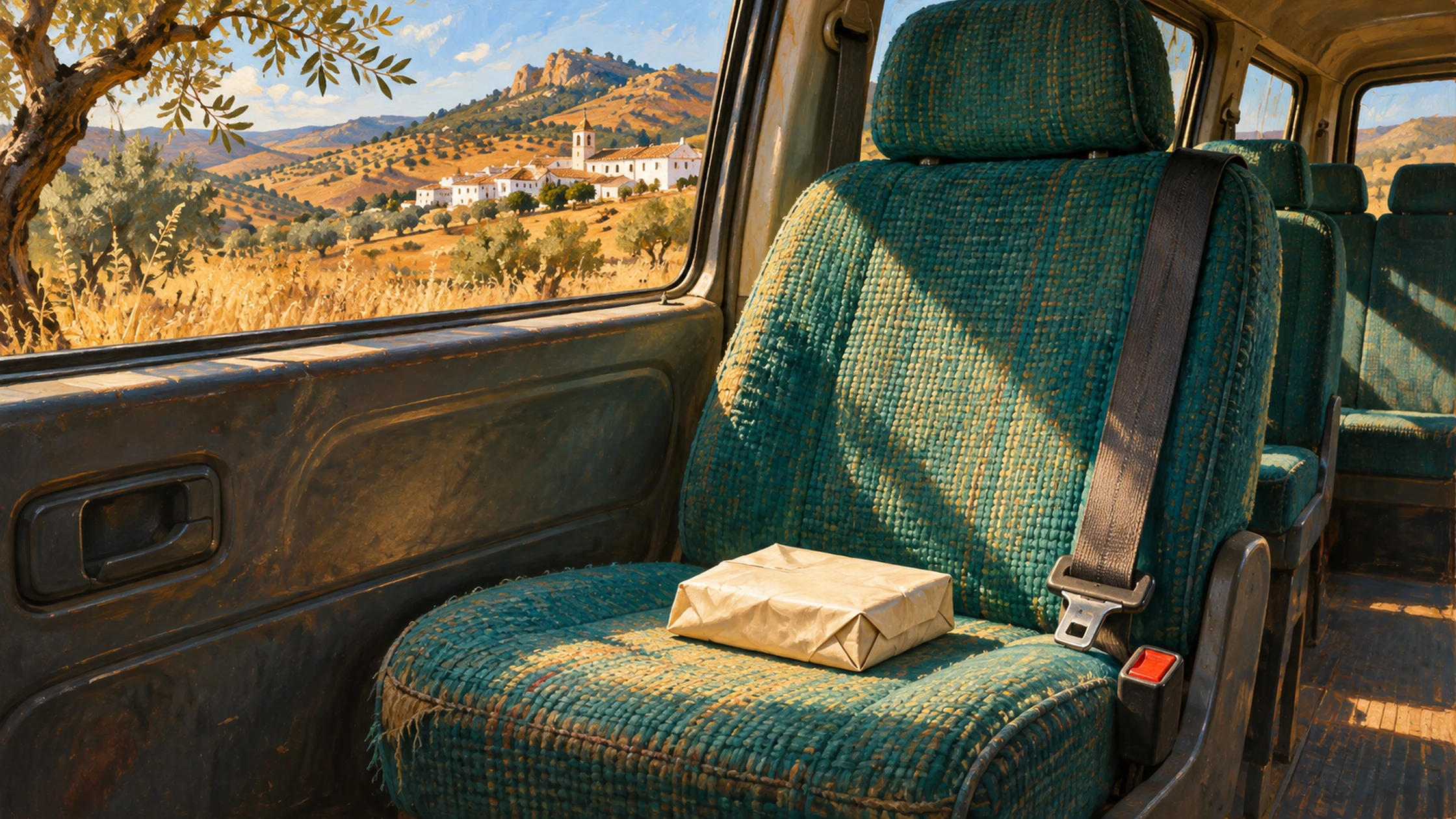
On the next full route, sunlight fell across the blue-green seat behind Alba. Eloy had set a small cream parcel there while he lowered himself into the next seat. He moved it onto his lap before Julián pulled away.
Alba added one passenger to the screen. In her separate notes she recorded the agreed collections, without names or contents. She left the number of passengers at one.
“Pilar says you criticised her driving,” she said.
“I criticised her radio.”
“She says you changed it.”
“It needed changing.”
Beyond the window the fields had the dusty gold of a loaf just before it burns. Alba closed the booking screen. She asked him which station he had chosen, and he began an answer so long that they were still listening when the mill disappeared behind them.
Money behind the story
Passenger counts describe use of a vehicle, but can miss what a journey enables for other people. The European Commission’s rural-mobility guidance announcement connects transport planning with access to services, integration and sustainable funding. It does not establish a right to this fictional route or endorse its arrangements.
For the invented four-week comparison, four full circuits cost 4 × €168 = €672; four short circuits cost 4 × €150 = €600. Two of each cost €636, saving the cooperative €36 against the full route while costing €36 more than the shortest option. From its existing €650 operating allocation, €14 remains. The operator confirms these charges and the trial invoices match them; other funded commitments are separate. This is a bounded cash comparison, not the van’s total lifetime cost or a measure of social benefit.
Volunteers still bear time, fuel and inconvenience; passengers can lose flexibility and companionship. HM Treasury’s Green Book distinguishes financial impacts from wider costs and benefits, including effects described qualitatively when reliable valuation is unavailable. That general appraisal principle is used here, not UK rules applied to Spain. No pharmaceutical, transport-licensing or insurance advice is implied. Sources checked 26 November 2026.
Financial sources checked 26 November 2026. Story figures and outcomes are illustrative. General financial education, not individual financial advice.
Stay with the story: three questions
- What does a service’s easiest-to-count measure leave out for people who do not appear in it?
- When a cheaper plan relies on someone volunteering, whose time and money should remain visible?
- Which practical conditions would need checking before you extended a successful short trial?



