
Money Stories · Original fiction · 10 minute read
At seventeen minutes past five, Orhan turned the empty watch case towards the light.
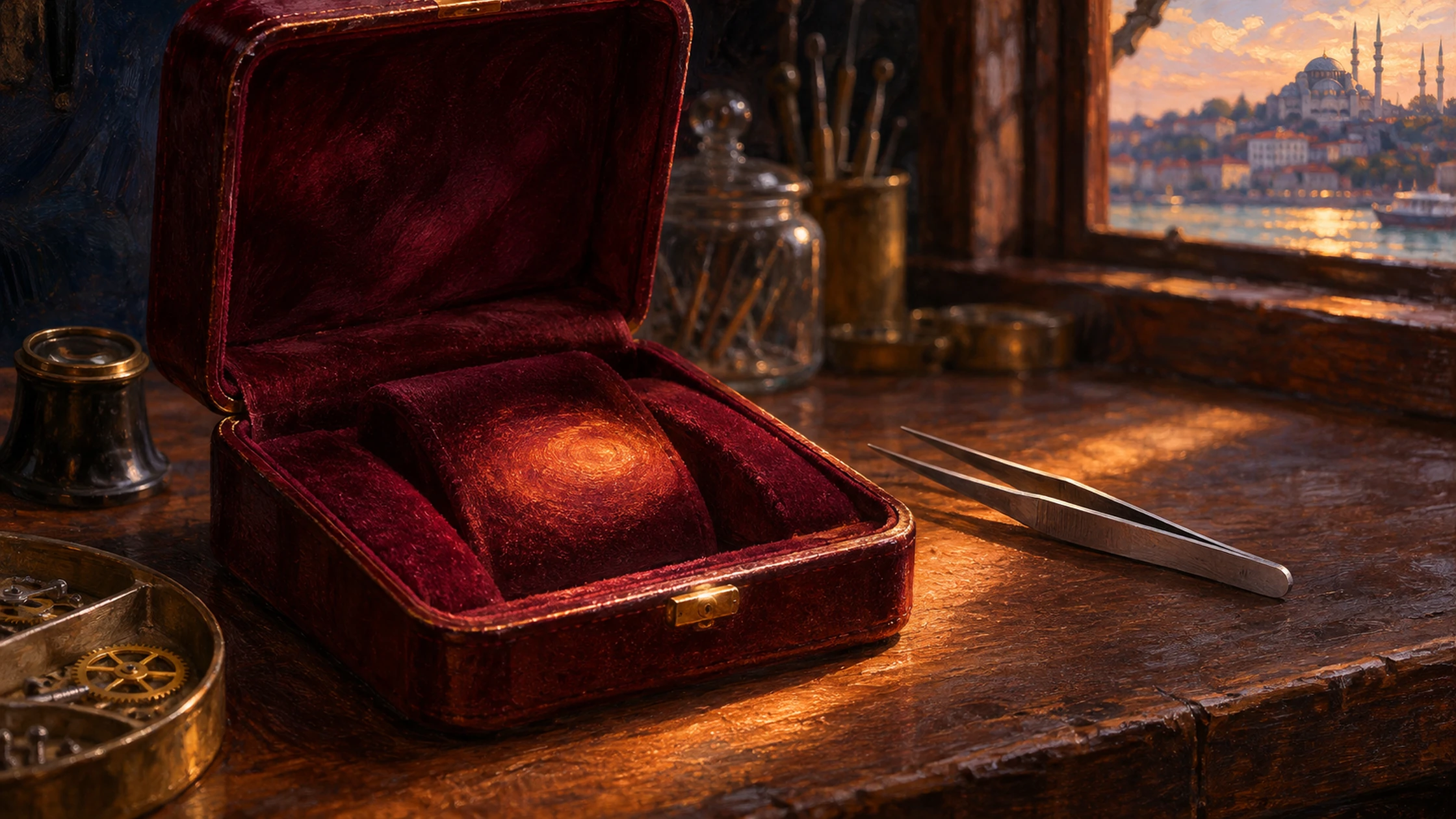
The burgundy velvet had faded except where his father’s watch had lain. He had taken the watch to the lender in its case, then asked for the case back. The woman behind the desk had waited while he found a reason.
“It belongs on a shelf,” he had said.
Now it stood open on the walnut workbench. A circle of late sunlight rested in the vacant hollow. His fine tweezers lay beside it.
Derya, his apprentice, came through the curtain carrying two cups of tea.
“Your customer called.”
“Which one?”
“The one you’re waiting for.”
There were several people Orhan was waiting for, but he knew whom she meant.
“Tomorrow?” he asked.
“Next week.”
He reached for the tea before she had put it down. A little spilled into the saucer.
The shutter had broken on a Tuesday. It had come down crooked and stopped, leaving the shop neither open nor shut. Orhan had stood beside it with the repairer while people squeezed past on the Istanbul pavement, looking at the exposed bottom of the window.
The repair cost 40,000 lira. The shop could not be left that way. He had a completed customer order worth 48,000 awaiting collection and payment: several watches, repaired and serviced. There had seemed to be a short distance between the bill and the money that would pay it.
Against his father’s watch he had arranged a short loan. Forty thousand reached him, without a deduction, and all of it went to the shutter repair. Under the written terms, 40,600 would settle the loan after the first month.
He remembered being pleased by the clean fit of those numbers. It was an embarrassing memory now. The customer’s invoice had acquired the solidity of cash in his imagination, although no cash had arrived.
He kept the agreement in a folder marked with the repayment date. Above the date he had placed a note about a watch movement he wanted to order. The note had slipped. For three days, it covered the date completely.
Derya moved it while looking for a receipt.
“Isn’t this Monday?” she asked.
He told her he knew. Then he called the customer.
At fifty-one, Orhan disliked being told he had his father’s hands. His father’s hands had been broader, with a pale scar beside the thumb. His father could make a shy customer feel welcome and a careless apprentice wish to become very small. People remembered the first quality more readily than the second.
The watch was a gift his father had bought himself after a good year. He had then pretended it was necessary for business.
“You have to show people what a properly kept watch looks like.”
“And a properly kept moustache?” Orhan’s mother had asked. His father had touched it at once.
Orhan remembered that dinner whenever he opened the case. He remembered the potato balanced on the edge of his father’s fork while he inspected his reflection in the back of a spoon.
The watch itself was neither immaculate nor unique. There was a scratch on its back that his father had made, then blamed on a clasp. Orhan had never polished it away.
When the first repayment date came, the customer still had not paid. Orhan went to the lender and asked for more time.
They agreed a further thirty days. He paid the 600 interest due from money the shop had already earned and could spare. The receipt showed that payment. The new agreement still showed 40,000 principal outstanding, with another 600 payable at the end of the extension.
He read those lines twice. He had bought a month and recovered none of the watch.
Outside, he checked his telephone. The customer had sent a message apologising for the inconvenience. Orhan put the telephone away without replying.
For the first week of the extension, he could almost work as before.
Then he began interrupting repairs to look at messages. A small screw escaped his tweezers one afternoon, and he spent twenty minutes on the floor. Derya found it caught in the turn-up of his trousers.
“Very secure storage,” she said.
He should have laughed. Instead, he told her to finish the job she had been given.
At closing time he apologised.
“I wasn’t laughing at you.”
“I know.”
She rinsed the cups in silence. He heard the little tap of glass against the sink and wished she would make another joke, so he could answer it properly.
That evening he laid out the things he might sell. Some belonged to customers and were not his to consider. Some were parts and working stock he would need for repairs already promised. Selling the useful pieces cheaply would leave holes in work that was supposed to bring in money next month.
There was an old desk lamp he could spare. He moved it to the floor. It made the exercise feel less empty, but its likely price would not settle the loan.
His sister came in as he was putting the stock away. She noticed the case.
“Still there?” she asked.
“The case is.”
She sat in the customer’s chair. He told her about the extension, the six hundred already paid, the new date.
“Father wouldn’t want you—”
“Please don’t.”
She stopped.
“Sorry,” he said. “You don’t know. Neither do I.”
His sister looked at the little hollow in the velvet.
“He’d have complained about the shutter bill.”
“He would have offered to fix it.”
“And we’d have had to stop him.”
This time Orhan laughed. They sat with that version of their father for a while: difficult, interested, alive in the wrong kind of repair.
The customer called four days before the new deadline.
“I’m sorting it out,” he said. “I know you’ve been patient.”
“Can you give me a date?”
“Very soon.”
“A date I can rely on.”
There was a pause. Orhan heard traffic on the other end. He could not tell whether the man was embarrassed or merely looking for somewhere to park.
“I can’t promise this week.”
When Orhan put down the telephone, he wrote 48,000 on a piece of paper. Under it he wrote Not received. The words looked childish. He left them there.
The invoice included parts and work; even when paid, it would not all be free profit. For now it could pay nothing at all.
The lender was willing to discuss another extension. Orhan would pay the current period’s 600 now; another month would add a further 600, with the 40,000 principal still to repay. He could probably find the six hundred due now. But he could not name the receipt that would reliably provide the principal and new interest after another month.
He had already paid six hundred. Paying six hundred more would not get the first payment back, and would still leave the principal. He folded the offer and returned it to the folder unsigned.
A collector he knew through the trade had previously expressed interest in his father’s watch. Orhan called him before he could turn the decision into another evening’s work.
“The watch is pledged,” he said. “It isn’t here for me to hand over.”
The collector said he understood. He would consider buying it if the lender agreed to a documented settlement and release.
Orhan described the scratch.
“I remember,” the collector said.
“It’s still there.”
“That’s all right.”
It was a considerate answer. Orhan disliked him for it for about five seconds, then asked when he was free.
The arrangement took several calls and a written agreement between Orhan, the buyer and the lender. Orhan checked it before the meeting. He was agreeing to a sale, not walking away from the loan or selling a watch that he could release on his own.
The agreed price was 54,000 lira. The lender’s written settlement figure was 40,600: the unchanged 40,000 principal and the second period’s 600 interest. The earlier 600 was already paid. There were no additional charges in their agreed figures.
At the meeting the buyer paid 40,600 directly to the lender and 13,400 to Orhan. They waited for both payments to be confirmed. The lender recorded the loan as settled, released its claim and handed the watch to the buyer under their agreement.
Orhan kept the confirmation showing nothing more owed. The 13,400 was what remained from the sale after the outstanding debt; he could not put 54,000 in the shop’s cash book as money available to spend.
The buyer held the watch in his palm before fastening it. His sleeve caught on the clasp. Orhan’s hand moved towards it automatically, then stopped.
“May I?” he asked.
The buyer extended his wrist.
Orhan freed the cloth. For a moment the watch lay against another man’s pulse, close enough for him to see the scratch on the edge of the back.
“Thank you,” the buyer said.
On the way home Orhan bought nothing. He had a strange feeling that any purchase, however small, would be the thing he had exchanged the watch for.
At the shop he found the desk lamp still on the floor. He put it back on the shelf and closed the case.
The late customer paid the following week. The receipt became real money on that day, available for the business’s bills and continuing work. It did not undo the sale, and Orhan did not call the collector.
He still thought of doing so. Sometimes, while waiting for the kettle, he composed the beginning of the conversation. Then the kettle stopped and he took the cups through.
The case went back on its shelf. For a while he kept it shut. Eventually he opened it because the hinge had begun to stick and he wanted to see why. Afterwards he forgot to close it.
Three months later Derya brought a customer’s watch to his bench. It was the same model as his father’s, with a different strap and a clean case back.
“I haven’t worked on one of these,” she said.
Orhan put on his loupe. The customer’s name was on the job ticket. He read it, although he already knew whose watch it was.
“Take your time.”
She reached for the wrong-sized tool, considered it and put it back before he spoke. He watched her choose another.
His father had used to hover at his shoulder, breathing loudly through his nose until Orhan’s own fingers began to shake. Orhan moved his chair a little further away.
“Tell me if I’m about to do something expensive,” Derya said.
“You’ll hear me.”
She smiled without looking up. Her hand settled. He answered her questions, sometimes with words and sometimes by placing the right tool within reach. Once he took over to show her a movement, then gave the work straight back.
At the end of the afternoon she asked him to check it. He bent beside her, close enough now to see what she had done.
The empty burgundy case stood behind them. Sunlight had reached the round mark in its velvet. Orhan moved his fine tweezers away from Derya’s elbow and stayed beside her while she finished.
Money behind the story
Orhan’s invoice is money owed, not money received. The Australian Taxation Office’s cash-flow guidance emphasises when money enters and leaves a business. That general timing principle is used here; Australian tax and business rules are not applied to Istanbul.
All lira amounts and terms are invented. Orhan receives and spends 40,000 on the shutter. His first 600 payment covers interest and secures an agreed extension; it does not reduce the 40,000 principal. The eventual settlement is 40,600, including the next period’s 600. Total finance cost is therefore 1,200. Of the 54,000 sale price, the buyer pays 40,600 directly to the creditor and 13,400 to Orhan. The prior 600 is already spent, not another deduction at settlement. Orhan does not receive 54,000 of spendable cash.
MoneyHelper explains lending against pledged valuables and the need to understand principal, interest and an agreed extension. It is UK guidance: its notice periods, sale rights and other legal protections are not Turkish rules. This fictional transaction assumes a lawful arrangement and a written sale-and-release agreement accepted by all parties, with all charges included. It does not imply a borrower can sell pledged property freely or compel a creditor to accept a private sale. Actual rights depend on the agreement and applicable local law.
Financial sources checked 25 November 2026. Story figures and outcomes are illustrative. General financial education, not individual financial advice.
Stay with the story: three questions
- When have you treated money someone owes you as though it were already available to spend?
- What would another extension change about your ability to repay, beyond moving the date?
- Which parts of an inheritance live in an object, and which might remain in your work or relationships?



