
Money Stories · Original fiction · 10 minute read
Rui disliked the word slightly. A man who had spent twenty-six years opening a café before the first delivery van deserved a more committed disagreement.
“Slightly reduce your milk order,” the purchasing assistant advised. Eighteen litres instead of the usual twenty.
Outside, Porto was preparing for a neighbourhood festival. A worker stood on a ladder threading lights above the street. Rui could remember the festival when they had run out of clean cups and served coffee in the little glasses reserved for juice. The assistant could remember transactions. These were different accomplishments.
He entered twenty-four.
His daughter Bia, wiping the counter, watched his finger finish the number.
“It has seen the weather forecast.”
“I have seen a festival.”
“You can see both.”
She was twenty-three and had recently begun working paid morning shifts at the café. At home Rui told people she was helping him. Bia had asked him to stop saying helping. He had agreed, then said it to the baker the following morning.
The assistant had been her suggestion. Rui approved every order himself; the software could neither send an order to the dairy nor pay an invoice. Mostly it arranged his recent sales into patterns and offered quantities. He had liked the tidy columns before they began disagreeing with him.
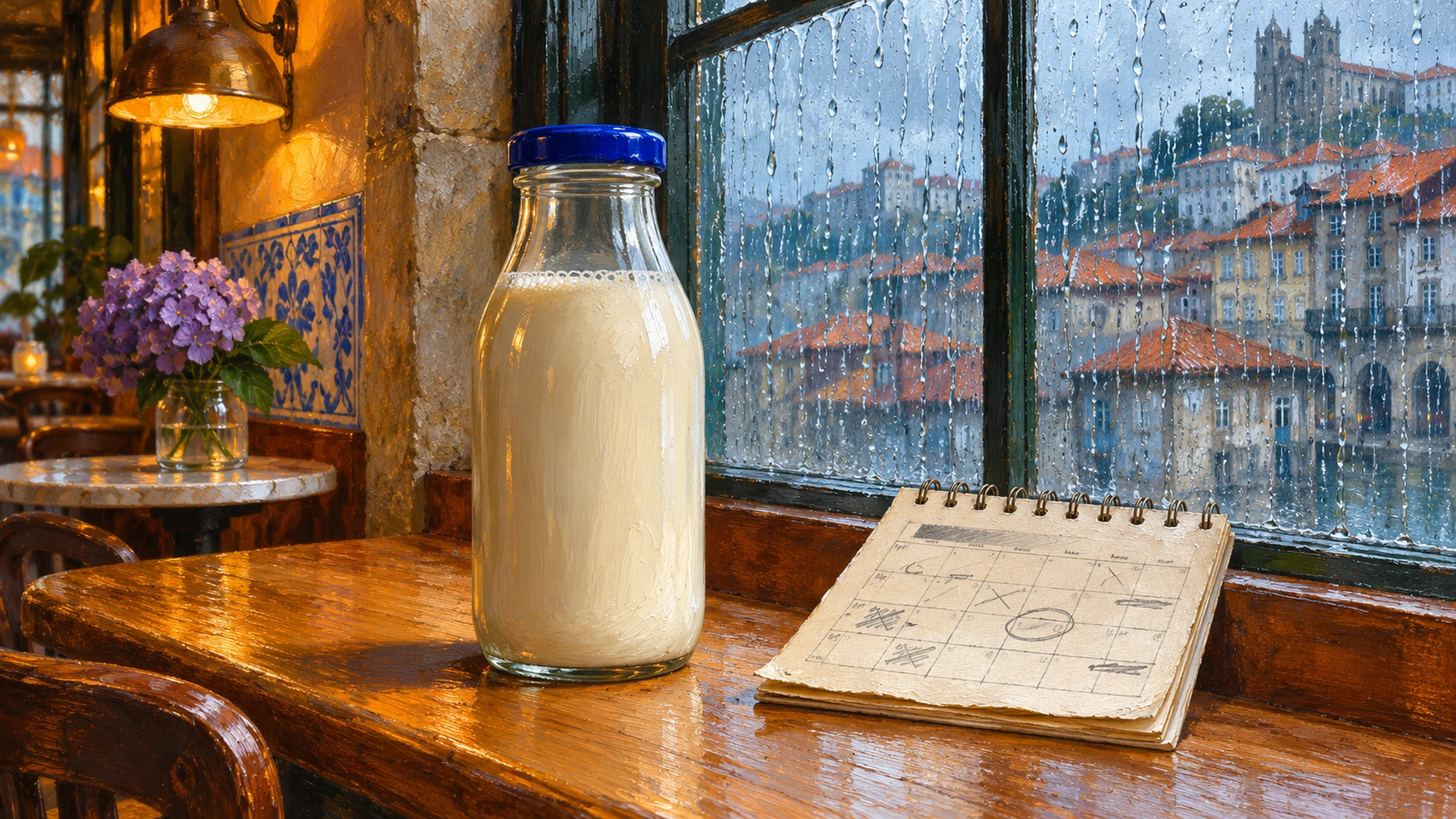
On Friday, the milk arrived in crates of one-litre glass bottles. Rui set one on the honey-coloured counter beside the paper calendar, its cobalt-blue cap bright under the pendant light. He liked this supplier’s bottles. Returning empties gave the business a shape he could lift.
At their agreed price of €1.40 a litre, twenty-four litres cost €33.60. He paid from the café’s existing working cash, as he always did on delivery. The festival takings had not arrived, but the invoice had.
By Saturday noon, the lights were hanging over an empty wet street. Rain ran down the window in parallel tracks until a gust joined them. A man came in carrying a folded stall canopy. He ordered an espresso and asked whether Rui had a towel.
Rui found him one. The man sat with the towel over his shoulders, resembling a boxer who had lost to the Atlantic.
“People will come when it clears,” Rui said.
The man examined the window. “Of course.”
On Sunday Bia brought her own lunch because the festival stall where she had planned to eat never opened. Rui pretended not to notice the sandwich. Through the following days, ordinary customers returned, but the festival customers did not arrive late to make the figures come true.
By the end of that delivery cycle, eighteen litres had been used. Six were left when their usable period ended. Rui checked the bottles and their dates. Keeping them did not make them usable.
He poured the milk away himself.
Bia was counting cups. She stopped while the liquid ran into the sink, then resumed. He was grateful that she did not speak and irritated that he had to be grateful.
Six litres. €8.40 of the purchase. Not the price of the coffees he could have sold, because nobody had bought those coffees. He wrote €8.40 on the invoice and tucked it beneath the till.
“Eighteen,” Bia said later, when they were alone.
“I can count.”
“I know.”
He wanted her to say the forecast had been lucky. It had been lucky, surely. Had the rain shifted north, had the canopy held, had the people been the sort who came out in rain—
She put a clean cloth over the espresso machine’s warming tray. “I’m not asking you to give it your keys.”
The next order recommendation was eighteen again.
Rui left it unchanged, with the air of a man allowing someone else to select the music in his own car. Eighteen bottles arrived. He paid €25.20. There was no usable milk carried over from the previous batch.
The second week was ordinary in ways that felt almost theatrical. The electrician complained about parking. Two students split a pastry. An elderly regular asked for his coffee hotter, as he did even when it was already too hot for Rui to carry comfortably.
They used seventeen litres before that batch’s remaining milk had to be discarded. One litre, costing €1.40, went down the sink.
“It was wrong,” Rui said.
“By one.”
He looked at Bia. She looked back, holding the empty bottle.
He laughed first. It surprised him enough that he had to sit down.
“All right. By one.”
She sat opposite. For a while they listened to the dishwasher taking in water. Then she drew four vertical lines on the reverse of an old menu.
“What it suggested. What we changed. Why. What happened.”
“That’s five columns.”
“Four lines, five columns.”
He took the pencil and put the dates at the top.
They kept the original recommendations. Rui could not edit eighteen into seventeen after the week was over and call the assistant perfect; Bia could not quietly remove the twenty-four he had actually ordered. Under his first change he wrote Festival. He paused, then added Expected a crowd despite rain forecast.
“You can write the rain was worse than I expected.”
“Then write that.”
He did. The sentence felt less like an admission once it was complete.
Bia’s shift had finished. He noticed her coat still hanging behind the door and asked whether she wanted to leave.
“I want to finish this. But tomorrow I want you to show me where you keep the supplier numbers.”
“You only have to ask.”
“I am asking.”
He had meant it generously. He heard, a moment later, the small door inside the sentence: everything available, provided she came through him. He opened the drawer beside the till and took out the dog-eared book. Some names belonged to businesses that had closed. One was a man who had died. He crossed those out while she copied the current numbers.
Under the second week, they entered eighteen ordered, seventeen used, one discarded. The used column included milk put into drinks and routine preparation. It was not a column of paid coffees. They would keep the sales record separately, along with the café’s other expenses.
Bia added another little space at the bottom: people turned away because there was no milk.
Rui tapped it. “We don’t run out.”
“Then it will be easy to fill in.”
He remembered a summer afternoon when he had sent a customer across the street. The customer had stayed across the street. He said nothing, but left the space there.
The following Wednesday, Bia laid a school notice beside his calendar. Her friend’s younger sister had brought it home. An open morning was planned for the next delivery week, with families leaving through the gate around the corner.
The assistant’s new recommendation was eighteen litres.
“It doesn’t have this,” Bia said.
“A festival, then.”
“No. A different event, with the same possibility of us getting carried away.”
Rui moved the notice closer. It was easy to like his daughter when she was a child explaining something she had just learned. It was more difficult to be corrected by an adult whose front tooth he remembered keeping in a matchbox.
She had called the school office to check the date and which gate they would use. She had not asked anyone to promise that parents would buy coffee. There was no guest list for the café. The notice gave them one piece of information, not customers in advance.
“How much?” he asked.
“I want to know what you think first.”
He glanced at her, suspicious of a technique.
“You’ve served this street longer than I have,” she said. “That’s an actual question.”
He looked at the previous orders. He wanted to say twenty-four, partly because the number still needed defending. Instead he took another sheet and worked out a smaller allowance for extra milk drinks across the morning. They checked it against the portion measures they used behind the counter.
Four extra litres. Twenty-two altogether.
There was room for the €30.80 purchase in the working cash already available. They did not have to borrow it or rely on the school’s families spending anything. They could lose money on unused milk again. Rui could bear that particular amount; he did not want to make being unembarrassed a purchasing rule.
Bia wrote the unchanged baseline, eighteen, then the addition of four, the school date, and the reason. Rui looked over her shoulder.
“Put uncertain.”
“I was going to.”
Their supplier, Duarte, phoned on Thursday because Rui had sent the order before the agreed noon deadline, without a second message changing it.
“I thought perhaps your phone had broken,” Duarte said.
Rui told him about the school.
“So shall I put you down for twenty-two every week?”
“No. Just this delivery. But you’ll have the next order by noon on Thursday too.”
It was a promise he could make without knowing whether it would rain.
On the open morning, the first family bought two espressos and a juice. Rui looked briefly at Bia. She ignored him. The second family ordered nothing and asked for the toilet. He gave them the key.
Then three people wanted milk coffees at once. Bia took the cups while he steamed the milk. She was getting better at hearing when to stop, though she still watched the jug as if it might conceal an exam question.
At half past eleven, a father reached the till with a paper crown sticking out of his coat pocket. He asked for a coffee and then, with the weary dignity of someone negotiating on behalf of a ruler, a second glass for the juice. Rui found one.
There was a busy hour, then a quiet one. The school traffic did not turn the café into a different business. Bia ate lunch sitting down. Rui repaired the loose handle on a cupboard. The festival lights were finally removed from the street.
Across the complete delivery cycle, they used twenty-one litres. At the end, one unusable litre remained and was discarded. They recorded its €1.40 purchase cost. No milk had carried into this cycle, and none would carry into the next; the bottle counts agreed with the quantities on their sheet.
The staff had noted no milk orders they had been unable to serve. That did not tell them what every passer-by might have wanted. It told them what they had seen.
Bia put the three weeks side by side. She did not call the third one a victory. Rui was glad. He would have been obliged to argue.
“Eighteen, eighteen, eighteen,” he said, pointing at the original forecasts.
“Eighteen, seventeen, twenty-one,” she said, pointing at the milk used.
“And next week?”
“We haven’t looked.”
The baker came in while they were clearing the table. He asked whether Bia was still helping her father.
“She works mornings,” Rui said. “And we do the orders together.”
Bia bent to collect a fallen pencil. When she straightened, she was smiling at the floor.
After closing, he showed her how to lift the milk jug a little earlier, how to hear the change beneath the machine’s louder noise. She tried it with water first, while he wiped the counter around the blue-capped bottle waiting to be returned to the fridge.
Her second attempt was better. On the calendar, a corner had curled into a damp patch. Rui held it flat while Bia reached for the pencil.
Money behind the story
A forecast, a purchase and the stock actually used are three different records. The Australian Government’s inventory guidance recommends tracking quantities and costs, checking physical stock and considering demand and delivery timing when reordering. Here that is a general method; Australian business or tax rules are not being applied to a Portuguese café.
The invented price is €1.40 per litre. The three purchases cost €33.60, €25.20 and €30.80: €89.60 for 64 litres. The café uses 56 litres and discards eight, whose purchase cost is €11.20. Each cycle starts with no usable carryover and ends after the remaining milk becomes unusable. All purchases are paid from existing working cash. These figures do not calculate profit, retail sales lost, or the cost of staff, software and other supplies.
Hyndman and Athanasopoulos’s forecasting text explains why relevant information missing from a statistical forecast can justify an adjustment, and why reasons should be documented. Keeping the original eighteen-litre forecasts makes Rui and Bia’s changes visible. Three weeks cannot establish the assistant’s reliability; their record also cannot measure every unobserved customer who might have bought something. The fictional milk prices, delivery arrangements and usable periods are scenario assumptions, not Portuguese market or food-storage guidance. Sources checked 25 November 2026.
Financial sources checked 25 November 2026. Story figures and outcomes are illustrative. General financial education, not individual financial advice.
Stay with the story: three questions
- Which piece of your own experience would be useful to write down so someone else could assess it?
- What information could change a forecast without making the original forecast dishonest?
- When an order works out well, what would you need to record before calling the decision repeatable?



