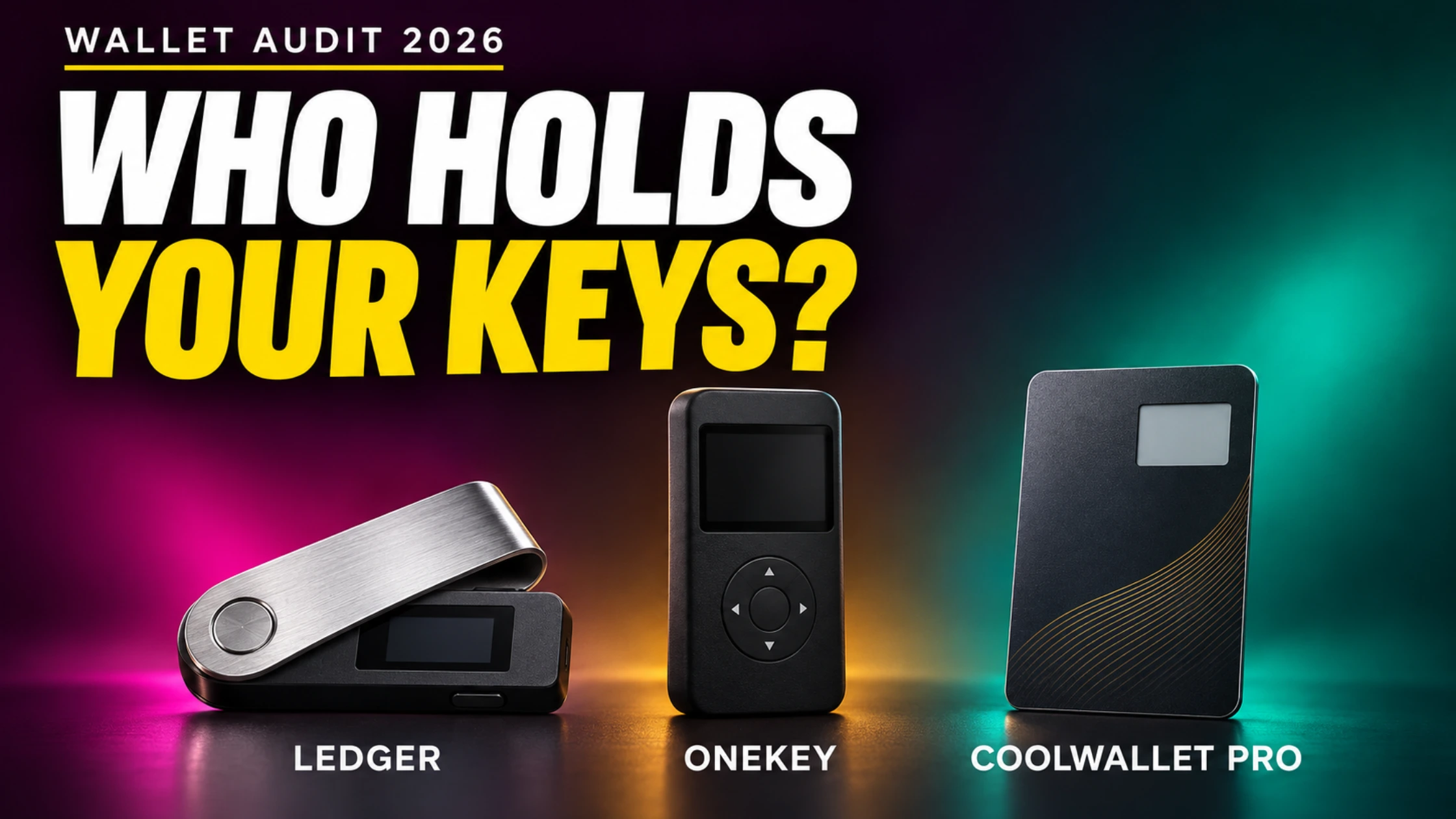
Self-Custodial Hardware Wallets & Air-Gapped Key Management: Ledger vs. OneKey vs. CoolWallet Pro (2026 Audit)
Key Takeaways (DN Self-Custody Benchmarks)
- The Non-Custodial Security Mandate: As centralized exchange collapses and smart contract approval drains continue to highlight counterparty risks, cold storage hardware wallets featuring Secure Element (EAL6+) chips and air-gapped signing mechanisms remain the ultimate defense for private key isolation.
- Blind Signing Risk Mitigation: Modern hardware wallets utilize clear-signing interfaces, parsing smart contract call data off-chain to display human-readable transaction parameters (spender address, token allowance, max slippage) before cryptographic signature generation.
- Ledger dominates institutional cold storage via its Secure Element chip architecture, Ledger Enterprise custody ecosystem, and deep integration with Web3 dApps and DeFi interfaces.
- OneKey delivers open-source, multi-chain hardware security, offering fully transparent firmware, native EVM/Solana/Bitcoin support, and air-gapped QR transaction signing.
- CoolWallet Pro provides credit-card form factor portability, enabling secure Bluetooth-encrypted mobile signing for active Web3 traders and on-the-go DeFi allocators.
Featured Security Outlets & VIP Discount Portals
Access certified cold storage hardware, secure key management devices, and priority cross-chain routing using our verified partner portals:
- 🔹 Ledger Hardware Portal: Get Certified Ledger Hardware Wallets — Direct Partner Link
- 🔹 OneKey Open-Source Hub: Launch OneKey Hardware Store — Referral Code:
46Z9TD - 🔹 CoolWallet Pro Mobile Vault: Get CoolWallet Pro Credit-Card Vault — Direct Partner Link
- 🔹 evedex (Low-Latency Execution Engine): Claim evedex VIP API Key — Promo Code:
9e3mk2nx - 🔹 deBridge (Cross-Chain Capital Router): Bridge Capital via deBridge — Partner Link:
20473 - 🔹 LogX Router (Multi-Chain Aggregator): Launch LogX Derivatives Router — Promo Code:
0506B422.logX
1. The Imperative of Air-Gapped Key Isolation in Web3
In digital asset trading, holding private keys on internet-connected devices (hot wallets like browser extensions or mobile apps) exposes capital to zero-day browser exploits, malicious dApp approvals, and clipboard hijackers.
Cold Storage Hardware Wallets isolate private key generation and transaction signing inside specialized microcontrollers (Secure Elements). When a trader executes a swap on a DEX or signs a perpetual futures order, the raw private key never leaves the hardware device. Instead, the transaction payload is sent to the hardware wallet, cryptographically signed inside the isolated chip, and returned to the network as a signed transaction hash.
To eliminate vulnerabilities associated with malicious smart contracts, 2026 hardware wallet benchmarks focus on three core defense pillars:
- Clear-Signing Execution: Replacing raw hexadecimal data with human-readable contract details on the device display.
- Air-Gapped Communication: Using camera-based QR code scanning or optical transfers instead of USB or Bluetooth connections to prevent malware transmission.
- Open-Source Auditability: Verifiable firmware codebases that allow security researchers to confirm zero backdoor insertion.
To evaluate which cold storage solution delivers the highest security rating, dApp composability, and hardware durability, Decentralised News audited Ledger, OneKey, and CoolWallet Pro.
2. DN Key Management & Hardware Security (DN-KMHS) Framework
Our security engineering team evaluates self-custodial hardware wallets using five quantitative criteria:
- Secure Element Certification Rating: Hardware resistance rating (e.g., EAL5+, EAL6+) against physical side-channel attacks, fault injection, and laser probing.
- Clear-Signing Contract Parsing Depth: Ability of the wallet firmware to parse complex EVM, SVM, and Move smart contract interactions into human-readable text.
- Firmware Open-Source Verifiability: Codebase transparency, checking whether firmware and hardware schematics are 100% open-source or proprietary.
- Air-Gapped Transmission Vector: Communication protocol security (Camera/QR Code, USB-C, Encrypted Bluetooth BLE 5.0).
- Multi-Sig & Institutional Vault Compatibility: Native integration with multi-signature architectures (e.g., Safe, ERC-4337 Account Abstraction, Ledger Enterprise).
3. Hardware Wallet Security Comparison Matrix
Below are the empirical benchmarks from our continuous 30-day hardware security audit:
| Hardware Wallet | Secure Element | Code Architecture | Air-Gapped Mode | Primary Form Factor | Verified Partner Portal |
|---|---|---|---|---|---|
| Ledger (Nano/Flex) | ST33 (EAL6+) | Proprietary BOLOS OS | USB-C / Encrypted Bluetooth | USB / Touchscreen Vault | Ledger Store |
| OneKey (Classic/Pro) | EAL6+ Secure Chip | 100% Open-Source Firmware | Air-Gapped Camera & QR Code | Compact / Touchscreen | OneKey Hub (46Z9TD) |
| CoolWallet Pro | CC EAL6+ Certified | Proprietary Secure Element | Bluetooth Encrypted Pairing | Credit-Card Flexible Form | CoolWallet Store |
4. Platform Deep Dives: Top Cold Storage Outlets
1. Ledger — The Institutional Industry Standard
Ledger remains the market leader in hardware security, powering retail and institutional cold storage through its proprietary BOLOS operating system and CC EAL6+ certified Secure Element chips.
Key Highlights: Clear-signing standardization displays human-readable smart contract details on-device, supported by deep dApp ecosystem connectivity and Ledger Live software.
💡 Security Pro Tip: Purchase authentic hardware units directly from the official Ledger Store to ensure supply chain integrity.
2. OneKey — Fully Open-Source & Air-Gapped
OneKey delivers an open-source hardware wallet ecosystem favored by developers, privacy advocates, and multi-chain allocators.
Key Highlights: 100% open-source software and hardware codebases paired with camera-based air-gapped QR code transaction signing on OneKey Pro.
💡 Security Pro Tip: Order open-source cold storage devices on the OneKey Store (Code 46Z9TD).
3. CoolWallet Pro — Ultra-Portable Credit-Card Vault
CoolWallet Pro redefines cold storage portability with a flexible, waterproof credit-card form factor designed to fit inside standard physical wallets.
Key Highlights: AES-256 encrypted Bluetooth mobile pairing enables secure on-the-go transaction signing and native PoS asset staking via iOS and Android apps.
💡 Security Pro Tip: Get credit-card form factor security from the CoolWallet Pro Store.
Frequently Asked Questions (FAQ)
What is the difference between blind-signing and clear-signing?
Blind-signing occurs when a wallet screen displays raw, unparsed hexadecimal code during a smart contract interaction, forcing the user to trust the host computer. Clear-signing parses the smart contract data, displaying human-readable contract details (spender address, exact token amounts, maximum approval limits) on the hardware screen so the user can verify parameters before signing.
What is an air-gapped hardware wallet?
An air-gapped hardware wallet has no physical or wireless connections (no USB, Bluetooth, Wi-Fi, or cellular connectivity). It communicates with host devices exclusively through optical QR code scanning using a built-in camera, eliminating direct physical or wireless attack vectors.
How do I bridge assets safely across chains using hardware wallets?
When moving assets across networks, always verify the destination address on your hardware wallet's clear-signing screen. Using intent-based cross-chain routers like deBridge allows you to execute native asset transfers in under 25 seconds with zero wrapped token risk.