
Money Stories · Original fiction · 9 minute read
Ben had practised saying “shall we just pay for our own?” often enough to develop a voice for it. Casual. Almost bored. A man introducing an idea that had occurred to him that very second.
When the bill arrived, he said, “Lovely.”
He had meant the evening. Nisha took it to mean the bill.
“I’ll put it through the app,” she said.
There were five of them, wedged beneath a plastic fern in a Manchester restaurant whose menu was attached to a block of wood. Ben’s menu had rocked throughout dinner. He had corrected it with a folded napkin, which Cal called the only successful treatment Ben had provided all week.
“Excellent progress,” Ben had told the menu. “Keep doing the exercises.”
He was twenty-eight, a junior physiotherapist, and genuinely fond of these people. Nisha had come to his flat with a screwdriver when his bed collapsed. Jo remembered the anniversary of his dad’s death without making him talk about it. Adam sent photographs of dogs he thought Ben would respect. Cal had once spent an entire Saturday helping him move a sofa that neither of them wanted.
Their friendship was not a collection of cocktails charged to the wrong person.
The cocktails, however, were becoming a problem.
Ben had ordered the sixteen-pound aubergine dish and a three-pound soda. He liked aubergine. Choosing it had involved no spiritual sacrifice, although he had quietly calculated the price of the fish.
The food and drinks came to £180. The optional service charge was £18.
“Leave that on?” Nisha asked.
Everyone said yes. The waiter had found Jo’s lost earring under a radiator.
“Thirty-nine sixty each, then.”
Nisha paid the £198 on her card. Four little requests went out. Ben’s arrived with a green circle and a photograph of him looking happy beside a canal.
The app did not look like Nisha making a decision. It looked like a decision that had already been checked.
Ben opened the photograph of the receipt.
“He’s auditing the fern,” Cal said.
Ben laughed. It was a reasonable joke. He wished it had been made on some other night.
“No, just transferring.”
He paid £39.60, as did Jo, Cal and Adam. Nisha’s own share was the same. Nobody added another tip. Everything balanced.
His nineteen pounds plus ten per cent would have been £20.90. The difference was £18.70. He knew this before his coat was on. He was annoyed to find that he knew it on the tram, too, while the woman opposite ate chips with complete absorption.
He wanted to be thinking about Jo’s story: her boss had asked her to make a drawing “more triangular emotionally”. For ten minutes they had tried to decide which emotion a rectangle represented. Ben had laughed so hard his jaw hurt.
Instead, he was moving £18.70 between imaginary columns.
At home he took his lunch out of the freezer, washed his face and delivered a speech to the bathroom mirror.
“There is a difference,” he told his toothbrush, “between being generous and being volunteered.”
Excellent. Clean. Devastating.
Then he pictured saying it to Nisha, who had remembered five people’s availability, two dietary requirements and the fact that Adam couldn’t sit beneath a speaker. The speech lost some of its shine.
He still wanted the eighteen pounds seventy.
Three weeks later, Nisha posted a link to a new restaurant.
Ben opened the menu. Small plates. No explanation of how small.
He typed, “I can’t make that one.”
It was Thursday. He could make it. He could make it so thoroughly that, if he declined, he would spend the evening hearing imaginary laughter through his phone.
He deleted the message.
“I’d like to come, but I need to keep dinner to thirty pounds including a tip. Can we agree to pay for what we each order? And agree shared things before ordering them?”
He put the phone facedown on his bed.
He picked it up.
Cal had replied: “Are we counting chips now?”
Ben began the toothbrush speech.
Before he could send it, another message appeared.
Cal: “Genuine question. I like not having to keep track.”
Ben deleted the speech again. This was becoming its principal function.
“I know. But keeping track is how I keep it to thirty.”
Nisha called while he was putting clean pillowcases on.
“I didn’t know it was bothering you.”
“I kept demonstrating that it wasn’t.”
“You did.”
He trapped the phone against his shoulder. The pillow refused to enter its case.
“I’m not asking you to reconstruct every dinner since university.”
“Good, because I can’t face another discussion about the Brighton garlic bread.”
“That was structural garlic bread. It came with the meal.”
She laughed, then stopped. “But could somebody else find the place this time? Everyone says anywhere, then anywhere turns out to have six exceptions.”
Ben had been one of those people. His exception was usually expense, disguised as a mysterious dislike of the atmosphere.
“I’ll do it.”
“And I don’t want to spend the following week reminding people to transfer.”
“Same night.”
“You’ve invented my ideal evening. Food and the absence of admin.”
He found a café that served dinner on Fridays and sent the menu. They would get one bill; the café was happy to take a single card payment. They could divide it themselves. No service charge was added. Ben suggested paying for individual orders and adding a ten per cent tip, with any shared dishes agreed first.
Jo replied privately. A client hadn’t paid her. Could they choose a time when she could get the bus home?
“Yes,” Ben wrote, and moved the booking half an hour earlier. He did not offer the others Jo’s reason.
Adam couldn’t come. He had promised to help his brother dismantle a shed. Ben briefly suspected “shed” was the code his friends had chosen for avoiding him, then remembered Adam had sent fourteen photographs of the shed.
Cal agreed to the plan, though he added, “Still think it takes something away.”
Ben left the message unanswered for a while. Then he wrote, “Come and argue it over dinner.”
The café had four tables and a fridge that made a determined humming noise. Nisha arrived carrying a bag of library books. Jo came in apologising for the bus, although she was early. Cal’s umbrella folded inside out as he shut it.
“Designed for reverse rain,” he said, and leaned it by the door.
The first ten minutes were stiff. Everyone studied the menu with the solemnity of people signing something abroad.
“I’d like the dhal,” Ben said. “And a soda.”
“I also permit myself the dhal,” Cal said.
Nisha looked at him.
“Sorry.”
“You don’t have to narrate it,” Ben said.
That helped. A little.
They ordered. Cal wanted a side of roast potatoes and asked whether anyone wanted to share it. Nobody did. He ordered it anyway. When it arrived, he appeared to find the arrangement satisfactory.
Jo described the new feedback on her drawing. It now needed “less knowledge of itself”. Nisha took a library book out of her bag and held it against the wall, demonstrating how a book with less self-knowledge might stand. The woman behind the counter watched them without alarm.
For a while, Ben forgot the bill completely.
Then Cal put down his fork.
“My dad used to get there early and pay before anyone else could. Every birthday. Even when he wasn’t working.”
“I remember,” Nisha said.
“I loved that. I hate the feeling of everybody protecting their own little bit.”
Ben turned his glass on the table. There were several replies available that would win the argument and make Cal unhappy.
“When you had that gap between jobs, I bought your dinner,” he said instead.
“I know. I haven’t forgotten.”
“I liked doing it.”
“So what’s different?”
“You asked. I said yes.”
Cal nodded, but not in agreement. “I suppose I like it when you don’t have to ask.”
“I like being able to come.”
The fridge stopped humming. It made the silence seem worse than it was.
Nisha reached for the water. “I like that somebody else booked the table.”
Jo raised her glass. “An undercelebrated pleasure.”
Cal passed Ben the jug. The argument remained on the table, smaller now, beside the salt.
They stayed. Nisha told them about the man at work who had mistaken a shared calendar for a private diary. Cal showed them a video of his nephew attempting to whistle, which sounded like a bicycle tyre being inflated badly.
By the time the woman came to clear their plates, Ben was warm and still slightly hungry.
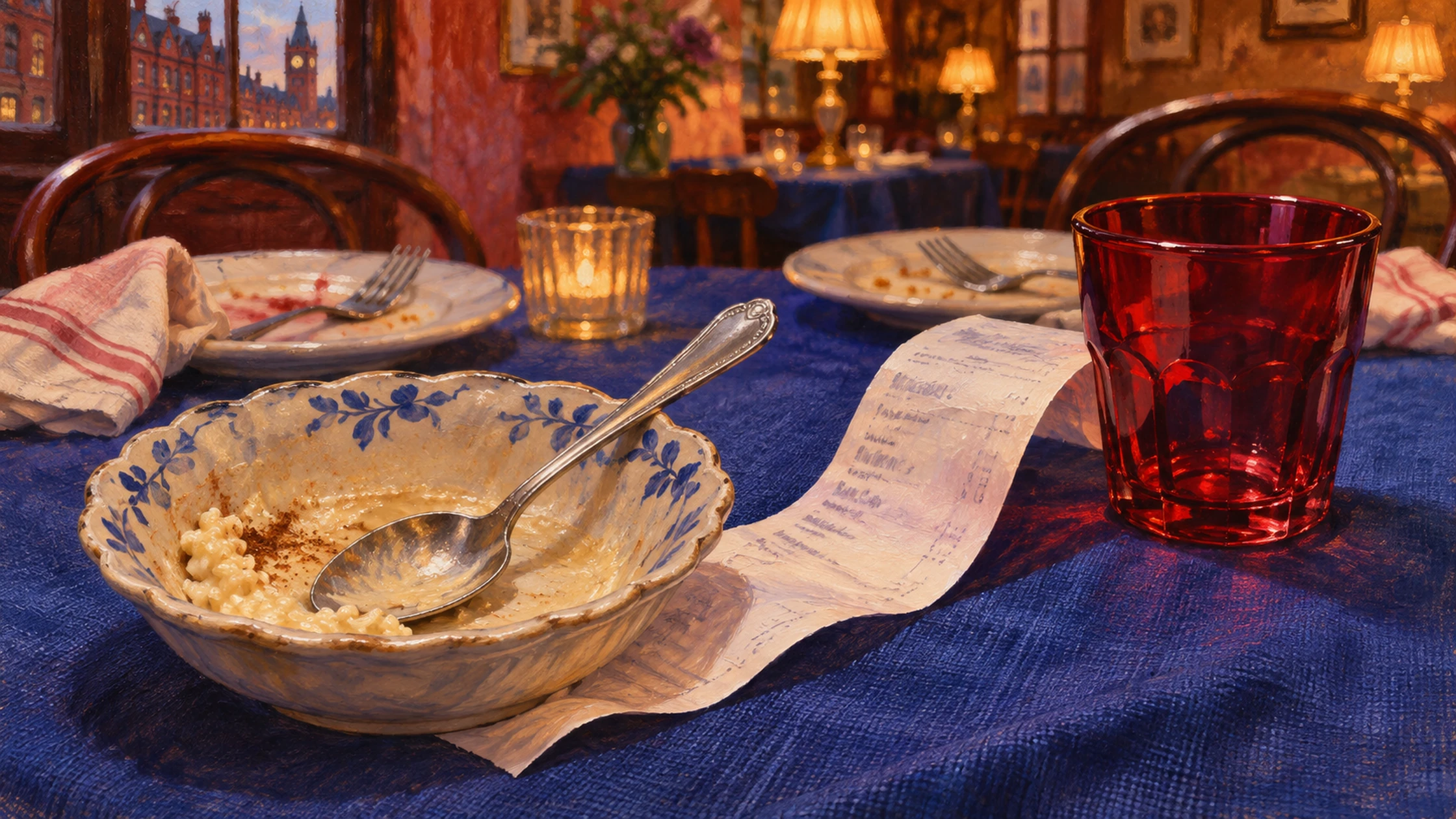
The little rice puddings were three pounds each. There were four left.
He checked his own order: ten pounds for the dhal and bread, two for the soda. Twelve plus the tip. Four puddings would be twelve, plus their tip. £26.40 altogether.
He could have kept the difference. He liked having a difference to keep.
“Does everybody fancy one? I’d like to get them.”
Nisha said yes. Jo asked whether they had nutmeg. Cal looked at Ben, perhaps checking for a trap, then said yes too.
They arrived in mismatched small bowls, each with a patch of brown skin. Jo pressed hers with the back of a spoon and sighed.
“That’s an emotion a rectangle could have.”
The bill was eighty pounds: sixty-eight for their separate food and drinks, twelve for the puddings. They added the agreed eight-pound tip. Nisha paid eighty-eight, then opened the app and entered different amounts.
“Mine’s nineteen eighty. Jo, seventeen sixty. Cal, twenty-four twenty. Ben, twenty-six forty.”
“Highest spender,” Jo said.
“It’s a very volatile table,” Ben said.
The three transfers arrived while Nisha was putting her books away. There was nothing left to chase.
Outside, Cal’s umbrella resumed its intended shape. He held it over them both while Ben searched for his tram pass.
“Still think it’s a bit of a faff,” Cal said.
“I know.”
“Dhal was good.”
“Yeah.”
Cal lifted the umbrella to let a woman pass. Rain struck Ben’s cheek. He found the pass in the wrong pocket and, for once, had no speech ready.
Money behind the story
An equal split and a split by individual orders distribute the same bill differently. Neither method establishes what every member of a group can afford. An app can calculate the chosen rule correctly while leaving that question unanswered.
At the first dinner, £180 of orders plus £18 service makes £198, or £39.60 each for five people. Ben’s £19 order with its proportional £1.90 service contribution would be £20.90. He pays £18.70 more under the equal split. The story does not treat this difference as an outstanding debt: that dinner is settled.
The second dinner has £68 of individual orders, £12 of puddings and an agreed £8 tip: £88. Ben pays £13.20 for his own order and tip, plus £13.20 for everyone’s puddings and their tip. His £26.40 is within his £30 limit. The other shares are £19.80, £24.20 and £17.60. Together they equal £88.
MoneyHelper’s guidance on talking with friends about money supports being open about affordability and proposing activities within your budget. It does not prescribe one universal restaurant rule. Agreeing the treatment of shared dishes, service, tips and repayment timing before ordering is an editorial application of that guidance. These invented UK prices illustrate the choices; they are not a restaurant survey. Source checked 24 November 2026.
Financial sources checked 24 November 2026. Story figures and outcomes are illustrative. General financial education, not individual financial advice.
Stay with the story: three questions
- What does Ben risk losing by speaking up, and what does remaining silent already cost him?
- Which parts of organising dinner fall to Nisha, and how does the new arrangement share that work?
- Why can Cal value spontaneous generosity while Ben still need a different rule for the bill?



