
Money Stories · Original fiction · 10 minute read
The certificate lived behind the birth certificates, where Pavel put things that could not be replaced by being sorry.
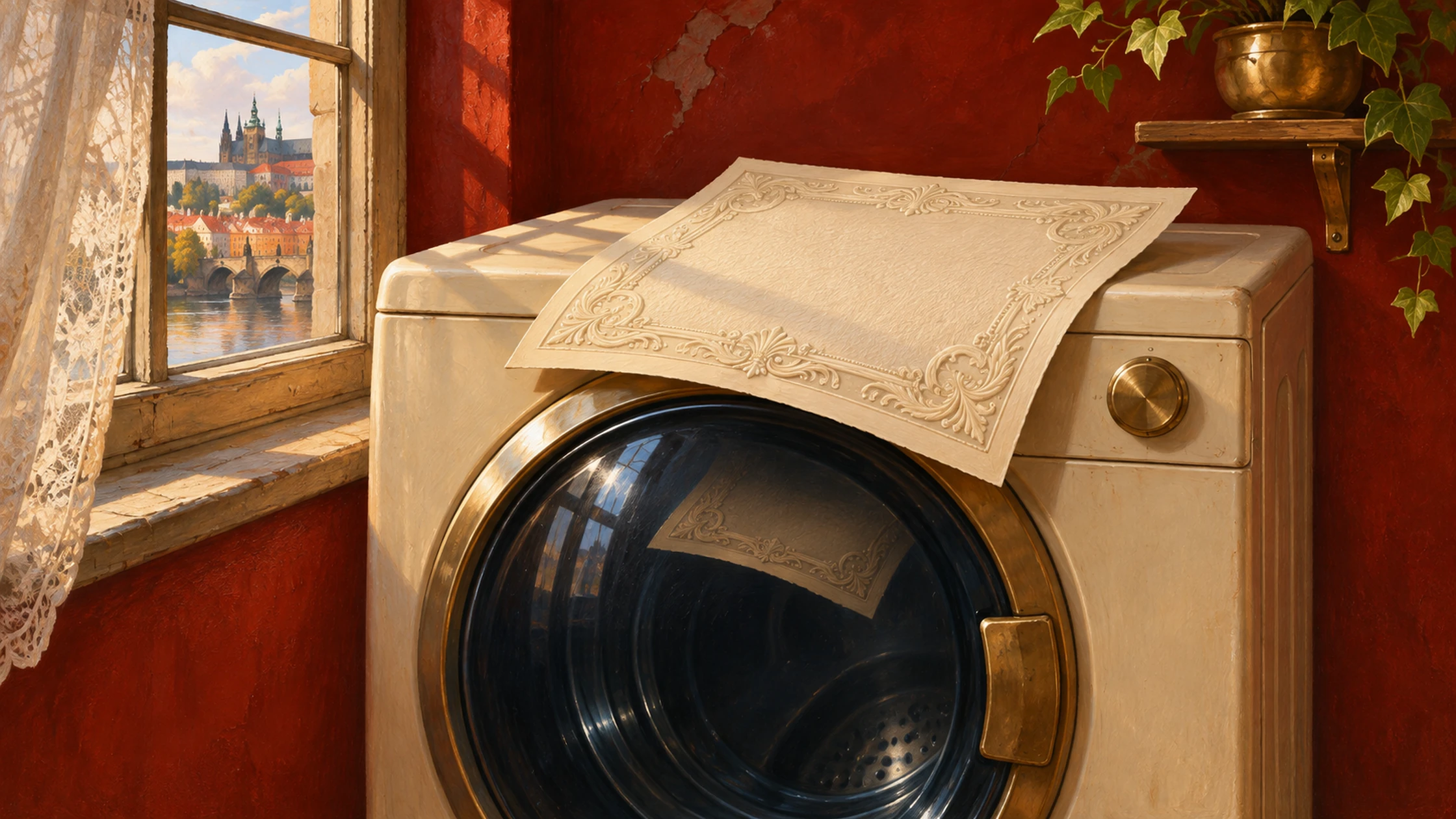
It had a silver border and his washing machine’s serial number. He had paid 1,800 crowns for five years of reassurance, although reassurance was not the word on the receipt. The machine itself had cost 18,900. He remembered both amounts because remembering expenditure was one of the ways he tried to deserve what he owned.
On Tuesday the drum made a noise like a chair being dragged across a ceiling. Pavel stopped the programme and stood in his Prague kitchen with a basket against his hip. Through the dark door he could see the white shirt he meant to wear on Friday.
His daughter Tereza was coming home to play with him at a small concert in a neighbourhood reading room. Violin and cello. Nothing ambitious, she had said, which he had accepted as a condition rather than an assessment. They had not played together in nearly a year.
She had asked him three weeks earlier while he was checking her return train. He had answered with the departure time. She had waited until he understood that she was inviting him to do something, not asking him to arrange it. Afterwards he had ordered fresh strings and practised before work, quietly, using the old mute. He had told Viktor about the invitation twice. He had not told Tereza that he was pleased. There would be time for that when they played, he had thought, as though gratitude were one of the things an instrument could be instructed to deliver.
He took the certificate from its sleeve. It was still clean.
The woman on the telephone asked when the fault had first appeared. He said that morning. She asked for the purchase date. Thirty-one months ago, he discovered. He disliked this number. The machine looked younger.
She arranged an assessment by a technician on the guarantee provider’s list. The visit would cost 600 crowns if the claim was not accepted. Pavel asked her to send that condition in writing. She did. He appreciated this until he wondered why he needed to appreciate it.
At work he processed corrections to municipal records. A form could be wrong in sixteen places and still have the right stamp. He had explained this to citizens with an expression he now suspected they had found unbearable.
Jiří arrived on Wednesday with a small case and a coat whose zip had lost its pull. He inspected the machine and wrote down a failed bearing assembly. The motor and control board were working.
“That’s good,” Pavel said.
“It depends which question you’re asking.”
Jiří sent his report. Later that afternoon the provider declined the repair under the additional guarantee, citing its list of covered components and a bearing exclusion. Pavel found the list on page four. Motor. Electronic control board. There was no silver border on page four.
He had believed a bearing was part of a motor. Jiří explained the distinction without enjoying it.
“It moves,” Pavel said.
“Many things move.”
Jiří gave him a written repair estimate of 3,600 crowns in total, including the 600 already paid for assessment. If Pavel went ahead, another 3,000 would be due. If further damage appeared, Jiří would stop and ask before doing anything beyond the estimate. He thought repairing this fault was reasonable. He did not offer a prediction of how many years the rest of the machine would live.
After Jiří left, Pavel searched for the salesman. He could picture the narrow tie, the demonstration towel, the thumb brushing a crumb from the counter. The shop told him the man no longer worked there.
“He said it covered the expensive things.”
“Can you send us the document?”
Pavel could send a document. He could send several. What he could not send was the ease with which the man had said it, or the pleasure Pavel had taken in being a customer who asked about protection instead of choosing only by price.
He drafted an email headed THE CERTIFICATE OF NOTHING.
Below it he wrote that he had always been a responsible consumer. He deleted responsible and put careful. He restored responsible. The distinction occupied him for twelve minutes.
Tereza called while he was explaining, in the fourth paragraph, why an ordinary person should not need a mechanical education to buy a washing machine.
“Have you tried the second movement?”
“I’ve had rather a day.”
“You said you wanted to play it.”
He told her about the guarantee. She listened. He began again from the purchase.
“Dad. Is this a call about your machine now?”
He almost said that he was doing all this for the household. She no longer lived in the household. Her room contained a drying rack and books he had promised not to rearrange.
“I’ll practise tomorrow,” he said.
“I arrive tomorrow.”
Afterwards he opened the cello case. The bridge threw a small shadow onto the varnish. He played eight bars badly, then went back to the email, where nobody could interrupt a sentence by playing the next note.
On Thursday morning his friend Viktor came to collect him for work. Viktor also played in the little amateur group. His instrument was a clarinet, which Pavel considered an unfairly portable solution to music.
The basket was still in the kitchen.
“Bring it over,” Viktor said.
“I have a claim.”
“Bring the claim too. It can watch.”
They carried the wet washing downstairs in two bags. Pavel kept the certificate in a separate folder. He was aware of how this looked and unable, for the moment, to look any other way.
Viktor put the first load on before work. That evening he would do another. Pavel bought 250 crowns’ worth of the detergent Viktor used and left the receipt beside the machine, an arrangement so formal that Viktor laughed.
“You can just say thank you.”
“I have.”
“Yes. With supporting documents.”
During lunch Pavel spoke to a consumer adviser. She asked about the purchase date, the first noise, the documents, the sales explanation. An additional guarantee and statutory rights were different things, she said. She could not decide his claim from its name. He should send the actual refusal and the material he had received when buying.
He had first noticed the fault after thirty-one months. He said so, even though he wished he had heard an earlier noise. She did not promise a free repair. She also did not tell him that the provider’s letter settled every possible question.
Pavel rewrote his complaint. He attached the receipt, the terms he had kept, the certificate and Jiří’s diagnosis. He described what he remembered the salesman saying, clearly as a recollection. He asked for a review of the refusal and an explanation of how the cover had been presented. He changed the subject line to the order number.
Then he sent a separate question about repairing the machine while the complaint was considered.
The provider agreed in writing that using Jiří for the quoted repair would not be treated as withdrawing the complaint. It asked him to keep the report, photographs and removed assembly available. It did not agree to reimburse him. Pavel read the answer twice, once for the permission he wanted and once for the money it had not promised.
There were 7,000 crowns in his household repair fund before the assessment. After the full 3,600 repair and the 250 for Viktor’s detergent, there would be 3,150. A comparable replacement he had priced would cost 21,800 delivered. He could not turn the original purchase price or the guarantee fee back into cash by staring at either receipt.
He telephoned Jiří and accepted the estimate.
When Tereza arrived, she found the cello on its stand and the kitchen table covered in documents.
“Are we performing for these?” she asked.
He cleared a space for her case. A page slid to the floor. She picked it up and, without reading it, put it face down.
They began slowly. She had marked a breath in pencil where he preferred to keep going. He explained that the phrase needed direction. She played it both ways. The second way was hers. He liked it less because it was better.
“Again,” he said.
She looked at him before lifting her bow.
This time he waited. It felt much longer than it sounded.
On Friday Jiří returned while they were rehearsing. He waited until they stopped, though Pavel would have welcomed the interruption. The difficult passage had acquired the force of a personal accusation.
The repair was completed within the estimate. Jiří gave him the old assembly in a small bag, the photographs and the invoice. Pavel paid the remaining 3,000. The repaired machine ran through its checks. A quiet machine, he found, offered very little spectacle.
“Would you buy the cover?” he asked.
“I’d need to read it.”
It was an answer Pavel might once have given at his own counter. This time he managed not to resent it.
He collected his clean shirt from Viktor. It had a faint crease in one sleeve. Viktor offered the iron; Pavel looked at the time and took the shirt as it was.
There were twenty-seven chairs in the reading room and not all of them were occupied. Tereza moved her chair slightly so they could see each other. Pavel was used to watching her fingers when they played. Tonight she wanted him to watch her face.
In the second movement his bow caught awkwardly at the change of string. The sound was small but unmistakable. He wanted to begin the phrase again. Tereza kept playing and gave him the look she had given him over the fallen paperwork: there was somewhere else they were going.
He followed her.
Afterwards Viktor said the pause in the middle had been lovely. Pavel began to explain whose idea it was, then saw that Tereza was already telling him. He went to get their coats.
The complaint acknowledgement arrived on Monday. It confirmed that the review remained open. There was no refund and no date on which Pavel could count on receiving one.
He put the silver certificate in a new folder with the receipt, terms, correspondence and repair evidence. On the front he wrote the provider’s name and the parts the written cover listed. Beside that he wrote QUESTION UNDER REVIEW. The removed bearing went into a labelled box in the cupboard, rather than being promoted to the family document drawer.
The birth certificates had room again. He found Tereza’s first school photograph behind them, one corner furred from being carried in a wallet. In it she was missing a tooth and holding a violin far too confidently for someone who could barely play it.
He sent her a photograph of the photograph.
She sent back the next piece she wanted to try, followed by a message: This one has a worse second movement.
Pavel printed the music. Before filing any of it, he put it on the stand.
Money behind the story
A commercial guarantee is additional protection, not a substitute for statutory consumer rights. The European Commission’s Your Europe guidance says such guarantees cannot reduce the minimum legal protection; more favourable advertised guarantee conditions can also matter. A reassuring title does not by itself establish the scope of cover.
The Czech Trade Inspection Authority distinguishes voluntary guarantees from liability for defects present at delivery that become apparent within two years. It also explains that reporting such a defect after that period is not automatically too late. These distinctions concern when a defect appeared and the applicable rights, not simply the date a complaint was sent.
Pavel’s fictional fault first appears after thirty-one months. The provider rejects his additional-cover claim, but this is not a finding that its exclusion is enforceable or that no other remedy exists. Its written agreement to the particular repair does not promise reimbursement. He retains the evidence while the dispute remains unresolved.
The invented repair costs 3,600 crowns, including the 600 assessment already paid. The remaining payment is 3,000, not another 3,600. From a 7,000-crown fund, that repair and 250 for his friend’s detergent leave 3,150. No refund is counted as available cash. The facts, documents and applicable law would determine any real claim. Sources checked 28 November 2026.
Financial sources checked 28 November 2026. Story figures and outcomes are illustrative. General financial education, not individual financial advice.
Stay with the story: three questions
- What did Pavel expect the certificate to promise, and what would he need to establish its actual protection?
- How would you separate a complaint worth pursuing from a practical decision that cannot wait for its outcome?
- What did Pavel risk losing while trying to prove that he had been careful?



