The Stablecoin Tax Swap: How Digital Dollars Could Make Government Debt Cheaper and Bank Loans More Expensive
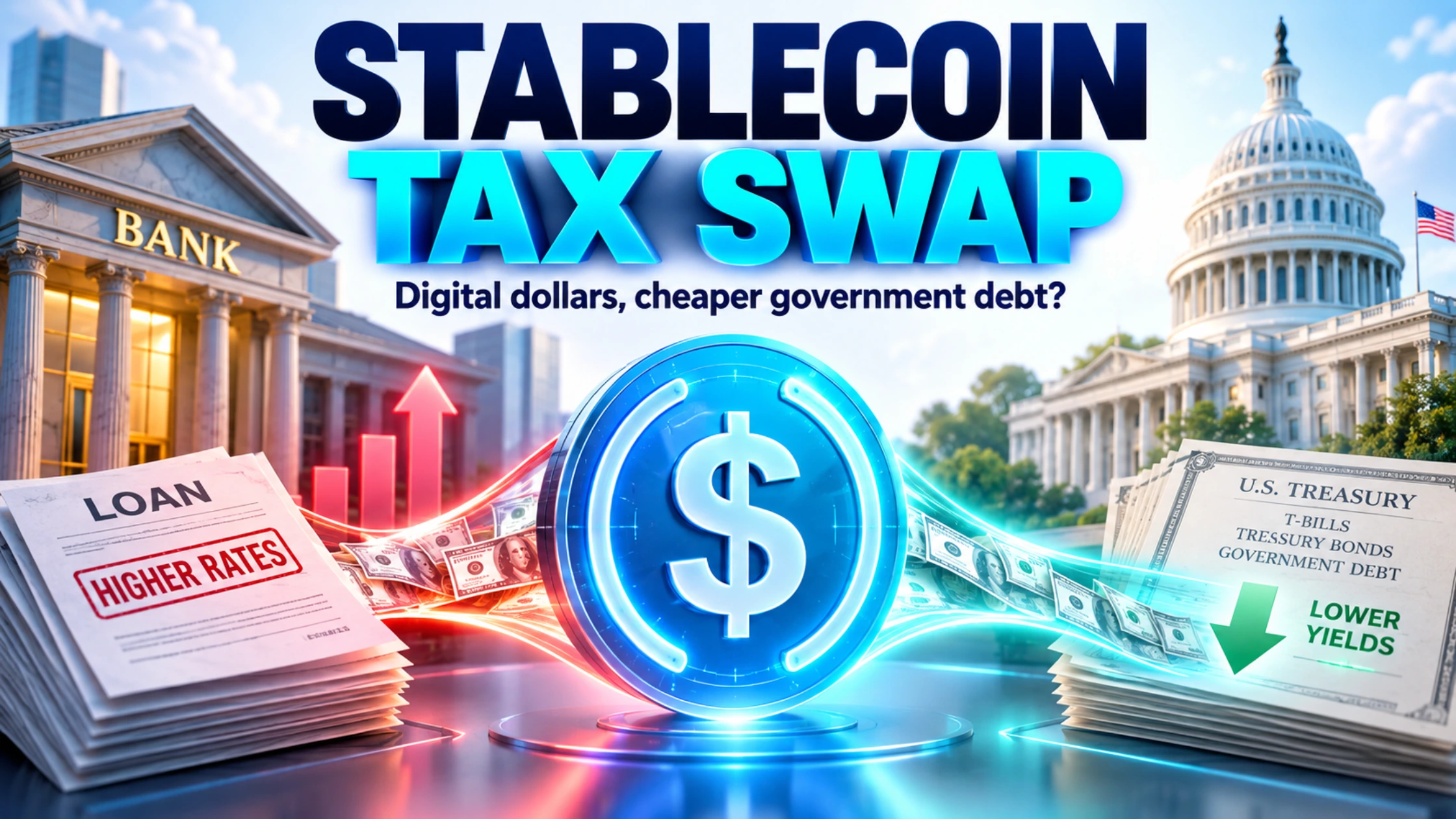
Stablecoins do not simply move dollars onto blockchains. They can redirect where savings sit, who earns the yield and which part of the economy receives the cheapest funding. At sufficient scale, that could quietly move part of the monetary advantage from banks and private borrowers toward the US Treasury.
The Signal
- The global stablecoin market is now approximately $305 billion, with USDT alone around $183 billion and USDC around $74 billion.
- Stablecoin growth can create two opposing macro channels: deposits migrate away from traditional bank funding while issuers recycle reserve assets into Treasury bills and other highly liquid instruments.
- BIS modelling finds that the bank-lending channel can raise bank funding costs and reduce credit supply, while the fiscal channel can lower government borrowing costs.
- Empirical BIS research finds that a $3.5 billion stablecoin inflow lowered three-month Treasury bill yields by about 0.7 basis points immediately and by roughly 4 basis points within 10 days in its sample. This should not be extrapolated linearly to much larger flows.
- The most economically favorable stablecoin user for the US funding system may be a foreign user: foreign demand can create new demand for dollar assets without necessarily replacing a US household bank deposit.
- The same transaction can therefore be supportive for US Treasury financing while weakening bank funding or monetary sovereignty somewhere else.
- DN calls this redistribution the Stablecoin Tax Swap. It is an economic analogy, not a literal tax.
Imagine moving $10,000 from your bank account into a dollar stablecoin.
To you, very little may appear to have changed.
You still think of yourself as holding dollars.
But inside the financial system, something important has happened.
Before the transaction, your money was a bank deposit. The bank could use that relatively stable liability to help fund mortgages, business loans, credit lines and other assets.
After the transaction, the stablecoin issuer must hold reserves against your digital dollars.
A large portion of those reserves may ultimately sit in Treasury bills, repo or other short-duration instruments.
Your savings did not vanish.
They changed destination.
That may become one of the most important macroeconomic consequences of stablecoin adoption.
And it is still largely discussed as a payments story.
The Stablecoin Debate Is Looking at the Wrong Transaction
Most stablecoin analysis focuses on what happens on the blockchain.
How quickly does the token settle?
How much does the transfer cost?
Which network carries it?
Can a smart contract use it?
Those questions matter.
But the more consequential transaction may occur behind the token.
It happens on the issuer's balance sheet.
The user hands over conventional money.
The issuer creates a token liability.
The issuer then decides where the reserve asset sits.
That reserve allocation determines who ultimately receives the funding.
Three Balance Sheets, One Dollar
The cleanest way to understand the process is to follow the dollar through three balance sheets.
1. The household
A household converts a bank deposit into a stablecoin.
The household still holds something intended to behave like one dollar, but its claim has moved from a commercial bank to a stablecoin structure.
2. The bank
The commercial bank loses a retail deposit or sees its funding composition change.
Retail deposits are valuable because they are often relatively sticky and inexpensive.
The Federal Reserve says deposits represent roughly two-thirds of US bank liabilities and are generally a stable source of funding at a cost below the return banks earn on assets.
If those deposits must be replaced by wholesale funding, money-market borrowing or more competitive deposit rates, bank funding becomes more expensive.
3. The stablecoin issuer
The stablecoin issuer invests the reserve.
Under the US GENIUS Act framework, permitted payment stablecoin reserves can include cash, demand deposits, very short-duration US Treasury securities, certain repo positions and other approved highly liquid assets.
The result is a new transmission path:
bank deposit → stablecoin → Treasury bill.
Stablecoins should be understood not only as payment instruments, but as funding routers. Their macroeconomic importance depends on where the money came from and where the reserve goes.
This Is Why We Call It the Stablecoin Tax Swap
The term is deliberately provocative, but the mechanism is precise.
It is not a government tax.
It is an economic transfer in the cost of funding.
Stablecoin adoption can put upward pressure on one funding cost while putting downward pressure on another.
The Bank for International Settlements describes two opposing channels.
The first is the bank lending channel.
If households shift deposits into stablecoins, banks can face higher deposit rates, more expensive funding and weaker incentives to extend loans.
The second is the fiscal space channel.
Stablecoin issuers buy short-term government securities, increasing demand for Treasury bills and potentially reducing the sovereign's borrowing cost.
The BIS model finds that the two effects push economic output in opposite directions.
Government financing becomes somewhat easier.
Private credit can become somewhat harder.
That is the swap.
The Treasury Bid Is Already Measurable
This is no longer purely theoretical.
BIS research estimates that stablecoin issuers purchased nearly $35 billion of US Treasury bills during 2025.
Their holdings had become comparable with major foreign holders and large US government money-market funds.
A separate BIS study examined daily stablecoin flows and short-term Treasury yields.
It found that a $3.5 billion stablecoin inflow reduced the three-month T-bill yield by about 0.71 basis points immediately and by about four basis points within 10 days, reaching a trough of around five basis points after 13 days.
The effect was concentrated at the short end.
It did not meaningfully extend into longer maturities.
That distinction is crucial.
Stablecoins are not necessarily becoming broad buyers of US duration.
They are becoming a potentially important buyer of the Treasury's shortest liabilities.
Stablecoin regulation is quietly becoming a form of sovereign debt-management policy. Rules governing permissible reserve assets can determine which segment of the government yield curve receives structural digital-dollar demand.
The 93-Day Gravity Well
The US regulatory structure makes the front-end concentration especially interesting.
The GENIUS Act permits qualifying Treasury securities with very short remaining maturities among payment-stablecoin reserve assets.
That creates what DN calls the:
93-Day Gravity Well.
As regulated payment stablecoins scale, their reserves can create structural demand around very short Treasury maturities.
That does not mean T-bill yields will simply keep falling as stablecoin supply rises.
Markets adapt.
Treasury issuance changes.
Other buyers reposition.
Reserve allocation varies.
And the BIS itself shows the price effect depends on market conditions.
But stablecoin regulation can still create a new class of price-insensitive or mandate-driven buyer at the front end of the sovereign curve.
That matters when government refinancing needs are large.
The Other Side of the Trade Is Sitting Inside Banks
The Treasury benefit has a mirror image.
Banks value retail deposits because they are typically cheaper and more stable than wholesale funding.
Federal Reserve researchers have warned that stablecoin adoption could shift bank funding from granular retail deposits toward more concentrated or rate-sensitive liabilities.
Even if total banking-system deposits do not collapse, the composition can become less attractive.
A bank can respond in several ways:
- pay depositors more,
- borrow in wholesale markets,
- hold more liquid assets,
- reduce lending,
- raise loan prices,
- shorten loan maturities, or
- develop competing tokenized-deposit products.
Federal Reserve research notes that more than 60% of increases in bank funding costs have historically been passed through into lending rates in relevant evidence cited by the authors.
The stablecoin competition therefore does not necessarily stop at banks.
It can eventually reach the borrower.
The Hidden Distributional Effect: Small Businesses May Pay More
This is where the story becomes more politically consequential.
Not every borrower accesses capital in the same way.
Large corporations can issue bonds.
Private-equity-backed businesses can borrow from private-credit funds.
Governments can access deep securities markets.
Small companies often depend far more heavily on banks.
Particularly smaller regional and community banks.
BIS analysis notes that if stablecoin adoption increases banks' reliance on wholesale funding, larger banks may be better placed to absorb the transition because they typically possess cheaper access to wholesale markets.
Smaller lenders may face a greater relative cost.
If those banks pull back, the borrower most exposed may not be a Wall Street institution.
It may be a small business.
The Most Important Stablecoin User May Live Outside America
Now the thesis becomes more interesting.
Suppose the stablecoin buyer is not an American moving money from a US bank account.
Suppose the buyer lives in Argentina, Turkey, Nigeria, South Africa or another economy and converts local savings into a dollar stablecoin.
From the US perspective, the economics can look different.
The stablecoin issuer still acquires dollar reserve assets.
Some of those reserves may still become Treasury demand.
But the original savings did not necessarily come from a US retail bank deposit.
The US Treasury can therefore receive an additional buyer without an equivalent direct loss of domestic US deposit funding.
BIS modelling explicitly finds that the overall macroeconomic effect changes with the strength of foreign stablecoin demand.
That leads to a powerful conclusion.
From the perspective of US public finance, the most valuable marginal stablecoin adoption may be foreign adoption. It can import savings into dollar reserve assets while exporting part of the banking and monetary adjustment to the country where the user resides.
That Is Good for the Dollar and Complicated for Everyone Else
Approximately 98% of stablecoin value is dollar-denominated, according to BIS research.
Another BIS study found that more than 70% of fiat-to-dollar-stablecoin conversions in its dataset originated from non-dollar currencies.
This means stablecoins increasingly provide a parallel route into dollars.
Historically, dollarization could require physical cash, foreign bank accounts or access to offshore financial infrastructure.
A stablecoin can potentially place dollar exposure inside a smartphone wallet.
The IMF has highlighted exactly this issue in emerging economies.
If users shift existing foreign-currency deposits from local banks into stablecoins whose reserves are invested abroad, domestic banks can lose funding for foreign-currency lending even if the individual still thinks they hold the same number of dollars.
The reserve moves.
The credit channel moves with it.
The Digital Triffin Effect
The United States has long benefited from global demand for dollars and dollar-denominated assets.
Stablecoins can extend that network effect.
A person does not necessarily need a US bank relationship to hold an instrument denominated in dollars.
If the token is backed substantially by US government securities, foreign demand for digital dollars can become indirect foreign demand for US sovereign debt.
DN calls this:
The Digital Triffin Effect.
Dollar stablecoins may strengthen the international role of the dollar precisely because they weaken the friction protecting smaller monetary systems.
That is the contradiction.
Stablecoins can decentralize access to dollars while further centralizing the world's choice of monetary unit around the dollar.
Who Actually Gets the Yield?
There is another layer to the transfer.
Treasury bills generate interest.
Traditional bank deposits may also pay interest, but often below market rates.
Payment stablecoin issuers under the US framework are prohibited from directly paying interest simply for holding the stablecoin.
That does not mean the underlying reserve income disappears.
The economic value may remain with issuers or be redistributed through exchanges, rewards, commercial arrangements or other intermediaries depending on the structure and regulation.
BIS research published in June 2026 specifically examined remuneration by centralized exchanges and found that some stablecoin-related yields are effectively linked to returns generated on issuer reserves or other platform activity.
This means the stablecoin transition can also alter who captures the spread between safe-asset yields and what the end user receives.
That is not merely a technology question.
It is a business-model question.
The stablecoin economy creates a new contest over the monetary spread: the difference between the yield earned by reserve assets and the yield ultimately passed to the user. Whoever controls distribution may capture as much economic value as whoever issues the token.
The System Has Four Winners and Losers
| Actor | Potential benefit | Potential cost | DN signal to watch |
|---|---|---|---|
| US Treasury | Additional demand for short-term government debt | Potential redemption-driven selling during stress | Stablecoin T-bill holdings and bill-market depth |
| Commercial banks | Potential issuer deposits and new tokenization businesses | Loss of sticky retail funding, higher deposit competition | Deposit betas, wholesale funding share, loan pricing |
| Stablecoin issuers | Reserve income, payments distribution, network effects | Liquidity requirements, redemption risk, regulation | Reserve mix, liquidity buffer, redemption concentration |
| Consumers | 24/7 settlement, portability, dollar access | Issuer, custody and regulatory risks, potentially forgone yield | Rewards, redemption quality, reserve transparency |
| Foreign economies | Cheaper access to dollar payments and savings | Dollarization, bank-funding leakage, weaker monetary control | Stablecoin inflows relative to deposits and GDP |
The Stablecoin Run Reverses the Trade
The fiscal benefit also contains its own tail risk.
Stablecoins create demand for Treasury bills when supply grows.
Large redemptions can reverse that flow.
If an issuer must raise cash rapidly, it can become a seller of reserve assets.
BIS research finds stablecoin effects on Treasury prices can become materially larger during stress and redemption episodes.
Another 2026 BIS study highlights the liquidity transformation inherent in holding demandable stablecoin liabilities against reserves that can include securities requiring sale or repo financing.
At sufficient scale, the same institution can therefore become:
a structural buyer during expansion,
and a forced seller during contraction.
This produces another financial paradox.
The more successful stablecoins become at supporting Treasury demand, the more relevant their redemption behavior becomes to Treasury-market stability.
The Government Gains a Buyer and Inherits a New Run Channel
Money-market funds offer a useful historical analogy.
They became enormous buyers of short-term government and private securities.
But their role in financial markets also meant that runs and large reallocations could affect underlying markets.
Stablecoins have a similar structural feature with one major difference:
they operate continuously.
A holder can seek liquidity on Saturday night.
Treasury markets, custodians and parts of the banking system do not necessarily operate with identical 24/7 liquidity.
That creates a time mismatch we will examine separately in this research series.
Banks Will Not Stand Still
A naive version of the stablecoin thesis assumes banks simply lose deposits indefinitely.
History suggests otherwise.
Federal Reserve research on previous episodes of financial innovation finds that banks tend to adapt when new instruments compete for deposits.
They can:
- raise deposit rates,
- launch new products,
- offer tokenized deposits,
- partner with stablecoin providers,
- increase wholesale funding,
- change asset composition, and
- use their regulatory and relationship advantages to retain customers.
This means stablecoins may not destroy banking.
They may force banks to pay a more competitive price for money.
For depositors, that could be beneficial.
For bank margins, less so.
Stablecoins Could Strengthen Monetary Policy Transmission
There is another counterintuitive implication.
The BIS macroeconomic model suggests widespread stablecoin adoption could strengthen monetary-policy transmission through the bank lending channel.
Why?
Because banks facing more contestable deposits may need to adjust funding costs more quickly when market interest rates change.
The era of sticky, under-remunerated deposits partially insulates bank funding from policy rates.
Stablecoin competition can weaken that insulation.
That means central-bank policy changes could pass more rapidly into:
deposit rates,
bank funding costs,
and ultimately loan rates.
Stablecoins are therefore not necessarily an escape from monetary policy.
At scale, they could change the mechanism through which monetary policy reaches the economy.
Stablecoins could paradoxically make parts of the banking system more sensitive to central-bank policy, not less. Competition for deposits may shorten the lag between a policy-rate move and the price borrowers pay for bank credit.
The Stablecoin Fiscal Transfer Is Not Automatically Bad
It is important not to turn this analysis into an anti-stablecoin argument.
Payments are expensive and fragmented.
Cross-border settlement can be slow.
Stablecoins can provide useful access to digital dollars.
They can improve competition.
They can enable programmable payments and machine-to-machine commerce.
For households in unstable monetary systems, dollar stablecoins can provide a valuable savings technology.
The relevant question is not whether stablecoins should exist.
It is whether markets understand the balance-sheet consequences of their success.
The Right Metric Is Source-to-Reserve Mapping
Headline stablecoin market capitalization tells only part of the story.
A much more useful dataset would ask where every incremental dollar comes from and where it ends up.
For example:
- US retail bank deposit → Treasury bill,
- US money-market fund → Treasury bill,
- foreign bank deposit → Treasury bill,
- physical dollar savings → Treasury bill,
- crypto asset sale → bank deposit,
- foreign local currency → dollar stablecoin → Treasury bill.
Each transaction creates a different macroeconomic effect even though every one ends with one additional dollar of stablecoin supply.
That is why stablecoin supply alone is not enough.
DN Stablecoin Monetary Transmission Monitor
Track the monetary plumbing, not only token prices
Stablecoin adoption increasingly intersects with Treasury yields, the dollar, bank equities and crypto liquidity. TradingView can be used to monitor cross-market price and rate signals, while CoinStats provides portfolio and digital-asset tracking. These are affiliate links.
DN Stablecoin Fiscal Transfer Simulator
The model below does not forecast Treasury yields or bank lending.
Instead, it forces the user to specify the transmission assumptions normally hidden inside broad claims about stablecoin growth.
The key question is:
How much incremental stablecoin demand becomes new Treasury demand, and how much comes at the expense of domestic bank funding?
Stablecoin Fiscal Transfer Simulator
Model how a hypothetical increase in stablecoin supply could redistribute funding between commercial banks and short-term government debt. All transmission assumptions are editable. The tool deliberately does not extrapolate historical Treasury-yield estimates automatically.
Calculating...
How to Read the Simulator
The most important input is not the size of the stablecoin market.
It is the source of the next dollar.
Consider two scenarios.
In the first, an American household moves $10,000 from a bank deposit into a stablecoin and the issuer buys Treasury bills.
The Treasury receives a new buyer, but a bank loses a valuable retail funding source.
In the second, a foreign household converts local currency into the same stablecoin.
The stablecoin issuer may still acquire Treasury bills, but the transaction does not necessarily remove a US household deposit.
Same stablecoin issuance.
Very different domestic macro effect.
This is why DN believes future stablecoin analysis must move beyond market capitalization and toward:
source-to-reserve mapping.
What Happens at $1 Trillion?
The global stablecoin market is already above $300 billion.
The intellectually interesting exercise is not to predict exactly when it reaches $1 trillion.
It is to ask what changes if it does.
At that scale, reserve allocation becomes macro allocation.
A system holding hundreds of billions of dollars in short-duration sovereign assets is no longer merely crypto infrastructure.
It becomes part of the money-market ecosystem.
The question of who supplies stablecoins therefore becomes connected to:
- Treasury debt management,
- bank deposit competition,
- credit availability,
- international dollarization,
- monetary-policy transmission,
- money-market liquidity,
- and eventually financial stability.
The $5 Trillion Thought Experiment
Push the thought experiment further.
Suppose dollar stablecoins eventually grow into a several-trillion-dollar monetary layer.
At that point, the question becomes much larger than crypto.
Who loses the deposits?
How much Treasury demand is created?
Do issuers become some of the largest buyers of short-term sovereign debt in the world?
Do banks respond by raising deposit rates?
Do households finally receive more of the monetary-policy rate?
Do SMEs pay higher borrowing costs?
Does foreign adoption deepen dollarization?
Do tokenized bank deposits emerge as the banking system's counterattack?
And what happens when a multi-trillion-dollar stablecoin sector experiences a redemption event?
These questions are no longer science fiction.
They are balance-sheet questions.
The stablecoin endgame may not be crypto replacing banks. It may be a competitive repricing of who gets to manufacture transaction money and who captures the safe-asset yield behind it.
What Would Prove the Thesis Wrong?
The Stablecoin Tax Swap thesis weakens if several things occur.
- Stablecoin adoption comes predominantly from cash, crypto collateral or existing money-market funds rather than bank deposits.
- Stablecoin issuers hold substantial reserve balances inside banks, offsetting deposit migration without materially worsening funding composition.
- Banks respond by issuing competitive tokenized deposits and retain their funding base.
- Deposit outflows fail to produce meaningful changes in bank funding costs.
- Banks absorb higher funding costs rather than passing them to borrowers.
- Stablecoin Treasury purchases prove too small relative to the T-bill market to create meaningful yield effects.
- Treasury issuance adjusts enough to absorb incremental stablecoin demand without measurable price impact.
- Foreign adoption does not scale beyond crypto trading.
The thesis would weaken further if payment stablecoins become primarily a technological wrapper around existing bank deposits rather than a new balance-sheet destination for savings.
That outcome is possible.
Banks are adapting quickly.
Tokenized deposits, faster payment rails and institutional stablecoin products could cause today's categories to converge.
But even convergence would validate the underlying principle.
The battle is ultimately over the balance sheet behind digital money.
The Bigger Conclusion
Stablecoins began as infrastructure for crypto trading.
They are becoming something much larger.
At more than $300 billion, they already represent a substantial pool of digital dollar liabilities.
The mistake is to analyze that number only as crypto market capitalization.
Every stablecoin has another side.
A reserve.
That reserve has to sit somewhere.
And wherever it sits, someone receives the funding.
If deposits move from banks into stablecoins whose reserves move into government bills, the system has not eliminated financial intermediation.
It has changed the intermediary.
That change can make payments faster.
It can widen access to dollars.
It can strengthen demand for Treasury bills.
It can also make bank funding more competitive, affect private credit and accelerate dollarization abroad.
The future of stablecoins therefore cannot be understood by looking only at blockchains.
You have to follow the money after it leaves the chain.
The most important stablecoin transaction may not be the token transfer you see.
It may be the Treasury bill purchased immediately afterward.
Primary Sources & Evidence
- Bank for International Settlements, Working Paper 1363: The Macroeconomics of Stablecoins, June 2026.
- Bank for International Settlements, Working Paper 1270: Stablecoins and Safe Asset Prices.
- BIS Annual Economic Report 2026, stablecoin funding and fiscal-space analysis.
- Federal Reserve FEDS Notes: Banks in the Age of Stablecoins: Some Possible Implications for Deposits, Credit, and Financial Intermediation.
- Federal Reserve FEDS Notes: Banks in the Age of Stablecoins: Lessons from Their Historical Responses to Financial Innovations.
- Federal Reserve: Payment Stablecoins and Cross Border Payments: Benefits and Implications for Monetary Policy Implementation.
- Federal Reserve Financial Stability Report, May 2026.
- IMF: Stablecoins: Promise, Risks, and Policy Choices for Emerging Markets, August 2026.
- BIS Working Paper 1340: Stablecoin Flows and Spillovers to FX Markets.
- BIS Working Paper 1355: Making Stablecoins Stable(r): Can Regulation Help?.
- Circle reserve and USDC transparency disclosures, September 2026.
- Tether reserve and financial disclosures, 2026.
- DeFiLlama stablecoin market-cap dataset, verified September 2026.
Frequently Asked Questions
What is the Stablecoin Tax Swap?
The Stablecoin Tax Swap is a Decentralised News framework describing how stablecoin adoption can simultaneously make bank funding more expensive while increasing demand for short-term government securities. It is an economic analogy, not an actual tax.
Why do stablecoins affect bank deposits?
When a user converts a commercial-bank deposit into a stablecoin, the bank may lose a relatively stable retail liability or see that funding replaced by a more concentrated form of wholesale funding. The exact effect depends on how the stablecoin issuer holds its reserves and where the original funds came from.
Why do stablecoin issuers buy Treasury bills?
Payment stablecoins require highly liquid reserve assets that can support redemption at par. Short-duration US government securities are therefore an important reserve asset for major dollar stablecoins.
Can stablecoin growth lower Treasury yields?
BIS empirical research has found that stablecoin inflows can reduce short-term Treasury bill yields, with the effect varying according to market conditions and the size of the stablecoin sector. Historical estimates should not be extrapolated mechanically to future market sizes.
Could stablecoins make bank loans more expensive?
Potentially. If stablecoin adoption increases competition for bank deposits or forces banks toward more expensive funding, banks may pass part of the higher funding cost to borrowers or reduce lending. The scale of this effect remains uncertain.
Why does foreign stablecoin demand matter?
Foreign demand can increase demand for dollar-denominated reserve assets without necessarily displacing a US retail deposit. However, it may shift savings away from banks and local currencies in the user's home country, creating different macroeconomic effects there.
Are stablecoins replacing banks?
Not currently. Banks remain vastly larger and provide credit, payments, deposits and many other services. Stablecoins may instead force banks to compete more aggressively for deposits and accelerate the development of tokenized deposits and faster payment infrastructure.
What happens during a stablecoin run?
Large redemptions can require an issuer to raise cash or sell reserve assets. At sufficient scale, this can transmit stress from stablecoins into money markets and short-duration government securities.
How large is the stablecoin market?
At the latest September 2026 verification, the total stablecoin market was approximately $305 billion, although the figure changes continuously.
Related reading:
The $500 Billion AI Risk Hiding Inside Private Credit
What Happens When AI Hardware Ages Faster Than the Debt Financing It?
The Trust Layer Is Breaking: AI, Stablecoins and the New Fight Over What Is Real
The Liquidity Premium Is Back: Why Private Markets, Bonds and Crypto Are Facing the Same Test
The Compute Supercycle: Why AI Is Turning Electricity, Chips and Data Centers Into the New Oil