
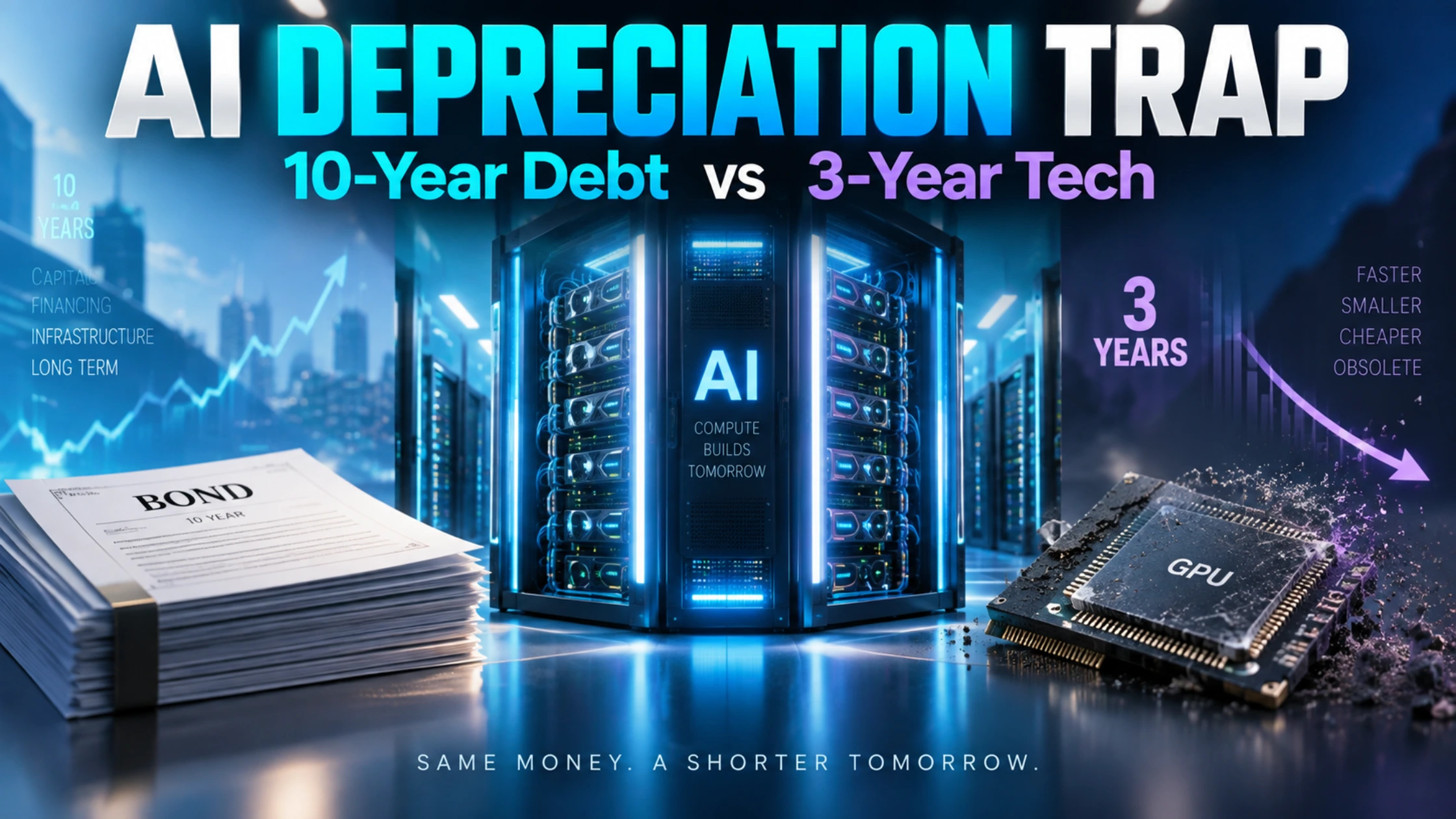
The AI Depreciation Trap: When Long-Dated Debt Finances Technology That Can Age in Three Years
AI infrastructure is being financed on one clock while the hardware generating the revenue runs on another. The hidden risk is not simply whether AI demand slows. It is whether the collateral becomes economically old before the debt gets repaid.
AI Summary
- The AI financing debate is overlooking a three-clock mismatch: short-lived compute hardware, long-lived data-center infrastructure and increasingly long-dated debt.
- Microsoft's fiscal 2026 filing places servers and network equipment at estimated useful lives of roughly two to six years, while data-center buildings and related infrastructure can remain useful much longer.
- The BIS says hyperscaler bond issuance topped $100 billion in 2025, with most issuance carrying maturities beyond five years, while off-balance-sheet vehicles increasingly use long-term leases and private credit.
- The core credit risk is not ordinary depreciation. It is obsolescence before principal amortization, especially when borrowers must fund a new hardware generation before the old debt has materially run off.
- The best collateral in an AI project may ultimately be secured power, grid access, fibre and a reusable site rather than the GPU fleet itself.
- The proprietary DN AI Asset-Liability Duration Gap Engine below stress-tests hardware life, debt maturity, residual value, replacement capex, utilization and contracted revenue coverage.
The AI boom is usually framed as a question of demand: Will companies buy enough artificial intelligence to justify the hundreds of billions being spent on chips, data centers and power?
That is the obvious question. It may not be the most dangerous one.
A more subtle risk is appearing inside the capital structure. Much of the infrastructure being built today will be financed for years, sometimes well beyond the commercial prime of the hardware sitting inside it. Servers can be replaced several times while the same building, power connection, lease or debt instrument remains outstanding.
This means the AI economy is increasingly running on three different clocks.
The Three Clocks Behind the AI Boom
Clock 1: Compute hardware
AI accelerators are productive assets, but they are not infrastructure in the same sense as a power plant or building. They live inside an unusually fast innovation cycle where performance per watt, memory bandwidth, interconnect design, software support and inference economics can change rapidly.
Microsoft's 2026 Form 10-K estimates useful lives of servers and network equipment at roughly two to six years. A Microsoft Research framework for AI data centers models IT infrastructure at roughly three to five years, compared with 15 to 30 years for facilities and seven to 10 years for networking infrastructure.
Amazon's accounting history shows why these estimates should not be treated as constants. The company increased the estimated useful life of servers from five to six years in 2024, then reduced the life of a subset of servers and networking equipment from six back to five years in 2025.
Alphabet has generally used six years for servers and networking equipment while acknowledging that useful lives are regularly reviewed for factors including technological obsolescence and utilization.
Accounting depreciation is not the same as economic obsolescence. That distinction is central to this thesis.
A server may remain operational for six years and still become unattractive for premium workloads after three or four if a newer architecture delivers materially better performance per dollar or per watt.
Clock 2: The physical data center
The shell around the compute moves much more slowly.
Land, substations, transformers, transmission rights, fibre routes, cooling systems and buildings can remain useful for decades.
Microsoft has explicitly described part of its recent capital spending as long-lived assets intended to support monetization for 15 years and beyond.
Alphabet has said roughly 40% of its 2025 capital investment, with a similar mix expected in 2026, went toward long-duration assets such as data centers and networking.
That makes a data center a strange hybrid asset.
Part of it resembles real estate or utility infrastructure.
Part of it resembles rapidly depreciating electronics inventory.
Combining those components into one headline capex number hides the most important question for lenders:
Which part of the asset actually secures the debt?
Clock 3: The financing
The third clock is getting longer.
The Bank for International Settlements says hyperscaler gross bond issuance exceeded $100 billion in 2025 and that most of the issuance was long-term, with maturities beyond five years.
AI infrastructure is also increasingly financed through special-purpose vehicles, private placements, infrastructure funds and private-credit structures.
In a common structure described by the BIS, a dedicated vehicle develops data-center assets using sponsor equity and private debt. A hyperscaler may take a minority stake while signing a long-term lease or capacity offtake agreement and sometimes providing guarantees.
Economically, the arrangement can shift what would have been upfront capital expenditure into multi-year commitments while leaving much of the financing outside the hyperscaler's consolidated balance sheet.
The BIS describes part of this phenomenon as shadow borrowing.
This is not automatically dangerous. Long-lived infrastructure should often be financed with long-dated capital.
The problem emerges when long-lived financing is implicitly underwritten by short-lived hardware economics.
The relevant credit variable is not hardware depreciation by itself. It is the difference between the economic life of revenue-producing compute and the rate at which the associated principal amortizes. We call this the AI Asset-Liability Duration Gap.
Why Straight-Line Depreciation Can Mislead
Traditional depreciation assumes value is consumed progressively over time.
Technology often does not behave that way.
An AI accelerator can retain considerable value while supply is tight, then reprice rapidly once the next generation reaches scale.
Its physical condition may barely change. Its economic position can change dramatically.
Secondary-market data already show how uneven those curves can be.
CCIR's September 2026 hardware dataset, for example, shows large differences in realized value retention across H100 and A100 configurations and generations. The provider's executed-price data also frequently differ substantially from advertised asking prices.
Those figures should not be treated as universal marks.
Form factor, warranty, location, configuration, workload suitability and cluster architecture matter.
But the lesson is important:
Residual value is a market variable, not an accounting constant.
That creates a potential mistake in credit underwriting.
A lender can see a $500 million fleet of accelerators today and assume there will be substantial collateral value in four years.
Yet the resale price in four years will depend partly on technology that does not exist today.
The Wrong-Way Collateral Problem
The most dangerous form of collateral is collateral that loses value precisely when the borrower needs it most.
AI hardware could exhibit that characteristic.
Imagine that a new accelerator generation delivers dramatically better inference economics.
Older hardware loses rental pricing power.
Utilization migrates toward the new generation.
Residual values fall.
The operator needs capital to refresh the fleet.
Those events are not independent.
They can happen together.
That means an AI borrower could simultaneously face:
- lower revenue from existing hardware,
- lower collateral value,
- higher replacement capex,
- pressure to refinance before scheduled maturity, and
- more cautious lenders precisely because the technology cycle has accelerated.
This is a classic wrong-way risk:
the collateral becomes weaker as the financing need becomes stronger.
A Worked Example: The $1 Billion AI Project
Consider an illustrative $1 billion AI infrastructure project.
Assume 60% of project cost is compute hardware, 65% of the overall project is debt financed, the debt matures over 10 years and the compute fleet has a four-year economic refresh cycle.
If principal amortizes evenly, roughly $390 million of the original $650 million debt would still remain after four years.
Now assume the original $600 million hardware fleet retains 40% residual value.
The old equipment is worth about $240 million and replacing the $600 million fleet requires roughly $360 million of net new capital after selling the old hardware.
The borrower is therefore approaching the first major technology refresh while still carrying hundreds of millions of dollars of debt from the original build.
This does not mean the project fails.
Strong operating cash flow, contracted offtake, refinancing capacity and a valuable powered site can absorb the burden.
But it illustrates why loan maturity alone is the wrong metric.
The first critical maturity in AI infrastructure may not be the legal maturity date of the debt. It may be the first mandatory hardware refresh date.
The Refresh Wall Could Matter More Than the Debt Wall
Credit analysts traditionally build maturity walls showing how much debt comes due each year.
AI infrastructure needs another chart:
the refresh wall.
This would estimate when large installed fleets become economically suboptimal and require replacement.
A company with no meaningful bond maturities until 2034 could still face a huge capital requirement in 2029 if the hardware generating its revenue loses competitiveness.
The correct analysis therefore combines:
- debt maturity,
- principal amortization,
- hardware vintage,
- expected refresh date,
- residual value,
- utilization,
- power cost,
- revenue contractedness, and
- site reusability.
This is closer to asset-liability management than conventional technology analysis.
Why the Risk Is Increasing Now
The financing structure is becoming more important because the AI buildout is moving beyond what operating cash flow alone can comfortably fund.
Reuters Breakingviews estimated that AI-related debt issuance had approached $500 billion by early August 2026, roughly one-fifth of higher-rated US debt issuance.
The BIS has separately warned that anticipated AI investment needs will increasingly require debt and private credit as spending moves beyond internal cash generation.
The credit market has started to notice.
Reuters reported this week that lenders are demanding tighter safeguards on some data-center projects amid construction delays, power constraints and permitting risk.
Financing structures increasingly include guarantees, asset pledges, long-term leases and conditions requiring projects to reach permitting or leasing milestones before funds are released.
The first AI investment phase was dominated by the strongest corporate balance sheets on earth.
The next phase increasingly distributes the risk through bondholders, insurers, banks, infrastructure funds, private-credit vehicles and special-purpose companies.
That changes the macro implications of an AI slowdown.
An equity correction hurts shareholders.
A credit problem can stop construction.
The Circular Financing Problem Makes Residual Values More Important
The BIS has also highlighted circular financing inside the AI ecosystem.
Hyperscalers and chip companies can invest in AI laboratories or infrastructure providers that then make long-term purchases of compute, cloud capacity or chips from the same ecosystem.
Again, this does not make the revenue unreal.
But it can make the distinction between external end demand and financially supported demand harder to observe.
If capital becomes more expensive, several parts of the circle can slow together.
That makes hard collateral and contracted cash flows more important.
Yet GPU collateral may itself be most vulnerable when new technology changes compute economics.
This creates a second mismatch:
the financing system increasingly wants asset backing precisely when the most visible asset may be the least stable part of the project.
The Most Valuable AI Collateral May Not Be the GPU
This leads to a more contrarian conclusion.
The highest-quality AI infrastructure collateral may ultimately be:
- a secured grid connection,
- low-cost power,
- a permitted data-center site,
- high-capacity fibre,
- reusable cooling and electrical infrastructure,
- a strong tenant covenant, and
- contracted capacity revenue.
Why?
A GPU can become obsolete.
A scarce megawatt in the right location may become more valuable.
If an operator can replace one generation of accelerators with another while preserving the site, power and customer relationship, then the long-lived infrastructure retains strategic value even as the hardware turns over.
This is why the next generation of AI credit underwriting should separate GPU collateral from site collateral.
The safest AI infrastructure loan may eventually be underwritten less like equipment finance and more like a hybrid of utility infrastructure, real estate and technology-refresh finance. The megawatt could prove more durable collateral than the accelerator.
Who Is Most Exposed?
| Business model | Main duration risk | Potential protection | What DN would monitor |
|---|---|---|---|
| Hyperscaler | Huge refresh capex despite strong balance sheet | Operating cash flow, diversified workloads, purchasing scale | Capex / OCF, depreciation, AI revenue, utilization |
| Neocloud / GPU cloud | Hardware obsolescence plus refinancing | Contracted utilization, strong customer mix, fast amortization | GPU rental curves, debt balance, customer concentration |
| Data-center SPV | Long-lived debt tied to tenant and technology assumptions | Reusable site, secured power, lease covenant, sponsor guarantee | Lease terms, exit clauses, site value, power availability |
| Private-credit lender | Collateral value falls when refinance need rises | Conservative LTV, amortization, collateral haircuts, covenants | Residual values, refresh wall, DSCR, secondary-market depth |
| Power / grid infrastructure | Demand disappoints after capacity build | Alternative customers, long asset life, grid scarcity | Deliverable MW, interconnection queue, offtake quality |
What Could Break the Depreciation-Trap Thesis?
The thesis is deliberately falsifiable.
It weakens if several developments occur together:
- older accelerators remain economically competitive for materially longer than expected,
- secondary-market residual values remain unusually strong across multiple hardware generations,
- AI demand grows fast enough to keep older fleets highly utilized,
- software optimization allows old chips to serve valuable workloads profitably,
- debt amortizes faster than hardware loses economic value,
- operators consistently pre-fund refresh capex from operating cash flow, and
- powered sites remain readily reusable across hardware generations.
In that world, the apparent duration mismatch is manageable.
The bull case should not be dismissed.
Microsoft's own research emphasizes the importance of rearchitecting the full data-center lifecycle rather than assuming infrastructure is disposable.
Older hardware can migrate toward inference, lower-priority workloads or markets where capital cost matters more than absolute performance.
The question is therefore not whether an H100 becomes worthless when a new generation ships.
The question is whether the cash flow from the old generation declines faster than the financing structure anticipated.
The Seven Signals That Matter Most
DN AI Duration Monitor
Research the cycle, not just the headline
For readers tracking AI infrastructure equities, semiconductor names, rates and credit-sensitive market moves, TradingView provides cross-market charting and alerts. For crypto-side spillovers and AI-assisted digital-asset research, DN also uses specialist portfolio and research tools. Links below are affiliate links.
DN AI Asset-Liability Duration Gap Engine
The calculator below is designed to stress the three clocks directly.
It is not a valuation model and does not forecast default.
It asks a narrower question:
How much financing remains when the first major technology refresh arrives, and how hard is that refresh likely to be on the project?
AI Asset-Liability Duration Gap Engine
Stress-test project cost, hardware concentration, debt maturity, compute life, residual value, EBITDA, utilization, contracted revenue and site reusability. All defaults are illustrative and should be replaced with project-specific assumptions.
Calculating...
How to Read the Engine
A low risk score does not mean an AI project is safe.
It means the financing structure is relatively well matched to the assumed refresh cycle.
A high score means several pressures are aligning: substantial debt remains when hardware needs replacing, residual value is low, replacement cost is large relative to EBITDA, utilization or contracted revenue is weak, and the site lacks enough durable infrastructure value to offset the technology risk.
The most important output may be the debt remaining at first refresh.
That figure forces the analyst to stop thinking only about final maturity and instead ask how much of the original financing survives into the next technology generation.
The Bigger Macro Implication
AI has become large enough that this is no longer a niche project-finance issue.
The BIS says AI-connected companies now occupy an unusually large share of equity markets, corporate issuance and venture funding.
If AI monetization disappoints, the shock would not stop at technology stocks.
It could travel through corporate bonds, private credit, insurers, bank funding lines, infrastructure funds and construction pipelines.
The critical distinction is between an AI equity bust and an AI credit bust.
An equity bust reprices expectations.
A credit bust changes who can keep building.
That is why the depreciation question matters.
Investors should not ask only whether AI infrastructure will still be needed in 2035.
It almost certainly will.
They should ask whether the specific hardware purchased in 2026 will generate enough cash before it must be replaced, and whether the debt financing that hardware will amortize quickly enough to survive the transition.
The AI supercycle can be real and the financing can still be wrong.
Those two statements are perfectly compatible.
And that is the heart of the AI Depreciation Trap.
Primary Sources & Evidence
- Bank for International Settlements: Financing the AI boom, from cash flows to debt
- BIS: Financing the AI infrastructure boom, on- and off-balance-sheet borrowing
- BIS Annual Economic Report 2026
- Microsoft fiscal 2026 Form 10-K
- Microsoft fiscal 2026 Q1 earnings call
- Microsoft Research: Rearchitecting the Datacenter Lifecycle for AI
- Amazon property and equipment useful-life disclosure
- Alphabet investor guidance on depreciation and useful lives
- Alphabet 2025 Q4 earnings call and 2026 capex discussion
- Reuters Breakingviews: AI construction crunch widens credit fault lines
- CCIR secondary GPU market and residual-value dataset
Frequently Asked Questions
What is the AI Depreciation Trap?
It is the risk that revenue-producing AI hardware becomes economically obsolete or requires major replacement while a substantial portion of the debt used to finance the original infrastructure is still outstanding.
Is accounting useful life the same as economic life?
No. Accounting useful life determines depreciation for financial reporting. Economic life asks how long the asset remains competitive and capable of earning an acceptable return. The two can diverge significantly in fast-moving technology markets.
How long do AI servers last?
Physical lifespan, accounting useful life and economic competitiveness are different. Major technology companies currently disclose server and networking useful lives that often fall within roughly two to six years, while actual economic value depends on workload, power efficiency, new hardware generations, utilization and resale demand.
Why does debt maturity matter for GPUs?
If debt amortizes more slowly than the hardware loses economic value, the borrower may need to finance a new hardware generation while still carrying debt from the old one. This can raise refinancing and collateral risk.
Does this mean AI data centers are a bad investment?
No. The thesis is about financing structure, not a blanket view on AI infrastructure. Projects with strong operating cash flow, conservative leverage, contracted demand, rapid debt amortization and reusable powered sites may be highly resilient even with frequent hardware refresh cycles.
What is the refresh wall?
The refresh wall is the estimated schedule at which large installed hardware fleets need economically meaningful replacement. It can matter before the legal debt maturity date because replacement capex may arrive while original financing remains outstanding.
What is the best collateral in an AI data-center project?
That depends on the structure, but scarce grid access, power rights, fibre, reusable facilities, high-quality tenant contracts and strong guarantees may prove more durable than the residual value of a specific GPU generation.
What would invalidate the thesis?
The mismatch would be less important if older hardware remains highly utilized and economically competitive, residual values remain strong, debt amortizes rapidly, refresh capex is consistently covered by internal cash flow and data-center sites remain readily reusable across generations.





