
Money Stories · Original fiction · 9 minute read
The message said forty-two millimetres. Peter read it with a length of split hose hanging from his hand.
He had been looking for the leak, although the tank was almost empty and finding the leak would not fill it. It was a job with an answer. He preferred those that morning.
Forty-two millimetres in the measuring area during the covered thirty days. The payment trigger had not been reached. Amount payable: zero.
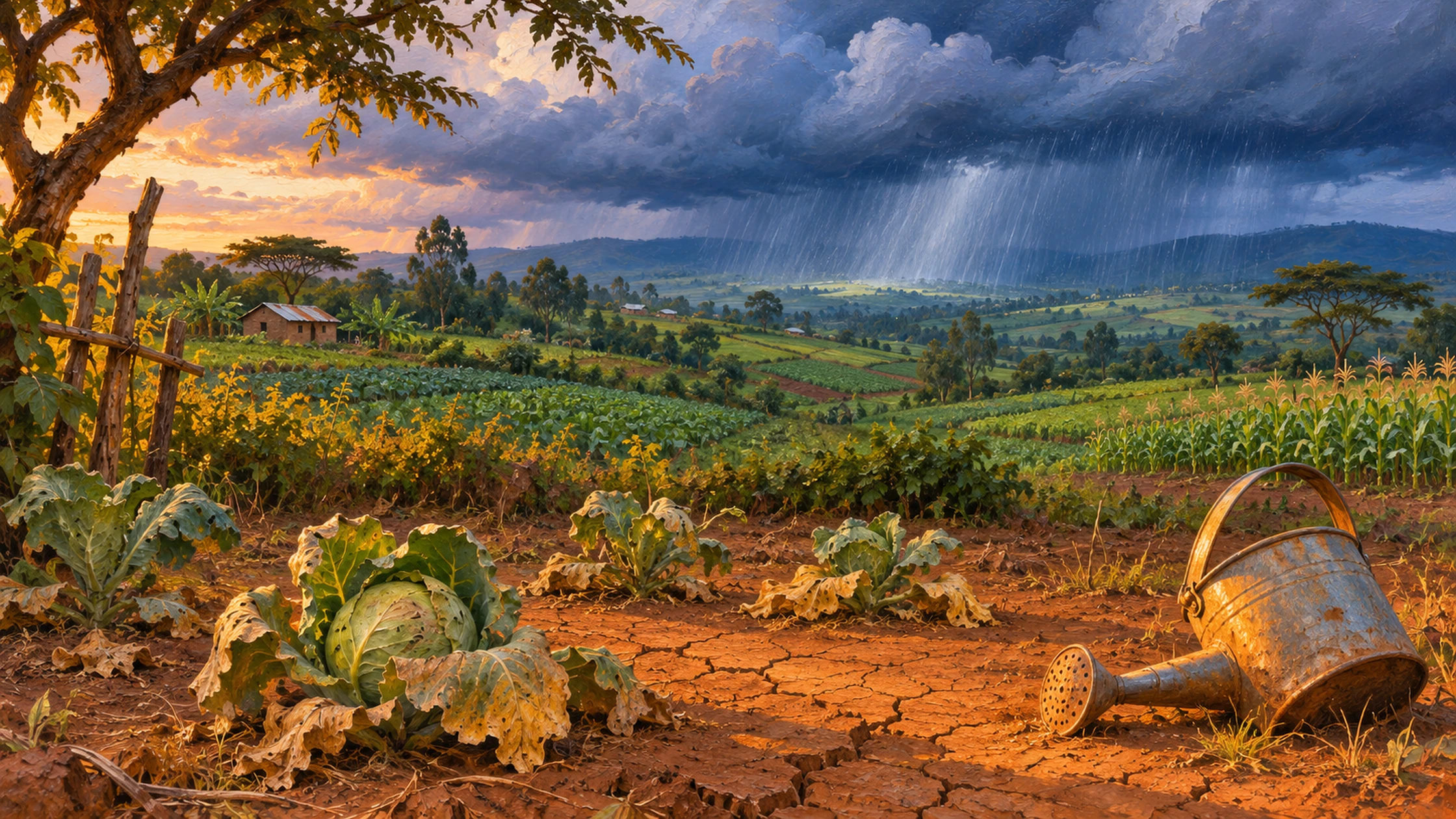
He put the phone on the tank lid. Across the plot, the young kale stood in uneven rows. Some plants still held their leaves out. Others had folded in on themselves. He had been carrying water to the nearest beds before sunrise, stopping when he reached the amount he could spare.
Miriam found him pressing his thumb over the split.
“Has it come?”
“The result.”
She looked at the phone. His sister read quickly, except when the words were disappointing. Then she read as though patience might improve them.
“But look.” She gestured at the beds.
He looked. There was nothing else he had looked at so much that month.
Before the rains, Daniel had brought him the leaflet in a clean envelope. Daniel saved envelopes, opening them at one short end with a knife. This made even ordinary documents look as though they had arrived from an important place.
The cover was offered by Kivuli Agricultural Cover. Peter knew the road to its little office. He had delivered vegetables to the shop beside it.
“They don’t have to send someone to count everything that dies,” Daniel said. “The number decides.”
“Whose number?”
Daniel showed him the map.
Their settlement, Kivuli Ridge, lay towards one edge of a square. The square also contained higher ground, a stretch of road and several farms Peter knew by the people who worked them. The provider used a satellite-derived rainfall estimate for the whole cell. It was not a reading taken from his water tank or his soil.
At the office, Esther explained it again. The contract covered one specified thirty-day period. If the final rainfall estimate for the assigned square was below forty millimetres, the policy paid six thousand shillings. Forty or more meant no payment. The premium was six hundred.
“Even if my plants survive?” Peter asked.
“If the reading is below forty, yes.”
“And if they don’t survive, but it says forty?”
“No payment.”
He repeated this to Miriam that evening. She put two hundred shillings beside his four hundred. Her contribution was a gift, she said, before he could make it another sum to return.
She was saving for a second sewing machine. The first worked, but she lost time changing the thread between jobs. Peter had offered to build a wider table when she bought the next one. There was already a board leaning against his wall.
“Six thousand would let you start again,” she said.
“It would help.”
“That’s what I mean.”
He bought the cover before its start date. Esther checked his location with him and circled the correct square on his copy. He kept the paper in Daniel’s envelope.
When the first useful rain came, he went out without his hat and let it soak his shirt. The earth darkened between the beds. He transplanted the kale he had raised in a small nursery, working into the evening while Miriam passed him the plants.
They argued about the table. She wanted drawers. He said drawers were an entirely separate profession.
“Then learn it,” she said.
For several days the soil held moisture. The plants settled. Peter began counting future bundles whenever he walked the rows, although he knew better than to enter them in the book.
Then the showers kept passing somewhere else.
He could see rain whitening the distant slope. On a trip to buy a hose connector, he rode along a stretch of road wet enough to mark his trousers. At home, the surface of his beds was pale again.
He dug below it before deciding what needed water. He did not confuse an ugly afternoon leaf with a dead plant. Some recovered overnight. Some stopped recovering.
The tank had never been enough to irrigate the whole plot through a long dry spell. It had seemed enough to get him between showers.
By the end of the covered period, he had stopped counting bundles.
“Then the cover is a lie,” Miriam said.
They were at his kitchen table. Her two hundred shillings were absent from it, but he could see exactly where she had put them.
“It said the number.”
“And you grow numbers?”
He pushed the envelope towards her. She did not open it.
He wanted her to understand that he had read the paper. He also wanted, absurdly, for the fact that he had read it to improve the field.
“I know what you told me,” she said. “I believed it would help when this happened.”
So had he. He had understood the possibility of no payment as a sentence. He had not understood how much of a morning it could occupy.
They went to the office together.
Esther pulled two chairs round the desk. A calendar had curled away from the wall. She checked the dates, the location and the final figure. Peter watched her finger move from the square on his paper to the square on her screen.
They were the same.
“Can it use the rain here?” Miriam asked, tapping the point that marked the plot.
“This contract uses the whole cell’s estimate.”
“There was water on the road,” Peter said. “Up near the bend.”
Esther nodded. “There can be different rain within the area. And what a total tells us is limited. It doesn’t tell us how much reached each bed or whether it came when a plant needed it.”
She was not claiming the photograph of his wilted plants was false. She looked at it for a long time. But it was not the measurement the policy used.
Peter asked for the calculation in writing. Esther printed the record and showed him how to request a review if he believed the location, dates or data had been applied incorrectly. He asked for that check too.
“I want to be sure,” he said.
“Yes.”
On the walk home, Miriam stopped at the edge of the plot.
“That square includes us?”
“Yes.”
She looked from the surviving beds to the slope beyond. “It doesn’t feel like it.”
He could offer no correction to that.
A few days later, the written reply confirmed the same result. The assigned cell was correct. Its final estimate was forty-two. Under the stated terms there was no payment for his loss.
Over the following weeks, Peter cut what leaves he could sell from the plants that recovered. He did two days of loading work. He postponed replacing the wheel on his barrow, tying the loose grip with wire again.
The money he had expected from the plot never arrived. The book contained actual sales now, small figures entered carefully. Writing them neatly was one pleasure he could still take from them.
He did not ask Miriam for another contribution.
For the next planting, after food, rent and the costs he had already committed to, he could find twelve hundred shillings. He laid out what that amount could buy on the back of a feed sack.
There was another arrangement in the folder Esther had given him. It assessed specified losses on the individual farm. It also had exclusions, an excess and a minimum premium of fourteen hundred shillings. He could ask more questions about it; he could not buy it with twelve hundred and still buy seed.
The old index cover came in a smaller amount: three hundred for a possible three thousand. The same square. The same forty-millimetre trigger for the next specified period.
“Half the mistake?” Miriam asked when he showed her.
He set down his pencil.
“Maybe.”
He would not tell her the square would match his field next time. He had no reason to promise that. Nor could he promise to manage a bad season alone just because he disliked how the first policy had felt.
“If the whole area is dry enough, it can still pay,” he said. “It could help me buy something to start again. But I can’t put all the spare money there.”
Daniel and two other growers were making a joint seed order. They would buy sealed packets together to meet the seller’s discount, each choosing and keeping their own varieties. Peter’s part was five hundred shillings. He checked the packet sizes before agreeing.
They had also priced a shared vehicle for one trip to collect the order. His seat and share of the load would cost two hundred and fifty. Everyone had to pay before the booking; Daniel couldn’t advance the fare for four farms.
That left one hundred and fifty uncommitted.
Miriam added the figures herself. Three hundred. Five hundred. Two hundred and fifty. One hundred and fifty.
“I would keep the three hundred too,” she said.
“I know.”
“I’m still saying it.”
“I know.”
She put the pencil down. There was no amount they could write that would make every choice available.
Peter bought the smaller cover. He paid his part of the seed order and the trip. The hundred and fifty remained in an envelope inside the seed tin. He decided to plant fewer beds at first, near the tank, although that also meant fewer plants to sell if the season was good.
On collection day, the driver arrived late. One of the growers had brought a sack that wasn’t in their agreed load. There was an argument before they left. Cooperation had acquired no special exemption from ordinary people.
But the packets were there, the sizes were right, and the seller charged what they had agreed. Peter brought his seeds home in a box that had once contained biscuits.
Miriam was waiting for the board. She had decided the second machine would have to wait, but the wider table could be useful now.
They carried it out together, one at each end. At her doorway she stopped him before the corner struck the frame.
“Turn it.”
“Towards me?”
“A little.”
He shifted his grip. Beyond her house, rain was moving over the far slope. He could watch it when they had got the board inside.
Money behind the story
Index insurance links payment to a specified measurement. In this invented contract, a final area rainfall estimate below 40 millimetres during the stated 30 days produces a fixed KSh6,000 payment; 40 millimetres or more produces none. The premium is KSh600. At 42 millimetres, the payment is zero even though Peter loses crops. This is an intentionally simplified contract, not a description of an available Kenyan product.
The International Finance Corporation’s index-insurance FAQ explains basis risk: an index can fail to match an individual policyholder’s actual loss. Geography, measurement and contract design matter; the timing of rain also matters for crop growth. A map cell is a measurement area, not a physical boundary directing weather. A contract operating as written can still leave a serious loss uncovered.
Peter’s next KSh1,200 is allocated as KSh300 premium, KSh500 seed, KSh250 transport and KSh150 retained. The smaller policy’s conditional payment is KSh3,000. These amounts, the alternative quote, location, provider and terms are invented. Renewing is Peter’s uncertain choice, not a product recommendation or a claim about Kenyan insurance law.
IFAD’s discussion of agricultural risk includes production, input-cost and market risks. Shared purchases can lower particular costs without replacing lost income or protecting neighbours against the same drought. Sources checked 24 November 2026.
Financial sources checked 24 November 2026. Story figures and outcomes are illustrative. General financial education, not individual financial advice.
Stay with the story: three questions
- What did Peter understand when he bought the policy, and what only became clear after his loss?
- Which risks does each part of his next KSh1,200 address, and which risks remain?
- What would Peter and Miriam need to know before they could judge whether the smaller policy is worth its premium?



