
Money Stories · Original fiction · 10 minute read
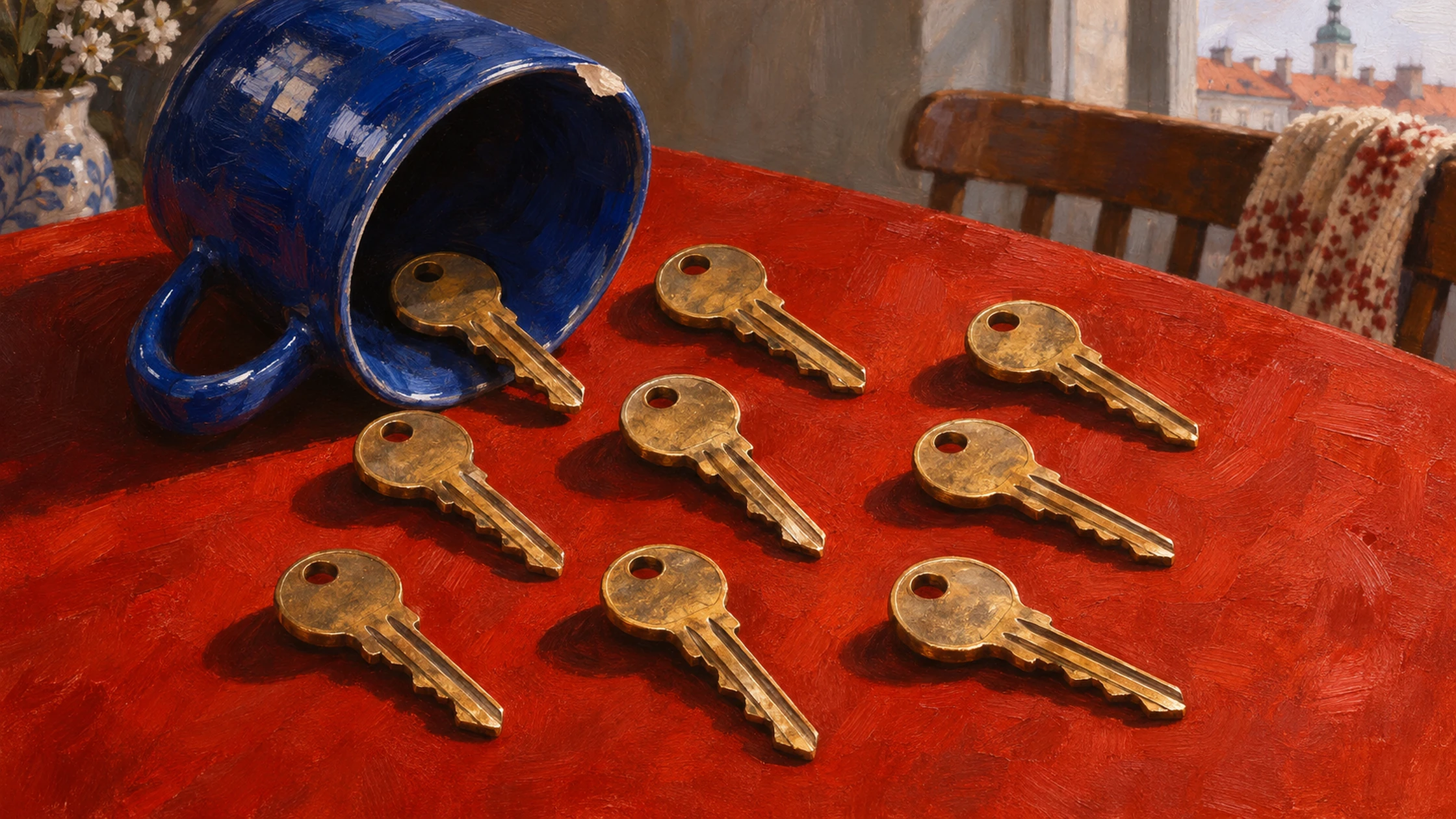
Marta emptied the mug onto the red kitchen table, and nine brass keys fell out.
Bartek watched them spread between the salt and his laptop. “Are we dividing those too?”
“I’m finding a pen.”
“In the key mug?”
There had been a pen in it once. There had been many things in the flat once: a decent frying pan, a promise to clean on Sundays, Lena’s shoes under the radiator. Marta picked up the chipped cobalt mug and looked inside, as though a pen might be painted at the bottom.
The nine keys were identical. They belonged to the old lock, replaced six months earlier when it began trapping people on the landing. Former residents had returned their copies over the years; the locksmith had removed the cylinder, and Marta had kept the useless little crowd. She knew the people the keys had admitted, though she could no longer tell which key had belonged to whom.
Lena had brought the mug on their first day. The chip was older than either of their lives in Warsaw. “It’s for things we can’t find,” she had said, giving it a job before they had bought any chairs.
Now Lena was at her aunt’s in Łódź. Her room was empty except for a standing lamp and three pale rectangles where pictures had been. She had left that morning, four weeks before the end of their tenancy, with a message saying she would call after dinner.
It was after dinner. Marta had eaten over the sink, still wearing the black trousers she wore backstage. A hook from a theatre costume had caught in one knee. She kept touching it instead of taking it out.
Bartek turned the laptop towards her. November’s rent was 3,600 złoty, due tomorrow. He had transferred his twelve hundred. Marta had hers ready. Lena had not sent anything.
“She says she’s not living here now,” he said.
“I saw the message.”
“Then why did you tell me she was paying?”
“Because she always has.”
That sounded like an accusation against the last three years.
They had known Lena was moving at the end of November. All three tenants and the landlord had already signed the documents ending the present tenancy then; a new agreement with Marta, Bartek and a replacement housemate would begin in December. Lena had found a room near work. Then her shifts at the print shop had been cut, and the new room had fallen through. The aunt’s offer had arrived suddenly. So had the van.
None of that explained the missing payment. It only made Marta ashamed of wanting an explanation.
She found a pen in her trouser pocket, beside a spool of grey thread.
The first person to return a key had been a student who baked at midnight. He had cried when he left, and brought back the wrong key twice. Marta remembered standing on the landing with him, testing them, while Lena held the door with her foot. They had all laughed at his astonishment that the city contained other doors.
She wondered when she had stopped remembering departures as departures and started remembering them as missing amounts.
Bartek opened the lease. Marta had organised the signing, scanned the pages, named the file and put it in their shared folder. She could remember doing all that more clearly than she could remember reading it.
The three of them were named as tenants. The rent was one amount for the flat. A clause made each of them answerable for the whole unpaid rent. Their own agreement, written in a message pinned to the house chat, divided it into thirds.
“I thought this”—Bartek tapped the pinned message—“was what we’d signed.”
“It is what we agreed with each other.”
“But not with him.”
They read the landlord’s reply to their earlier question. Under their signed agreement, he expected the whole November rent, not separate room payments. The documents for December did not erase November. He had not agreed to release Lena early because she had moved her boxes.
Marta had imagined telling him she had paid her share and then closing the laptop. She was angry at the lease for having been there all along.
“Could we use her deposit?” Bartek asked.
“It isn’t money in this account. We haven’t agreed any return or deduction.”
They left it out of the calculation. Utility payments already due had been settled separately; nobody was going to make the rent problem smaller by quietly forgetting another bill.
The phone rang. Lena’s name filled the screen, with a photograph Marta had taken in a theatre corridor. Lena wore a ridiculous feathered hat. Marta had always liked the picture because Lena was looking at her, not at the camera.
She answered and put the phone between the keys.
“Are you both there?”
“Yes,” Marta said.
“I have two hundred.”
Bartek sat back. His chair gave the short squeak they had been meaning to repair.
“I thought if I went before the month got going—”
“You agreed to November,” he said.
“I know what the message says.”
“It isn’t just the message.” Marta heard her own voice become the voice she used when an actor would not stand still for a repair. “We signed one lease. The room being empty doesn’t change it.”
There was a kettle in Lena’s background, then her aunt asking something too far from the phone to understand.
“I didn’t know how to tell you,” Lena said.
“You told a man with a van.”
The sentence pleased Marta for perhaps a second. Then she wanted to take it back, but not enough to say so.
Another key had belonged to the woman who kept a lemon tree in the bathroom. When she moved, the tree went first, strapped into the passenger seat of a taxi. Lena had stood beside Marta on the pavement, holding a fallen lemon as if it were an egg.
Afterwards they had sat on the floor of the empty room and shared it in sour slices because neither wanted to fetch a knife and sugar. Marta remembered the beautiful uselessness of that evening. Nothing had been decided or improved.
“Can we stop saying what should have happened?” Lena asked through the phone. “I can’t send it if I haven’t got it.”
“And I can’t have it just because you haven’t,” Marta said.
Bartek pulled a sheet of paper towards him.
With Lena’s two hundred, they would still be a thousand short. Marta had nine hundred set aside for winter, beyond her own rent and ordinary living money. She could put in six hundred. That would leave three hundred, and the thermal lining she had priced for the bedroom curtains would have to wait. Bartek could provide four hundred from his contingency money. He said that was his limit.
“I’ll get it all back to you next week,” Lena said.
Marta closed her eyes. She wanted the promise to be true so badly that she almost accepted it.
“From what?”
Lena had arranged temporary packing work paid weekly. After her contribution at her aunt’s, travel, food and existing payments, she expected to have about 250 left each week. They went through the amounts once, without asking her to prove the price of every meal. Nothing in them produced a thousand by next Friday.
“Four payments of two-fifty,” Bartek said. “That at least sounds like the money you’ve described.”
They agreed on four consecutive Fridays beginning the following week. Each payment would go directly as 150 to Marta and one hundred to Bartek. No interest or fee. If a wage failed to arrive, Lena would contact them before the due date so they could discuss what happened next; silence would not count as a revised agreement.
Marta typed the dates, amounts and both recipients into one document. She added what each of them was paying tonight and that it covered Lena’s missing share of November rent. They each read it and confirmed it in writing.
“Do you need my signature in blood?” Lena asked.
“I need you not to make me embarrassed to ask.”
Lena said nothing for a while. Then: “All right.”
The two hundred arrived. Marta moved six hundred from winter savings; Bartek sent his additional four hundred. The full 3,600 went to the landlord. It was a relief, and it was also a payment made possible by two people having less protection than they had possessed an hour before.
Lena thanked them. Bartek said goodnight. Marta stayed on the call after he took his laptop away.
“I thought you’d tell me I should have saved more,” Lena said.
“I might have. I was angry. I’m still angry.”
“Are you going to be like this every Friday?”
“I don’t know.”
It was the least comforting answer Marta had given all evening. It was also the one she could leave alone.
The ninth key had never belonged to a housemate. It was the spare they gave friends who came to water the plants. Lena had once used it to let herself in after a late shift, when she had left her own key at work. Marta had woken to a clatter in the kitchen and found her making toast in a coat, laughing at the absurdity of having needed permission from a pot plant.
On the table the nine keys were equally worn. No arrangement of them would tell Marta which one had opened that night.
She put them back in the mug and placed it on the shelf above the kitchen door. She and Bartek agreed that their next house meeting would include the actual lease, the payment dates and what would happen if somebody needed to leave. The new housemate had already signed the landlord’s agreement. They would read their own arrangement with her before she moved in, instead of sending her a friendly total and calling it settled.
The hook was still caught in Marta’s trousers. She worked it out with her thumbnail.
On the first agreed Friday, Lena’s payments arrived: 150 to Marta, one hundred to Bartek. Marta’s winter reserve was 450 now. Lena still owed them 750 altogether. The other three payments existed as dates, not money.
Lena was back in Warsaw to collect the lamp. They met for coffee first, each paying from her own ordinary spending money. When she arrived, Marta saw a loose button on Lena’s sleeve and reached towards her before remembering she had not decided how to behave.
Lena held still.
“Have you got a needle?”
“At the flat.”
“I can do it there.”
Lena turned her cup so the handle faced Marta, the old arrangement when one of them wanted a taste. Marta left it there for now. For a little while they talked about the lamp: who had put it together, why it leaned, whether it would fit in the boot. Neither woman called it a good lamp. Neither suggested leaving it behind.
Money behind the story
The story distinguishes a private cost split from obligations to a creditor. Under Poland’s Civil Code, Articles 366 and 369, joint and several liability can arise from law or a legal transaction; the creditor can seek the unpaid obligation from one or more liable debtors. Article 376 addresses recovery between co-debtors according to their internal legal relationship. Here, all three are named tenants whose fictional signed lease expressly provides joint and several liability. This is not a claim that every shared tenancy has identical terms, nor that unnamed adult occupants necessarily have no liability.
The invented rent is PLN3,600. Marta and Bartek each provide their PLN1,200 share. Lena contributes PLN200 now; Marta advances PLN600 and Bartek PLN400, completing the rent. Their later repayment agreement does not postpone the landlord’s payment.
Four promised weekly repayments of PLN250 split into PLN150 for Marta and PLN100 for Bartek: totals of PLN600 and PLN400. After the first, Lena still owes PLN750. Marta’s winter reserve moves from PLN900 to PLN300, then PLN450. Future instalments remain uncertain until received.
The month-end tenancy transition is already agreed with the landlord in writing; no deposit refund is assumed or used. Actual liability, tenancy changes and recovery depend on the documents, facts and applicable law. The figures and agreement are educational fiction, not individual legal advice.
Financial sources checked 25 November 2026. Story figures and outcomes are illustrative. General financial education, not individual financial advice.
Stay with the story: three questions
- Does the agreement you have with the people sharing a cost match what each of you signed with the person being paid?
- What could you realistically lend or advance without making another commitment impossible to meet?
- How could you make space for friendship while stating what is owed and when you need to hear about a problem?



