This article is for informational and educational purposes only. It is not financial advice. Meme coins and newly launched tokens carry an extremely high risk of total loss; the statistics below describe historical population-level outcomes, not a prediction for any individual token. This article contains affiliate links; Decentralised News may earn a commission if you sign up through them, at no extra cost to you.
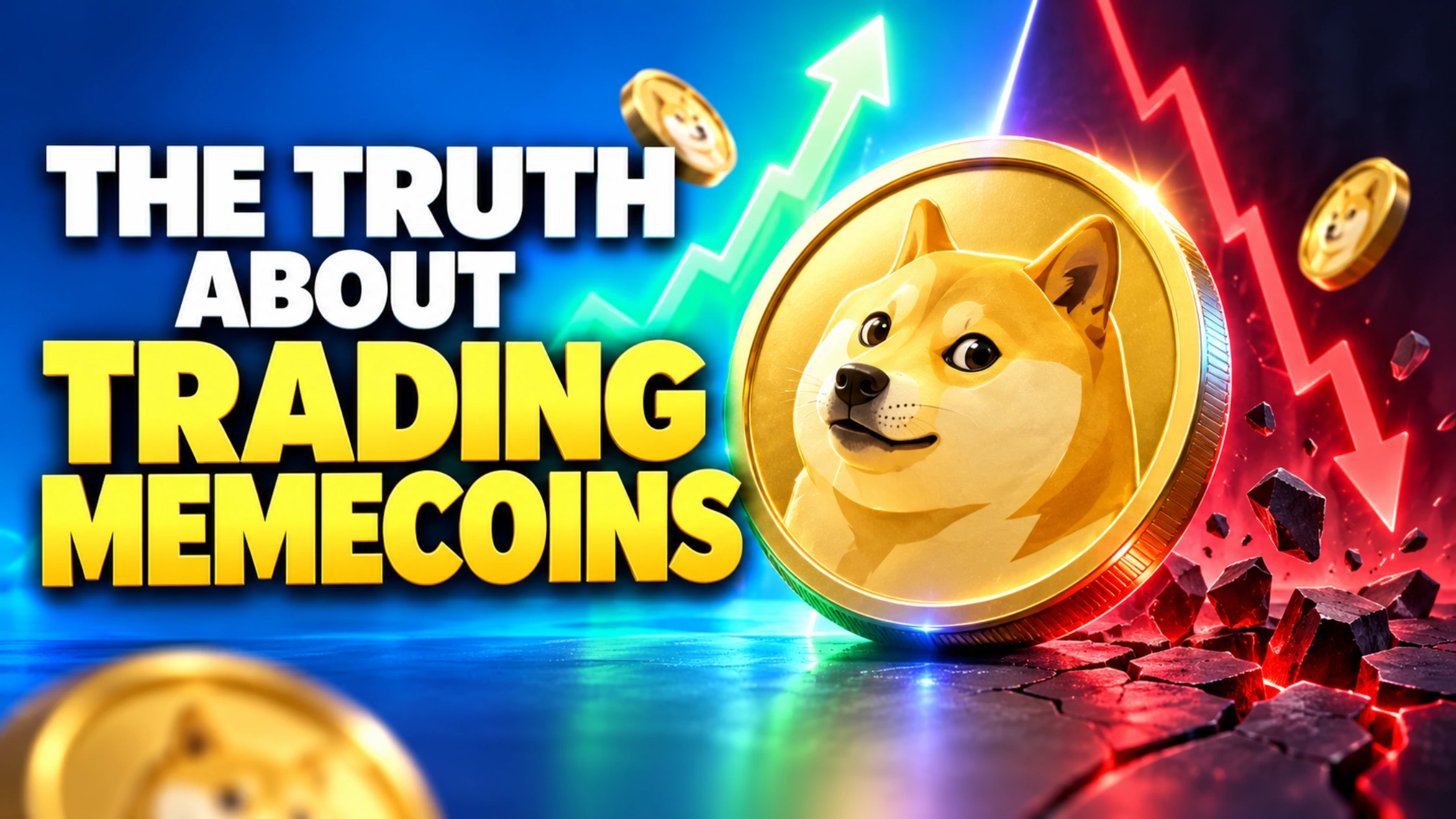
95% of Every Meme Coin Ever Launched Is Already Dead. Here’s the Exact Curve.
Summary: A comprehensive on-chain study of 18.67 million tokens launched on Solana’s pump.fun between January 2024 and June 2026 found that 68.67% never traded again after their launch day, and only 4.55% survived past 90 days. The average lifespan of a pump.fun token is roughly 12 days. This is not a cherry-picked bad month, it is the base rate, and it has held remarkably steady across the platform’s entire operating history. Virtuals Protocol’s tokenized AI agents follow a structurally different but equally sobering pattern: rather than dying outright, the platform’s own flagship, most-successful tokens, AIXBT, Luna, the largest agent tokens by market cap, have each fallen 66% to 97% from their individual peaks while remaining nominally alive and tradable, a slow bleed rather than a flatline. Below, DN builds the actual statistical survival curve behind both platforms and a tool that tells you, in plain probability terms, how unusual it would be for the specific token you’re looking at to still be alive, or worth anything close to its peak, at its current age.
The number that should end most “still early” arguments
Survivorship bias is the single most consistent distortion in how meme coins get discussed publicly. Every conversation about a token that’s still trading, by definition, excludes every token that already died, which means the tokens people are actually talking about at any given moment are, mechanically, a wildly unrepresentative sample of the full population that once existed. CoinGecko’s study, spanning 18.67 million pump.fun launches over roughly two and a half years, is large enough and long enough to correct for that distortion directly rather than gesture at it. The headline numbers: 68.67% of all tokens, approximately 12.8 million of them, recorded their final trade on the same calendar day they launched. Another 2.18 million survived exactly one additional day before activity stopped entirely. By day 14, cumulative survival had fallen to roughly 9.6%. By day 90, only 4.55%, about 850,000 tokens, remained actively traded at all. A separate analysis of a three-month cohort found an even harsher reading, 98% of tokens dead within that window and an average lifespan of just 12 days, using a stricter definition of “dead” based on trading volume collapse rather than a token’s literal final trade.
An even higher bar than mere survival makes the picture starker still. Pump.fun‘s bonding-curve mechanism requires a token to accumulate roughly 85 SOL in real reserves before it “graduates” to an actual decentralized exchange and becomes tradable the way most people picture a real cryptocurrency working. Academic analysis of the platform’s launch data puts that graduation rate at somewhere between 0.2% and 0.63% of all tokens launched, depending on the exact measurement window used. In plain terms: the overwhelming majority of pump.fun tokens never even reach the stage where they’d be tradable on a real exchange, let alone survive there.
Why Virtuals Protocol’s agent tokens die a different kind of death
Virtuals Protocol, the leading platform for tokenizing AI agents, presents a genuinely different failure pattern, and understanding the difference matters more than picking which platform is “worse.” Where pump.fun tokens overwhelmingly die within hours, flatlining to zero trades and staying there, Virtuals’ agent tokens tend to keep trading for much longer while quietly losing the overwhelming majority of their value. Ribbita, currently the largest agent token by market cap at roughly $147 million, peaked near $0.44 in October 2025 and has since fallen to around $0.15, a 66% decline, while remaining the platform’s flagship success story. Luna, the first agent ever launched through Virtuals’ Initial Agent Offering and a livestreamer with over 500,000 TikTok followers, peaked near $0.25 and now trades around $0.006, a 97% decline, despite continuing to be one of the platform’s most visible and actively used agents. The VIRTUAL token itself, the protocol’s own native asset, fell from an all-time high of $5.07 in January 2025 to roughly $0.60 to $1.20 through much of 2026, an 80% to 87% decline, while the protocol’s own monthly revenue collapsed by 96% between January and June 2025 before partially recovering. Over 18,000 agent tokens have launched on Virtuals, and the platform’s own analysts note that the large majority carry negligible market capitalization, a similar long-tail failure pattern to pump.fun’s, just measured in slow value decay across months rather than an instant flatline within hours.
This distinction matters for a specific, honest reason: it is much harder to build a rigorous, population-level survival study for Virtuals-style tokens than for pump.fun’s, precisely because Virtuals tokens don’t stop trading the same clean, measurable way pump.fun’s do. The Virtuals figures in this article describe the platform’s own named, flagship agents, the tokens successful enough to have individual coverage and data, not a comprehensive study of all 18,000-plus launches the way CoinGecko’s pump.fun analysis covers its full population. That gap is itself the point: the platform whose headline mortality statistics look most brutal, pump.fun, is also the one with the most rigorous, most complete data behind those statistics. The platform that looks healthier by comparison, Virtuals, mostly lacks an equivalent study, and there is good reason to expect that if one existed for its full, unglamorous long tail rather than just its handful of famous survivors, the picture would look considerably worse than the flagship examples suggest.
What actually separates the roughly 1-in-20 that make it
CoinGecko’s own analysis and separate research into the broader token failure landscape point toward a consistent, if unglamorous, pattern among survivors. A 2026 analysis of the wider token failure landscape, covering more than 11 million dead projects across the crypto market broadly, found that projects with three specific characteristics, actual revenue, active ongoing development, and product-market fit established prior to a token’s launch rather than after it, survived at dramatically higher rates than projects without them, though even among that stronger cohort, the same research found a failure rate of roughly 52%, essentially a coin flip even for genuinely promising projects. None of this describes a reliable formula for picking winners in advance. It does describe, with real statistical backing, why “the community is strong” and “we’re just getting started” are not, on their own, evidence that a specific token is meaningfully different from the 95% that didn’t make it.
DN Meme Coin Survival Curve
Enter a launch platform and a token's age to see its statistical survival probability against the real population curve behind it.
Enter a launch platform and how many days old a token is, and see its statistical survival probability plotted against the real population curve behind it, built from CoinGecko’s 18.67-million-token pump.fun study and Virtuals Protocol’s own flagship-agent value-decay pattern. The tool states plainly which of the two curves rests on a full population study and which rests on a smaller, necessarily survivorship-biased sample of named success stories, rather than presenting both with false equivalence.
Reading your own result honestly
If a tool like this returns a survival probability in the single digits for a token you’re currently holding or considering, that is not evidence the token is about to fail, plenty of the roughly 1-in-20 pump.fun survivors and 1-in-5 or so enduring Virtuals agents keep trading for a long time afterward. It is evidence that the base rate for tokens at that exact age has, historically, been unfavorable, and that whatever specific reasons make your token different need to be genuinely specific to that token, not generic optimism that applies equally to the 95% that already died holding the same optimism.
Where to position around this thesis
For readers who want exposure to this sector without gambling directly on unproven, hours-old launches, the more disciplined approach is trading tokens that have already survived long enough to reach meaningful liquidity on a major exchange, Bybit, OKX, Binance, KuCoin, Bitget and Gate all list established tokens that have cleared exactly the survivorship bar this article describes, a meaningfully different risk profile than a token still on a bonding curve. Anyone holding a resulting position long-term should also consider a hardware wallet such as Ledger for self-custody.
Frequently asked questions
What percentage of meme coins actually fail? On Solana’s pump.fun, the largest meme coin launchpad, a CoinGecko study of 18.67 million tokens found 68.67% never traded again after their launch day, and only 4.55% survived past 90 days. A separate three-month cohort study found a 98% failure rate with an average token lifespan of 12 days.
What does “graduation” mean for a pump.fun token, and how rare is it? Graduation occurs when a token accumulates enough real reserves, roughly 85 SOL, to migrate from pump.fun’s bonding curve to an actual decentralized exchange, becoming tradable the way most cryptocurrencies are. Academic research puts the graduation rate at between 0.2% and 0.63% of all tokens launched, meaning the overwhelming majority never reach this stage at all.
How do Virtuals Protocol’s AI agent tokens compare to pump.fun’s meme coins? They fail differently rather than less often. Pump.fun tokens overwhelmingly stop trading entirely within hours or days. Virtuals’ agent tokens tend to keep trading for much longer while losing the large majority of their value, with even the platform’s most successful flagship agents down 66% to 97% from their individual peaks.
Is there good data on how many Virtuals Protocol agent tokens have failed? Not to the same rigorous, population-wide extent as pump.fun. The Virtuals figures most commonly cited describe the platform’s own named, successful flagship agents rather than a comprehensive study of all 18,000-plus tokens launched, meaning the true platform-wide picture, if it existed, would likely look considerably worse than the well-known success stories suggest.
What separates the small percentage of tokens that survive? Broader research into token failure across the crypto market found that projects with genuine revenue, active ongoing development, and product-market fit established before launch survived at meaningfully higher rates, though even that stronger cohort still failed roughly half the time, underscoring that no combination of traits guarantees survival.
Does a low survival probability mean I should sell a token I’m holding? This is not financial advice. A statistically low base-rate survival probability for tokens of a similar age and platform does not predict the outcome for any specific token, but it is a useful, honest input to weigh against whatever specific reasons you believe make your position different from the large majority that shared the same age and didn’t survive.
Decentralised News maintains E-E-A-T standards through primary-source verification of all survival, failure and market-cap data cited above, sourced directly from CoinGecko’s pump.fun token survival study, peer-reviewed graduation-rate research, ChainPlay’s memecoin lifespan analysis, and Virtuals Protocol’s own published agent and revenue data, current as of September 2026. Population-level historical statistics do not predict the outcome of any individual token; this is not financial advice.
Related reading:
Fomo Review 2027: Social Crypto Trading, Memecoins, Perpetuals and Onchain Markets Explained
Best Crypto Exchanges for Altcoins in 2027: New Listings, Meme Coins and Low-Caps
How to Buy Meme Coins Without Getting Rugged (Most People Fail This)
How to Find Meme Coins Early on Solana With an AI Agent (2026 Guide)
The Narrative Heat Map: Which Crypto Story Is Catching Fire Before Price