MCP vs A2A for Financial Agents 2027
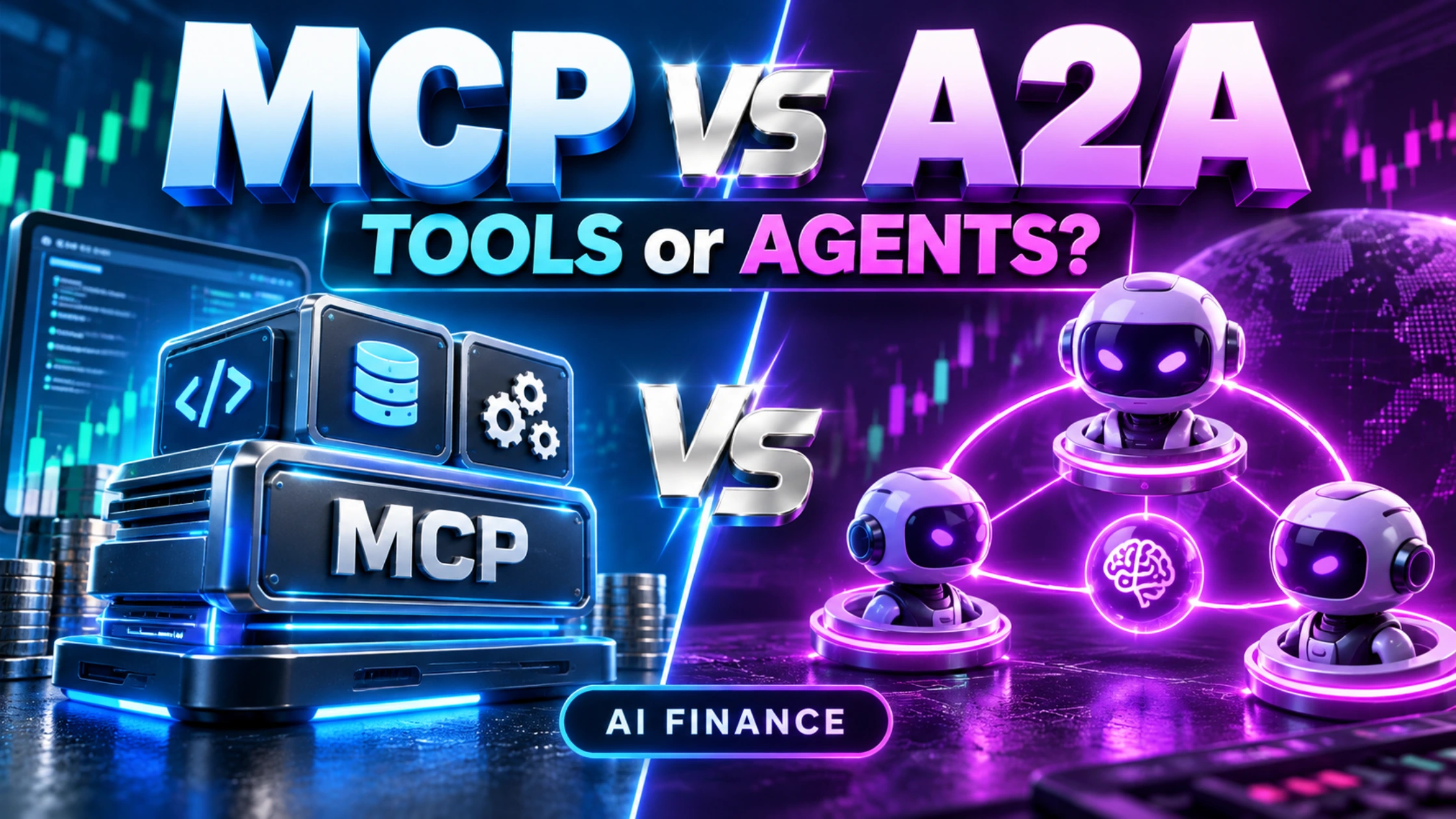
Model Context Protocol and Agent2Agent are becoming foundational standards for agentic systems, but they solve different problems. In financial applications the distinction is not academic: confusing a callable tool with an autonomous counterparty can create unnecessary complexity, hidden authority and dangerous execution paths.
What Matters
MCP and A2A should not be treated as competing standards.
MCP is primarily a protocol for connecting an AI application to capabilities:
- tools;
- resources;
- data;
- prompts;
- external software;
- long-running server operations.
A2A is primarily a protocol for connecting one autonomous agent to another autonomous agent.
It provides semantics for:
- agent discovery;
- capability advertisement;
- delegation;
- messages;
- stateful tasks;
- artifacts;
- streaming;
- asynchronous collaboration.
But the distinction has become more subtle.
MCP's July 2026 specification added a stateless protocol core and formal Tasks extension.
So it is no longer accurate to say:
“MCP does short calls. A2A does long jobs.”
Both can participate in long-running work.
The better distinction is:
MCP crosses a capability boundary.
A2A crosses an autonomy boundary.
And neither protocol, by itself, determines whether an AI system should be allowed to move money.
Why Most MCP vs A2A Comparisons Are Already Out of Date
The protocols changed quickly during 2025 and 2026.
MCP's current 2026-07-28 specification moved to a stateless core.
Protocol-level sessions and the old initialization exchange were removed from the new architecture.
Each request can be self-describing.
Tool and method names can be exposed in HTTP headers so infrastructure such as gateways, rate limiters and authorization systems can route requests without parsing the JSON body.
The release also introduced or formalized:
- cacheable capability lists;
- Multi Round-Trip Requests;
- stronger authorization mechanics;
- an extensions architecture;
- the Tasks extension;
- a formal deprecation lifecycle.
Meanwhile A2A reached v1.0 in March 2026.
Its current specification supports:
- Agent Cards;
- cryptographically signed Agent Cards;
- task lifecycle management;
- messages and artifacts;
- JSON-RPC;
- gRPC;
- HTTP+JSON;
- streaming and asynchronous workflows;
- standard web authentication mechanisms.
The ecosystem is therefore no longer debating two immature experiments.
It is increasingly deciding how two production-oriented standards fit together.
The Simplest Correct Explanation
| Question | MCP | A2A |
|---|---|---|
| Primary relationship | Agent/application → capability provider | Agent → autonomous agent |
| Core abstraction | Tools, resources, prompts and extensions | Agent Cards, messages, tasks and artifacts |
| Who decides how work is done? | Usually the calling agent chooses the operation and parameters | The receiving agent may independently plan how to satisfy the delegated objective |
| Discovery | Discover server capabilities | Discover remote autonomous agents and their skills |
| Long-running work | Supported through MCP Tasks extension | Native to A2A task semantics |
| Best financial use | Market data, portfolios, risk engines, execution services, wallets, databases | Research agents, risk agents, execution agents, treasury agents, compliance agents |
| Does it provide financial authorization? | No | No |
| Does it settle money? | No | No |
The DN Autonomy Boundary Test
Consider two instructions.
Instruction A:
“Return the current BTC-USDC order book.”
That is a bounded capability.
An MCP tool is a natural fit.
Instruction B:
“Evaluate the cheapest compliant route for converting $5 million of USDC into EUR before 4pm, negotiate with approved venues, and return the best executable proposal.”
That is not simply a function call.
The receiving system may need to:
- plan;
- contact counterparties;
- request more information;
- wait;
- compare alternatives;
- produce an artifact;
- maintain a task state.
That looks much more like an A2A delegation.
MCP: The Capability Plane
Model Context Protocol
Current major specification reviewed: 2026-07-28
MCP standardizes how AI applications connect to systems where tools and data live.
An MCP server can expose:
- tools that perform actions;
- resources that expose information;
- prompts representing reusable interaction templates;
- extensions for additional protocol capabilities.
For finance, that can mean an MCP server exposing:
- account balances;
- market prices;
- positions;
- historical candles;
- order books;
- backtesting;
- risk calculations;
- strategy creation;
- order submission;
- wallet operations.
What Changed in 2026?
The stateless MCP core matters because it makes remote servers easier to operate behind conventional web infrastructure.
A request can be independently routed rather than depending on hidden protocol session state.
For enterprise financial infrastructure, this improves compatibility with:
- load balancers;
- API gateways;
- WAFs;
- rate limiters;
- central policy enforcement;
- observability systems.
That matters more than it sounds.
The safer financial-agent architecture is usually one in which normal infrastructure can see and control consequential calls.
A2A: The Delegation Plane
Agent2Agent Protocol
Current stable major version reviewed: v1.0
A2A assumes the remote endpoint may itself be an autonomous system.
The calling agent does not need access to the remote agent's:
- prompt;
- internal memory;
- planning algorithm;
- tools;
- model provider;
- implementation framework.
Instead the remote agent publishes an Agent Card.
The card can describe:
- identity;
- provider;
- skills;
- capabilities;
- supported protocol interfaces;
- security requirements.
A2A v1.0 supports Agent Card signatures using standard JSON Web Signatures.
The card can therefore be cryptographically integrity-protected.
The remote party can then receive a message and either return an immediate response or create a stateful Task.
A2A's Core Economic Significance
A2A makes it easier to outsource judgment, not merely computation.
That is why it matters to financial systems.
A portfolio agent can ask a separate risk agent:
“Evaluate whether increasing ETH exposure by 3% remains inside our volatility, drawdown and liquidity mandate.”
The risk agent is not merely returning one raw database field.
It can own the analysis and return a structured recommendation artifact.
The Confusing Part: Both Protocols Now Have Tasks
This is where many comparisons break down.
MCP now has a Tasks extension.
A2A has Tasks as a central part of its collaboration model.
The names are similar.
The semantics are not identical.
| Dimension | MCP Task | A2A Task |
|---|---|---|
| Why it exists | Allow a server operation to continue asynchronously rather than returning immediately | Represent stateful work delegated to an autonomous agent |
| Typical origin | A tool/resource-related protocol request | A message or objective sent to another agent |
| Who owns execution logic? | The MCP server implementation | The remote agent |
| Typical example | Run a 20-minute backtest | Research five venues, obtain quotes and produce an execution recommendation |
| Main semantic focus | Deferred capability result | Delegated autonomous work |
Architecture 1: A Single Financial Agent Using MCP
This architecture is sufficient when one orchestrating agent owns the reasoning and the remote systems are primarily deterministic services.
Adding A2A here merely because several servers exist would not necessarily improve the system.
Architecture 2: Multiple Specialist Agents Using A2A + MCP
This is the pattern DN expects to become common.
A2A outside the specialist.
MCP inside the specialist.
But even this architecture remains incomplete for meaningful capital.
The Missing Layer: Neither Protocol Is a Risk Policy
Suppose an A2A Execution Agent receives:
“Buy $1 million of SOL immediately.”
A2A can transport the objective.
The Execution Agent can use MCP to call an exchange tool.
But several questions remain unanswered:
- Was $1 million inside the principal's mandate?
- Is SOL approved?
- Is the venue approved?
- What leverage is permitted?
- What slippage is permitted?
- Has the mandate expired?
- Does the transaction require another approver?
Those questions belong to a deterministic control plane.
The DN Four-Plane Financial Agent Architecture
Who owns the objective?
Typical technologies: A2A, agent identity, KYA, signed mandates.
What data and operations can the agent invoke?
Typical technologies: MCP, APIs, databases, exchange connectors.
What actions are actually permitted?
Typical technologies: policy engines, limits, wallet policies, approvals, kill switches.
What economically happened?
Typical technologies: exchange ledgers, blockchains, payment rails, receipts and reconciliation.
The Financial Authority Handoff Surface
Every time financial intent moves from one independently controlled component to another, authority has to be interpreted.
Consider:
Human → Portfolio Agent → Execution Agent → MCP Trading Server → Exchange
There are several handoffs.
At each one, the system can accidentally:
- broaden permissions;
- lose context;
- misinterpret amount;
- lose mandate provenance;
- duplicate a request;
- apply stale policy.
The Protocol Role Inversion Problem
Inversion Type 1: Agent Disguised as Tool
Suppose an MCP tool called:
execute_best_trade()
internally:
- researches venues;
- makes economic judgments;
- negotiates;
- waits for market conditions;
- chooses an execution strategy.
The interface makes the system look deterministic.
But the hidden implementation is autonomous.
That can conceal:
- who owns the task;
- which decisions were made;
- what state persists;
- where further delegation occurs.
Inversion Type 2: Tool Disguised as Agent
Now imagine wrapping:
get_btc_price()
inside a fully discoverable autonomous A2A agent.
That creates unnecessary:
- task semantics;
- identity complexity;
- agent discovery;
- governance;
- operational overhead.
A plain capability endpoint would be cleaner.
Use Case Matrix for Financial Agents
| Financial Function | Best-Fit Protocol Layer | Why |
|---|---|---|
| Read account balances | MCP | Deterministic capability/data access |
| Fetch market prices | MCP | Resource/tool call |
| Run a backtest | MCP Task | Long-running capability without autonomous peer semantics |
| Request independent risk assessment | A2A | Delegated analytical objective to another agent |
| Ask multiple brokers for executable proposals | A2A + execution APIs | Cross-party autonomous coordination |
| Place exchange order | MCP/API + policy engine | Bounded financial execution capability |
| Transfer wallet funds | MCP/API + wallet policy | Execution requires deterministic controls below the protocol |
| KYC file review | A2A or MCP depending autonomy | Simple screening can be tool-like; full case ownership may be agent-like |
| Continuous treasury optimization | A2A + MCP | Persistent autonomous planning combined with tool/data access |
| Machine payment settlement | Neither alone | Requires actual payment/settlement infrastructure such as card, stablecoin, x402 or other rail |
Trading Architecture: Where MCP Fits Best
Trading systems contain many naturally MCP-shaped capabilities.
An execution agent might use MCP tools such as:
market.get_order_book
portfolio.get_positions
risk.check_order
strategy.run_backtest
orders.submit
orders.cancel
orders.status
account.get_balance
These are explicit actions with defined parameters and expected outputs.
The intelligence remains primarily in the calling agent.
That separation is useful.
The model can propose:
“Reduce BTC exposure by 8%.”
The risk MCP server can independently answer:
“Maximum permitted reduction at current policy state: 5%.”
The execution layer can enforce the lower value.
When A2A Becomes Useful in Trading
A2A becomes more compelling when independent agents own distinct objectives.
For example:
- Portfolio Agent decides desired exposure.
- Risk Agent independently evaluates constraints.
- Execution Agent determines implementation.
- Compliance Agent evaluates jurisdiction or restricted instruments.
- Post-Trade Agent reconciles final state.
These agents may:
- use different models;
- come from different vendors;
- operate in different organizations;
- maintain separate task states;
- use different internal tools.
That is the environment A2A was designed to make more interoperable.
Financial Agents Should Not Trust Acknowledgements
The protocol layer also does not solve one of the hardest execution problems:
unknown financial state.
An MCP order tool can return a timeout.
The order may still have reached the exchange.
An A2A Execution Agent can report:
“working.”
That does not prove whether the underlying order filled.
A financial agent therefore still needs:
- client order IDs;
- idempotency;
- authoritative venue state;
- fill reconciliation;
- balance reconciliation;
- position reconciliation.
This connects directly to the DN concept of Unknown-State Latency.
Authentication Is Not Financial Authorization
Both ecosystems have improved security substantially.
MCP's current specification includes more mature OAuth-oriented authorization mechanics and issuer validation.
A2A Agent Cards can declare security schemes, while v1.0 formalizes signed cards using JWS.
Those controls matter.
But authentication answers:
“Who is communicating?”
Financial authorization asks:
“What may this actor do with this capital under this mandate right now?”
That requires additional controls.
The Financial Stack Beyond MCP and A2A
| Problem | Possible Infrastructure |
|---|---|
| Agent identity | A2A Agent Card, ERC-8004, enterprise identity, KYA systems |
| Delegation | A2A, signed mandates, capability tokens |
| Tool access | MCP |
| Authorization | AuthZEN-style policy, wallet policy, exchange permissions, institutional policy engines |
| Payments | Cards, bank rails, stablecoins, x402, AP2-compatible commerce systems |
| Execution | Exchange API, broker API, DEX transaction, wallet signer |
| Settlement evidence | Venue ledger, blockchain state, payment receipt |
| Emergency containment | Signer revocation, credential revocation, kill switch, account freeze |
A Real MCP Trading Example: Coinrule
Coinrule MCP
Coinrule currently operates an official remote MCP server connecting compatible AI assistants including ChatGPT, Claude, Gemini and Grok to Coinrule Cloud.
Supported workflows include:
- portfolio inspection;
- balance retrieval;
- strategy monitoring;
- backtesting;
- strategy creation;
- management of supported trading automation.
Importantly, Coinrule remains the underlying execution and validation layer.
The AI assistant does not receive the user's Coinrule password or exchange API keys.
The remote MCP connection uses OAuth and can be configured with:
- Read Only access;
- Read + Write access.
This is a useful example of the architecture DN considers directionally sound:
frontier model → standardized MCP tools → deterministic trading platform → exchange.
Explore Coinrule MCP Read Coinrule MCP DocumentationAffiliate disclosure: DN may earn compensation from eligible Coinrule registrations. The protocol conclusions in this article are independent of that commercial relationship.
Why A2A Agent Cards Matter for Finance
An open agent market needs discovery.
An agent deciding whether to delegate work to another autonomous system may need to know:
- what the agent claims to do;
- who provides it;
- where its service is located;
- which protocol interfaces it supports;
- which authentication schemes it requires;
- which skills it advertises.
A2A packages that into an Agent Card.
Version 1.0 supports multiple standard bindings including:
- JSON-RPC;
- gRPC;
- HTTP+JSON.
Cards can also be signed.
That creates a useful integrity primitive.
- the agent is competent;
- its financial advice is correct;
- its reputation is genuine;
- it possesses authority for today's transaction;
- its underlying tools are uncompromised.
This Is Why KYA and A2A Are Complementary
The DN Know Your Agent framework asked:
Who is the agent, who does it represent and under what mandate is it acting?
A2A helps transport and discover agent-level identity metadata.
KYA goes further into:
- principal binding;
- mandate;
- authority;
- reputation;
- validation;
- accountability.
In a high-value financial system, the A2A Agent Card can therefore become one input into trust assessment rather than the complete trust decision.
The DN Financial Agent Protocol Architect
Which Protocol Does Your Financial Agent Actually Need?
Describe the architecture. The tool estimates whether MCP, A2A, both, or neither alone best fits the interaction and flags additional controls required for financial authority.
This tool evaluates protocol architecture, not regulatory compliance, security certification or financial suitability.
What the Tool Is Really Measuring
The key variable is not whether a workflow is “agentic.”
It is the location of autonomy.
If the intelligence lives almost entirely in one orchestrator and the external systems expose bounded operations, MCP may be enough.
If autonomy is distributed across independent systems, A2A becomes more valuable.
If distributed agents also need tools and databases, both protocols become useful.
If real money is involved, neither protocol is enough.
Example: Research Agent
Suppose a portfolio agent needs current protocol revenue, governance proposals and onchain activity.
A simple design:
Portfolio Agent → MCP → Research Database
may be sufficient.
The database does not need agency.
It needs accurate retrieval.
Example: Independent Credit Agent
Now suppose a treasury agent needs:
“Obtain an independent credit-risk opinion on Counterparty X using your own approved data sources and return a signed recommendation.”
A2A becomes more natural.
The credit agent owns the delegated analytical objective.
Internally, that Credit Agent may use MCP to access:
- financial statements;
- credit databases;
- market pricing;
- onchain data;
- risk models.
Example: Autonomous Treasury Agent
A sophisticated treasury architecture could look like:
That is much closer to the architecture of a real autonomous financial institution than:
LLM → wallet.
The Agent Should Not Carry Every Credential
MCP and A2A interoperability can tempt developers to make the orchestrating model the central holder of credentials.
That increases blast radius.
A safer system can keep:
- exchange credentials inside execution infrastructure;
- wallet keys inside signing infrastructure;
- bank credentials inside payment infrastructure;
- administrator credentials inside a separate control plane.
The agent receives capability.
It does not necessarily receive the underlying secret.
Discovery Creates New Counterparty Risk
Dynamic agent discovery is powerful.
It is also economically dangerous.
A future agent may discover:
- an execution agent;
- a credit agent;
- a tax agent;
- a data seller;
- a market maker;
- a payment agent.
Discovery solves:
“Who says they can do this?”
It does not solve:
“Should I trust them?”
This is why open A2A markets will eventually require:
- KYA;
- reputation;
- validation;
- economic stake;
- counterparty policy;
- transaction limits.
Cancellation Does Not Equal Financial Reversal
Both MCP Tasks and A2A Tasks can support cancellation concepts.
Financial systems need to interpret cancellation very carefully.
Canceling:
“Find the best EUR quote.”
is simple.
Canceling:
“Buy €5 million.”
is not.
By the time the cancellation arrives:
- an order may have filled;
- a blockchain transaction may be broadcast;
- a card payment may be authorized;
- a quote may be binding.
The Future Internet of Financial Agents
A2A adoption is strategically important because it opens the possibility of an interoperable market of specialized agents.
A future portfolio agent might dynamically select:
- the best tax agent;
- the best execution agent;
- the best risk agent;
- the best stablecoin routing agent;
- the best credit agent.
Each specialist could use MCP internally.
That resembles the development of the web.
Applications did not need one company to own:
- the browser;
- every website;
- every database;
- every payment system.
Open standards allowed independently developed systems to interoperate.
The Standards Are Converging Institutionally
The ecosystem has also moved toward neutral governance.
The Agentic AI Foundation now hosts or governs key projects across the emerging open agent stack.
A2A officially joined the AAIF as a Growth Stage project in August 2026.
The foundation has attracted major:
- cloud companies;
- software vendors;
- payment companies;
- financial institutions;
- model providers.
That matters because protocol adoption in financial services depends heavily on neutrality.
A bank is unlikely to want its core agent interoperability layer controlled solely by a competing model vendor.
The Financial Architecture DN Expects to Win
| Layer | Preferred Design Principle |
|---|---|
| Reasoning | Models can be replaceable and task-specific |
| Agent Coordination | A2A or equivalent interoperable autonomous delegation |
| Capability Access | MCP or bounded APIs |
| Identity | Persistent verifiable agent + principal binding |
| Authorization | Deterministic and independent of model reasoning |
| Credentials | Scoped, short-lived and isolated from model context |
| Execution | Deterministic financial service |
| Settlement | Authoritative venue, blockchain or payment state |
| Emergency Control | Independent revocation and containment |
| Audit | Principal → Agent → Mandate → Action → Settlement evidence |
What Would Prove This Architecture Wrong?
The distinction between tool protocols and agent protocols could narrow further.
MCP's roadmap already includes increasingly agentic capabilities.
A2A can expose agents that behave almost like specialized services.
The protocols may therefore overlap more over time.
Another possibility is that dominant agent platforms hide both standards behind higher-level orchestration frameworks.
Developers might rarely interact directly with either protocol.
But even if implementation details converge, the architectural distinction remains useful:
capability invocation and autonomous delegation create different trust relationships.
That difference will remain important wherever money is involved.
DN Protocol Evaluation Methodology
This research does not produce an overall “winner” because MCP and A2A solve different problems.
DN compares them across:
- Capability exposure: structured access to tools and data.
- Autonomous delegation: ability to hand objectives to independent agents.
- Discovery: identifying available servers, capabilities or agents.
- Long-running work: asynchronous execution and status handling.
- Cross-vendor interoperability: ability to span different implementations.
- Security architecture: authentication and protocol-integrity mechanisms.
- Enterprise deployment: scalability, governance and observability.
- Financial suitability: compatibility with independent authorization, settlement and audit systems.
The article uses the specifications and project documentation current at the review date.
Protocols Are Only the Plumbing
The next layers are identity, authorization, wallets, execution reliability and emergency control.
Know Your Agent Index Agentic Wallet Security Index Trading API Latency Benchmark AI Agent Kill-Switch Benchmark x402 Cost & Reliability Benchmark When Bots NegotiateFrequently Asked Questions
What is the difference between MCP and A2A?
MCP primarily connects an AI application or agent to external tools, resources and services. A2A primarily enables one autonomous agent to discover, communicate and collaborate with another autonomous agent. They are complementary rather than direct competitors.
Can MCP handle long-running tasks?
Yes. The 2026-07-28 MCP architecture includes a Tasks extension that lets supported server operations return asynchronous task handles for deferred completion and polling.
If MCP supports tasks, why is A2A still needed?
Because duration is not the main distinction. An MCP Task represents a long-running capability operation, while an A2A Task represents work owned by another autonomous agent. A2A also provides agent discovery, Agent Cards, message semantics and cross-agent collaboration.
Should a trading agent use MCP or A2A?
A single trading agent accessing market data, risk checks and execution tools can use MCP effectively. A multi-agent architecture in which separate risk, portfolio, execution or compliance agents own distinct objectives may benefit from A2A between agents and MCP inside each agent for tools.
Does MCP make a financial tool safe?
No. MCP standardizes capability access. Financial safety still requires least privilege, deterministic authorization, transaction limits, credential isolation, reconciliation and emergency controls.
Does A2A prove an agent can be trusted?
No. A2A supports agent identity metadata, security declarations and signed Agent Cards, but those mechanisms do not independently establish competence, reputation, financial authority or the validity of a specific transaction mandate.
Can MCP or A2A settle payments?
Neither protocol is itself a payment or settlement rail. Payments require separate infrastructure such as bank rails, cards, stablecoins, x402-compatible systems or other payment networks.
What is the DN Autonomy Boundary Test?
The DN Autonomy Boundary Test asks whether the remote system is being asked to perform a specific capability or is being delegated an objective and given freedom to decide how to achieve it. Capability invocation generally points toward MCP, while autonomous delegation points toward A2A.
What is Protocol Role Inversion?
DN Protocol Role Inversion occurs when an autonomous agent is represented as though it were a deterministic tool, or when a simple deterministic capability is unnecessarily wrapped as an autonomous agent.
What is the Financial Authority Handoff Surface?
The DN Financial Authority Handoff Surface measures the number and significance of boundaries across which financial intent is delegated, translated or executed. Additional handoffs create greater need for scope preservation, identity, authorization and auditability.
Primary Sources
- Model Context Protocol: 2026-07-28 Specification
- MCP TypeScript SDK v2
- MCP Tasks Extension
- Model Context Protocol 2026 Roadmap
- A2A Protocol
- A2A Protocol: What's New in v1.0
- A2A Core Concepts
- A2A Protocol Definitions
- A2A: Joining the Agentic AI Foundation
- Linux Foundation: A2A Adoption and Production Use
- Coinrule MCP Documentation
Affiliate Disclosure: Decentralised News may receive compensation from eligible Coinrule registrations through the partner link included in this article. Commercial relationships do not determine the protocol analysis, methodology or conclusions.
Protocol Status: Agent protocols continue evolving quickly. This article reflects MCP specification 2026-07-28 and A2A v1.0 documentation available at the review date. Implementers should verify current specifications before deploying production systems.
Security Disclaimer: Protocol interoperability does not guarantee secure financial execution. High-value agentic systems require independent identity, least privilege, deterministic authorization, credential controls, settlement verification and incident response.
Financial Disclaimer: Nothing on this page constitutes personalized financial, investment, trading, legal, cybersecurity or tax advice. Automated and autonomous financial systems can produce rapid and irreversible losses. 18+.
Related reading:
The AI Capital Absorption Test: When the Compute Boom Must Prove Itself
Agentic Finance Frontier Index 2027: Astra vs Grok Bot vs Claude vs Gemini vs Muse
AI Agent Kill-Switch Reliability Benchmark 2027: Revocation, Limits & Emergency Controls
Best Agentic Checkout Systems 2027: ACP vs UCP vs Visa vs Mastercard
Fastest Crypto Trading APIs 2027: Latency, Rejections & Reliability Ranked
Best Crypto Platforms for AI Agents 2027 | Agentic Finance Rankings
Agentic Wallet Security Index 2027: The Safest Wallets for AI Agents
Best Wallets for AI Agents 2027: Security, Payments & Autonomous Finance