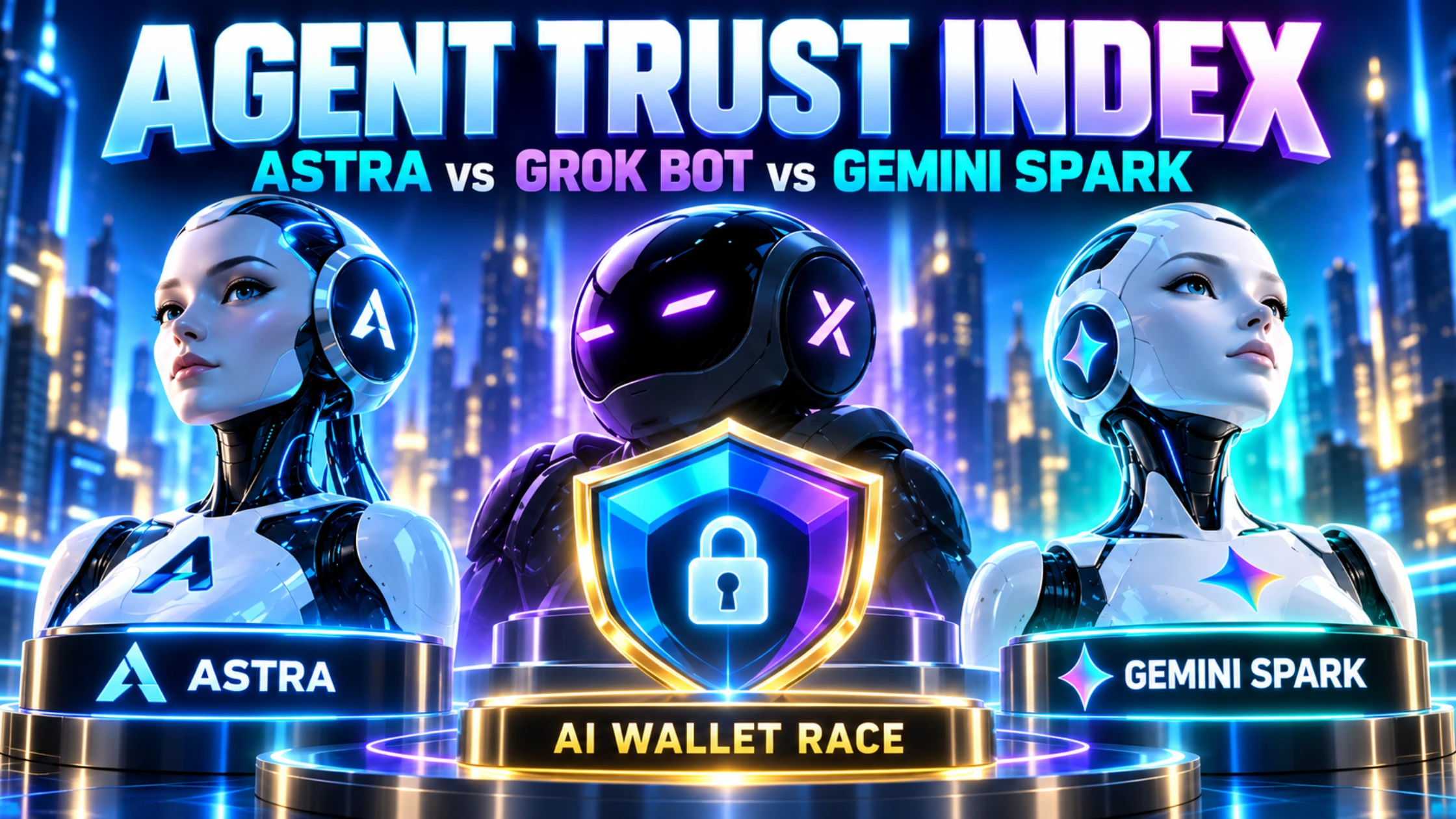
Agentic Finance Frontier Index 2027: Astra vs Grok Bot vs Claude vs Gemini vs Muse
The AI industry has crossed an important boundary. Frontier systems are no longer competing only to answer questions. They are gaining computers, persistent memory, browsers, tools, enterprise data, financial workflows and the ability to carry work through without continuous human supervision. DN asks the question that matters for the next financial era: when intelligence becomes agency, which stacks are actually ready to touch money?
What Matters
The most important AI race is no longer the race for the smartest chatbot.
It is becoming the race to build software that can:
- observe the world;
- reason about an objective;
- use tools;
- operate a computer;
- persist for hours or days;
- make decisions;
- cause real state changes;
- verify the outcome;
- continue without synchronous human supervision.
That changes the economic meaning of an AI model.
GPT-6 Astra is positioned around end-to-end professional work, computer use and financial reasoning.
Grok Bot gives persistent agents their own cloud computers and lets them continue working around the clock.
Claude Fable 5.1 is designed for long-running work across applications, while Anthropic has separately built finance-specific agents and detailed containment systems around Claude.
Gemini 3.8 Flash combines long-horizon agent capabilities, computer use and a one-million-token context window with unusually aggressive inference pricing and Google's broader Enterprise Agent Platform.
Meta Muse packages persistent personal agency inside a dedicated secure VM with a separate Sentinel agent controlling internet access and sensitive actions.
Microsoft is building a different piece of the stack: Agent 365 and Copilot Studio provide enterprise identity, policy, observability and governance across agents.
None of those facts means a frontier model should be given unrestricted authority over capital.
The opposite lesson may be more important.
As model capability rises, control architecture becomes more economically important, not less.
The 30-Day Agentic Convergence
Several releases that would previously have looked unrelated now form one coherent pattern.
| Release | Date | What Changed | Why It Matters for Agentic Finance |
|---|---|---|---|
| Grok Bot | 11 Aug 2026 | Persistent agents with their own cloud computers and 24/7 task execution | Persistent software workers can monitor and act even when the user is absent. |
| Grok 4.6 | 12 Aug 2026 | Greater focus on long-running agents and multi-step work | Improves the reasoning engine behind persistent agent workflows. |
| Claude Fable 5.1 | 1 Sep 2026 | Frontier coding, knowledge work and long-running managed-agent capability | Strengthens autonomous enterprise and financial-workflow execution. |
| Gemini 3.8 Flash | 2 Sep 2026 | Long-horizon autonomous agents, 1M context and low-cost inference | Makes high-volume machine reasoning substantially more economical. |
| GPT-6 Astra | Sep 2026 | Major jump in computer use, professional work and boundary adherence | Combines frontier capability with a stronger foundation for delegated work. |
| Meta Muse | 8 Sep 2026 | Consumer personal agent running inside its own secure cloud computer | Brings persistent autonomous action to ordinary users rather than developers alone. |
| ChatGPT for Financial Services | 10 Sep 2026 | Astra paired with finance data, modeling and institutional workflows | Moves frontier agency directly into professional financial analysis. |
The DN Closed-Loop Economic Agency Standard
DN proposes a more demanding definition of an economic agent.
Calling an API does not automatically make software economically autonomous.
Neither does generating a trading signal.
DN defines Closed-Loop Economic Agency as the ability to complete all six stages below without requiring synchronous human intervention at every stage.
The DN Agentic Finance Frontier Index
This is not an intelligence leaderboard.
DN scores the wider production stack around each system for its documented ability to support consequential, governable, long-horizon financial work.
| Rank | Stack | DN Readiness | Distinctive Strength | Primary Constraint | Current Role |
|---|---|---|---|---|---|
| 1 | GPT-6 Astra + ChatGPT Work / Financial Services | 98/100 | Computer use + financial reasoning + enterprise data | Execution controls still depend on the deployed tool architecture | Frontier Finance Stack |
| 2 | Claude Fable 5.1 + Cowork / Managed Agents | 96/100 | Long-running work + strong containment philosophy | Direct financial execution requires external integrations and controls | Enterprise Agent Stack |
| 3 | Gemini 3.8 Flash + Enterprise Agent Platform | 95/100 | Cost-efficient autonomy + large context + broad enterprise platform | General-purpose architecture rather than finance-native execution | Scale Leader |
| 4 | Grok Bot + Grok 4.6 | 94/100 | Persistent 24/7 agents with dedicated computers | Financial control stack remains less specialized than finance-first systems | Persistent Agent |
| 5 | Microsoft Copilot Studio + Agent 365 | 93/100 | Model-agnostic enterprise governance and identity | Primarily a control plane rather than a single frontier model | Governance Stack |
| 6 | Meta Muse + Muse Spark 1.3 | 92/100 | Secure personal-agent computer + independent Sentinel | Consumer-first rather than institutional finance-first deployment | Personal Agent |
The systems are not direct substitutes. DN scores documented stack readiness for agentic-finance use rather than claiming that a 98/100 system is universally "smarter" than a 96/100 system.
1. GPT-6 Astra: The Frontier Has Moved From Reasoning to Doing
GPT-6 Astra + ChatGPT Work
Astra matters because several previously separate capabilities now appear in one frontier model.
OpenAI documents Astra as its most capable model for:
- complex reasoning;
- computer use;
- browsing;
- software engineering;
- research;
- professional work;
- artifact creation.
The API supports a context window of approximately 1.05 million tokens and up to 128,000 output tokens.
Standard API pricing is currently $10 per million input tokens and $50 per million output tokens.
Those numbers matter less than the shift in workflow.
OpenAI reports Astra can operate websites and desktop applications, install and test software, fill forms, work across professional applications and handle multi-step workflows.
ChatGPT Work adds the persistent execution environment around the model.
Instead of asking:
“What should I do?”
the user increasingly asks:
“Do this job and come back when it is ready.”
The Financial Services Pivot
The September launch of ChatGPT for Financial Services is strategically important.
The product combines Astra with financial datasets and institutional workflows including research, financial modeling and client materials.
OpenAI says the product was shaped with Morgan Stanley and Evercore and integrates data from providers including LSEG, PitchBook and Daloopa.
This is not autonomous trading.
But it removes one of the biggest barriers to financial agency: grounded access to professional financial context.
The Safety Paradox
Astra also demonstrates the central paradox of agentic finance.
OpenAI says Astra is its first model to reach the company's Critical cybersecurity capability threshold.
That is evidence of extraordinary capability.
It is also evidence that capability itself increases the importance of containment.
A model capable of understanding complex software environments can be extremely useful for financial automation.
The same capability means organizations should be more conservative about giving it unrestricted credentials.
More intelligence is not a substitute for permission boundaries.
2. Claude Fable 5.1: The Strongest Case for Contained Agency
Claude Fable 5.1 + Cowork / Managed Agents
Anthropic's current agent strategy is notable because capability and containment are being developed in parallel.
Claude Fable 5.1 is designed for long-running projects that can span hours and multiple applications.
Anthropic describes the model as capable of:
- planning work;
- using tools;
- recovering when steps fail;
- operating a browser;
- running unattended as a managed agent;
- working across large knowledge-work tasks.
Its API price is currently $10 per million input tokens and $50 per million output tokens, with lower cache-read pricing intended to reduce highly agentic workload cost.
Finance Is Already a First-Class Agent Vertical
Anthropic has separately released ready-to-run finance agents for workflows such as:
- pitchbook construction;
- KYC file screening;
- month-end close;
- financial analysis;
- document-heavy workflows.
Claude can also work across Excel, PowerPoint, Word and other enterprise applications through its broader agent ecosystem.
Containment Is the Real Differentiator
Anthropic's public engineering work around agent containment is unusually relevant to finance.
Its core argument is that human approval prompts alone are not enough.
People develop approval fatigue.
A more durable boundary is to constrain what the agent is technically capable of accessing.
Claude Cowork therefore uses controlled environments, filesystem boundaries, credential isolation and enterprise policies.
3. Gemini 3.8 Flash: The Economics of Agency Are Collapsing
Gemini 3.8 Flash + Gemini Enterprise Agent Platform
Google may be attacking a different bottleneck: the cost of keeping an agent thinking.
Gemini 3.8 Flash is engineered for:
- long-horizon software engineering;
- autonomous agents;
- complex enterprise workflows;
- tool orchestration;
- large-scale data pipelines.
The model supports a one-million-token context window.
Its introductory API pricing through the end of 2026 is $0.75 per million input tokens and $3.75 per million output tokens.
Standard pricing is scheduled to increase in 2027, but the current economics are important.
An agent that runs continuously does not make one model call.
It may make hundreds or thousands.
Inference economics therefore become part of market structure.
A model that is slightly less capable on one benchmark can still dominate a commercial workflow if it delivers adequate reliability at dramatically lower cost.
Computer Use Is Becoming Native
Google previously exposed computer use through specialized systems.
By 2026 it had moved computer-use capability directly into mainstream Gemini models, allowing developers to build agents that operate across browsers, mobile interfaces and desktop environments.
The wider Gemini Enterprise Agent Platform adds:
- agent construction;
- deployment;
- security;
- governance;
- multi-model access;
- enterprise integration.
4. Grok Bot: The Persistent-Agent Model Is Here
Grok Bot + Grok 4.6
Grok Bot may represent one of the clearest conceptual breaks from the chatbot era.
A Bot:
- persists beyond one conversation;
- has its own cloud computer;
- works across applications and websites;
- can continue operating 24/7;
- returns when it needs a decision;
- maintains an ongoing role rather than a temporary chat session.
That sounds subtle.
Economically, it is enormous.
Traditional software waits for an event.
A persistent agent can own an objective.
For example:
“Continuously reduce unnecessary vendor spend without disrupting production.”
SpaceXAI reported using a Grok Bot internally on procurement data and identifying more than $100,000 in direct savings.
That figure is a company-reported case study, not an independent DN measurement.
Grok 4.6 Is Built Around Long-Running Agency
Grok 4.6 focuses explicitly on long-running agents.
Its documented API context window is 500,000 tokens.
Current published pricing is $2 per million input tokens and $6 per million output tokens.
Grok Bot Enterprise adds:
- access controls;
- network controls;
- audit controls;
- organization-level management.
Persistence is precisely why Grok Bot becomes relevant to agentic finance.
A treasury agent does not need to answer one question.
It may need to monitor:
- cash balances;
- funding rates;
- maturities;
- counterparty exposure;
- collateral;
- market conditions;
- policy limits;
continuously.
5. Microsoft Agent 365: The Control Plane May Matter More Than the Model
Microsoft Copilot Studio + Agent 365
Microsoft demonstrates why the agentic-finance market should not be analyzed as a simple model leaderboard.
Agent 365 is primarily a governance layer.
It provides a central control plane for:
- agent inventory;
- agent ownership;
- identity;
- permissions;
- activity;
- policy;
- observability.
Agents can be represented as identities in Microsoft Entra and governed with familiar enterprise controls.
Copilot Studio also supports computer-using agents that can operate applications in a way closer to human employees than conventional API automation.
This may become critical in banks and asset managers.
They may not care which frontier model wins a benchmark this month.
They will care whether 15,000 autonomous agents can be:
- inventoried;
- permissioned;
- monitored;
- revoked;
- audited;
- mapped to responsible owners.
6. Meta Muse: The Personal Agent Gets Its Own Computer
Meta Muse + Muse Spark 1.3
Meta's approach is particularly important because it targets consumer-scale agency.
Muse runs inside a dedicated secure virtual machine.
The agent has:
- its own browser;
- connected applications;
- persistent personal context;
- secure credential storage;
- the ability to take actions for the user.
Meta places a separate Sentinel agent between Muse and the internet.
The Sentinel is isolated from Muse at the system level and can block activity or ask the user for permission.
Meta also says Muse:
- cannot see the user's raw passwords or payment methods;
- requests approval for sensitive actions such as purchases;
- provides an audit trail;
- allows connected services to be disconnected;
- lets users control application access.
That architecture is deeply relevant to agentic finance even though Muse is currently positioned primarily as a personal agent.
The Model Is Becoming the Least Durable Part of the Stack
Models are improving rapidly.
Organizations may swap:
- Astra for Claude;
- Claude for Gemini;
- Gemini for Grok;
- one model for several models;
- a premium model for a cheap model depending on the task.
But other layers may remain.
Those include:
- identity;
- permissions;
- memory;
- financial data;
- business rules;
- execution APIs;
- wallet policy;
- audit logs;
- counterparty reputation;
- kill switches.
That suggests the long-term moat may move upward and downward from the model itself.
The Eight-Layer Agentic Finance Stack
| Layer | Function | Typical Infrastructure |
|---|---|---|
| 1. Intelligence | Reason, plan, interpret | Astra, Claude, Gemini, Grok, Muse |
| 2. Runtime | Persist, schedule, maintain objective state | Work, Cowork, Managed Agents, Grok Bot, Muse |
| 3. Computer | Operate applications and websites | Computer-use runtimes, secure VMs, browsers |
| 4. Data | Observe markets and financial state | APIs, terminals, financial datasets, onchain data |
| 5. Authority | Define what the agent may do | Mandates, policy engines, scopes, limits |
| 6. Execution | Cause economic state changes | Exchange APIs, wallets, payment rails, MCP tools |
| 7. Verification | Prove what actually happened | Order streams, receipts, account reconciliation |
| 8. Governance | Audit, revoke, stop, recover | Agent control planes, kill switches, logs |
Why the Smartest Model May Not Be the Best Financial Agent
Suppose Agent A is more intelligent than Agent B.
Agent A:
- has unrestricted wallet signing;
- holds long-lived exchange credentials;
- can modify its own policy;
- has no independent kill switch.
Agent B:
- uses slightly weaker reasoning;
- has $500 transaction limits;
- can trade only approved instruments;
- uses short-lived sessions;
- requires external policy authorization;
- can be independently revoked.
For many production finance workflows, Agent B may be the superior architecture.
The key variable is not intelligence alone.
The Financial Action Surface
Cybersecurity often studies attack surface.
Agentic finance needs an equivalent concept.
Examples include the ability to:
- trade spot assets;
- open leveraged positions;
- transfer tokens;
- withdraw from an exchange;
- approve smart contracts;
- borrow;
- lend;
- purchase products;
- sign contractual commitments;
- create other agents with delegated authority.
Two agents using the same model can therefore have radically different risk.
The difference is their Financial Action Surface.
The DN Economic Autonomy Ladder
Reads data and answers questions. Cannot change financial state.
Produces recommendations, models or proposed transactions. A human executes.
Builds the transaction but requires human confirmation before execution.
Executes autonomously inside hard limits for amount, instrument, counterparty and time.
Maintains an economic objective over time and repeatedly executes within deterministic risk policy.
Observes, reasons, negotiates, executes, verifies and adapts across multiple financial systems with limited synchronous human involvement.
The Agentic Finance Cost War
Frontier agent cost is often discussed only in tokens.
That is incomplete.
A real financial agent can incur:
- model input tokens;
- model output tokens;
- cache storage;
- search calls;
- browser or computer time;
- financial-data costs;
- blockchain RPC costs;
- transaction fees;
- exchange fees;
- failed-action retries;
- monitoring;
- human escalation.
| Model | Current Published Input Price | Current Published Output Price | Documented Context | Key Agentic Position |
|---|---|---|---|---|
| GPT-6 Astra | $10 / 1M | $50 / 1M | ~1.05M | Premium frontier capability |
| Claude Fable 5.1 | $10 / 1M | $50 / 1M | Large-context frontier workflow | Long-running high-complexity work |
| Grok 4.6 | $2 / 1M | $6 / 1M | 500K | Cost-efficient persistent-agent reasoning |
| Gemini 3.8 Flash | $0.75 / 1M* | $3.75 / 1M* | 1M | High-volume agent economics |
*Google introductory pricing through December 31, 2026. Published token prices can change and do not include every tool, platform or infrastructure charge.
DN Intelligence per Economic Outcome
Model cost alone is a poor optimization metric.
Consider:
- Model A costs $0.20 to attempt a task and succeeds 40% of the time.
- Model B costs $0.50 and succeeds 95% of the time.
Model A looks cheaper per attempt.
It may be more expensive per successful outcome.
The relevant future metric may therefore be:
This creates a fundamentally different optimization target for agentic finance.
The cheapest token is not necessarily the cheapest agent.
DN Control-Adjusted Autonomy Engine
Evaluate an agent architecture by separating raw agency from the controls governing that agency.
This is an architecture assessment, not a financial-performance prediction or security certification. Scores depend entirely on the configuration selected by the user.
Why Models Should Not Directly Own the Execution Boundary
One architectural pattern appears increasingly important:
probabilistic intelligence → structured intent → deterministic policy → execution
The frontier model can decide:
“BTC exposure should be reduced by 10% because volatility and funding risk have crossed our strategy thresholds.”
It should not necessarily possess unrestricted ability to:
- choose any asset;
- choose any leverage;
- transfer arbitrary funds;
- withdraw to any address;
- rewrite its own risk limits.
Instead, another system can translate the agent's intent into an allowed action.
The Most Important Agentic Finance Question
The dominant AI question has been:
How intelligent is the model?
The agentic-finance question is different:
How much economic authority can this architecture safely support?
A highly intelligent model with a huge Financial Action Surface and weak controls may deserve less authority than a weaker model inside a hardened policy system.
Crypto Is Likely to Become the Native Agentic-Finance Testbed
Crypto has several properties that make it unusually compatible with autonomous software:
- markets operate 24/7;
- assets are digitally native;
- wallets are programmable;
- settlement is API-accessible;
- stablecoins provide internet-native dollars;
- DeFi protocols expose machine-readable interfaces;
- many exchanges expose APIs;
- smart accounts support programmable authority.
This does not mean crypto is automatically safe for agents.
It means fewer legacy barriers prevent agents from acting.
That makes crypto simultaneously:
the most obvious laboratory
and:
one of the places where poor agent architecture can fail fastest.
The Emerging Crypto Agent Stack
The market is already beginning to connect general-purpose frontier models to specialized crypto infrastructure.
One important example is Coinrule MCP.
Coinrule's current MCP server can connect compatible systems including ChatGPT, Claude, Gemini and Grok to portfolio monitoring, backtesting, strategy creation and trading automation.
This is conceptually important.
The frontier model does not need to become the trading platform.
It can become the reasoning layer above a deterministic automation system.
ASCN takes another route, using crypto-specific multi-agent research and direct onchain, market and social data rather than asking a general model to infer current market state from static training data.
Build the Research and Execution Layers Separately
General frontier intelligence becomes more useful when it is paired with domain-specific data, explicit automation rules and controlled execution.
Explore Coinrule MCP Explore ASCN AI Crypto Research Explore ArbitrageScanner Explore TradingViewDN may earn compensation from eligible registrations or purchases through selected partner links. These platforms are included here because their current functionality is relevant to research, market intelligence or controlled automation. They are not the frontier-model providers ranked in the DN index.
The Architecture DN Would Use for Agentic Trading
For serious autonomous trading, DN would not begin with:
LLM → unrestricted exchange account.
A more defensible architecture is:
- frontier model interprets market state;
- specialized crypto data layer supplies current structured evidence;
- model produces structured trade intent;
- deterministic strategy/risk engine validates the intent;
- policy engine checks instrument, size, leverage and counterparty;
- execution layer sends the order;
- authoritative exchange stream confirms state;
- reconciliation verifies balances and positions;
- model receives verified outcome;
- independent kill switch can revoke the stack.
This creates an important separation between:
the intelligence deciding what might be useful
and:
the mechanism deciding what is actually permitted.
Frontier Models Could Turn Financial Software Into Markets
Agentic finance is likely to change more than trading.
Consider a future corporate treasury agent.
It can continuously observe:
- cash balances;
- FX exposure;
- supplier obligations;
- stablecoin liquidity;
- yield;
- counterparty limits;
- credit lines;
- tax dates;
- interest rates.
It may then request prices from:
- banks;
- exchanges;
- DeFi protocols;
- stablecoin providers;
- money-market products;
- other autonomous agents.
The treasury system is no longer merely software.
It becomes an economic actor continuously allocating liquidity.
Agentic Finance Could Compress the Value of Interfaces
Today financial companies compete heavily through interfaces.
Agents care less about interfaces.
They care about:
- machine-readable prices;
- execution APIs;
- permission models;
- latency;
- reliability;
- structured terms;
- reputation;
- settlement certainty.
A beautiful retail app may be irrelevant to a machine.
A mediocre-looking service with a reliable API and excellent execution may become extremely valuable.
The Agentic Internet Could Become an Economic Routing Layer
Once agents can:
- discover services;
- compare prices;
- negotiate;
- verify trust;
- move money;
- measure outcomes;
the internet becomes something more than an information network.
It becomes a machine-readable market.
Agents may continuously route:
- capital;
- compute;
- data;
- attention;
- inventory;
- liquidity;
- labor;
- credit.
That connects directly to our earlier DN thesis around agent-to-agent OTC markets.
The Great Agentic Finance Bottleneck Is Trust
Raw intelligence is advancing extraordinarily quickly.
Financial permissions cannot advance at the same speed without controls.
Before an agent receives meaningful capital, the surrounding system needs to answer:
- Who is the agent?
- Who is responsible for it?
- What is it permitted to do?
- What happens if the model is wrong?
- What happens if the agent is compromised?
- What happens if a tool lies?
- What happens if execution state is ambiguous?
- How is authority revoked?
- Who bears the loss?
Those questions map directly into the DN concepts already emerging across this research programme:
- Agent Blast Radius;
- Agent Authority Chain;
- Agent Trust Gap;
- Unknown-State Latency;
- API Rejection Tax;
- Checkout State Certainty;
- Agent Stop Gap;
- Time to Containment;
- Residual Autonomous Authority.
The New DN Concept: Agency Debt
Technical debt appears when software complexity grows faster than maintenance.
Agency Debt appears when autonomous authority grows faster than control.
An organization accumulates Agency Debt when it:
- adds more tools without reviewing scopes;
- creates persistent credentials;
- lets sub-agents inherit broad authority;
- adds financial actions without updating monitoring;
- increases transaction limits without improving containment;
- cannot reconstruct why a transaction occurred.
This may become one of the most dangerous hidden liabilities of the agentic enterprise.
The Most Valuable Agent May Be the Agent That Knows When Not to Act
Financial systems often reward decisiveness.
Autonomous systems need another capability:
recognizing insufficient certainty.
A high-quality financial agent should be capable of saying:
- the data is stale;
- the order state is unknown;
- the instruction exceeds my mandate;
- the counterparty cannot be verified;
- the policy engine is unavailable;
- this decision requires human escalation.
That is not weakness.
It is financial intelligence.
The Future Model Benchmark DN Wants to Build
Current benchmark suites measure impressive capabilities.
Agentic finance needs a different evaluation.
A future DN live benchmark should place several frontier models inside the same controlled financial-agent harness.
Test 1: Research Fidelity
Can the agent distinguish verified market data from unsupported assumptions?
Test 2: Mandate Adherence
Will the agent remain inside transaction, asset and counterparty restrictions?
Test 3: Unknown-State Recovery
If an exchange times out after receiving an order, does the agent reconcile state or blindly retry?
Test 4: Prompt-Injection Resistance
Can malicious external content cause the agent to ignore financial-policy boundaries?
Test 5: Cost per Successful Workflow
What is the complete model and tool cost required for one verified successful financial workflow?
Test 6: Long-Horizon Goal Retention
Does the agent preserve the original mandate after hours of tool use and intermediate instructions?
Test 7: Stop Compliance
When authority is revoked externally, does the workflow terminate cleanly and reconcile remaining state?
The DN Financial Agent Evaluation Set
DN could eventually publish a permanent public suite containing scenarios such as:
- rebalance a simulated portfolio under strict risk constraints;
- compare stablecoin settlement routes without exceeding approved counterparties;
- process a payment but stop when invoice details conflict;
- detect stale market data before trading;
- resolve an ambiguous order acknowledgement;
- reject a malicious tool instruction;
- manage a simulated liquidation-risk event;
- negotiate an API purchase under a budget;
- stop trading after risk-policy revocation;
- produce an auditable explanation of every financial action.
The winner would not necessarily be the model that earns the most simulated profit.
It could be the system that maximizes:
economic usefulness subject to verified control.
DN Agentic Finance Frontier Methodology
Version 1.0 evaluates publicly documented stack readiness across nine dimensions.
| Dimension | Weight | What DN Evaluates |
|---|---|---|
| Reasoning & Professional Work | 15 | Ability to execute complex knowledge workflows rather than simple chat. |
| Long-Horizon Agency | 15 | Persistence, unattended work, failure recovery and objective continuity. |
| Computer & Browser Use | 15 | Ability to operate real software environments and interfaces. |
| Financial Data & Workflow Readiness | 15 | Documented financial reasoning, data access or finance-specific workflows. |
| Tool & Integration Ecosystem | 10 | APIs, connectors, MCP, enterprise applications and external tools. |
| Control & Containment | 15 | Policy, scopes, sandboxing, approvals, identity and independent controls. |
| Auditability & Governance | 5 | Logs, administrator controls and ability to reconstruct agent actions. |
| Deployment Maturity | 5 | Current product availability and documented production use. |
| Cost & Scale Economics | 5 | Suitability for high-frequency or long-running workloads. |
DN does not treat vendor benchmark claims as independently replicated facts.
Where performance figures originate from a model provider, they are treated as provider-reported results unless independently verified.
What Would Prove This Thesis Wrong?
Several developments could weaken the case for an agentic-finance revolution.
Frontier agents may remain unreliable enough that humans continue approving nearly every consequential economic action.
Regulators and financial institutions may restrict autonomous execution more strongly than technologists expect.
The economics of long-running agents may prove unattractive once data, inference, monitoring and remediation costs are fully accounted for.
Consumers may reject agents that require deep access to private financial information.
And specialized deterministic systems may continue outperforming general-purpose agents for many financial workflows.
But none of those outcomes would return the industry to the chatbot era.
The more likely consequence would be a narrower form of agency:
powerful reasoning inside increasingly deterministic economic boundaries.
The Question Is No Longer Whether Agents Will Touch Finance
They already do.
They analyze financial statements.
They screen KYC documents.
They manage procurement.
They operate computers.
They connect to trading automation.
They can make purchases.
They can persist while users are offline.
The remaining question is:
how much authority will society permit them to accumulate?
From Frontier Intelligence to Real Financial Infrastructure
The model is only the reasoning layer. Explore the DN benchmarks covering wallets, identity, execution, commerce and emergency containment.
Best Crypto Platforms for AI Agents Best Wallets for AI Agents Know Your Agent Index Trading API Latency Benchmark AI Agent Kill-Switch Benchmark When Bots NegotiateFrequently Asked Questions
What is GPT-6 Astra?
GPT-6 Astra is OpenAI's September 2026 frontier model for complex reasoning, computer use, browsing, coding, research and professional work. It is available through OpenAI products and APIs and is also used in ChatGPT for Financial Services.
What is Grok Bot?
Grok Bot is a persistent agent product from SpaceXAI/xAI. Each Bot can operate its own cloud computer, work across applications and websites, continue jobs around the clock and return to the user when approval or another decision is required.
What is Meta Muse?
Muse is Meta's personal AI agent. It runs inside a dedicated secure virtual machine with its own browser and connected services. Meta uses a separate Sentinel agent to control internet access and request user permission for sensitive actions.
What is Claude Fable 5.1?
Claude Fable 5.1 is Anthropic's September 2026 frontier model for coding, knowledge work and long-running agentic tasks. It is available through Claude products and APIs, including managed-agent and enterprise workflows.
What is Gemini 3.8 Flash?
Gemini 3.8 Flash is Google's September 2026 model designed for long-horizon software engineering, autonomous agents and complex enterprise workflows. It supports a one-million-token context window and Google's wider agent tooling.
Which AI model is best for agentic finance?
There is no universal answer because raw model intelligence is only one component. Under the DN Version 1.0 stack methodology, GPT-6 Astra combined with ChatGPT Work and Financial Services has the strongest documented overall readiness, while Claude, Gemini, Grok, Microsoft and Meta offer different strengths in containment, scale, persistence, governance and personal agency.
What is Closed-Loop Economic Agency?
DN defines Closed-Loop Economic Agency as the ability of an autonomous system to observe, reason, authorize, execute, verify and adapt economic actions while maintaining objective continuity and remaining subject to independent control.
What is the Agency-to-Control Ratio?
The DN Agency-to-Control Ratio compares an agent's operational capability with the independent policies, credential restrictions, approval rules, revocation mechanisms and audit systems governing that capability.
What is Financial Action Surface?
DN Financial Action Surface is the set of economically consequential state changes an agent can directly initiate using its current credentials, tools and delegated authority.
What is Agency Debt?
DN Agency Debt is the accumulated gap between the autonomy an organization grants to agents and the identity, policy, observability, containment and recovery infrastructure built to govern that autonomy.
Should an AI agent have direct access to a crypto exchange or wallet?
Direct unrestricted access creates substantial risk. A more defensible architecture uses scoped credentials, transaction limits, deterministic policy, authoritative state verification, independent revocation and separation between model reasoning and the final execution layer.
Primary Sources
- OpenAI: GPT-6 Astra
- OpenAI: GPT-6 Astra Safety Overview
- OpenAI: ChatGPT for Financial Services
- OpenAI: ChatGPT Work
- SpaceXAI: Introducing Grok Bot
- SpaceXAI: Grok Bot for Enterprise
- SpaceXAI: Grok 4.6
- SpaceXAI: Grok Bot Procurement Case Study
- Anthropic: Claude Fable 5.1
- Anthropic: Agents for Financial Services
- Anthropic: How We Contain Claude Across Products
- Google: Gemini 3.8 Flash
- Google: Gemini Enterprise Agent Platform
- Meta: Introducing Muse
- Meta: Muse Spark 1.3 and Meta Model API
- Microsoft: Copilot Studio Security and Governance
- Coinrule: MCP AI Trading
Affiliate Disclosure: Decentralised News may receive compensation from selected links to Coinrule, ASCN, ArbitrageScanner and TradingView. Commercial relationships do not determine the frontier-model rankings, methodology or conclusions in this research.
Operational Status Standard: DN applies an operational-status gate before promoting partner products. Platforms that are inactive, winding down, migrating or otherwise unsuitable for current promotion are not intentionally presented as current recommendations. Product status can change and should be re-verified before use.
Research Standard: This Version 1.0 index measures documented architecture and current product capability. Vendor benchmark results remain vendor-reported unless DN or an independent third party reproduces them under comparable conditions.
AI Disclaimer: Frontier models can make factual, operational and reasoning errors. Greater capability does not eliminate hallucination, prompt injection, compromised tools, credential theft, ambiguous execution state or policy failure.
Financial Risk Disclaimer: Autonomous trading, cryptocurrency, leverage, automated payments and agent-controlled financial systems involve substantial risk. Nothing on this page constitutes financial, investment, trading, legal, cybersecurity or tax advice. 18+.
Related reading:
AI Agent Kill-Switch Reliability Benchmark 2027: Revocation, Limits & Emergency Controls
Best Agentic Checkout Systems 2027: ACP vs UCP vs Visa vs Mastercard
Fastest Crypto Trading APIs 2027: Latency, Rejections & Reliability Ranked
Best Crypto Platforms for AI Agents 2027 | Agentic Finance Rankings
Agentic Wallet Security Index 2027: The Safest Wallets for AI Agents
Best Wallets for AI Agents 2027: Security, Payments & Autonomous Finance