
DN execution reliability research · Checked 22 November 2026 · 2027 design guide
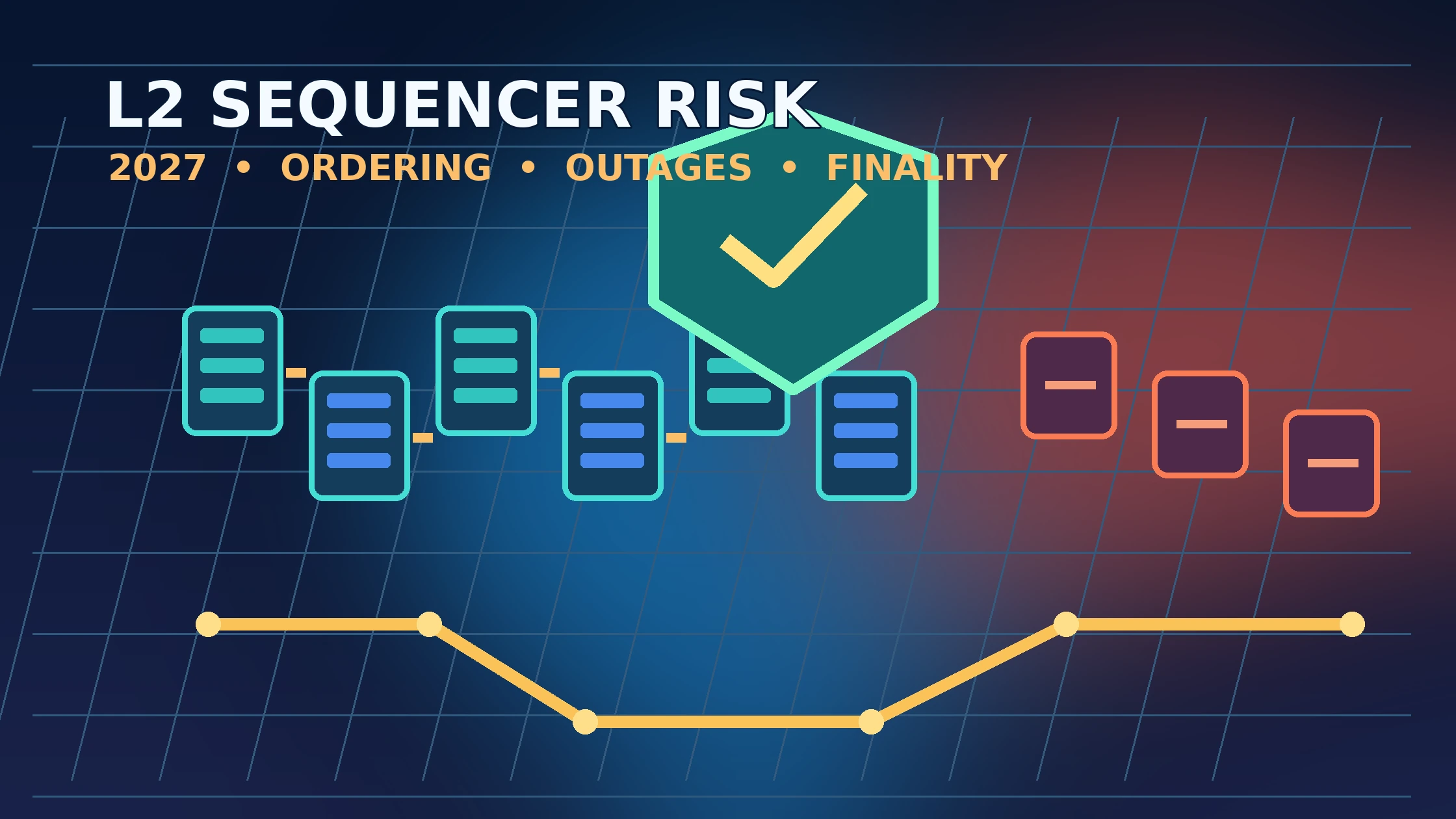
Short answer: AI bots on L2 networks face operational risks from ordering policy, sequencer downtime, stale oracles, parent-chain finality and forced-inclusion delays. These are architectural risk categories, not proof that five AI attacks occurred. Operators should design measurable fail-safe tests instead of assuming a fast sequencer makes every transaction safe or final.
Why 2027 bots need a sequencer checklist
Sequencers accept and order L2 transactions. In Arbitrum’s documented architecture, orders flow through admission and queues before blocks are produced and posted on the parent chain. Under a first-come-first-served policy, receipt order matters; under a priority-gas auction, priority fees influence ordering. An AI agent that assumes the wrong policy may incorrectly model order fills or transaction costs.
Five failure modes, each with a measurable gate
| Failure mode | Why it matters | Required check |
|---|---|---|
| 1. Ordering policy and MEV | First-come-first-served and priority fee auctions have different assumptions | Document admission, queue and fee ordering; simulate spread and slippage |
| 2. Sequencer outage | An RPC may accept a request while sequencing pauses | Check sequencer uptime, retry semantics, order acknowledgments and fallback |
| 3. Stale price and liquidation triggers | Oracle timestamps can lag through a network interruption | Check feed freshness, Chainlink uptime feed where available and grace periods |
| 4. L1 posting and finality gap | Soft sequence confirmation differs from parent-chain inclusion and finality | Track submission, batch posting and final settlement separately |
| 5. Forced inclusion and withdrawal delay | Emergency bypass often requires waiting and parent-chain fees | Document forced-transaction path, timeout and owner/allowlist limitations |
DN L2 Transaction Safety Preflight
Use this checklist when integrating an agent, bot, lending vault or bridge with an L2. It records preparedness only: it does not query the network or certify a transaction.
A worked example: the bot retries while the sequencer is down
An automated strategy submits an order, receives an inconclusive timeout and immediately resubmits. If the first order has been accepted but not acknowledged, repeated submits can create duplicate exposure. The correct safeguard is to assign an idempotency key or unique order identity where the integration supports it, inspect pending state against authoritative chain and account records, and pause when status is ambiguous. A fast interface response is not evidence of final execution.
Arbitrum’s documented forced path
Arbitrum lets users send delayed messages via the parent-chain inbox, then force-include them after the configured window. Its documentation currently describes a 7,200-parent-block limit on Arbitrum One and Nova, approximately 24 hours when evaluated at twelve seconds per Ethereum block. This value must be checked against current deployment parameters before relying on it. Parent-chain costs, allowlists, pauses and unusual L3 parent-chain conditions can affect the real recovery path. A timeout mechanism is not equivalent to instant recovery.
How to interpret an oracle during an outage
Chainlink instructs L2 applications to check sequencer uptime in addition to ordinary price-feed freshness. It also warns that different data feeds have different deviation and heartbeat thresholds. A trading agent should not treat an old timestamp, an L2 being down, or a provider’s different network deployment as proof of a usable price. Define separate freshness and recovery guardrails and re-evaluate any risk-sensitive order after the chain returns.
Related DN research: Shared Sequencer Recovery focuses on backlog and recovery mechanics; this guide focuses on AI trading control gates.
What we do not claim
- No measured cross-rollup MEV incident or five confirmed bot exploits are reported here.
- No promise that every L2 has the same delayed inbox, finality period or censorship protection.
- No claim that a force-inclusion window makes a large leveraged position safe.
- No backtested agent strategy or live deployment benchmark has been run by DN for this guide.
Sources and methodology
Review date: 22 November 2026. We mapped official architecture documents to user-controlled acceptance tests. Parameters change, so implementation work must reread the deployed contracts and chain documentation.
- Arbitrum sequencer and transaction-ordering policy.
- Arbitrum delayed inbox and force inclusion.
- Chainlink data feeds and heartbeat guidance.
- Chainlink consuming feeds on L2s and uptime checks.
Disclosure: This is independent DN infrastructure research. No chain, venue or tool is ranked or sponsored. Educational information only; not investment advice.
Frequently asked questions
Is an L2 sequencer the same as a validator?
Not necessarily. The sequencer admits and orders transactions while other components execute, prove, post and finalize them under the chain’s design.
Can an AI trading bot assume subsecond settlement on an L2?
No. A fast preconfirmation is different from final settlement and withdrawal availability.
Does Arbitrum have a force-inclusion path?
Yes. Its documented delayed inbox can route transactions through the parent chain if the sequencer refuses or is offline, subject to a force-inclusion window and chain settings.
Does force inclusion always complete immediately?
No. Arbitrum documents a waiting window and underlying parent-chain block requirements.
Can an L2 oracle keep reporting during a sequencer outage?
Behaviour varies. Check oracle updatedAt and sequencer-uptime feed where supported; unsafe stale observations should not drive liquidation decisions.
Are all L2 ordering rules the same?
No. The chain’s sequencer and fee/priority policy determine sequencing and may change under governance or releases.
Does this article prove that bots are exploiting five vulnerabilities?
No. These are five operational risk models and test cases; no exploitation campaign or model benchmark is claimed.
What should an agent do on uncertain execution state?
Stop new risk-taking, reconcile already submitted order identifiers and balances, and use documented recovery paths rather than blind retries.



