
DN 2027 Research Desk · Decision record N040 · Reviewed 25 November 2026
A government has trillions in debt and rates rise. A pundit immediately multiplies the entire debt stock by the higher rate and declares a huge new annual interest bill. But fixed-rate bonds issued years earlier do not all reset tomorrow; maturities and refinancing schedules control the timing.
What Matters
Refinancing sensitivity is a flow question: separate maturing fixed-rate debt, genuinely floating-rate exposure and fresh borrowing before applying a rate shock.
The signal: Which number changes the decision once we preserve the exact definition, period and legal party? The difference is often hidden in the footnote rather than the headline.
Evidence at a glance
2027 decision framework; evidence last checked 25 November 2026
Dated primary records, not future observations
Reader-entered hypothetical parameters, no transactions
Unresolved inputs require the original contract, dataset or regulator
The question behind the headline
A government has trillions in debt and rates rise. A pundit immediately multiplies the entire debt stock by the higher rate and declares a huge new annual interest bill. But fixed-rate bonds issued years earlier do not all reset tomorrow; maturities and refinancing schedules control the timing.
Refinancing sensitivity is a flow question: separate maturing fixed-rate debt, genuinely floating-rate exposure and fresh borrowing before applying a rate shock. That distinction matters to a working reader. The value of a factual source is not that it makes a complicated decision sound certain; it identifies the terms that control what can and cannot be inferred. DN’s purpose here is to make that decision inspectable, not to manufacture a future performance statistic.
The trillion-dollar multiplication error
A debt stock is the face amount of obligations outstanding at a moment. Interest expense is paid across time under the applicable coupon, discount and rate structures. A 100-basis-point market-rate rise does not mechanically add 1% of the entire fixed-rate debt stock to this year’s cash interest expense. Existing coupons continue until maturity or another contract event. The speed of budget transmission depends on the maturity structure, issuance mix, changing deficits and floating-rate obligations.
The Treasury’s own issuance calendar is a lesson
The US Treasury’s November 4, 2026 quarterly refunding statement describes how specific notes and bonds mature and how new securities finance both redemption of old obligations and additional cash needs. It announced a $125 billion offering to refund about $97 billion of privately-held maturities and raise approximately $28 billion of new cash. That is an observable stock-flow distinction: refinancing an old principal amount is not the same economic event as adding net new borrowing.
Different security types transmit rates differently
Short-dated bills reprice relatively quickly when renewed. Longer dated fixed-rate notes and bonds hold their coupons until maturity, even as their market prices fluctuate. Treasury floating-rate notes can reset by reference to their stated terms. Inflation-linked securities have separate principal adjustment mechanics. A useful simulator does not put these instruments in one bucket and pretend a generic 4% rate applies to everything.
A maturity-bucket model
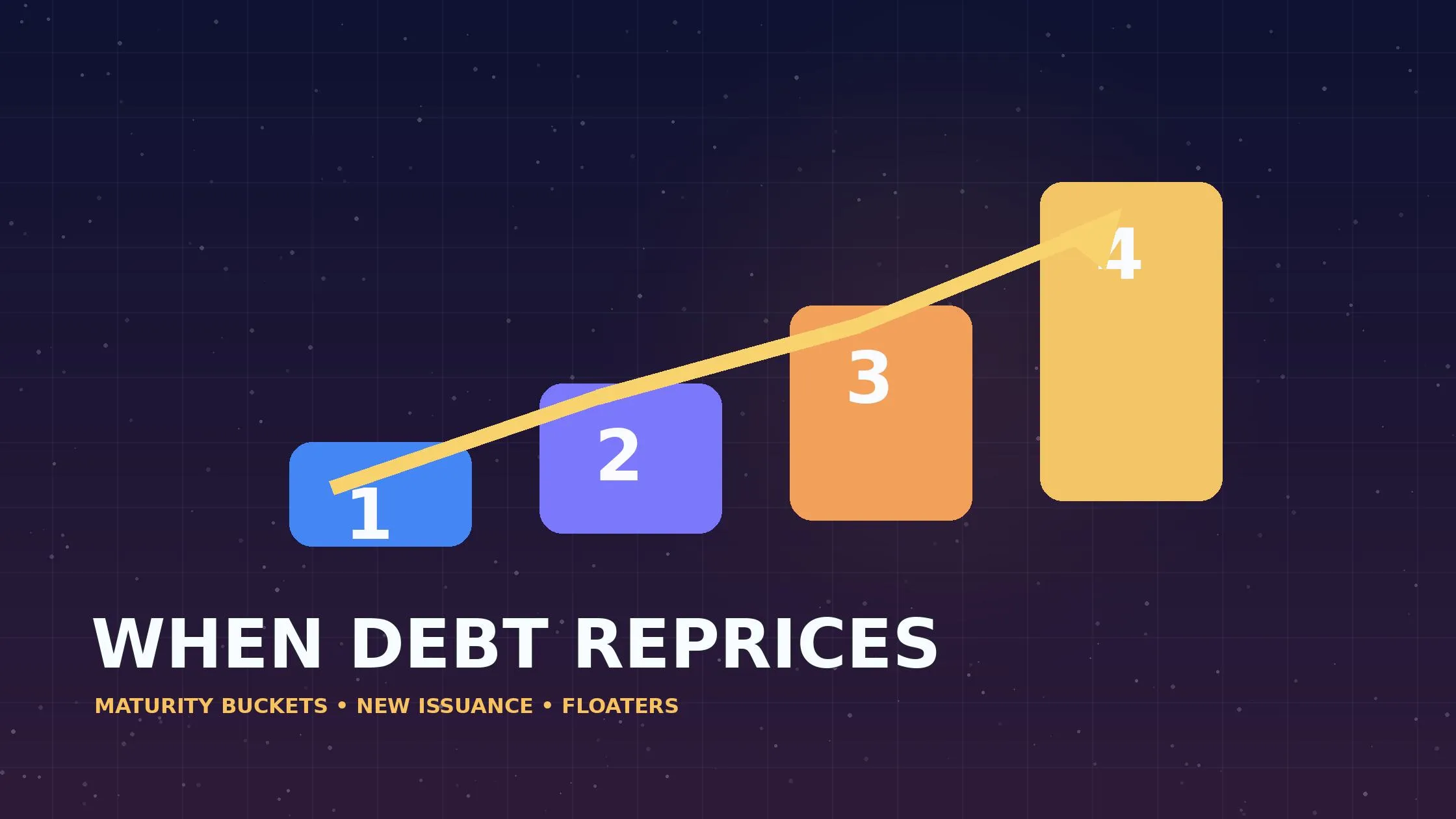
Divide the stock into a bucket maturing within one year, another rolling between years one and three and the remainder that continues under existing rates during the selected horizon. Enter the old average funding cost and a shocked marginal rate for each refinancing amount. In a one-year illustrative model, the incremental annualized run-rate from the maturing bucket is its principal multiplied by the rate change. Then add the floating-rate change and any interest on separately modelled new deficit borrowing.
Do not confuse annualized run-rate with cash interest this year
If a bond refinances on December 1, the new rate applies for only part of that fiscal year, while its full-year annualized interest run-rate becomes visible later. This local model produces an annualized run-rate at a specified refinancing boundary; it is not a budget forecast for the exact fiscal year. A more sophisticated Treasury model would use auction dates, coupons, marketable/nonmarketable composition and projected issuance.
Rates can fall while the bill rises
A government can refinance a maturing low-coupon bond at a higher rate even when current yields are lower than they were twelve months ago. The relevant comparison is the rate on the particular obligation being replaced. Conversely, today’s market rate can rise without immediately lifting interest paid on long-lived fixed debt. Neither effect alone demonstrates insolvency. The fiscal implications also depend on revenues, primary balances and nominal economic growth.
Borrowing estimates are scenarios, not promises
The Treasury’s November 2, 2026 financing estimates project borrowing for successive quarters subject to cash-balance assumptions. A hypothetical deficit rate can be included in the tool as a separate new-issuance line; users must not silently treat those borrowing projections as debt already outstanding. Comparisons with private-sector credit also need care because sovereign issuers, monetary institutions and debt markets operate under different legal and economic constraints.
The first run of the model
Take an illustrative debt stock of $1 trillion, with $200 billion maturing during the selected horizon, $100 billion of floating-rate debt and $50 billion of new borrowing. If the relevant rate changes from 3% to 5%, the annualized incremental interest from refinanced and floating debt would be $6 billion. New borrowing at 5% would add $2.5 billion to annualized run-rate, giving $8.5 billion under the simplified assumptions, not a blanket $20 billion charge on the whole legacy stock.
What the policy debate should measure
An evidence-led fiscal article tracks maturity distribution, actual average rates, floating-rate terms, inflation-linked obligations, cash balances and issuance forecasts. It then reports which fraction reprices during the selected period. Missing maturity data should produce an unresolved category, not a confident prediction of government collapse or a claim that higher rates have no fiscal consequences.
DN Research Desk: reproduce the decision
Change the assumptions and calculate. All values are illustrative unless you have independently verified them. The exported JSON captures your own inputs and derived outputs, not an audited dataset or certification.
The browser-only instrument does not request credentials, execute trades, download records or submit information to DN.
Worked example, with the assumptions visible
$1,000bn stock; $200bn refinances + $100bn floating; $50bn new issuance; 3% → 5% shock: $6bn incremental legacy run-rate plus $2.5bn from new borrowing.
Boundary: Output is a full-year annualized run-rate at the scenario boundary, not projected fiscal-year cash interest or CBO budget scoring.
Source and calculation methodology
Primary-record priority. The governing document, regulator, official data release or contractual disclosure is the preferred authority. A search snippet, provider pitch and secondary analysis cannot silently replace it. Each case is tagged with a review date. Where a number comes from our worked example, it is fictional and labelled as such, regardless of whether real institutions are discussed nearby.
Reproducibility. The calculator reads the fields shown on this page; its source logic is versioned in DN’s own website code. Inputs are not collected by the form. Zero, invalid, negative, impossible percentages and contradictory boundaries should produce a visible input error rather than a misleading successful result. The downloadable JSON record is a local document of the assumptions the reader used. It is not proof that the original numbers were true.
Limitations. Output is a full-year annualized run-rate at the scenario boundary, not projected fiscal-year cash interest or CBO budget scoring. A reliable operational use needs the relevant documents, proper asset and entity identification, currency and timestamp consistency, and professional review where law, tax or accounting rules determine the outcome.
Last verified: 25 November 2026. The 2027 edition is a planning framework; no 2027 event or result is represented as already having occurred.
Primary sources
- US Treasury November 2026 quarterly refunding
- Treasury FiscalData average interest rates
- Treasury Monthly Statement of the Public Debt
Related DN research (different decision)
Questions readers and research agents should ask
Is this an observed 2027 result?
No. The 2027 label marks the forward-looking edition. Dated sources were reviewed through 25 November 2026; examples are illustrative.
Does the calculator read live platform data or authenticate my paperwork?
No. The instrument runs locally using reader-entered values. Source evidence and actual legal rights must be checked separately.
What should I save before acting?
Save the dated primary document, original numeric inputs, unit definitions, approval or contractual conditions, and the calculator export as an illustrative working record.
Can the calculation guarantee profitability or eligibility?
No. The tool does not determine eligibility, regulatory compliance, investment suitability, taxes, or safety.
DN Alpha Thesis
Refinancing sensitivity is a flow question: separate maturing fixed-rate debt, genuinely floating-rate exposure and fresh borrowing before applying a rate shock.
Retain the unresolved fields as unresolved. Better information is not the same as a more confident sentence; it is a smaller gap between the measurable record and the decision someone is asked to take.
Disclosure: Independent educational research with no product endorsement in this article. Nothing in this publication is a personalised recommendation, legal opinion, tax ruling, audit or safety assurance.



