
Money Stories · Original fiction · 10 minute read
The fourth chair arrived on a Tuesday, wrapped more carefully than anything Celia owned.
The delivery man stood inside her door and asked where she wanted it.
“There,” she said, pointing at the table.
He looked at the other three chairs, already assembled, and at the long cardboard box in his hands. “I mean the box.”
She laughed too late. For the rest of the morning she left it upright against the wall, as if a guest had arrived early and was waiting politely to be introduced.
Her sister Noma was coming on Friday with her son. Their neighbour Mrs Jacobs had been invited to supper. Four people. Four proper chairs. Celia had counted this several times, enjoying how completely the furniture answered the question.
She had lived in the flat for eight months. Before that, there had been a room in a house where someone else's shoes were always drying beside the heater. Before that, another room. Noma had visited neither. She knew Celia's life through photographs taken carefully enough to exclude the things that still belonged to other people.
The table was second-hand, round, with one pale ring left by a hot pot. Celia liked it. She had bought clear plastic to protect the surface, though the surface had already survived someone else's children. Beneath the plastic she placed a postcard of the sea. It made the ring look almost intentional.
The chairs were six hundred rand each. The app had shown the smaller number first: one hundred and fifty now. She had bought them on four successive evenings after work, one colour at a time, as if furnishing the flat gradually were the same as paying for it gradually.
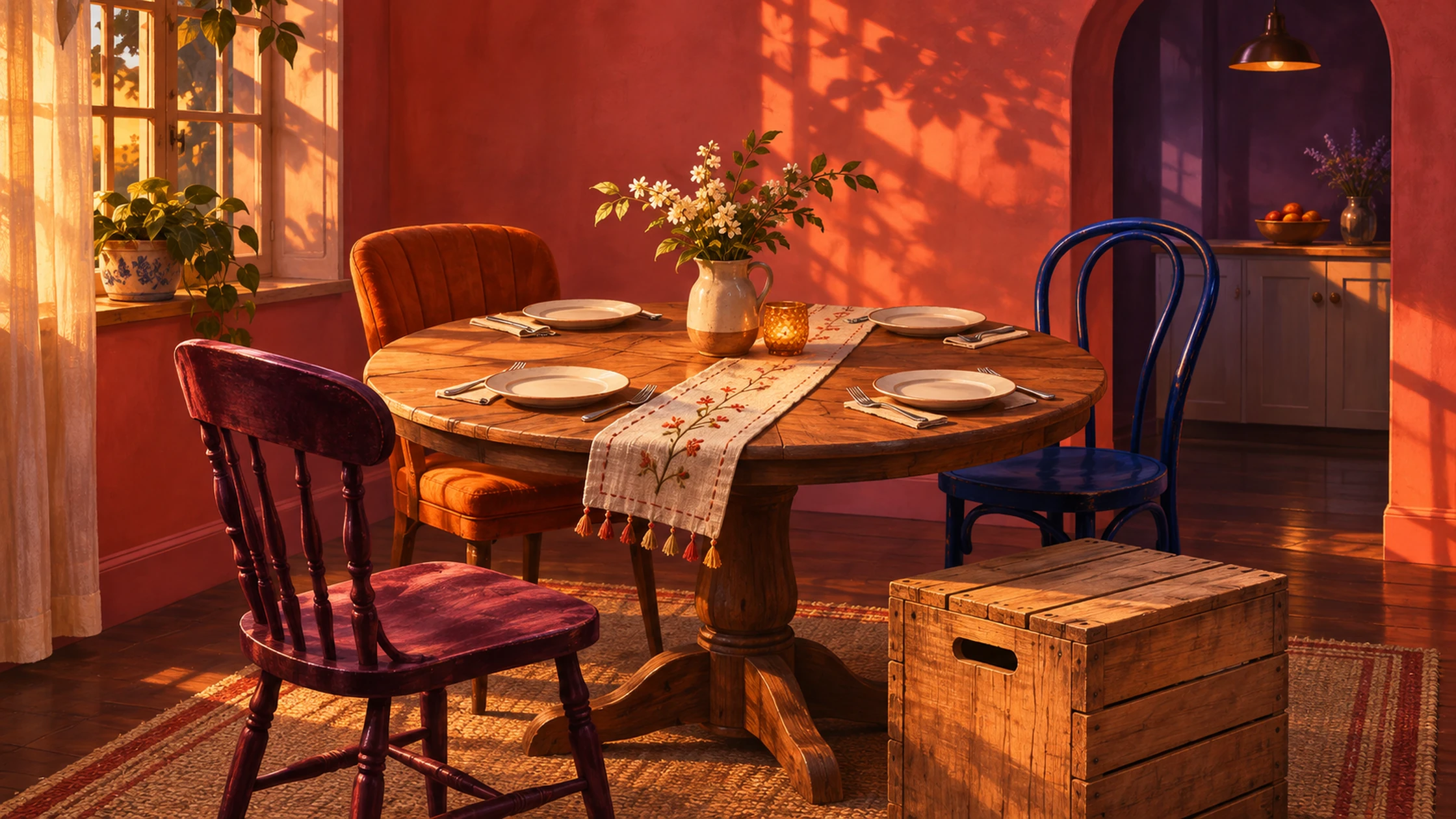
The first was mustard. The second was green. For the third she chose a red she called terracotta because terracotta sounded quieter. The fourth was blue.
At the hotel, where Celia worked nights on reception, guests often asked for things by describing the feeling they wanted. A room that did not feel like a business trip. A restaurant that felt local. Somewhere special but not expensive. Celia had become good at translating these requests into things that could actually be booked.
For herself she wanted a flat that felt finished.
On Wednesday, while a man in the lobby searched for a reservation made under his wife's maiden name, her phone lit up. The blue chair's next payment was approaching. A second message concerned the green one. The red chair had sent its reminder earlier.
She turned the phone over.
The man found his confirmation. He apologised for being difficult, though he had not been. Celia gave him his key and watched him walk towards the lift with the uncomplicated relief of a problem solved.
At half past two, when the lobby was empty, she opened every payment screen.
Six hundred for the four chairs over the coming days. Two hundred and eighty for her phone. Two hundred and twenty on the clothing account, the final amount she had promised herself would be the final amount.
She wrote the numbers on the back of a breakfast order.
The total was eleven hundred.
She checked it with the calculator, then without the calculator, as if the first machine might have been adding something from elsewhere.
After the rent, ordinary groceries and transport to work, she had seven hundred and eighty rand available before her salary arrived. She had also put away a little for the weekend: one hundred and eighty for the outing she had planned, one hundred and forty towards replacing the kettle whose lid had to be held down.
Together those two amounts were the difference. She could pay everything due. She could not have everything she had already imagined.
For a while she considered asking to change one payment date. Then she opened an offer for a small loan. The application began by congratulating her on being eligible. She had not yet asked for anything.
She closed it when the night porter came in to make tea.
“Milk?” he asked.
“Please.”
He held up the carton. “That was a question for both of us.”
There was almost none left. They divided it, and the ordinariness of this nearly made her cry.
On Thursday morning, Celia stood in front of the blue chair's box with a kitchen knife. If she assembled it, the set would be complete. If she returned it unused, the shop's written terms said the purchase could be reversed once inspected. The lender's help page warned that payments remained due until the refund had been processed.
She put the knife down.
In the photograph on the box, the blue chair stood in a room with no plugs, no laundry and no evidence that anyone needed to keep a broken kettle until next month.
She messaged the shop. Then she called, because she did not understand one sentence in the reply. A woman named Mpho explained the return process and sent the information again in writing. Nothing would be refunded in time for this week's payments. Celia thanked her twice.
The blue chair would go back. This week's eleven hundred would still have to be there.
She moved the outing money and the kettle money into the account from which the payments would be taken. Her balance became sufficient. Her weekend became, in her imagination, visibly smaller.
Noma called while Celia was washing a saucepan.
“Theo wants to know if you have a television.”
“Tell him I have windows.”
There was a muffled exchange, then Noma returned. “He says do they have cartoons.”
Celia laughed. She had been preparing all morning to sound normal, and now she almost did.
“What should we bring?” Noma asked.
“Nothing.”
The word came too quickly. Celia watched a bubble travel through the water at the bottom of the pan.
“Actually,” she said, “would you bring the bread you make? If you're already baking.”
“I can bake.”
“And I have to change our plans a bit.”
She described the payments. Not her whole financial life, not a defence of every purchase. Just the four chairs and the dates, the outing they would miss, the blue one still in its box.
Noma was quiet long enough for Celia to begin explaining again.
“You don't have to furnish a house because I'm coming,” Noma said.
“I know.”
“Do you?”
Celia bristled. Noma was younger. There were limits to how much younger sisters should be allowed to understand.
“I wanted it to be nice,” she said.
“I want to see where you live.”
“That is what I mean.”
Another silence. This one held something neither could improve by talking.
Then Noma said, “I'll bring the bread. Theo is bringing a dinosaur. Apparently it has already been packed.”
On Friday, Mrs Jacobs lent Celia a handcart to take the unopened chair to the shop. She offered to come, but Celia said she could manage. At the crossing, a woman helped her tilt the cart over the kerb. No one asked why she was carrying furniture in the direction opposite to home.
The shop assistant checked the packaging and gave her a return receipt. Celia took a photograph of it before putting the paper in her bag. The assistant said the payment account would update after processing. She asked how she would know, and he showed her where to look.
Back at the flat there were three chairs and a space she found surprisingly difficult to ignore.
Mrs Jacobs had a spare chair, but it was at her daughter's house. What she had here was a sturdy wooden crate that she used when reaching the top of a cupboard. Celia tested it carefully on the floor, then added a folded towel.
“I'll sit there,” she said.
“You have not yet met your nephew's opinion,” Mrs Jacobs replied.
Noma and Theo arrived with two bags, a loaf wrapped in a tea towel and a plastic dinosaur whose mouth had been repaired with tape. Theo took a tour of the flat before removing his shoes. He examined the kettle, the postcard under the plastic and the view from the window.
“Where's your bed?”
“Through there.”
“Just yours?”
“Just mine.”
He considered this. “Can I see?”
She showed him. He bounced once on the edge before remembering to ask.
Noma stood in the doorway. “It's lovely, Ce.”
Celia could have listed the defects. The cupboard that caught. The sound of the upstairs washing machine. The drawer with only one proper handle. Instead she let her sister look.
Supper was beans cooked with tomato and onion, bread, and a small bowl of grated cheese that Theo treated as a separate course. Mrs Jacobs brought oranges because they were already in her kitchen and she thought there were too many for one person. Celia did not calculate what each contribution was worth.
Theo claimed the crate. He said it was the captain's chair. When Celia pointed out that captains usually had taller seats, he said that was on television. He had already established that they did not have one.
The mustard chair squeaked under Noma. The green one rocked slightly until Mrs Jacobs folded a piece of the bread bag beneath a leg. Celia watched this with a private irritation at the manufacturer, followed by relief that nobody thought the fault was hers.
They talked about the bus journey and a neighbour's wedding, about a man at the hotel who had asked whether the sea was open at night. Noma laughed until she put her forehead against the back of her hand. Theo demanded to know the answer.
“Yes,” Celia told him. “But the lifeguards go home.”
After supper, they walked as far as the corner and came back because the wind was sharp. Their outing cost nothing and was not, Celia decided, as good as the outing she had wanted. She allowed herself this small disappointment. It did not spoil the evening.
While Noma settled Theo, Celia checked the first scheduled payment. Paid. The next remained listed. The return was still processing. She left enough in the account for all of it, then put the phone away.
Her sister came back into the kitchen and began washing the dishes without asking where anything was. Celia dried them. At home as children they had argued over these jobs so often that their mother had once threatened to make them eat from the saucepan.
“You can be pleased with it,” Noma said.
“With what?”
Noma glanced around the flat. “All this.”
Celia dried the same plate for longer than necessary. “I am.”
On Monday, the returned chair appeared correctly in her account. The remaining charges for it were cancelled, and the payments already collected for it came back. She checked the amounts against the receipt and put the money aside. There were still three chairs to finish paying for. The kettle still needed a lid held down.
Beneath the clear plastic on the table, beside the postcard, she placed a small calendar with the remaining payment dates marked. Noma had drawn a tiny chair beside each one before leaving.
Mrs Jacobs came to collect her crate that afternoon. Theo had left the dinosaur on it.
Celia picked up the toy to photograph it for her sister, then paused. She moved the washing off the radiator, considered the room, and moved it back.
In the picture she sent, you could see where she lived.
Money behind the story
The four chairs cost R2,400 in total. In the payment window Celia examines, four R150 chair instalments, a R280 phone payment and a R220 clothing payment add up to R1,100. Against R780 available for these obligations, the gap is R320. She fills it by redirecting R180 from an outing and R140 from a planned kettle replacement. These are invented amounts, included to make the trade-off visible.
The mechanism is overlapping commitments. A small payment can be affordable in isolation while several payments compete for the same income. The US Consumer Financial Protection Bureau explains that common buy-now-pay-later products divide a purchase into instalments; the precise fees and obligations depend on the agreement. Its 2025 research separately examines borrowers’ overlapping loans. These US sources describe a mechanism, not South African legal rights.
Returning a purchase can also involve processing time. California’s financial regulator describes how refunds pass through the retailer and provider, with payment treatment varying by provider. Celia therefore follows her fictional agreement and waits for confirmation; readers should check their own contract and applicable protections.
Her calendar makes the commitments visible together. It cannot create extra income. The emotional choice is equally concrete: she gives up part of the weekend she pictured without giving up the people she wanted around the table.
Financial sources checked 24 November 2026. Story figures and outcomes are illustrative. General financial education, not individual financial advice.
Stay with the story: three questions
- Which cost in the story buys practical usefulness, and which buys the feeling of having arrived?
- What changes when Celia sees all her due dates on one calendar?
- What would you want a payment app to show before approving another small instalment?



