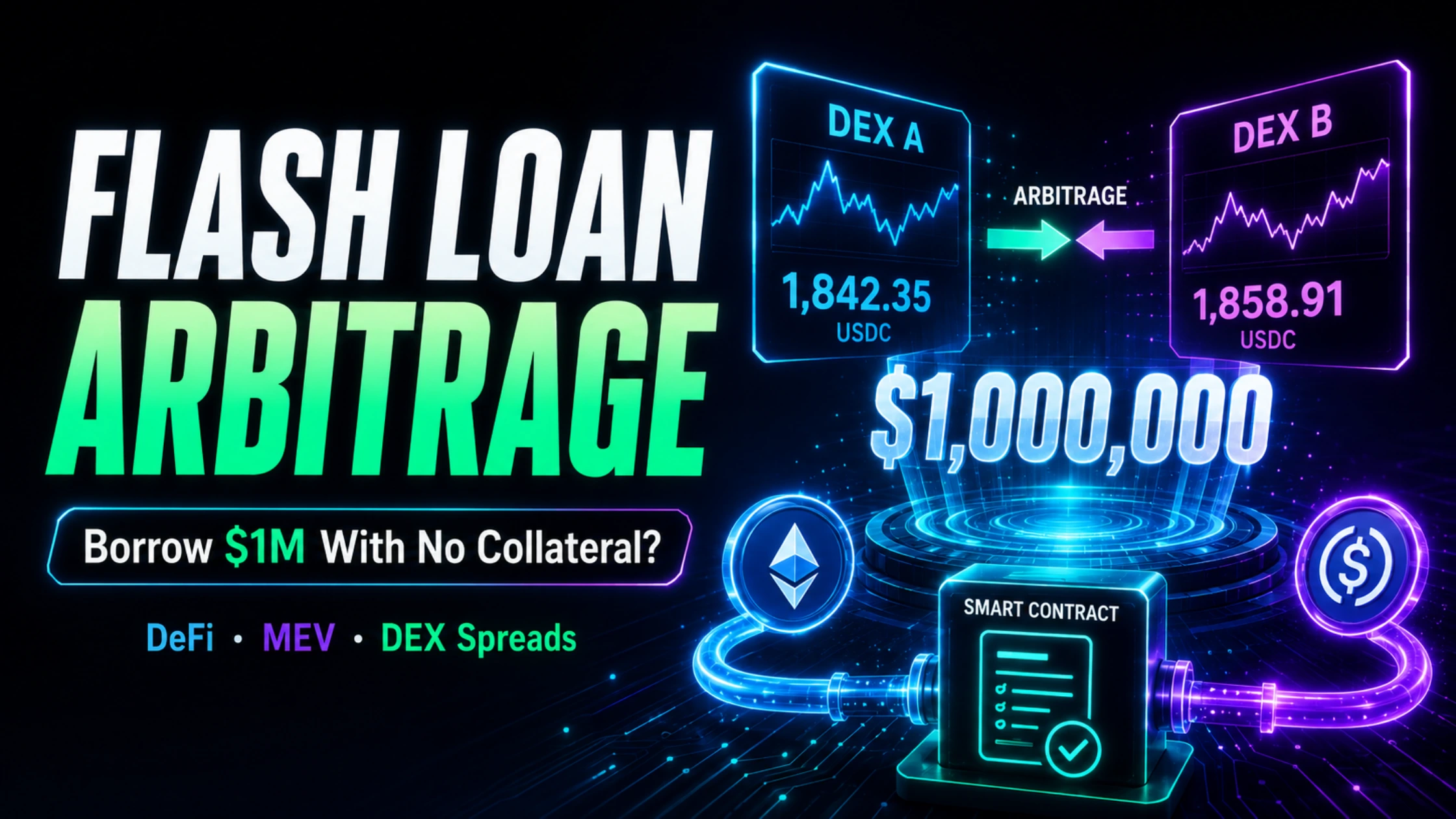
Flash loans let you borrow millions of dollars with no collateral for a single blockchain transaction. This guide explains how they work and why the economics make retail flash loan arbitrage almost always unprofitable — with a live calculator to prove it.
Flash Loan Arbitrage 2026 — How to Borrow $1 Million With No Collateral (And What to Do With It)
A flash loan lets you borrow any amount of capital from Aave, Balancer, or Uniswap v3 with zero collateral, provided you return the full amount plus a small fee within the same transaction. A $1 million flash loan costs $900 in fees on Aave. The catch is not the fee. The catch is that the economic conditions required to profit from a flash loan arbitrage — the right price spread, on the right DEX pair, at the right gas price, before someone else closes it — almost never materialize for retail traders.

What a Flash Loan Actually Is
Most financial concepts have analogies in traditional finance. Flash loans do not. They are a construct that is only possible on programmable blockchains and they have no precedent in any financial system that existed before Ethereum.
Here is the mechanism. On a blockchain, a transaction is either executed in full or rejected entirely. There is no partial execution. This property, called atomicity, means that a sequence of actions bundled into a single transaction either all happen or none of them happen.
A flash loan exploits atomicity as follows. You request a loan from a protocol like Aave. Aave releases the funds to your smart contract within the transaction. Your contract executes whatever actions you intended — buying a token on one exchange, selling it on another, triggering a liquidation, swapping collateral in a DeFi position. At the end of the transaction, your contract repays the loan plus the fee. If the repayment fails for any reason — insufficient funds, a failed swap, an incorrect calculation — the entire transaction reverts. Every state change is undone. The loan is never actually made. Aave loses nothing. You lose only the gas cost of the failed transaction.
This is why flash loans require no collateral. If you fail to repay, the transaction reverts and the loan is erased from existence. The protocol has zero credit risk because failure is impossible by design — either the loan is repaid or it never happened.
The Three Things People Actually Do With Flash Loans
Arbitrage is the first and most discussed use. If a token trades at $1.000 on Uniswap and $1.012 on SushiSwap, a flash loan lets you borrow $1,000,000, buy the token on Uniswap, sell it on SushiSwap, repay the loan, and keep the $12,000 spread minus fees. In theory. The reality of why this rarely works for retail traders is what most of the internet does not explain clearly — and what the calculator below demonstrates.
Collateral swaps are the second use, and arguably the most practically useful for DeFi power users. If you have an Aave loan with ETH as collateral and want to replace that ETH with wBTC without closing the position, a flash loan executes the entire collateral swap atomically. You borrow USDC via flash loan, repay your Aave debt, withdraw your ETH collateral, sell ETH for USDC plus wBTC, deposit wBTC as new collateral, re-open the loan, repay the flash loan — all in one transaction. Without a flash loan, this requires multiple sequential transactions with timing risk between each.
Self-liquidation is the third use. If your Aave health factor is approaching liquidation, a flash loan lets you liquidate your own position at the standard rate before an external liquidator does so at a penalty rate. The economic difference between self-liquidating and being externally liquidated can be several percentage points of the position size.
This article focuses on arbitrage because it is what attracts most interest — and because the economic analysis of why retail arbitrage does not work is the genuinely useful thing to understand.
The Arbitrage Math That Most Explanations Skip
The flash loan arbitrage appears simple: borrow money, buy cheap, sell expensive, repay loan, keep profit. The economics only become clear when you account for every cost in the chain.
The flash loan fee. Aave charges 0.09% of the loan amount. On a $1,000,000 flash loan that is $900. On a $100,000 loan it is $90. On a $10,000 loan it is $9. This fee is fixed at the protocol level and non-negotiable. Balancer charges zero. Uniswap v3 charges 0.05%.
The DEX trading fees. Buying on Uniswap and selling on SushiSwap each incur trading fees of 0.3% on standard pools (Uniswap v3 has pools at 0.05%, 0.3%, and 1%). On a $1,000,000 flash loan arbitrage through standard pools, the round-trip trading fee is $6,000. This cost is embedded in the swap and does not appear separately — it reduces the amount of token you receive on the buy side and the amount of USDC you receive on the sell side.
Slippage. Slippage is the difference between the price you expected and the price you received because your trade moved the pool’s price against you. On a $1,000,000 trade through a pool with $10,000,000 of liquidity, slippage on the buy side is approximately 10% of the pool depth — you move the price by roughly 10%. On the sell side, the same occurs in reverse. Large flash loan arbitrages suffer significant slippage on pools that are not deep enough to absorb the volume, which can eliminate the spread entirely.
Gas cost. A flash loan arbitrage transaction executes several contract calls: the flash loan initiation, the swap on DEX A, the swap on DEX B, the repayment. The total gas consumption for this operation on Ethereum mainnet is approximately 200,000 to 500,000 gas units depending on complexity. At 20 gwei and an ETH price of $3,200, 300,000 gas units costs approximately $19. At 80 gwei during network congestion it costs approximately $77. During peak demand periods, gas costs can exceed $200 for a flash loan arbitrage transaction.
The critical implication: gas cost is a fixed cost that does not scale with the flash loan amount. A $100,000 flash loan and a $10,000,000 flash loan pay the same gas. This means flash loan profitability scales dramatically with loan size — small flash loans cannot cover their gas costs because the percentage profit they need is too large.

Why Retail Traders Almost Never Win at Flash Loan Arbitrage
The economic math creates a minimum viable scale problem. Consider the following realistic scenario:
Flash loan: $50,000 via Aave Flash loan fee: 0.09% = $45 DEX trading fees: 0.3% × 2 = $300 Slippage (0.15% each side): $150 Gas cost (medium congestion, Ethereum): $25 Total costs: $520 Break-even spread required: $520 / $50,000 = 1.04%
A 1.04% price discrepancy between the same token on two Ethereum DEXes would need to exist and persist long enough for your transaction to execute. In practice, DEX price discrepancies above 0.3% on liquid pairs are arbitraged away by MEV bots in milliseconds — not seconds, milliseconds. The arbitrage opportunity that would make your $50,000 flash loan profitable almost certainly does not exist by the time your transaction reaches the mempool.
This is the honest conclusion that the calculator below is designed to demonstrate interactively. Plug in your own numbers and the tool will show you the minimum price differential required to cover your costs — and then you can assess whether a price gap of that magnitude exists and persists for long enough to capture.
Who Actually Makes Money on Flash Loan Arbitrage
The entities profiting from flash loan arbitrage in 2026 are not retail traders with access to Remix IDE and a Metamask wallet. They are MEV (Maximal Extractable Value) searchers running custom infrastructure that:
- Monitors all DEX price feeds simultaneously with sub-millisecond latency
- Pre-builds and signs transactions in advance using Flashbots MEV-Boost to submit directly to block builders, bypassing the public mempool
- Uses gas optimization to reduce transaction costs to a fraction of what a standard smart contract call costs
- Operates bundles that include multiple arbitrage opportunities within a single block
- Runs co-located infrastructure next to Ethereum validators to minimize latency
The gap between a retail trader attempting flash loan arbitrage and an MEV searcher is equivalent to the gap between a person with a calculator and a quantitative hedge fund with co-located infrastructure on every major exchange. The tool below does not bridge that gap. What it does is show you the economic math clearly enough to make an informed decision about where to spend your time.
Use the Calculator
Enter your flash loan parameters and the tool shows whether the trade is profitable — and what minimum spread is needed to break even.
Reading the Output — What the Numbers Tell You
The tool’s most important output is not the net profit figure. It is the break-even spread percentage — the minimum price differential between DEX A and DEX B that would need to exist for your specific combination of loan size, fee, gas cost, and slippage to generate any profit at all.
For most realistic inputs — amounts below $500,000, gas costs above $15, slippage above 0.1% per side, and the standard Aave fee of 0.09% — the break-even spread will land somewhere between 0.4% and 2%. That is the price discrepancy that would need to exist on a liquid token pair before the trade becomes viable.
The minimum loan amount output tells a complementary story. For a given spread, it calculates the smallest flash loan that would generate positive net profit. At a 0.5% spread with medium gas costs, the minimum viable loan is typically $50,000 to $200,000. For that loan amount to work, the 0.5% spread would need to persist through a transaction that takes 12 to 30 seconds from initiation to on-chain inclusion — during which time every MEV bot on the network is also watching the same spread.
The honest summary that the calculator demonstrates: flash loan arbitrage is technically accessible to anyone with basic Solidity knowledge, and economically unviable for almost everyone using it. The barrier is not the technology. It is the competition.

What to Do Instead — The Alternatives With Better Retail Economics
The frustration of understanding flash loan arbitrage and concluding it is not viable for retail traders should redirect rather than discourage. The same underlying interest — finding a structural edge that generates profit from market inefficiency — applies to strategies with better retail economics.
Funding rate carry on perpetuals is the institutional strategy that translates to retail scale. Rather than exploiting price discrepancies across DEXes in microseconds, it exploits the structural payment imbalance between leveraged long and short holders in perpetual futures markets. The edge is persistent, does not require competing with MEV infrastructure, and generates income continuously rather than requiring precise transaction timing. A delta-neutral funding rate carry trade on BloFin using the strategies described in our funding rate arbitrage guide is achievable with $5,000 of capital and generates annualized yields of 8% to 25% depending on market conditions.
Bridge arbitrage operates on minute-to-hour timescales rather than milliseconds, making it retail-accessible in a way that on-chain flash loan arbitrage is not. The same token trading at different prices on Ethereum and Base, connected via a bridge that takes 10 minutes to transfer, gives a retail trader a realistic execution window. The bridge arbitrage calculator in this series quantifies this opportunity for specific corridor pairs.
CEX-to-CEX price spreads occasionally open wide enough for manual execution, particularly during periods of high volatility when exchange prices diverge faster than arbitrageurs can close them. This window is still narrow — seconds to minutes — but it is orders of magnitude wider than the milliseconds available for on-chain DEX arbitrage.
If you are genuinely interested in DeFi and want to interact with Aave or on-chain protocols, OKX’s Web3 wallet provides a clean interface for accessing Aave, Uniswap, and other DeFi protocols without needing to manage a separate wallet and browser extension stack. deBridge provides the cross-chain infrastructure for moving capital between Ethereum and L2s where gas costs are lower and some flash loan opportunities may exist at more accessible economics.

Flash Loans on L2 Networks — Are the Economics Better?
Ethereum mainnet flash loan arbitrage is almost never profitable for retail traders because of gas costs. L2 networks including Arbitrum, Optimism, Base, and Polygon have gas costs 10 to 100 times lower, which changes the break-even calculation meaningfully.
On Arbitrum, a flash loan arbitrage transaction might cost $0.30 to $2.00 in gas rather than $15 to $100 on Ethereum mainnet. This shifts the minimum viable loan amount dramatically downward — a $10,000 flash loan might theoretically be profitable on Arbitrum if a sufficient price spread exists.
The counterpoint is liquidity. Arbitrum’s DEX liquidity is a fraction of Ethereum mainnet’s. Lower liquidity means price discrepancies are more volatile and appear more frequently — but they also mean higher slippage on trades, which partially offsets the gas advantage. The larger discrepancies on L2s exist partly because they are harder to arbitrage cleanly and partly because smaller pools move more on any given trade.
The net effect is that L2 flash loan economics are better than Ethereum mainnet but still not at the level where retail traders can consistently compete with dedicated MEV searchers who have optimized every aspect of their execution infrastructure for the same networks.

FAQ
What happens if a flash loan arbitrage does not work out? If any step in the flash loan transaction fails — insufficient funds to repay, a swap that returns less than expected, or an error in the logic — the entire transaction reverts. Every state change is undone, as though the transaction never happened. You lose only the gas cost of the failed transaction. The flash loan itself is never actually made from Aave’s perspective because the repayment condition was not met.
Can I do flash loan arbitrage without knowing how to code? Some no-code flash loan tools exist, but they typically charge additional fees and abstract away the complexity in ways that make the economics even less favorable. Understanding the math — which this calculator provides — is more useful than a no-code tool that obscures it. If you cannot code a flash loan contract, the practical conclusion from this article applies even more strongly: there are better uses of your time and capital than attempting to compete with MEV bots.
What is the cheapest flash loan available in 2026? Balancer charges zero fees for flash loans — the only cost is gas and the trading fees on the DEXes you interact with. Uniswap v3 charges 0.05% and Aave charges 0.09%. The choice between them depends on which protocol has the liquidity you need for your specific arbitrage, not just the fee rate. Balancer’s zero-fee flash loans are useful for certain collateral swap and refinancing applications where the DEX trading fees are the primary cost.
Why do price discrepancies between DEXes exist at all if arbitrageurs close them so quickly? Price discrepancies appear constantly because DEX prices are not synchronized. Every time a large trade moves a pool’s price on Uniswap, the price on SushiSwap has not changed yet. The discrepancy exists in the moment between the trade and the arbitrage that corrects it. In liquid markets this window is measured in milliseconds. In less liquid markets or during high-volatility periods it can persist for seconds. The existence of discrepancies does not mean they are exploitable by retail traders — it means the MEV infrastructure that closes them is the real beneficiary.
Is flash loan arbitrage legal? Flash loan arbitrage using price discrepancies between decentralized exchanges is legal in virtually every jurisdiction that has addressed the question. It is arbitrage: buying where cheaper and selling where more expensive. It differs from market manipulation, front-running, or sandwich attacks, which exploit other users’ transactions rather than market prices. Some academic literature has questioned the ethics of MEV extraction that harms other users, but straightforward DEX-to-DEX arbitrage falls outside that critique.
Explore more practical alternatives: BloFin — funding rate carry for consistent yield without millisecond execution · OKX Web3 Wallet — access Aave and on-chain DeFi · deBridge — cross-chain bridge for bridge arbitrage opportunities.
Recommended reading:
Statistical Arbitrage in Crypto 2026 — How to Find Correlated Pairs and Trade Mean Reversion
Bridge Arbitrage 2026: How to Profit From Cross-Chain Crypto Price Gaps
Funding Rate Arbitrage: How to Earn Consistent Yield by Trading the Sign Flip in 2026
Funding Rate Arbitrage: The 8% Monthly Yield Machine (2026 Edition)
Funding Rate Arbitrage: The 200% APY Strategy Nobody Talks About
The Funding Rate Arbitrage Playbook: 6 Exchanges Where Basis Trading Still Prints 15%+ APY in 2026
Perpetual Futures Trading in 2026: Best Platforms, Strategies, Funding Rates, Risk Models & Pro Tips
Best Funding Rate Arbitrage Platforms (2026)