
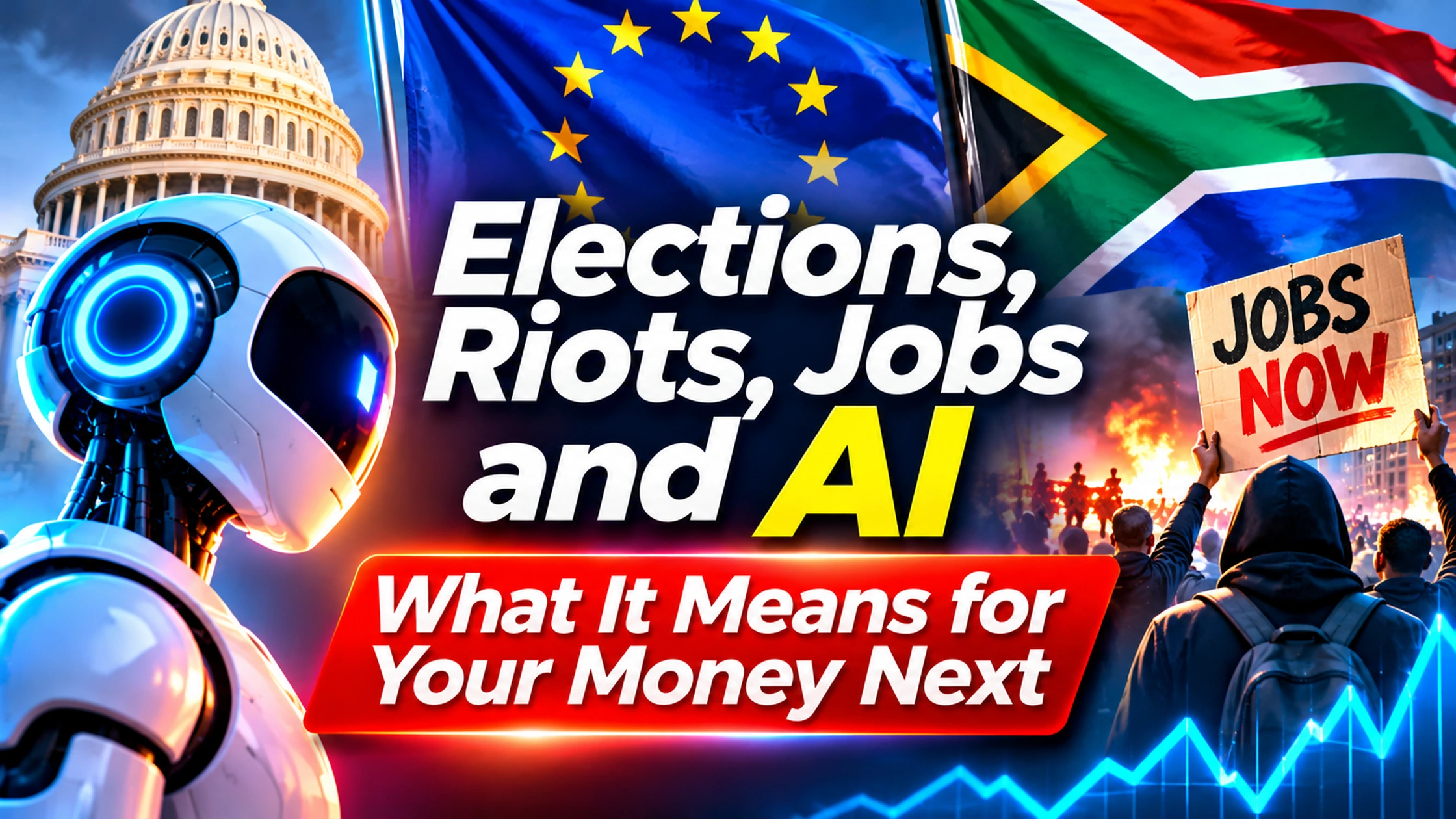
Technology can be booming while voters still feel like the future is getting worse.
Artificial intelligence is attracting extraordinary capital. Data centres are expanding. Productivity expectations are rising. Yet across major democracies, young people are protesting, voting for economic relief or expressing deep frustration over housing, wages, public services and access to work.
That is not a contradiction. It is the central political-economic mismatch of the moment.
What Matters
In the United States, the 2026 midterm election produced a clear demand for economic relief, with affordability and inflation remaining central voter concerns. In Europe, cost-of-living protests have spread from France to Italy, Germany, Spain, Portugal and beyond. In South Africa, the official unemployment rate was 33.6% in Q2 2026, while youth unemployment for ages 15 to 34 reached 47.4%.
The Signal
The common signal is not that all countries have the same politics. They do not.
The common signal is that a large share of the population believes the economy is not translating aggregate progress into personal security quickly enough.
United States
Post-election pressure is focused on affordability, inflation, debt, healthcare and whether AI-driven growth will translate into broad household gains.
France and Europe
Youth-led and broader demonstrations have focused on living costs, housing, wages, education and public services, with protests spreading across multiple countries.
South Africa
Mass unemployment remains the defining economic constraint for millions of young people, with youth unemployment above 47% in the latest available Q2 release.
AI economy
Capital expenditure and data-centre investment are accelerating faster than many households perceive improvements in wages, opportunity or public services.
Why the AI boom can feel invisible to households
Investment booms create visible winners first: chipmakers, cloud providers, utilities, data-centre developers, software firms, landowners and skilled workers near the new capital.
The broader benefits arrive through slower channels: lower prices, higher productivity, new business formation, better services, new occupations or higher real wages.
That lag matters politically. A voter can read about record AI investment while simultaneously paying higher rent and worrying about job displacement. Both realities can be true at once.
The four mismatches driving political anger
| Headline progress | Lived experience | Political risk |
|---|---|---|
| AI investment boom | Fear of job displacement | Technology becomes associated with insecurity |
| GDP growth | Weak wage growth or expensive essentials | Voters reject “good economy” messaging |
| Asset-market gains | Housing unaffordability | Intergenerational resentment rises |
| Digital efficiency | Strained public services | Citizens question where productivity gains went |
Europe’s protests are about more than inflation
By early November, more than 1,700 large protests and riots had taken place across 31 European countries since mid-September, according to an analysis of ACLED data cited by Al Jazeera. France accounted for the largest share, but Italy, Spain, Germany and Portugal also saw significant demonstrations.
The grievances are broader than one price index: housing affordability, low wages, education, pensions, public services and energy costs have all featured prominently.
That is important because official inflation can fall while accumulated price levels remain painfully high. Households do not reset their memory when inflation slows.
South Africa shows the jobs version of the same mismatch
South Africa’s problem is less about a sudden inflation shock and more about access to work itself.
Stats SA reported 8.5 million unemployed people in Q2 2026 and a 33.6% official unemployment rate. Among 15-to-34-year-olds, unemployment increased to 47.4%.
For a young person facing that labour market, debates about AI productivity are filtered through a much more immediate question: will technology create a route into the economy or make entry even harder?
The U.S. election adds an affordability warning
The 2026 midterms reinforced the political salience of living costs. Inflation was still running above the Federal Reserve’s long-run target, while voters remained focused on household affordability.
At the same time, AI is one of the largest potential growth engines in the U.S. economy. That creates a policy tension: governments want to accelerate investment without appearing indifferent to workers who fear displacement or households that do not yet feel the gains.
DN Future Participation Gap Index
DN proposes a framework for measuring when technological progress is at risk of becoming politically disconnected from household reality.
Youth unemployment — 25%
High youth unemployment increases the share of people excluded from the growth story.
Housing pressure — 20%
When housing absorbs a growing share of income, future optimism falls.
Real-wage pressure — 20%
Weak purchasing-power growth undermines confidence in headline GDP gains.
Public-service strain — 15%
Poor education, transport or healthcare makes national progress feel abstract.
Technology displacement fear — 10%
Workers may resist AI when the downside feels immediate and the upside uncertain.
Asset-access gap — 10%
People without property or financial assets capture less of asset-led growth.
DN Future Participation Calculator
Score each factor from 0 to 100. Higher scores imply a larger gap between headline progress and household participation.
What governments usually get wrong
Policymakers often treat productivity and redistribution as separate phases: first make the economy grow, then spread the gains.
Politically, that sequence can fail if the transition is long enough. People vote during the transition.
The credibility of an AI growth strategy therefore depends on whether people can see mechanisms connecting investment to jobs, training, lower prices, cheaper services, higher wages or broader asset ownership.
The opportunity for emerging markets
Countries with high youth unemployment do not necessarily lose from AI. They may gain enormously if AI lowers the cost of starting firms, exporting services, accessing education and competing globally.
But that outcome is not automatic. Cheap intelligence is valuable only when people have electricity, connectivity, capital, payment access and enough institutional stability to use it productively.
The economic opportunity is therefore not simply “adopt AI.” It is “make AI a participation technology.”
DN Alpha Thesis
The political fault line of the AI era may not be between people who like technology and people who do not.
It may be between people who can see themselves inside the new economy and people who experience it as something happening around them.
When capital spending, stock markets and productivity forecasts rise while housing, work and public services feel less secure, voters stop asking whether the future is impressive.
They ask whether the future includes them.
Sources
- Statistics South Africa — Quarterly Labour Force Survey Q2 2026
- Stats SA — Q3 2026 release advisory, due 10 November 2026
- Associated Press — U.S. post-election affordability pressures, November 2026
- Reuters — French youth protests, November 2026
- Al Jazeera / ACLED analysis — European protest wave
- Euronews — Economic pressures behind Europe’s protests
FAQ
Are Europe’s protests mainly about AI?
No. The immediate grievances are mostly living costs, housing, wages, education and public services. AI matters as part of the wider debate about who benefits from economic transformation.
What is South Africa’s youth unemployment rate?
Stats SA reported a 47.4% unemployment rate for people aged 15 to 34 in Q2 2026. Q3 data is scheduled for release on 10 November 2026.
Why connect elections with AI investment?
Because governments increasingly rely on AI investment as a growth strategy while voters judge economic performance through household affordability, employment and public services.



