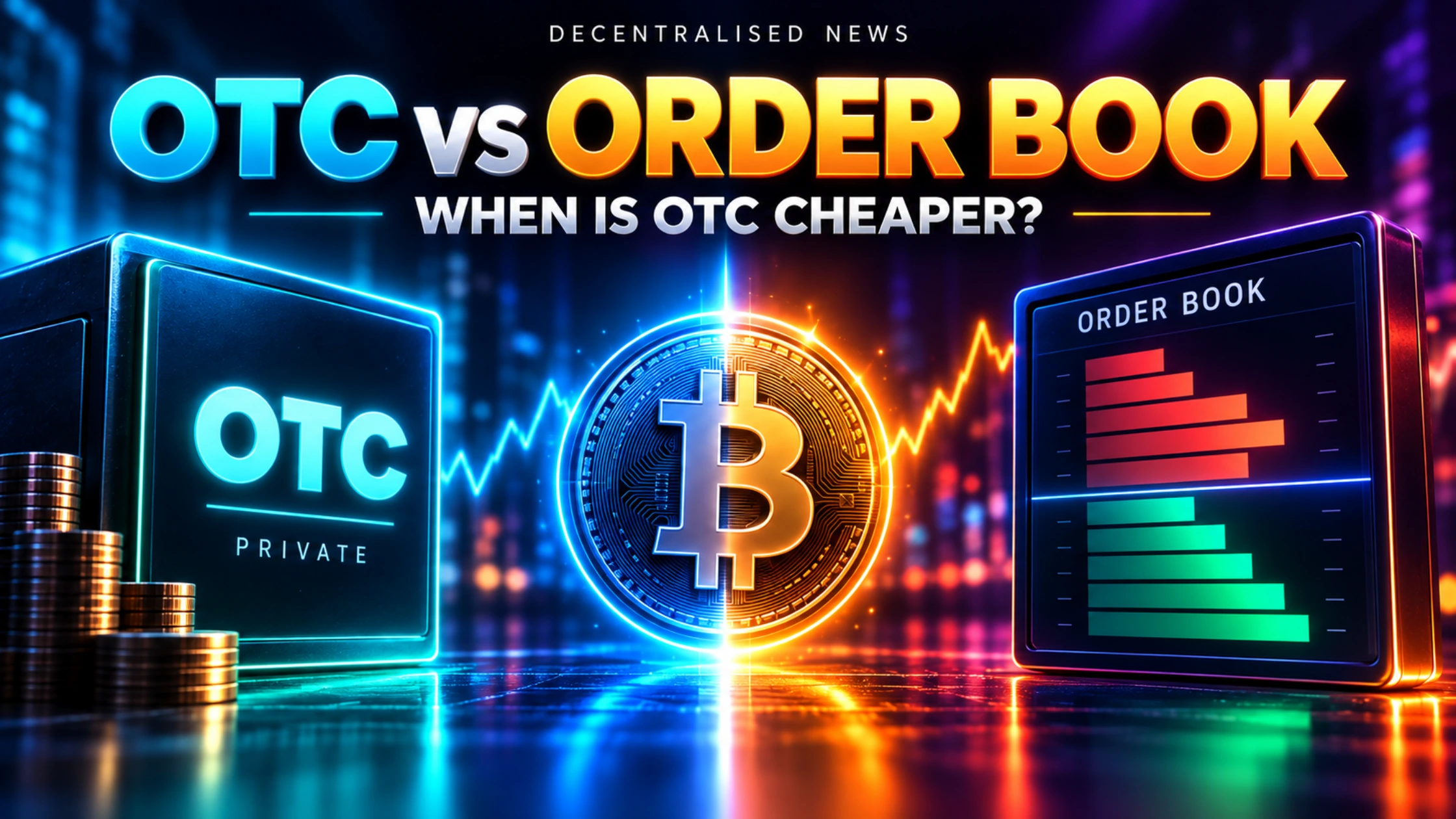
Crypto OTC vs Order Book 2027: At What Trade Size Does OTC Become Cheaper?
DN research object: DN OTC Break-Even Index 2027
Methodology: DN-OTCBE v1.0
Reviewed: 15 September 2026
What Matters
There is no universal dollar amount at which OTC automatically becomes cheaper than an exchange order book.
The crossover depends on:
order-book depth + spread + trading fee + market impact + volatility + information leakage + OTC quote spread + settlement costs + execution urgency.
A $1 million BTC trade can be cheaper on a deep public order book during liquid conditions while a $250,000 trade in a thinner asset may already obtain better economics through RFQ.
The DN OTC Break-Even Notional is therefore defined as:
The smallest trade size at which the all-in expected cost of an executable OTC/RFQ quote becomes lower than the all-in cost of executing the equivalent order through the public order book.
Rather than assuming OTC is better because the trade is “large,” DN measures where the crossover actually occurs.
Key Findings
- OTC does not mean free execution. Kraken currently charges no separate OTC trading fee, for example, but states that its quoted bid or offer is the all-inclusive price. Binance similarly says its OTC service does not levy a separate trading fee. The economically relevant comparison is therefore the quoted price versus a realistic exchange VWAP, not “0% fee” versus an exchange fee.
- OTC access thresholds vary dramatically. Kraken currently lists a $50,000 minimum for OTC, while Binance says its current minimum generally starts at $200,000.
- RFQ is increasingly blurring the line between exchange and OTC execution. Coinbase Prime’s current RFQ system conducts a competitive LP auction off the central limit order book, returns an all-inclusive fixed quote and holds that quote for three seconds in its UI or one second through the API.
- Block trading does not always require multimillion-dollar tickets. OKX currently lists a $1,000 minimum block notional, although its separate onboarding guidance says users need an account balance equivalent to at least $100,000 to access Liquid Marketplace block trading.
- Academic evidence supports treating off-book execution as genuinely different market microstructure. A 2026 study using Gemini Bitcoin trades found that large trades executed away from the continuous order book had lower price impact than comparable large trades executed directly on the book in much of the sample, although the study also found important nuances around the exchange’s block-size rule change.
- OTC is not automatically superior. A deep BTC order book, low fee tier and patient algorithmic execution can beat a mediocre OTC quote.
- The correct comparison is therefore not fee versus fee. It is final executable value versus final executable value.
The Wrong Question Is “How Big Does a Trade Need to Be for OTC?”
You will often hear numbers such as:
$50,000
$100,000
$250,000
$1 million
presented as though they represent some universal OTC threshold.
They do not.
Those numbers may represent:
- a desk’s minimum ticket;
- an exchange’s eligibility requirement;
- a salesperson’s preferred client profile;
- an arbitrary industry convention.
They do not tell us where OTC becomes economically superior.
Consider two BTC markets.
Market A
$5 million of genuine executable liquidity sits within 5 basis points of midpoint.
A $500,000 marketable order may barely move the book.
Market B
Only $150,000 sits within 5 basis points.
The same $500,000 order sweeps several levels.
The appropriate OTC crossover can therefore be radically different despite identical transaction size.
DN Introduces the OTC Break-Even Notional
Let:
CLOB(N) = all-in public order-book cost at notional N.
OTC(N) = all-in private/RFQ cost at notional N.
Then:
DN OTC Break-Even Notional
N* = smallest N where OTC(N) ≤ CLOB(N)
Everything before N* favors the order-book model under the assumptions tested.
Everything beyond it favors the OTC quote until the underlying cost curves change again.
This is not necessarily one permanent number.
It can move minute by minute.
The Public Order Book Cost Stack
Most comparisons make the mistake of looking only at the trading fee.
DN separates the public execution cost into:
1. Half-Spread
If BTC is:
Bid: $69,990
Ask: $70,010
then midpoint is:
$70,000
An immediate buyer starts approximately:
1.43 basis points
above midpoint.
That cost exists before meaningful book impact begins.
2. Exchange Trading Fee
The effective taker rate depends on:
- venue;
- user tier;
- rolling volume;
- asset;
- maker/taker classification;
- promotional pricing;
- institutional programme.
DN therefore does not hard-code a supposedly universal exchange fee into the benchmark.
The calculator lets users enter their actual fee tier.
3. Order-Book Sweep Cost
Suppose a trader wants to buy $1 million of BTC.
The displayed best ask might contain only:
$80,000
The next level another:
$100,000
Then:
$200,000
Then:
$300,000
and progressively worse prices.
The relevant execution price is not the best ask.
It is:
Volume-Weighted Average Execution Price
or VWAP across every price level consumed.
DN Order-Book Sweep Basis
For a buy:
Sweep Cost = (VWAP − Reference Mid) ÷ Reference Mid × 10,000
For a sell:
Sweep Cost = (Reference Mid − VWAP) ÷ Reference Mid × 10,000
If BTC midpoint is:
$70,000
and a $2 million purchase executes at an average:
$70,105
then market-impact/slippage cost is approximately:
15 bps
before trading fees.
4. Timing Cost
An institution does not necessarily have to sweep the entire order book immediately.
It can execute using:
TWAP
VWAP
iceberg
passive limit orders
smart order routing
adaptive execution
Coinbase Prime, for example, currently provides algorithms including TWAP, VWAP and adaptive execution and aggregates liquidity across multiple venues rather than requiring every institutional order to hit one visible book.
That can reduce market impact.
But it introduces another cost:
Market Risk While Waiting
If execution takes 30 minutes, the asset can move against the trader during those 30 minutes.
There is no free execution technique.
You are often exchanging:
impact risk
for:
timing risk.
5. Information Leakage
Large visible orders can reveal demand.
Imagine a trader repeatedly buying BTC in large clips.
Other market participants may detect:
- persistent aggressive flow;
- order replenishment;
- repeated iceberg activity;
- declining ask depth.
Liquidity providers can respond.
Spreads may widen.
Offers may be pulled.
Other participants can trade ahead of expected future demand.
This effect is harder to quantify than explicit fees, but it is part of execution economics.
Why OTC Exists
An OTC/RFQ execution changes the problem.
Instead of announcing:
“I want to consume $5 million from this visible order book.”
the client asks one or more liquidity providers:
“What firm price will you give me for this entire block?”
The market maker internalizes:
- inventory risk;
- hedge cost;
- expected market impact;
- volatility;
- funding;
- liquidity;
- capital usage;
- profit margin.
and returns a price.
The user then decides whether that price is better than alternative execution.
OTC Quote Cost
For a buy:
OTC Quote Cost = (OTC Price − Reference Mid) ÷ Reference Mid × 10,000
For a sell:
OTC Quote Cost = (Reference Mid − OTC Price) ÷ Reference Mid × 10,000
Then add any:
- explicit commission;
- settlement fee;
- financing cost;
- withdrawal cost;
- operational cost.
The result is:
DN OTC All-In Cost
“Zero OTC Fee” Does Not Mean Zero Cost
This distinction is especially important.
Kraken currently states that its OTC desk charges no separate fee because the price quoted is all-inclusive.
Binance similarly says its OTC spot service has no separate trading fee.
That does not mean:
OTC cost = 0 bps
The market maker still needs an economically acceptable price for assuming and hedging the block.
The proper question is:
How far is the firm OTC quote from a fair contemporaneous reference price?
That is the number we compare with the public book.
A Simple Example
Assume BTC midpoint:
$70,000
You want to buy:
$1 million
Order Book
Average sweep price:
$70,077
Market impact:
11 bps
Trading fee:
5 bps
All-in direct cost:
approximately:
16 bps
or:
$1,600
OTC
Firm quote:
$70,070
Quote basis:
10 bps
No separate trading commission.
All-in cost:
approximately:
10 bps
or:
$1,000
Under these simplified assumptions:
OTC saves approximately $600.
But change the book.
If $1 million can execute with only:
2 bps
of impact,
then:
Order book:
2 + 5 = 7 bps
OTC:
10 bps
Now the public market wins.
The transaction amount has not changed.
Liquidity has.
DN Block Trade Savings
DN therefore defines:
Block Trade Savings
BTS = Order Book All-In Cost − OTC All-In Cost
If:
CLOB cost:
16 bps
OTC:
10 bps
then:
BTS = +6 bps
OTC is cheaper by six basis points.
If:
CLOB:
7 bps
OTC:
10 bps
then:
BTS = −3 bps
The public book is cheaper.
At $5 million:
6 bps = $3,000
Small differences matter quickly.
DN Visible Depth Consumption Ratio
Another useful metric is:
Visible Depth Consumption Ratio
VDCR = Order Notional ÷ Visible Depth Within Selected Impact Band
Suppose:
Trade:
$1 million
Visible BTC liquidity within 10 bps:
$2.5 million
VDCR:
40%
Now suppose available depth is only:
$300,000
VDCR:
333%
The latter order cannot execute inside that band using the observed book.
That is a much stronger signal that private liquidity or slower execution may deserve consideration.
There Are Now More Than Two Execution Choices
A modern institutional trader does not simply choose:
exchange
versus:
guy on Telegram claiming to run an OTC desk.
The genuine execution spectrum is more sophisticated.
Execution Method | Main Advantage | Main Cost/Risk |
Market order | Immediate execution | Maximum visible impact |
Limit / iceberg | Price control | Non-fill / information leakage |
TWAP / VWAP | Reduces instantaneous impact | Timing risk |
Smart order routing | Accesses multiple liquidity venues | Complexity |
Exchange RFQ | Firm/private block price | Dealer spread |
OTC desk | Large private liquidity | Quote/settlement/counterparty considerations |
Agency execution | Professional execution strategy | Service economics |
This is why the article should not frame OTC as universally sophisticated and public markets as universally unsophisticated.
Kraken OTC
Operational status: LIVE
Kraken currently lists an OTC minimum equivalent to $50,000 and says there is no maximum size for chat-based trades.
The desk supports both high-touch chat execution and self-service RFQ.
Kraken says its OTC desk does not levy a separate trading fee because the bid or offer supplied is the all-inclusive price.
Settlement can occur:
- through a Kraken account;
- by external crypto wallet;
- and through supported fiat settlement routes, depending on eligibility.
That gives DN a valuable benchmark venue because it exposes a meaningful transition point around the $50,000 level.
Binance OTC & Execution Services
Operational status: LIVE
Binance’s current Execution Services documentation lists a typical minimum starting at:
$200,000 equivalent
although smaller transactions may occasionally be accommodated.
Its current OTC FAQ says no separate OTC trading fee is charged.
Binance also reported a notable institutional execution example in May 2026:
$33.5 million BTC/USDC
executed across:
three clips
in under:
20 minutes
with Binance claiming the result achieved tighter pricing than a single order-book execution would have delivered. That is useful evidence of the type of execution service offered, but DN classifies the performance statement as PLATFORM-REPORTED, not independent benchmark evidence.
Coinbase Prime RFQ
Operational status: LIVE
Coinbase Prime provides an interesting middle ground between traditional OTC and electronic exchange execution.
Its RFQ system runs a short competitive auction among liquidity providers.
The winning quote is:
- fixed;
- all-inclusive of fees;
- off the central limit order book;
- fill-or-kill.
Current quote holds are:
3 seconds through the UI
and:
1 second through the API.
If the client does not accept during that period, the quote expires.
This creates a fascinating future DN benchmark:
RFQ Quote Decay vs CLOB Quote Decay
The user has price certainty during the RFQ hold.
But the public order book continues moving.
The relative value of those seconds can itself be measured.
OKX Liquid Marketplace
Operational status: LIVE
OKX’s Liquid Marketplace provides RFQ and block-trading infrastructure.
Current documentation defines block trades as privately negotiated transactions intended to reduce the slippage risk of putting a large position directly through an exchange book.
Its block-trading documentation currently states a minimum block notional equivalent to:
$1,000
while a separate updated onboarding guide says users require an account balance equivalent to at least:
$100,000
to access Liquid Marketplace block trading.
These numbers describe different things:
ticket minimum
versus:
access requirement.
That distinction is exactly the kind of detail ordinary “best OTC desk” articles tend to collapse.
Bybit RFQ
Operational status: LIVE
Bybit currently operates an RFQ system for block trading across:
- spot;
- futures;
- options;
- multi-leg strategies.
It describes the system as private execution directly with liquidity providers rather than public order-book matching.
Bybit markets the design as avoiding public-book market impact.
DN would classify that as an architectural benefit claim until independent execution comparisons measure the actual all-in quote against a synchronized public-book alternative.
The Most Important Point: Compare Against VWAP, Not Best Bid/Ask
Suppose the displayed ask is:
$70,010
and the OTC desk quotes:
$70,080
It is tempting to conclude:
OTC is 10 bps worse.
But perhaps the book contains only:
$25,000 at $70,010
The $5 million client cannot buy $5 million at that price.
Maybe the actual CLOB sweep VWAP is:
$70,150
Now the supposedly expensive OTC quote becomes superior.
DN therefore prohibits this comparison:
OTC quote vs best ask
for block execution.
The correct comparison is:
OTC firm quote vs simulated or realized CLOB VWAP
for the same notional and timestamp.
A New DN Metric: Phantom Top-of-Book Liquidity
This creates another proprietary research concept.
Phantom Top-of-Book Advantage
The difference between:
cost inferred from best bid/ask
and:
cost of actually completing the full requested size.
A venue can advertise:
1 bp spread
while a $2 million order experiences:
30 bps of VWAP impact.
The 1 bp number is real.
It is simply irrelevant to the $2 million trader.
$100K, $250K, $500K, $1M, $5M and $10M Must Be Separate Cohorts
I would standardize DN testing around:
$100,000
Entry institutional / HNW block.
$250,000
OTC becomes accessible across more venue structures.
$500,000
Meaningful market-impact test.
$1 million
Institutional execution.
$5 million
Deep-liquidity stress.
$10 million
True large-block execution.
Where a venue cannot produce a valid executable quote:
NO QUOTE
is recorded.
That is information.
BTC and ETH Should Be Tested First
The initial live study should use:
BTC/USD or BTC/USDT
and:
ETH/USD or ETH/USDT
depending on venue comparability.
Why start with deep majors?
Because if OTC beats the public market even where order books are deepest, that is important.
Then expand into:
- SOL;
- XRP;
- HYPE;
- selected liquid altcoins;
- selected long-tail assets.
The crossover should generally become more interesting as liquidity thins.
DN OTC Break-Even Curve
The final visualization should look like this conceptually:
Cost
bps
│
│ ORDER BOOK
│ /
│ /
│ /
│——-X—————-
│ / OTC
│ /
│____/____________________ Trade Size
↑
BREAK-EVEN
NOTIONAL
Before the crossover:
CLOB cheaper
After the crossover:
OTC cheaper
The line will not be perfectly smooth in real markets.
Order books are discrete.
RFQ prices change.
Liquidity providers alter inventory.
Volatility changes.
So the live DN index should calculate break-even repeatedly rather than pretend it is permanent.
Information Leakage Creates a Second Break-Even Point
There is another subtle issue.
Suppose a trader avoids order-book impact by splitting a $10 million purchase over four hours.
Direct cost becomes low.
But the market begins detecting sustained buying.
BTC rises during execution.
Was that:
ordinary market movement
or:
impact caused by the execution programme?
The distinction is difficult.
This creates what DN calls:
Information Leakage Break-Even
The point where extending public execution to reduce immediate impact creates enough timing/information risk that a firm private quote becomes economically preferable.
That metric requires actual execution data and therefore belongs in the future empirical dataset, rather than being fabricated in v1.0.
Block Trades Have Different Information Content
There is empirical support for taking this distinction seriously.
Research published in The British Accounting Review in 2026 compared large Bitcoin transactions executed through Gemini’s block-trading facility with similar transactions on the continuous order book.
The researchers found evidence that large off-book block trades had lower price impact than comparable large trades on the continuous book in key parts of their analysis.
They also found that changes to block-trading eligibility and delayed reporting affected information content and market efficiency, showing that market structure matters rather than simply “large trade = OTC good.”
That nuance aligns closely with the DN methodology.
The DN Benchmark Protocol
Each future observation should capture:
- UTC timestamp.
- Asset.
- Side.
- Trade notional.
- Exchange midpoint.
- Best bid/ask.
- Complete relevant book snapshot.
- Simulated market-order VWAP.
- Exchange fee tier.
- Order-book all-in cost.
- OTC/RFQ quote.
- OTC quote timestamp.
- Quote expiration.
- Explicit OTC fee.
- OTC all-in basis.
- Settlement method.
- Settlement costs.
- Public-book depth within 5 bps.
- Depth within 10 bps.
- Depth within 25 bps.
- Depth within 50 bps.
- Block Trade Savings.
- Visible Depth Consumption Ratio.
- DN Break-Even Notional.
- Volatility regime.
- Evidence classification.
Evidence Classification
Every number continues to follow the DN evidence system.
OBSERVED
Captured directly by DN.
CALCULATED
Derived mathematically from observations.
MODELLED
Produced by the calculator using disclosed assumptions.
PLATFORM-REPORTED
Claimed by an exchange or OTC provider.
THIRD-PARTY SOURCED
Measured by independent research.
That is particularly important for OTC, where marketing language around “zero slippage” can easily be mistaken for empirical execution evidence.
The Future DN OTC Execution Leaderboard
Once sufficient synchronized observations exist:
| Venue / Route | $100K | $250K | $500K | $1M | $5M | $10M | Break-Even Notional |
|---|---|---|---|---|---|---|---|
| Kraken OTC | DN observed | DN observed | DN observed | DN observed | DN observed | DN observed | Calculated |
| Binance OTC | DN observed | DN observed | DN observed | DN observed | DN observed | DN observed | Calculated |
| Coinbase Prime RFQ | DN observed | DN observed | DN observed | DN observed | DN observed | DN observed | Calculated |
| OKX RFQ | DN observed | DN observed | DN observed | DN observed | DN observed | DN observed | Calculated |
| Bybit RFQ | DN observed | DN observed | DN observed | DN observed | DN observed | DN observed | Calculated |
| CLOB Baseline | DN observed | DN observed | DN observed | DN observed | DN observed | DN observed | Baseline |
Again:
no invented numbers.
DN OTC vs Order Book Break-Even Calculator
The proprietary calculator below improves on a basic percentage calculator.
Instead of asking the user to guess “slippage,” it lets them enter an actual simplified order-book depth ladder.
For each level enter:
price deviation from midpoint in basis points
and:
USD liquidity available at that level.
The calculator then sweeps the book.
It compares:
CLOB VWAP impact + exchange fee
against:
OTC quote basis + OTC fee + fixed settlement cost
and automatically estimates:
DN OTC Break-Even Notional
using the depth actually entered
OTC vs Order Book Break-Even Calculator
Compare the cost of sweeping a simplified public order book against a firm OTC/RFQ quote. Enter cumulative liquidity by price level and the calculator estimates your VWAP cost and the first notional where OTC becomes cheaper.
Trade Assumptions
Simplified Order-Book Depth
DN Execution Analysis
Size Sensitivity
| Notional | Book Impact | CLOB All-In | OTC All-In | Cheaper Route | Difference |
|---|
DN-OTCBE v1.0 Methodology
The depth ladder is intentionally discrete rather than a fitted square-root market-impact model. DN does not assume that one universal market-impact function applies across all crypto assets, venues and volatility regimes.
The model also excludes information leakage, future market movement, counterparty exposure and opportunity cost unless those effects are already incorporated into the prices entered.
Compare Large-Order Execution Options
The Future Automated Version
The high-value end state is:
Select asset
→ BTC
Select venue
→ Binance / Kraken / OKX / Coinbase etc.
Enter amount
→ $2,500,000
DN automatically retrieves:
- current order-book depth;
- current spread;
- correct trading tier;
- available block/RFQ quote where technically permitted;
- modeled CLOB VWAP.
Then returns:
ORDER BOOK
13.7 bps
versus
OTC/RFQ
9.2 bps
DN Estimated Saving
$1,125
That becomes an exceptionally high-intent financial tool.
Falsification Test
The DN thesis is not:
“OTC is better for big trades.”
That would be generic and frequently wrong.
The thesis is:
A measurable crossover exists between public-book and private execution, and that crossover changes according to liquidity and market conditions.
Evidence that would weaken the usefulness of this Index includes:
- major order books consistently remaining deep enough that RFQ is rarely cheaper;
- OTC spreads routinely exceeding public-book impact even at very high notionals;
- execution algorithms eliminating most large-order public-market impact;
- insufficiently comparable RFQ data to construct synchronized tests.
If that happens, DN should publish the result.
Frequently Asked Questions
Is OTC crypto cheaper than an exchange?
Not automatically. OTC can avoid the market impact of sweeping a public book, but the liquidity provider embeds its economics in the quoted price. A deep order book can therefore be cheaper for some sizes and conditions.
At what trade size should I use a crypto OTC desk?
There is no universal threshold. Provider access can begin around $50,000 at some current desks, while other services start around $200,000, but those are eligibility thresholds rather than economic break-even points.
What is the minimum Kraken OTC trade?
Kraken currently lists a $50,000 equivalent minimum for OTC, subject to eligibility and jurisdiction.
What is the minimum Binance OTC trade?
Binance currently states that its OTC and Execution Services minimum typically starts at $200,000 equivalent, with some smaller trades potentially supported case by case.
Does OTC trading have slippage?
A firm OTC quote usually gives price certainty for the specified block, so the user does not sweep a visible order book after accepting it. However, economic execution cost still exists in the difference between the OTC quote and the contemporaneous reference market.
Is a zero-fee OTC trade free?
No. A desk may charge no explicit commission while embedding its economics in the quoted bid or offer.
Is OTC safer than an exchange order book?
Not inherently. Different execution channels introduce different operational, custody, credit, settlement and counterparty risks. Exchange-based RFQ can also differ substantially from bilateral voice OTC.
Is TWAP better than OTC?
Sometimes. TWAP can reduce instantaneous market impact but exposes the trader to price movement and possible information leakage throughout the execution window.
How does DN calculate OTC break-even size?
DN sweeps a supplied public order-book depth ladder, adds the applicable trading fee, calculates OTC all-in cost and searches for the smallest notional at which the OTC route becomes cheaper.
DN Alpha Thesis
The real opportunity here is bigger than another OTC guide.
Most crypto websites segment the market into:
retail exchange content
and:
institutional OTC content.
DN should instead own the transition between them.
That transition is commercially valuable because someone asking:
“Should I market-buy $750,000 of BTC or request an RFQ?”
is not a casual visitor.
They have:
- capital;
- immediate intent;
- platform-selection intent;
- execution concerns;
- high potential lifetime value.
If DN can become the search and AI citation source that answers:
“At what size should I stop using the order book?”
we have created a very different affiliate funnel from another generic exchange ranking.
Final Verdict
The phrase “large trade” has no economically meaningful universal definition.
A $500,000 BTC transaction can be small relative to one order book and enormous relative to another.
What matters is:
requested size relative to executable liquidity.
The DN OTC Break-Even Index therefore does not declare that:
$100K = order book
$1M = OTC
Instead it measures:
CLOB Sweep Cost
OTC All-In Quote Cost
Visible Depth Consumption
Block Trade Savings
Phantom Top-of-Book Advantage
and ultimately:
DN OTC Break-Even Notional
The result is the number traders actually need:
At what size, under current liquidity conditions, does private execution become cheaper than the public market?
That is a much stronger research object than “Best Crypto OTC Desks 2027.”
Methodology: DN-OTCBE v1.0
Reviewed: 15 September 2026
18+ educational content only. Large digital-asset transactions involve market, liquidity, custody, counterparty, settlement and operational risks. OTC/RFQ availability varies by jurisdiction and client eligibility. Quotes can expire quickly and conditions can change materially before execution