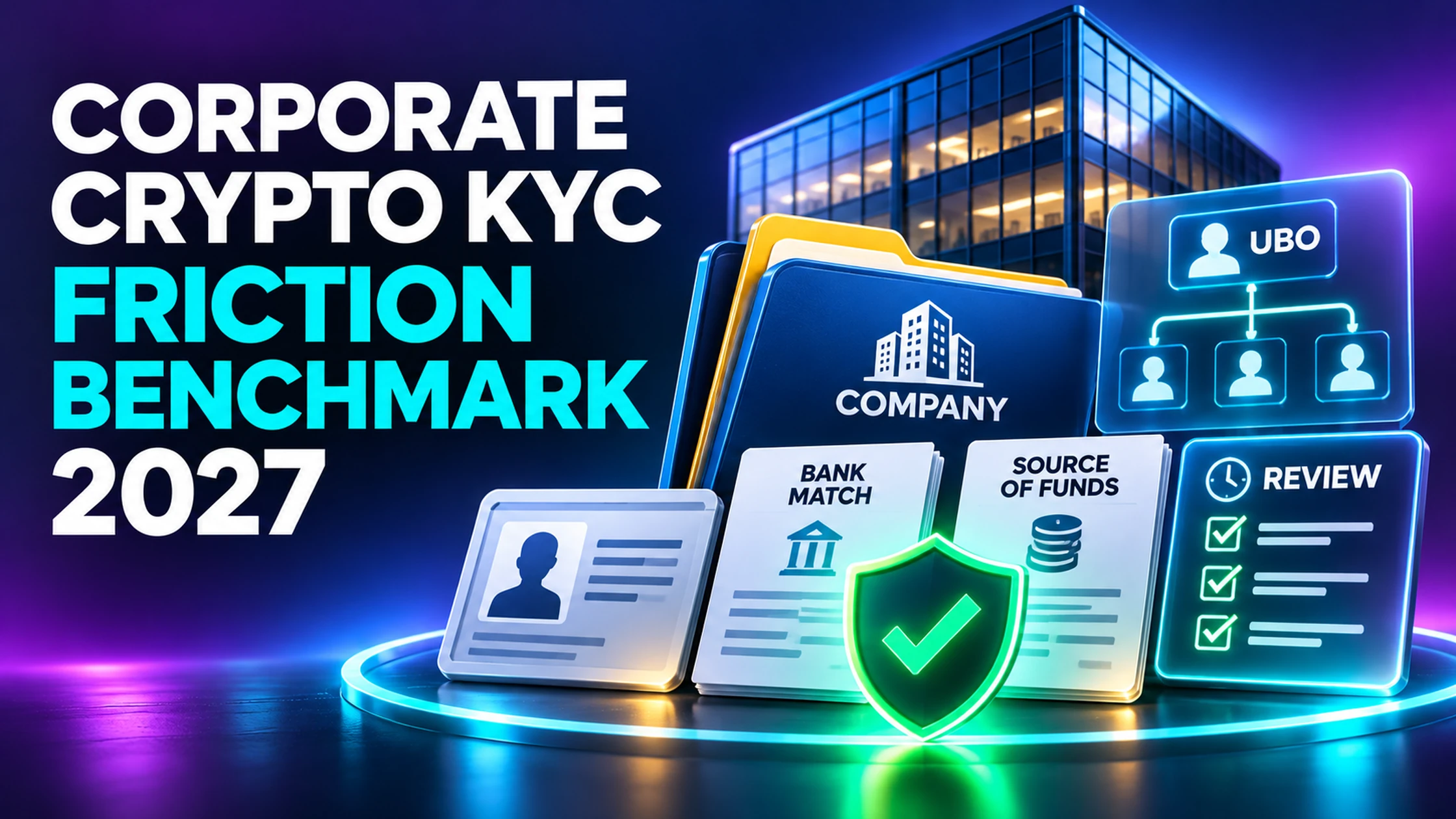
Retail KYC asks who you are. Corporate KYC asks who owns the company, who controls it, where the money came from, which bank account belongs to the entity, whether the business is regulated, and whether every document agrees with every other document.
What Matters
Corporate crypto onboarding friction is not mainly about uploading more PDFs. It is about dependency chains.
A business application can be delayed because:
- one beneficial owner has an expired proof of address;
- the bank account name does not exactly match the legal entity;
- an ownership chart omits an intermediate holding company;
- source-of-funds evidence does not reconcile with financial statements;
- an entity is regulated and triggers AML attestations;
- documents require notarized translation or certification;
- or a reviewer asks for enhanced due diligence after the initial submission.
DN therefore measures corporate KYC as a workflow-friction problem, not simply a document-count problem.
DN Evidence Block
The Signal: Corporate KYC Fails at the Edges
The basic corporate documents are predictable:
Certificate of IncorporationArticles / ConstitutionBusiness AddressUBO RegisterDirector RegisterBank Statement
The friction appears when those documents do not line up perfectly with the application or when the business model triggers deeper review.
DN Corporate KYC Friction Dimensions
| Dimension | What DN measures |
|---|---|
| Document Breadth | Formation, ownership, bank, tax, address, source-of-funds, regulatory and authorization requirements. |
| UBO Complexity | Ownership threshold, number of individuals requiring ID/POA and intermediate entities. |
| Certification Burden | Notarization, certified true copies and certified translations. |
| Source-of-Funds Depth | How much evidence is required to prove how the entity obtained and will fund the account. |
| Review-Time Transparency | Whether the provider publishes a realistic expected review window. |
| Additional-Info Risk | Likelihood that the application enters enhanced review after initial submission. |
| Banking Match Risk | Whether fiat funding requires exact legal-name matching and business bank accounts. |
| Re-verification Burden | How much periodic KYB refresh can interrupt an already-live account. |
Kraken: Most Transparent Public Processing Window
Kraken's current business-account guide states that standard processing is approximately five business days when requested documents are submitted accurately and completely.
The required set includes formation documents, a comprehensive shareholder/UBO register, organizational chart for layered ownership and proof of business operating address.
Kraken also notes that high demand or additional information requests can extend the process, and its current document-requirements page warns of delays in processing new accounts.
Kraken — Business account verification
Coinbase: Highly Documented, but Review Can Take Weeks
Coinbase Business says the application itself should take approximately 15–30 minutes when documents are ready, but most applicants hear back within a few weeks.
Its standard business requirements include government ID for the applicant/control person and each owner above the relevant ownership threshold, formation documents, business bank statements, tax identification and a detailed business description.
Coinbase Business — application timeline
Institutional onboarding can go further, including source-of-funds evidence, director registers, regulatory licences, AML attestation letters and authorized-user lists depending on entity type and jurisdiction.
Coinbase Re-verification Is an Ongoing Operational Requirement
Coinbase Business periodically asks existing businesses to reconfirm legal entity details, ownership information and documents. Coinbase says the update itself often takes 5–10 minutes, but the submitted update is then reviewed and may lead to additional requests.
If the required refresh is not completed, account capabilities can be restricted.
Coinbase — Business verification updates
Binance: Dynamic KYB and Deeper Financial Questions
Binance's entity-verification flow generates a corporate-document checklist from the company's jurisdiction, legal form and business activity.
Its current guide asks for registered and operating addresses plus information such as:
- source of wealth;
- source of funds;
- primary business activity;
- assets under management;
- monthly transaction volume;
- funding method;
- and purpose of the account.
Binance also documents separate proof-of-address and source-of-funds/wealth standards, which can require financial statements, bank statements, contracts, investment records and professional attestations.
OKX: Institutional KYB With Explicit Review Tasks
OKX requires institutional customers to complete KYB before trading, deposits and withdrawals are fully available.
Its 2026 verification guidance emphasizes a task-based workflow: applications can remain under review, move to a “provide information” state, or be returned/rejected with feedback.
OKX also warns that corporate bank deposits can be rejected if the sending bank-account name does not exactly match the registered business name, including suffixes such as “Pty Ltd.”
OKX — Institutional onboarding
Bitget: Certification Can Become the Dominant Cost
Bitget's latest CFD institutional KYB guidance illustrates how jurisdiction-specific requirements can increase friction materially.
That flow requires certified true copies, with certification by a registered lawyer, notarial authority or recognized regulated professional. It also uses a 20% UBO threshold rather than the more common 25% threshold and can require certified identity/address evidence for directors and UBOs, ownership charts, source-of-funds documents and a board resolution.
Bitget — Institutional KYB guidance
This is product- and jurisdiction-specific rather than a universal Bitget requirement, but it demonstrates why “how many documents?” is not enough to measure friction.
DN Corporate KYC Benchmark
| Provider | Public timing | UBO / ownership burden | SOF/SOW depth | Certification burden | DN observation |
|---|---|---|---|---|---|
| Kraken | ~5 business days standard | High | Risk-based | Moderate | Best timing transparency |
| Coinbase Business | Few weeks typical | High | Moderate to high | Moderate | Strong documentation, slower expected review |
| Coinbase Institutional | No single universal SLA | Very high | High | Jurisdiction-dependent | Most detailed institutional compliance stack |
| Binance | No universal public SLA verified | High | High | Translation can add friction | Dynamic, business-model-sensitive KYB |
| OKX | No universal public SLA verified | High | Risk-based | Moderate | Clear status/task workflow |
| Bitget institutional examples | Product/jurisdiction specific | High; 20% in cited CFD flow | High | Potentially very high | Certification can dominate friction |
This is a documented-process benchmark, not a promise of approval time. Applications can take longer because of geography, business model, ownership complexity, regulatory status, document quality and enhanced due diligence.
DN Corporate KYC Friction Calculator
Corporate KYC Friction Calculator
Estimate onboarding complexity from ownership layers, beneficial owners, certification requirements, source-of-funds evidence and expected review iterations.
Ownership
Documents
Review
DN Corporate Onboarding Analysis
Corporate KYC friction comes from dependencies and review loops, not just the initial upload count.
How the Calculator Works
The model weights four sources of friction equally:
- ownership structure;
- document burden;
- evidence/certification requirements;
- and review iteration risk.
Workflow days are not a promise. DN models:
The three-day assumption is deliberately conservative and editable only through methodology revision, not presented as a provider SLA.
DN Corporate KYC Preparation Checklist
Entity
Certificate of incorporation, articles/constitution, registration number, registered and operating address.
Ownership
Share register, UBO details, control persons and full corporate ownership chart through intermediate entities.
Banking
Recent business bank statement in exact legal entity name and matching declared address where required.
Source of Funds
Bank statements, financial statements, contracts, capital commitments or other evidence connecting funds to the entity.
Authorization
Board resolution, authorization letter or list of authorized representatives and their IDs.
Regulatory
Licences, exemptions, AML attestations and compliance-officer information where applicable.
The Most Common Corporate KYC Failure Modes
| Failure | Why it causes delay | DN mitigation |
|---|---|---|
| Entity name mismatch | Bank statement, incorporation certificate and application use different suffixes or abbreviations | Use exact legal name everywhere |
| Ownership chart incomplete | Intermediate holding entities or indirect UBOs are missing | Map ownership through natural persons |
| Expired POA | Proof of address exceeds validity window | Refresh before application |
| Weak SOF evidence | Funds cannot be reconciled to business activity or financial statements | Prepare full source trail |
| Missing authorization | Applicant is not clearly empowered to bind the company | Board resolution / authorization letter |
| Untranslated documents | Reviewer cannot accept or process non-English originals quickly | Prepare certified translation where required |
| Bank account not in entity name | Fiat rail cannot match sending company to verified entity | Open business bank account first |
DN Alpha Thesis
Corporate KYC is becoming a hidden product-quality differentiator for crypto exchanges.
Institutional users do not only care whether verification eventually succeeds. They care whether:
- requirements are predictable before they start;
- the review status is visible;
- additional requests are specific;
- documents can be reused across products;
- and periodic reverification does not unexpectedly disable operating accounts.
Falsification Test
The DN thesis weakens if corporate onboarding time is driven almost entirely by customer risk rather than provider workflow design, or if document transparency has little relationship with actual approval speed.
If repeated applicant data shows that all major exchanges converge on similar friction once risk is controlled, DN should stop treating KYB usability as a meaningful differentiator.
Frequently Asked Questions
What is corporate KYC or KYB?
Know Your Business verification checks the legal entity, ownership, controllers, business activity, source of funds and related compliance information before an exchange activates a business or institutional account.
How long does corporate crypto verification take?
It varies materially. Kraken currently publishes a standard estimate of about five business days for complete business applications, while Coinbase says most Business applicants hear back within a few weeks. Other providers may not publish one universal SLA.
Why do exchanges ask for UBO information?
They need to identify the natural persons who ultimately own or control the company and assess AML, sanctions and financial-crime risk.
Why do exchanges ask for source of funds?
Source-of-funds checks establish where the money used to fund the account comes from and whether it is consistent with the entity's business and financial profile.
Can corporate verification continue after the account is opened?
Yes. Re-verification and periodic compliance reviews are normal and can require refreshed documents or additional information.
Primary Source Ledger
- Kraken — Business account verification: required corporate documents and five-business-day standard estimate.
- Kraken — Verification processing time: additional due diligence and delay conditions.
- Coinbase Business — Application timeline: 15–30 minute application and typical review within a few weeks.
- Coinbase Business — Requirements: formation documents, bank statements, tax ID, owners and business description.
- Coinbase Institutional — LLC onboarding: source of funds, directors, licences, AML attestations and authorized representatives.
- Binance — Entity Verification: dynamic corporate checklist, SOW/SOF, activity, AUM and volume.
- Binance — Source of Wealth / Source of Funds: evidence standards.
- OKX — Institutional onboarding.
- OKX — Institutional verification status and tasks.
- Bitget — Institutional KYB guidance: certified true copies, 20% UBO threshold and SOF evidence in cited CFD flow.
Change Log
| Date | Version | Change |
|---|---|---|
| 5 Nov 2026 | DN-CKYB v1.0 | Initial corporate KYC friction benchmark with ownership, certification, source-of-funds and review-loop methodology plus calculator. |
Continue the DN Business Trading Stack
Retail Exchange KYC Friction Index Best Crypto Exchanges for Business Accounts Exchange Legal Entity Mapper Crypto Prime Brokerage BenchmarkBusiness Account Platforms Mentioned
Commercial disclosure: the links below are affiliate links. DN may earn compensation if you register through them. Corporate-KYC scoring and editorial analysis remain independent.
Open Kraken Open Binance Open OKX Open BitgetMethodology disclosure: Corporate KYC is case-specific. Publicly stated review times are estimates, not guarantees. Additional due diligence can be triggered by geography, ownership complexity, sanctions exposure, business model, regulatory status or source-of-funds questions. Educational research only.