
Money Stories · Original fiction · 10 minute read
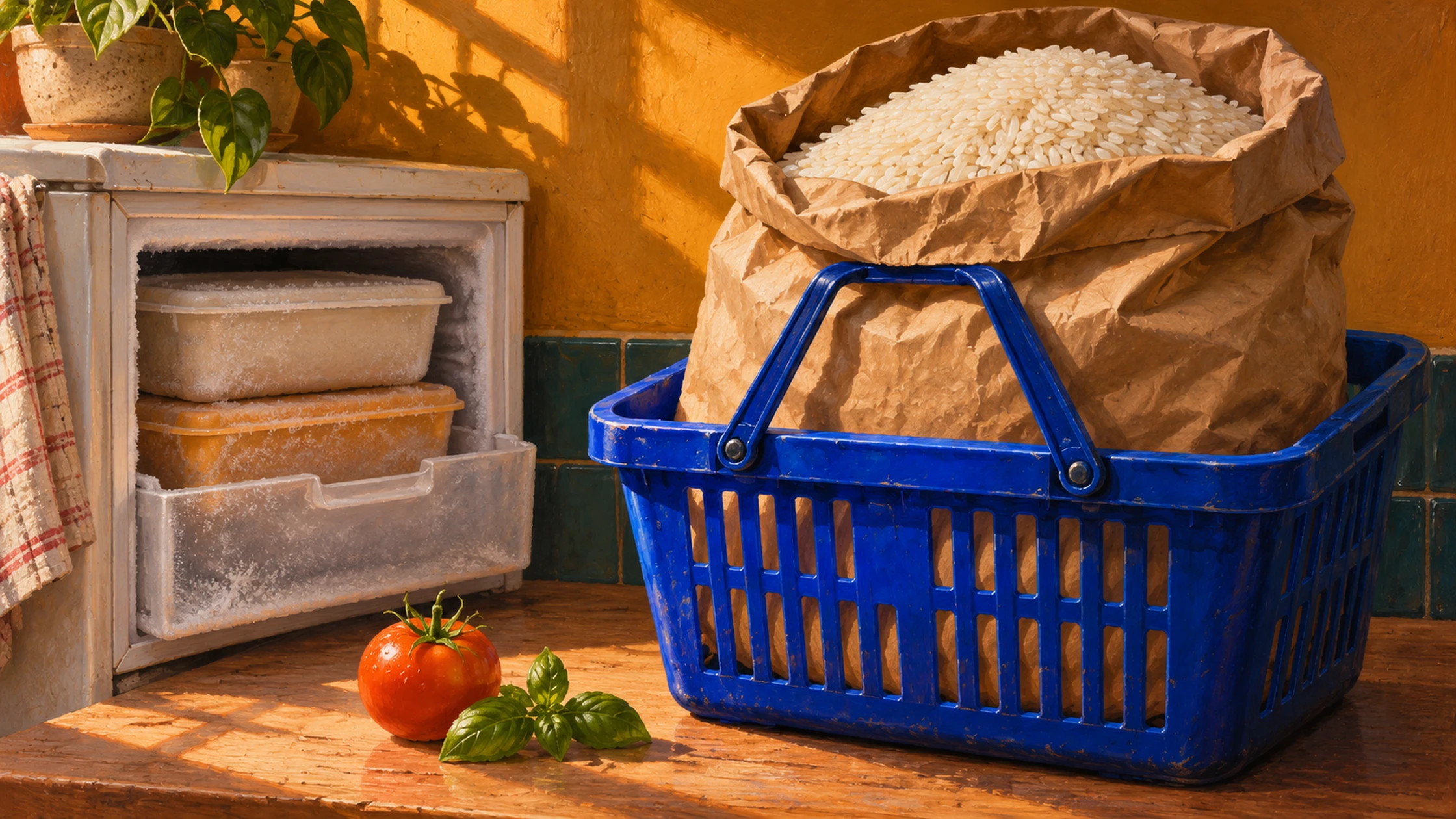
The bag of rice on Ruth's phone weighed ten kilos. Her son had weighed less than that when she first took him swimming.
She enlarged the picture with two fingers. Plain paper, blue seam, no handle.
“Where,” she asked, “does it think I live?”
Eli looked over her shoulder. “Somewhere with rice.”
It was Wednesday, and she had forty-six pounds for the week's food. The shopping assistant had spent forty-five pounds sixty, including delivery, and congratulated her on the value. Beside the rice was a comparison showing what each kilo would cost. A green line pointed towards a smaller number.
The order was still waiting for her approval. She had put that rule in herself. She liked a machine to stop somewhere she could reach it.
Ruth repaired buses. At work, an instruction that looked straightforward on a screen could require two people, a different spanner and the removal of something the designer had apparently never seen. This did not make her against instructions. It made her interested in the space around them.
At home, lately, she had been less interested. There was a limit to the number of things she wanted to work out after a late shift.
Her colleague had suggested the assistant. You gave it a list, your budget and a few preferences; it assembled an order from the shop linked to the trial. Ruth had asked it to keep the cost down and make proper meals. It remembered what she had bought last week, which had seemed like thoughtfulness.
Now it wanted to send her enough rice to become a person who stored rice.
The kitchen in the flat was not badly designed. It had been designed for a shorter life than the one Ruth was trying to fit into it.
One cupboard held plates. Another held a pan whose handle prevented the door from closing unless the pan was turned towards Sheffield. Below the sink were cleaning things, a toolbox and a biscuit tin containing screws. Eli had once moved the screws into a jar so he could use the tin for biscuits. Neither system had lasted.
At their old house there had been a freezer in the garage. Ruth still reached in her mind for its empty lower drawer. The flat's freezer was a compartment above the fridge, occupied by two boxes of leftovers and a loaf that had acquired the shape of the shelf.
She opened it while looking at the order. Two whole frozen chickens were on offer. The assistant proposed cooking one on Sunday and dividing the other into portions for later.
“There is no later,” she said to the freezer.
“There is Friday,” Eli said.
“I'm on lates Friday.”
“I know.”
He was fifteen and had become good at saying things in a tone that suggested she had asked the wrong question. She waited. In the flat next door, someone started a vacuum cleaner, stopped it, and moved a piece of furniture with the determination of a person moving an argument.
“I said Leon could come round.”
“On Friday?”
“For food. I said we could cook.”
Ruth closed the freezer too firmly. A little frost fell onto the counter.
Eli picked up one piece and held it until it vanished.
“You could have asked.”
“You said I could have people.”
She had. She remembered making a large, easy gesture on the day they moved in. Your room. Your place too. Have people round.
She had meant it. She had not meant the words to expire whenever her rota became difficult.
“What were you going to cook?”
“Pasta. That tomato thing.”
“Tinned tomatoes are on the order.”
“The one with the fresh ones.”
“It's the same thing.”
“It isn't.”
It wasn't. She knew the dish: chopped tomatoes, oil, a little basil, hot pasta turned through it at the last moment. They used to eat it in the garden, carrying the bowl out because no one wanted to find four separate plates. It was the first meal Eli had learned without asking her to read each step aloud.
The assistant had replaced the fresh tomatoes with tins. On a cost comparison, the substitution was reasonable.
Ruth looked at the forty pence remaining.
“We'll see.”
Eli's face closed. He took his school bag to his room, although it was already in his room and he was only moving it from one side of the doorway to the other.
She could have deleted the order and started again. She had done the food shop for years before a programme offered to help. For a moment, that seemed like a reason to do it the hard way forever.
Instead she opened the plan beneath the prices.
It had given her Sunday afternoon for cooking. She would be at the depot on Sunday afternoon. It had also given her Eli for seven dinners. He would spend the weekend with his father. The assistant had used the household pattern from an earlier week, before the rota changed and the visit was arranged.
There were sensible things in the basket. It had found a smaller packet of oats that cost less per kilo than the large one she usually bought. It had remembered they were almost out of milk. It had included the beans Eli liked instead of the ones she bought because they were what she had grown up with.
The food was not wrong in one simple way. It belonged to a week that was not theirs.
She found the sentence she had typed at the beginning: Get the best value you can. We need to eat properly.
She would not have accepted that as a work order for a bus. Get it working well. Spend as little as possible. No mention of which fault, what time it had to leave, or whether the driver could wait.
Her phone offered to refine the plan.
Ruth put it down and knocked on Eli's door.
“How many dinners are you here for?”
“Why?”
“Because apparently I don't know.”
He opened the door. A shirt hung from the wardrobe handle. In the corner, a box marked BOOKS contained everything except books. He had not complained about the room since the move. She had treated that as proof he was happy with it.
They counted the evenings on his fingers. Thursday. Friday with Leon. Monday. Tuesday, unless his father could swap a night. Ruth added the meals she needed to take to work.
“You could just give me some money,” he said. “We can get chips.”
“Do you want chips?”
He shrugged.
“Or do you want to make the pasta?”
He studied the floor between them.
“I told him I can make it.”
There it was, small and quite different from the problem she had been solving. Her son had invited someone into their new home and promised to feed him. He wanted the promise to be true.
“Then let's put it on the list.”
“The proper tomatoes.”
“The proper tomatoes.”
They sat at the little table with the phone between them. Ruth wrote the actual evenings on the back of an envelope. Eli drew a rectangle for the freezer and filled most of it with a loaf.
“That's art,” she said.
“It's a scale drawing.”
“Your loaf's too optimistic.”
He made it larger.
They told the assistant that neither could do a long cooking session this week, that there was almost no freezer room, and that they needed individual meals rather than ingredients for an imaginary month. Ruth changed the instruction from lowest unit prices to a week's usable meals within the limit. She asked it to show any assumption it had made about storage or cooking time.
It proposed a new basket. Some things cost more for the amount they got. The one-kilo bag of rice was £1.90; the ten-kilo bag had been £14. Ruth could see perfectly well which was cheaper per kilo. She could also see the £12.10 that the smaller bag left available this week.
Eli pointed at the screen. “It still thinks you can do that on Sunday.”
The assistant had retained one of the earlier meal suggestions. They removed it. A correction was not a reason to stop checking.
Then they looked at what they already owned. There was half a packet of pasta behind the screw tin, two onions, and more lentils than either remembered choosing. The assistant had not known about those. Ruth photographed the list she had made, not the inside of every cupboard. It was enough information for the task.
They settled on meals they would actually make. Eli would cook on Friday. Ruth would make enough lentils on Thursday for her work lunch as well. One ready-made portion stayed in the basket for the night she knew she would get home too tired to behave like the person in a meal plan.
“That's more expensive,” Eli said.
“Than cooking, yes.”
She nearly added that she could manage without it. She was very good at making her future self available for extra work.
“It stays,” she said.
The revised groceries came to £38.40. With the £3 delivery, £41.40. There was £4.60 left inside the limit. It was not a fortune or a reward. It was room for something they had forgotten.
Ruth read the quantities before pressing approve.
On Friday, she woke earlier than she wanted to and checked the bags against the order. The rice fitted on the shelf. The tomatoes were less beautiful than their photograph, as tomatoes often were. One had a soft place. She cut it away and put the rest in a bowl for lunch.
Eli came into the kitchen in a clean T-shirt.
“He's not coming until six,” she said.
“I know.”
“I'm just saying you don't have to start now.”
“Mum.”
She stopped.
He set the table while she made tea. There were two places, then, after a moment, a third. She would not be there to use it. He moved the third plate back to the cupboard without comment.
At half past three she left for work. In the hall she began to explain the timing of the pasta, heard herself, and changed the sentence.
“You've got everything?”
“Yes.”
“Call if you need me. I might take a minute.”
“All right.”
At the depot she spent an hour on a door that would close, open again, and insist there was an obstacle where she could see nothing. It turned out to be a small misalignment. She adjusted it, tested it, and tested it again.
Her phone vibrated in the pocket of her overalls.
Eli had sent a photograph. The pasta bowl stood between two plates. Leon's hand was entering the frame with a piece of bread. In the background Ruth could see the cupboard door properly closed; someone had turned the pan.
He had seconds, the message said.
She enlarged the picture. There was a little basil on the table, separated from the rest, probably too bruised to use.
She started to type a question about whether they had washed up. Deleted it.
Save me some if there's any.
When she got home, a covered bowl waited on the middle shelf of the fridge. Her name was written on a scrap of paper beneath it, although there were only two of them in the flat and the food was obviously for her.
She ate standing at the counter. The tomatoes had softened into the oil. It was good cold.
The assistant had already offered to plan the following week. Ruth left the notification unopened. In the morning she would ask Eli which nights he would be home.
Money behind the story
Ruth has two different questions: which package costs less per kilogram, and which set of purchases makes useful meals this week. In the invented prices, 10 kg for £14 is £1.40 per kilogram; 1 kg for £1.90 costs more per kilogram but leaves £12.10 available for other needs today. The UK Competition and Markets Authority explains unit pricing as a way to compare grocery prices. Storage, waste, preparation time and the amount actually needed remain separate questions.
The fictional assistant improves once Ruth and Eli supply the missing constraints. That illustrates a wider design issue. NIST’s AI Risk Management Framework discussion of human–AI interaction warns that reducing complex human situations to mathematical models can remove necessary context. It also stresses clear responsibilities and attention to the people affected. The framework is guidance, not evidence that this invented shopping service exists or performs reliably.
Both baskets stay below Ruth’s £46 ceiling. The first leaves £0.40; the revised £38.40 of groceries plus £3 delivery leaves £4.60. These are illustrative amounts, not current Sheffield prices or a recommended food budget. Approval before purchase lets the family correct the plan before paying. A useful result is a basket that fits their week, including a meal worth inviting someone to share.
Financial sources checked 24 November 2026. Story figures and outcomes are illustrative. General financial education, not individual financial advice.
Stay with the story: three questions
- Which cost in your own week would a transaction history fail to reveal?
- When does buying less at a higher unit price make sense?
- What must a shopping assistant ask before it is allowed to spend?



