
What Matters
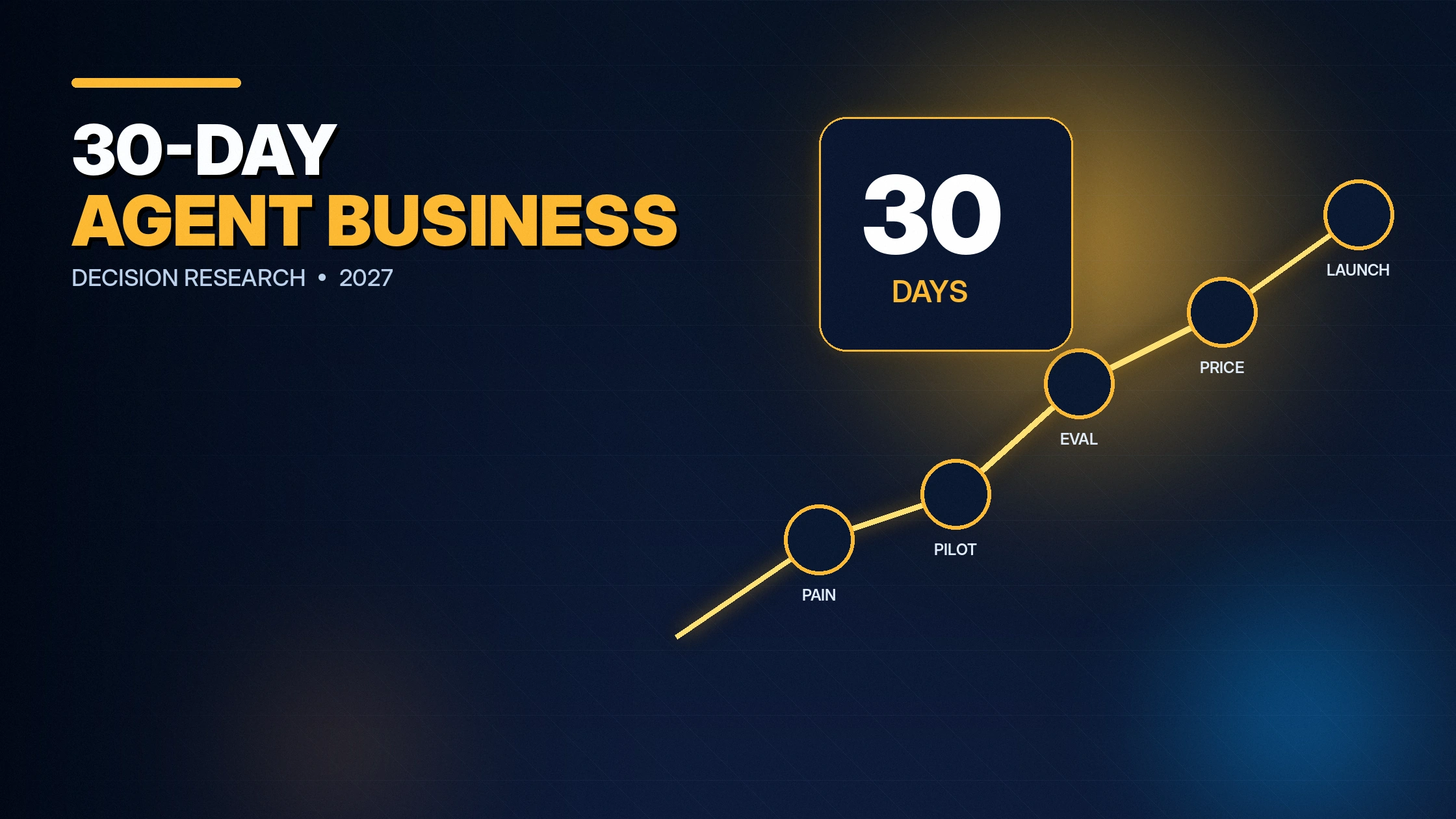
An AI-agent business is not passive income. It is a service operation with software leverage. The strongest first offer solves one bounded workflow for one identifiable buyer, produces an observable outcome, and includes support when the workflow breaks. A 30-day launch can validate demand and deliver a working pilot. It cannot prove durable product-market fit or guaranteed income.
DN Evidence Block
Reviewed: 16 November 2026 · Evidence type: current official product documentation and pricing for n8n, Make, Taskade, Chatbase and Replit, plus DN’s own planning assumptions.
Boundary: The time and revenue examples below are labelled planning scenarios. DN did not run a controlled 30-day agency experiment for this article, and no income outcome is promised.
- n8n prices cloud plans by completed workflow executions and also offers a self-hosted community edition.
- Make prices workflow operations as credits and offers a free tier.
- Taskade and Chatbase bundle hosted agent-building capabilities, while Replit offers a code-first hosted development route.
- Tool fees are only one part of cost. Validation, implementation, human review, support, hosting and failed runs usually dominate early-stage economics.
The Business Model in One Sentence
Choose a painful, repetitive business process; build a bounded agent that improves it; charge for implementation and ongoing operation; and preserve a human escalation path for exceptions.
The weakest starting point is “I run an AI automation agency.” That describes the technology, not the buyer’s problem. A stronger offer sounds like: “We reduce unanswered property-maintenance enquiries by classifying requests, drafting replies and escalating emergencies to a named manager.” The second statement gives a buyer something concrete to evaluate.
Before Day 1: Choose a Workflow, Not an Industry Slogan
A suitable first workflow has five properties:
- Frequent enough to matter. It happens every day or every week, not once a year.
- Bounded enough to test. The input, expected output and escalation rule can be written down.
- Low enough risk for a pilot. The agent can begin in read-only or draft mode.
- Accessible data. The buyer can legally provide the documents, messages or system access required.
- An identifiable economic outcome. Less handling time, faster response, fewer missed leads, cleaner records or fewer avoidable errors.
DN’s Verifiability Gradient is useful here. A workflow with fast, observable feedback is easier to improve than one where success appears months later.
The 30-Day Plan
Days 1–3: Define the Buyer and One Painful Workflow
Write a one-page problem brief:
- Who experiences the problem?
- How often does it occur?
- What do they do today?
- What does a failure cost in time, missed revenue, delay or risk?
- Which step requires judgment, and which step is repetitive?
- What must always stay with a human?
Do not start by building. Start by collecting five real examples of the workflow. For a support agent, that means five representative enquiries and the desired replies. For an invoice-chasing agent, it means five invoices with different due dates, dispute states and customer histories.
Days 4–7: Conduct Five Problem Interviews
Ask prospective buyers to describe the last time the process failed. Avoid asking whether they “would use AI.” That question encourages politeness and speculation. Ask instead:
- Show me how this was handled last week.
- Where did the process slow down?
- What information was missing?
- Who had to approve the next step?
- What happens when the normal path breaks?
- What would make you refuse to automate this?
A useful validation signal is not enthusiasm. It is access: the buyer is willing to provide sample data, introduce the process owner, define a pilot outcome, and reserve time to review the result.
Days 8–10: Design the Pilot Contract
The pilot should define:
| Field | Example |
|---|---|
| Workflow | Classify inbound maintenance requests and draft a response |
| Inputs | Email body, property identifier, approved contractor list |
| Allowed actions | Read, classify, draft and create an internal ticket |
| Prohibited actions | Send messages, book contractors or approve spend |
| Acceptance test | Correct priority and destination on 45 of 50 labelled examples |
| Escalation | Human review for safety, missing property ID or confidence below threshold |
| Pilot period | Two weeks in shadow or draft mode |
| Data rule | No personal data outside the approved systems; logs retained for 30 days |
For higher-risk financial workflows, apply the personal agent policy and the transaction permission framework before giving the agent any live authority.
Days 11–16: Build the Smallest Working Version
Choose the simplest route that supports the workflow:
- Hosted no-code agent: suitable for document-grounded support, research or internal Q&A.
- Low-code workflow: suitable when the process needs triggers, multiple systems, branching, retries or records.
- Code-first agent: suitable when the business needs custom authentication, durable execution, complex policy, high scale or portable infrastructure.
The DN build-path guide compares these routes in detail. For the pilot, avoid adding optional tools. Each new integration increases the number of credentials, failure modes and support obligations.
Days 17–20: Build the Evaluation Set
Use the buyer’s real examples, remove sensitive details where possible, and label the expected outcome. Include:
- ordinary cases;
- missing information;
- conflicting instructions;
- unavailable tools;
- prompt injection or malicious content;
- requests outside the agent’s authority;
- duplicate events;
- cases that must escalate.
Record more than the final answer. Log the model version, source data, tool calls, errors, human corrections and final disposition. This turns the pilot into a reusable evaluation asset rather than a collection of anecdotes.
Days 21–24: Run in Shadow Mode
Shadow mode means the agent processes live work but does not change the customer-facing system. Compare the proposed action with the human action. Measure:
- correct completion rate;
- unsafe or prohibited-action rate;
- escalation precision;
- average review time;
- cost per completed case;
- rework caused by missing context;
- failure-recovery time.
Do not hide human review from the cost model. If the agent saves ten minutes but creates eight minutes of review, the operational gain is two minutes, not ten.
Days 25–27: Price the Real Service
There are three common components:
- Discovery/setup fee: workflow mapping, integrations, evaluation set and deployment.
- Recurring operating fee: monitoring, hosting, platform fees, model usage, support and review.
- Variable usage: a transparent allowance or pass-through for unusually high volume.
Avoid pricing only by model tokens. The buyer values the outcome and the operating reliability. The seller must still understand the underlying cost.
Days 28–30: Deploy With an Operating Agreement
The go-live record should identify the owner, version, tools, credentials, limits, alerts, support hours, review cadence, rollback path and data-retention rules. Define what constitutes an incident and who can stop the agent. If the workflow handles money, public communications, employment decisions or regulated information, obtain appropriate legal and compliance review.
Three Planning Budgets
These are illustrative planning ranges, not quotations or promised costs. Prices exclude tax and may change.
| Build profile | Typical stack | Direct software range | Main hidden cost |
|---|---|---|---|
| Lean no-code pilot | Hosted agent builder + existing business tools | $0–$100/month before higher usage | Source preparation and human review |
| Low-code operating workflow | n8n or Make + model API + database/notifications | $30–$250/month at modest volume | Error handling, credentials and maintenance |
| Code-first product | Custom runtime + hosting + database + observability | $50–$500+ in infrastructure at early scale | Engineering, security and support |
Current official entry points include Make’s free 1,000-credit plan and paid plans, n8n’s cloud and self-hosted routes, Taskade’s hosted agent plans, Chatbase’s support-agent plans, and Replit’s hosted coding environment. The right choice depends on workflow shape, not the lowest headline price.
DN Agent Business Launch Planner
Estimate monthly contribution before tax. Enter assumptions; the tool does not predict sales.
Excludes tax, sales time, refunds, financing, legal work and founder salary unless represented in the hourly input.
Worked Scenario
Three clients pay a $1,500 setup fee and $500 per month. The operator spends $180 on shared tools and four support hours per client valued at $50 per hour. The recurring monthly contribution is $720 before tax and before sales or founder overhead. The first month also contains $4,500 of setup revenue, but that is not recurring. This distinction prevents a strong launch month from being mistaken for a stable business.
What to Put in the Client Agreement
- Exact workflow and excluded work.
- Data controller/processor responsibilities where relevant.
- Client responsibilities for source quality and account access.
- Acceptance criteria and the process for change requests.
- Service hours, incident severity and support response.
- Third-party platform dependencies and pass-through costs.
- Liability limits appropriate to the risk and jurisdiction.
- Termination, data export, credential revocation and deletion.
A lawyer should review contracts used with real clients. DN’s checklist is an operating prompt, not legal advice.
When the Idea Should Be Abandoned
Stop or redesign the offer if buyers will not share examples, the workflow cannot be evaluated, the agent requires broad authority before proving value, support cost exceeds the buyer’s willingness to pay, or the only persuasive sales argument is that “AI is the future.” A failed validation week is cheaper than maintaining a product nobody needs.
From Workflow to Offer: Three Concrete Examples
Offer A: Support-Triage Pilot
Buyer: a software company receiving 1,000 support messages a month. Scope: classify each message, retrieve approved documentation, draft a reply and create an escalation ticket when evidence is missing. Acceptance: correct queue and escalation on a labelled test set, with zero unauthorized refunds or account changes.
The seller is not selling “a support AI.” The seller is selling a measured reduction in untriaged work and response preparation. That makes the pilot easier to price and the outcome easier to defend.
Offer B: Property-Maintenance Intake
Buyer: a property manager coordinating tenant maintenance. Scope: collect property ID, issue type, urgency and access details; prepare a ticket; flag safety-critical terms. Acceptance: required fields captured, correct priority and no contractor booking without approval.
The service must include emergency escalation and local process knowledge. A generic chatbot is not enough because safety and authority determine the workflow.
Offer C: Accounts-Receivable Exception Queue
Buyer: an agency with recurring invoices. Scope: identify overdue invoices, retrieve prior correspondence, classify dispute state and draft a reminder. Acceptance: correct balance, due date and escalation; no legal threats or changed payment terms.
The agent can reduce preparation work while leaving negotiation and legal judgment with the account owner.
How to Sell the First Pilot Without Earnings Hype
A credible proposal has four parts:
- Current-state evidence: volume, handling time, backlog, errors or missed handoffs.
- Bounded intervention: the exact step the agent will prepare or automate.
- Acceptance criteria: test cases and failure thresholds agreed before deployment.
- Operating commitment: monitoring, support, rollback and review.
Do not promise that the client will “10× productivity.” Promise to run a defined pilot and publish the observed result to the client. If the baseline is unavailable, spend the first week measuring it.
Customer Economics
The buyer should be able to estimate value without relying on speculative revenue:
Monthly process value = hours avoided × loaded hourly cost + avoidable error cost + time-sensitive revenue retained − new review and operating cost.
Suppose a team handles 800 cases a month. The agent saves three minutes on 60% of them, producing 24 hours of gross time savings. Human review adds eight hours and the service costs $600. At a loaded labour cost of $40 per hour, the net time value is $640 before any service-quality benefit. The buyer now has a rational basis for deciding whether to continue.
Do not count “hours saved” if the staff cannot use the time for other valuable work. Measure actual capacity or service improvement.
Sales Evidence Pack
Before outreach, prepare:
- a one-page workflow diagram;
- five synthetic or permissioned examples;
- a list of allowed and prohibited actions;
- the evaluation scorecard;
- a data-processing and deletion summary;
- a sample incident/rollback process;
- a price with included volume and support;
- a clear statement of what the agent does not do.
This pack is more persuasive than an AI-generated demo with no controls.
Operating Metrics After Go-Live
| Metric | Why it matters | Bad interpretation |
|---|---|---|
| Accepted outcomes | Counts work the client could use without material correction | Counting every agent output |
| Human review minutes | Shows the real labour burden | Ignoring review because it happens “in the background” |
| Escalation quality | Tests whether uncertainty reaches the right person | Rewarding low escalation regardless of missed risk |
| Cost per accepted outcome | Combines tools, model calls, failures and labour | Reporting only token cost |
| Incident and near-miss rate | Reveals permission or process failures | Counting only customer-visible incidents |
| Source freshness | Shows whether the agent relied on current evidence | Assuming retrieval means current |
Support Model
Define three support classes:
- Configuration request: a planned change to prompts, data or workflow.
- Operational fault: the expected workflow did not complete.
- Security or high-impact incident: unauthorized action, data exposure or financial consequence.
Set response targets appropriate to each class. Do not promise 24/7 support if the business cannot provide it. A low-priced service with an unlimited emergency obligation is not sustainable.
The Next 60 Days
After the 30-day launch, do not immediately add more agents. Spend the next 60 days:
- expanding the evaluation set from real failures;
- reducing review time without weakening escalation;
- measuring customer retention and support burden;
- standardizing deployment, credentials and logs;
- deciding which customization belongs in configuration and which should be refused;
- building a documented exit/export path.
Only after two or three customers share the same workflow should the seller treat it as a repeatable product.
Common Failure Modes
- Building before obtaining real examples.
- Choosing a workflow because an integration exists rather than because the buyer cares.
- Using the client’s production data without a written data boundary.
- Giving write access before the draft-mode workflow passes.
- Pricing below the cost of support and custom changes.
- Failing to version prompts, tools and model configuration.
- Making income or savings claims from one successful pilot.
- Depending on a platform feature without an exit plan.
Frequently Asked Questions
Can a beginner start an AI-agent business without coding?
Yes, for bounded workflows supported by hosted tools. The beginner still needs process knowledge, testing, data handling, sales and support discipline.
Should I charge a setup fee or a monthly fee?
Most service models need both: setup pays for workflow discovery and implementation; recurring fees pay for operation, monitoring and support.
What is the safest first agent?
A read-only or draft-mode agent with a clear evaluation set and human escalation path.
How many clients should the first version support?
One to three design partners are enough to expose workflow differences before scaling the product.
Can I promise a percentage of time saved?
Only after measuring the full process, including review and exceptions, for a defined customer cohort.
Methodology and Limitations
DN translated current platform pricing and documented capabilities into three planning profiles. The budgets are illustrative, not observed benchmarks. They omit country-specific tax, labour law, legal review and unusual infrastructure requirements. Platform pricing was checked on 16 November 2026 and may change. Validate current terms before purchase.
Affiliate disclosure: DN may earn compensation from selected tools mentioned here, including Make, Taskade, Chatbase, and Replit. The article does not promise earnings and does not rank tools by commission.
Primary Sources



