Best Hyperliquid Alternatives for High Funding, Lower Fees and More Markets in 2027
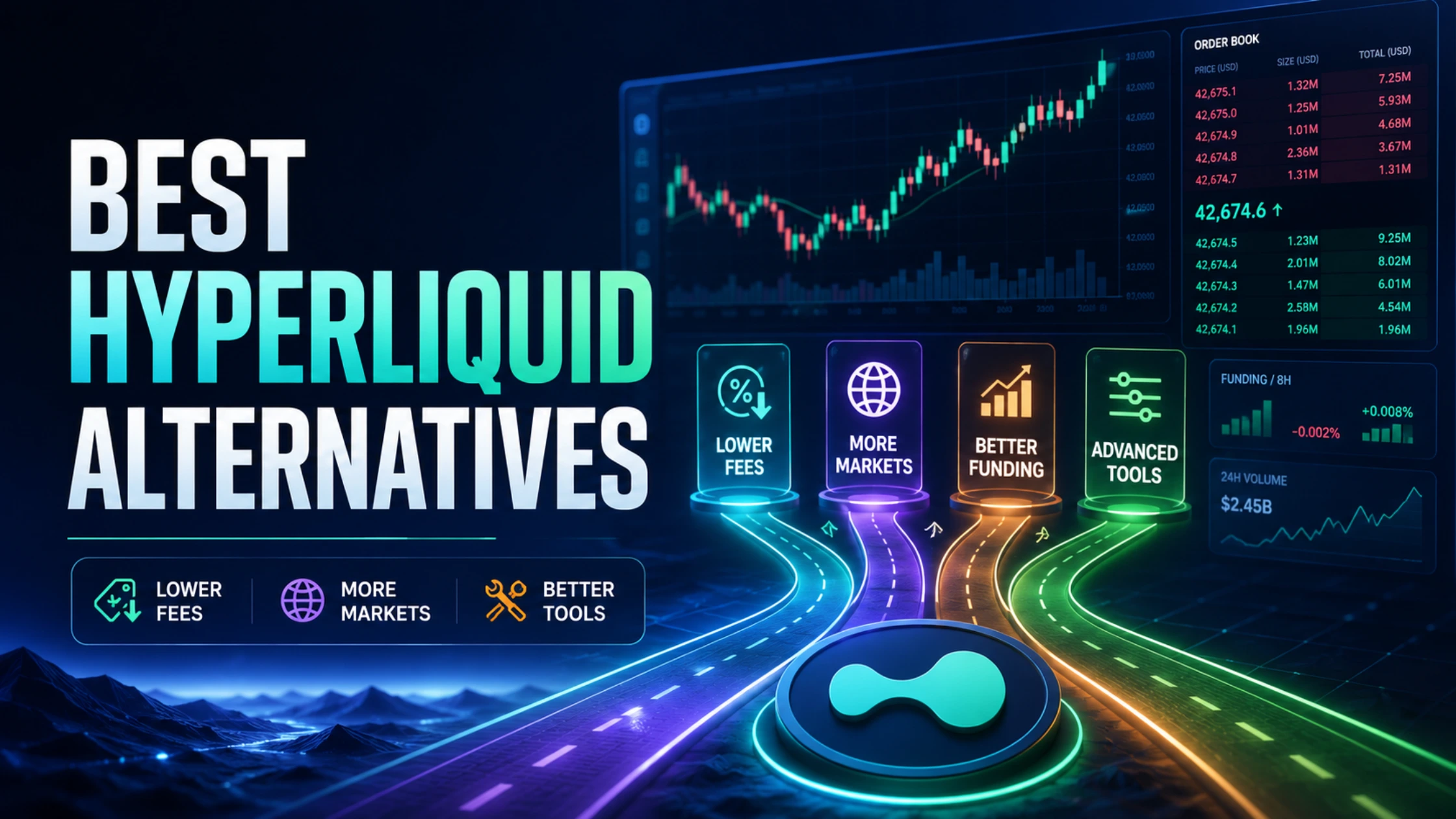
Our flagship comparison ranks the best Hyperliquid alternatives by fees, funding, markets, liquidity, custody, decentralisation, incentives, order types and API quality.
Research Verified: 26 July 2026
Editorial Note: This 2027 guide is based on platform structures and fee schedules verified in July 2026. Fees, markets, funding formulas, incentives and jurisdictional restrictions should be rechecked before publication or trading.
Summary
Hyperliquid has become a benchmark for on-chain perpetual futures. It combines a fully on-chain order book, non-custodial custody, more than 300 markets, sophisticated APIs and strong crypto liquidity. Its base perpetual fee tier begins at 0.015% for makers and 0.045% for takers, while funding is settled hourly.
Its success has not eliminated the need for competing venues.
The perpetual market is fragmenting into specialised platforms offering:
- Zero-fee accounts
- Maker rebates
- Funding-payment rebates
- Hundreds of smaller markets
- Stocks, forex and commodities
- Tokenised securities as collateral
- Yield-bearing margin
- Privacy
- Options
- Hybrid institutional execution
- Alternative settlement and custody models
Flagship verdict: Lighter is the strongest fee-focused Hyperliquid alternative. ADEN leads on raw market breadth. Paradex offers the most complete privacy and multi-product proposition. GRVT is particularly attractive to high-volume and API traders. Ostium and Ondo Perps are the most differentiated RWA alternatives.
No platform can guarantee lower funding. The optimal venue depends on the contract, direction, intended holding period, order size and live market imbalance.
Hyperliquid Benchmark
Category | Hyperliquid |
Architecture | Fully on-chain order book on Hyperliquid L1 |
Custody | Non-custodial |
Advertised markets | 300-plus spot and perpetual markets |
Base perpetual maker fee | 0.015% |
Base perpetual taker fee | 0.045% |
Highest published volume-tier taker fee | 0.024% before staking adjustments |
Funding settlement | Hourly |
Main order types | Market, limit, stop market, stop limit, TP/SL and advanced instructions |
API | Extensive REST, WebSocket and SDK ecosystem |
Main strength | Liquidity and transparent on-chain execution |
Main reason to diversify | Funding, specialist markets, lower-fee venues and alternative products |
Hyperliquid’s fees are based on rolling 14-day weighted volume. HYPE staking can reduce fees, and qualifying market makers can earn rebates.
Decentralised News Hyperliquid Alternative Framework
We evaluated each venue across nine dimensions:
- Direct trading fees: Maker, taker and execution charges
- Holding costs: Funding, rollover or borrowing costs
- Market breadth: Crypto, altcoins, equities, commodities, forex and options
- Liquidity: Depth, spread, slippage and large-order execution
- Custody: Wallet control, smart contracts, hot wallets and account recovery
- Decentralisation: On-chain execution, sequencers, enclaves and off-chain matchers
- Order functionality: Stops, TWAP, scaled orders, iceberg orders and block trading
- API quality: REST, WebSockets, rate limits, SDKs and subaccounts
- Incentives: Rebates, points, cashback, yield and referral programmes
Affiliate compensation is excluded from the ranking methodology.
Hyperliquid Alternatives Comparison
Platform | Headline Fee Position | Main Market Edge | Execution and Custody | API Quality | Best For |
Standard accounts: 0 maker and 0 taker | Crypto, spot and expanding RWA markets | Ethereum ZK rollup with verifiable matching | Strong | Low-fee active trading | |
0.003% maker, 0.038% taker at VIP 0 | 400-plus crypto perps and 20-plus stock perps | Gate Layer-based decentralised platform | Strong | Maximum market selection | |
Base maker rebate, 0.045% taker | Crypto and traditional-asset perps | Hybrid, self-custodial exchange model | Institutional | Market makers and funds | |
Zero-fee retail trading | Perps, spot, options and pre-markets | Private Starknet-based appchain | Excellent | Privacy and multi-product margin | |
3 to 5 bps entry, no close fee | 71 RWA and crypto markets | On-chain collateral with RFQ execution | Strong SDK | Forex, commodities and equities | |
0.015% maker, 0.035% taker | Tokenised-equity collateral | SGX enclave and attestor model | Documented | Equity and index perps | |
Taker as low as 1.5 bps, maker rebates | Spot, perps and margin on Ink | On-chain batched order infrastructure | Strong | Unified-margin traders | |
Market-specific | Yield-bearing DUSD margin | Perp execution with on-chain settlement features | REST and WebSocket | Productive collateral | |
Market and tier dependent | Perps, options and pre-launch futures | Off-chain order book, L2 settlement | Excellent | Options traders | |
0.015% maker, 0.045% taker before cashback | Crypto, RWA perps and AI bots | Off-chain matcher with Eventum infrastructure | Strong SDK | Cashback and automation | |
0.02% maker, 0.05% taker | Privacy and early incentives | Decentralised perpetual design | Developing | Points and privacy users | |
0.04% or 0.06% per open or close | RWA perps on Solana | Pool-liquidity model | Developing | Pool-based RWA trading | |
Check live market | Sui-native perpetuals | On-chain Sui infrastructure | REST API | Sui users | |
Promotions and live schedule vary | Crypto, TradFi, bots and copy trading | On-chain custody, off-chain settlement | Verify live | Broad hybrid trading | |
Competitive CEX schedule | Futures, spot, copy trading and AI | Centralised custody | Available | AI-assisted CEX users | |
Check live interface | Permissionless multichain trading | Non-custodial smart contracts | Public detail limited | Early multichain users | |
Published live schedule | 90-plus perps and predictions | Platform-specific | Public market-data API | Developers and prediction traders |
Fee schedules and product conditions are based on official sources available during the research period.
Tier One: The Strongest Broad Hyperliquid Alternatives
1. Lighter: Best for Lower Fees and Funding Rebates
Lighter is the clearest answer for traders primarily concerned about direct fees.
Standard Accounts currently pay no maker or taker fees across spot and perpetual markets. The platform applies intentional latency of 300 milliseconds to taker orders and 200 milliseconds to maker and cancellation actions. Premium Accounts remove some latency but introduce maker and taker fees.
Lighter is built as a custom zero-knowledge rollup on Ethereum. It generates proofs for exchange operations including matching and liquidations, with state changes verified through Ethereum.
Lighter Fee Structure
Account | Maker Fee | Taker Fee | Taker Latency |
Standard | 0% | 0% | 300 ms |
Premium, no LIT staked | 0.0040% | 0.0280% | 200 ms |
Premium, highest published staking tier | 0.0028% | 0.0196% | 140 ms |
Premium users can also receive up to a 15% rebate against eligible funding payments.
Best For
- Fee-sensitive traders
- Retail traders who can tolerate a speed bump
- Traders paying persistent positive funding
- API users
- Ethereum-aligned self-custody
Main Limitation
Zero fees do not ensure the lowest total execution cost. Traders must compare spread, depth and latency against Hyperliquid.
2. ADEN: Best for More Markets
ADEN’s strongest competitive advantage is market selection.
Its official documentation reports more than 400 crypto perpetual pairs and more than 20 stock perpetual markets. Crypto leverage can reach 125x, while stock perpetuals can offer up to 50x.
ADEN also supports iceberg, scaled, TWAP, market, limit, IOC, FOK and post-only instructions. It provides cross and isolated margin and a professional REST API.
ADEN Fee Position
Tier | Maker | Taker |
VIP 0 | 0.0030% | 0.0380% |
Higher tiers | Lower | Lower |
Funding
ADEN supports eight-hour and four-hour funding intervals. Markets experiencing extreme rates can move to hourly settlement.
Best For
- Small and mid-cap perpetuals
- Stock perpetuals
- Advanced order users
- High-leverage traders
- Points-programme participants
Main Limitation
More markets can mean uneven liquidity. Traders should assess depth individually rather than treating every listed contract as equally tradeable.
3. GRVT: Best for Market Makers and Institutional Traders
GRVT competes through maker economics, account infrastructure and professional trading tools.
Its entry-level perpetual tier provides a small maker rebate and a 0.045% taker fee. The highest standard published volume tier provides a 0.003% maker rebate and 0.024% taker fee.
GRVT Perpetual Fees
Tier | 30-Day Volume | Maker | Taker |
Level 1 | $0 | -0.0001% | 0.0450% |
Level 4 | $10 million | -0.0010% | 0.0370% |
Level 7 | $250 million | -0.0023% | 0.0290% |
Level 9 | $1 billion | -0.0030% | 0.0240% |
GRVT supports market-specific one-hour, four-hour and eight-hour funding schedules, traditional-asset perpetuals and dedicated trading APIs.
Best For
- Market makers
- Funds and professional desks
- Hummingbot users
- API trading
- Maker-rebate strategies
Main Limitation
The most attractive fee levels require substantial volume.
4. Paradex: Best for Privacy, Options and Unified Margin
Paradex has evolved from a perpetual exchange into a broader private trading environment.
It provides more than 90 markets across perpetuals, spot, dated options and pre-markets, with more than 100 perpetual contracts and leverage of up to 50x. Account positions, orders and data can be encrypted across its infrastructure.
Paradex supports:
- Cross margin
- Isolated margin
- Portfolio margin
- Partial liquidations
- Limit, market and stop orders
- Scaled orders
- TWAP
- TP/SL
- REST and WebSocket APIs
Retail trading is currently promoted as zero fee, while professional API orders use separate execution and fee conditions.
Best For
- Traders wanting private positions
- Options traders
- Portfolio-margin users
- Automated trading
- Multi-product accounts
Main Limitation
Retail and professional orders do not receive identical execution, queue and fee treatment. API traders must understand the classification rules.
Tier Two: Specialist Alternatives
Ostium: Best for Macro Markets
Ostium lists 71 instruments covering 33 stocks, six ETFs, seven commodities, seven indices, nine forex pairs and nine cryptocurrencies. Leverage reaches 200x on selected contracts.
Its cost model differs materially from Hyperliquid.
Cost | Ostium |
Opening fee | 3 to 5 basis points |
Closing fee | None |
Oracle request | $0.10 USDC |
Holding cost | Continuous rollover |
Rollover basis | SOFR, futures term structure or underlying funding, plus carry premium |
This makes Ostium especially useful when a trader wants exposure to gold, oil, stocks, indices or currencies without depending on a crypto-only order book.
Ondo Perps: Best for Tokenised Securities as Collateral
Ondo Perps offers perpetual exposure to equities, indices, commodities and an ETF, with maximum leverage of up to 20x.
Its published fee schedule is 0.015% for makers and 0.035% for takers. Markets remain available around the clock, including when the underlying traditional venue is closed.
Feature | Ondo Perps |
Standard collateral | USDC |
Specialist collateral | Supported tokenised equities |
Maker fee | 0.015% |
Taker fee | 0.035% |
Maximum leverage | 20x |
Execution | SGX secure enclave |
Verification | Independent attestor network |
Nado: Best for Flexible Margin
Nado combines spot, perpetuals and margin trading on Ink.
Its standout features include unified margin, isolated margin, subaccounts, TP/SL, TWAP and a fixed speed bump for aggressive orders.
Nado’s best published fee tiers offer taker rates as low as 1.5 basis points and maker rebates as high as 0.8 basis points. Funding transfers directly between traders.
StandX: Best for Yield on Trading Margin
StandX combines DUSD, perpetual trading and margin yield.
The protocol’s premise is that collateral should remain productive while a trader maintains positions. Its documentation also describes Position Yield, community market-making incentives, block trades, TP/SL and programmatic trading through REST and WebSocket APIs.
Aevo: Best for Options
Aevo remains one of the clearest alternatives for traders who require options alongside perpetual futures.
It uses an off-chain order book and risk engine with settlement on its custom Layer 2. The platform provides REST and WebSocket APIs and supports options, perpetuals and pre-launch products.
EVEDEX: Best for Cashback and Integrated Bots
EVEDEX’s standard fee schedule matches Hyperliquid’s base rates at 0.015% maker and 0.045% taker.
Its differentiation comes from cashback of up to 35%, AI trading tools, one-click execution and wallet-connected account infrastructure.
Cashback | Effective Maker Cost | Effective Taker Cost |
0% | 0.01500% | 0.04500% |
20% | 0.01200% | 0.03600% |
35% | 0.00975% | 0.02925% |
Cashback is paid after fees and depends on programme conditions. It should not be treated as a guaranteed permanent fee tier.
Tier Three: Emerging and Experimental Alternatives
Antarctic
Antarctic offers privacy-focused perpetual trading, a standard 0.02% maker fee, 0.05% taker fee and AX Points incentives. Its base fees are currently higher than Hyperliquid’s, making the privacy and reward proposition more important than the direct cost comparison.
GMTrade
GMTrade uses liquidity pools on Solana and specialises in RWA markets. Opening and closing positions costs 0.04% or 0.06% depending on the effect on pool balance.
Astros
Astros is a Sui-native perpetual DEX offering API access and sub-second execution claims. It is most relevant to traders already holding assets on Sui.
AlphaX
AlphaX combines on-chain custody with off-chain settlement and offers crypto, TradFi-linked products, bots and copy trading. Its live fee promotions and liquidity should be verified directly before routing larger positions.
Aivora
Aivora is an AI-focused centralised exchange rather than a DEX. It provides USDT and USDC perpetuals, spot, copy trading, APIs and integrated account-risk tools.
TXFlow
TXFlow’s terms describe a permissionless and non-custodial interface for perpetuals, spot and order-book products across public blockchains. Public product and fee documentation remains comparatively limited.
IO Trader
IO Trader provides prediction markets, perpetual futures and a public REST API covering more than 90 perpetual pairs. It may be more valuable as a developer and specialist-market venue than as a direct liquidity replacement for Hyperliquid.
Funding Models Compared
Platform | Funding or Holding-Cost Model | Important Difference |
Hyperliquid | Eight-hour calculation, hourly settlement | Standard peer-to-peer funding |
Lighter | Hourly | Premium users can receive rebates |
ADEN | One, four or eight hours | Interval can shorten in extreme markets |
GRVT | One, four or eight hours | Schedule varies by market |
Nado | Market-driven peer-to-peer | No platform fee on funding |
EVEDEX | Eight-hour calculated rate | Applied periodically between traders |
Paradex | Continuous funding | Uses multi-venue inputs |
Ostium | Continuous rollover | Based on carry rather than trader imbalance |
Ondo Perps | Eight intervals daily | Designed for RWA markets |
StandX | Peer-to-peer funding | Margin may earn separate yield |
Best Platform by Trading Objective
Objective | Leading Platforms |
Zero direct fees | Lighter, Paradex |
Lowest high-volume taker fee | Lighter Premium, GRVT, Nado |
Largest market catalogue | ADEN |
Crypto liquidity benchmark | Hyperliquid |
Private positions | Paradex, Antarctic |
Stocks and indices | Ondo Perps, Ostium, Paradex, ADEN |
Forex and commodities | Ostium, GMTrade |
Options | Aevo, Paradex |
Yield-bearing collateral | StandX |
Tokenised-equity collateral | Ondo Perps |
Maker rebates | GRVT, Nado |
Trading-fee cashback | EVEDEX |
Sui-native trading | Astros |
AI-assisted centralised trading | Aivora |
Public market-data API | IO Trader |
Emerging multichain venue | TXFlow |
Broad hybrid product suite | AlphaX |
The Decentralised News Total-Cost Test
A Hyperliquid alternative should be considered cheaper only when:
Trading fees + spread + slippage + funding + transfer costs + collateral costs are lower for the intended position.
The following factors should be measured:
Metric | Why It Matters |
Round-trip maker or taker fees | Direct entry and exit cost |
Spread | Immediate execution loss |
Slippage at the planned size | Large positions can move the book |
Expected holding period | Determines funding exposure |
Funding direction | Longs and shorts can face opposite costs |
Withdrawal and bridge costs | Can erase small savings |
Collateral yield | Reduces opportunity cost |
Margin efficiency | Changes liquidation distance |
Incentive certainty | Points are less valuable than cash rebates |
API reliability | Failed cancellations can overwhelm fee savings |
A zero-fee platform with thin liquidity may be more expensive than Hyperliquid.
A venue with a higher headline fee may be cheaper when it provides deeper liquidity or a more favourable funding rate.
How to Migrate a Position Safely
- Compare the same contract on both venues.
- Confirm collateral and network requirements.
- Calculate the full round-trip cost.
- Deposit a small test amount.
- Test order placement and cancellation.
- Test a withdrawal.
- Open the replacement position before closing the original only when sufficient capital is available.
- Avoid becoming unintentionally exposed during the transfer.
- Verify funding settlement times.
- Use conservative leverage until the new platform’s liquidation system is understood.
Moving a position creates execution and basis risk. Prices can diverge while the old position is closing and the new one is opening.
Final Verdict
Hyperliquid remains one of the strongest all-round perpetual exchanges. Its liquidity, on-chain transparency and developer ecosystem justify its position as a market benchmark.
The alternatives are increasingly difficult to ignore.
Choose Lighter when direct fees and funding rebates are the priority.
Choose ADEN when market selection matters most.
Choose GRVT for maker rebates and institutional APIs.
Choose Paradex for privacy, options and unified margin.
Choose Ostium for forex, equities and commodities.
Choose Ondo Perps for tokenised-equity collateral.
Choose Nado for flexible margin and maker economics.
Choose StandX for productive collateral.
Choose Aevo for options.
Choose EVEDEX for cashback and automation.
The strongest trading setup may not involve replacing Hyperliquid entirely. It may involve maintaining access to several platforms and routing each position according to live funding, liquidity, fees and product availability.
Affiliate Disclosure
This article contains referral links for Lighter, ADEN, GRVT, Antarctic, GMTrade, Nado, Astros, StandX, IO Trader, Ondo Perps, EVEDEX, AlphaX, Aivora, TXFlow, Aevo, Paradex and Ostium.
Decentralised News may receive compensation or platform rewards when eligible users register or trade through these links. Affiliate status does not affect the comparison framework, security analysis or conclusions.
Educational Disclaimer
This article is for informational and educational purposes only. It does not constitute investment, financial, trading, legal or tax advice.
Perpetual futures involve substantial risk. Funding rates, spreads, fees and liquidity can change rapidly. Leverage can result in liquidation and total loss. Smart contracts, wallets, bridges, sequencers, APIs, oracles and matching engines can fail or be exploited.
Confirm live conditions and jurisdictional eligibility before depositing or trading. Never trade with money you cannot afford to lose. For adults aged 18 and over.