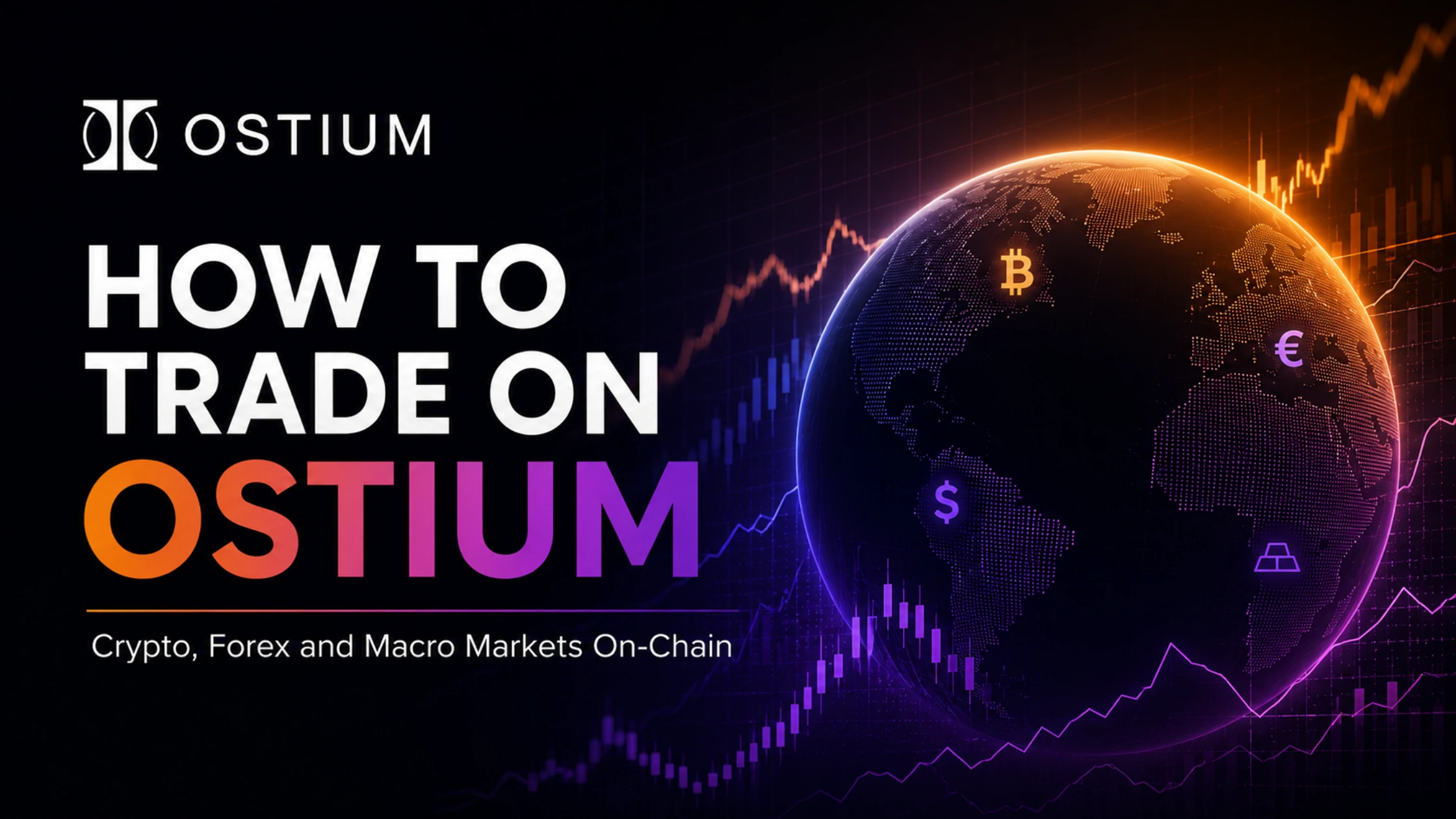
A practical 2027 guide to trading on Ostium from a crypto wallet. Learn what Ostium offers, how to connect a wallet, choose macro markets, use USDC collateral, set leverage, avoid liquidation and manage risk.
Summary
Ostium is a decentralized trading platform for users who want on-chain access to global markets.
It is built for traders who want to express views on crypto, forex, commodities, indices, stocks and ETFs using synthetic perpetual instruments settled in USDC.
The official Decentralised News referral link is Ostium.
By 2027, Ostium’s core appeal is clear:
One wallet.
USDC collateral.
On-chain settlement.
Self-custody.
Macro market access.
Crypto and traditional-market exposure from one interface.
But the core risk is also clear:
Leverage turns small mistakes into large losses.
A trader can be right on the macro thesis and still lose because the leverage was too high, the stop loss was poorly placed, the market was closed, rollover costs were ignored or liquidation was too close.
The best way to trade on Ostium is not to maximize leverage.
It is to build a controlled process:
Use a separate wallet.
Fund with small USDC collateral.
Choose one market.
Use low leverage.
Check liquidation.
Set stop loss and take profit.
Understand market hours.
Track every trade.
Ostium gives access.
Discipline decides the outcome.
Quick Answer
To trade on Ostium in 2027:
Open the platform.
Connect a supported wallet.
Confirm the correct network.
Add USDC collateral.
Choose a macro or crypto market.
Select long or short.
Set collateral.
Choose leverage.
Review notional position size.
Check fees, spread and rollover cost.
Check liquidation price.
Set stop loss and take profit.
Confirm the trade.
Monitor or close the position.
Best beginner route:
Use a dedicated trading wallet, start with a small USDC amount, trade a liquid market such as BTC, ETH, gold, US500 or EUR/USD only after studying it, use low leverage and set a stop loss before opening.
Use Ostium here:
Trade on Ostium with referral code 1RCGN.
What Ostium Offers
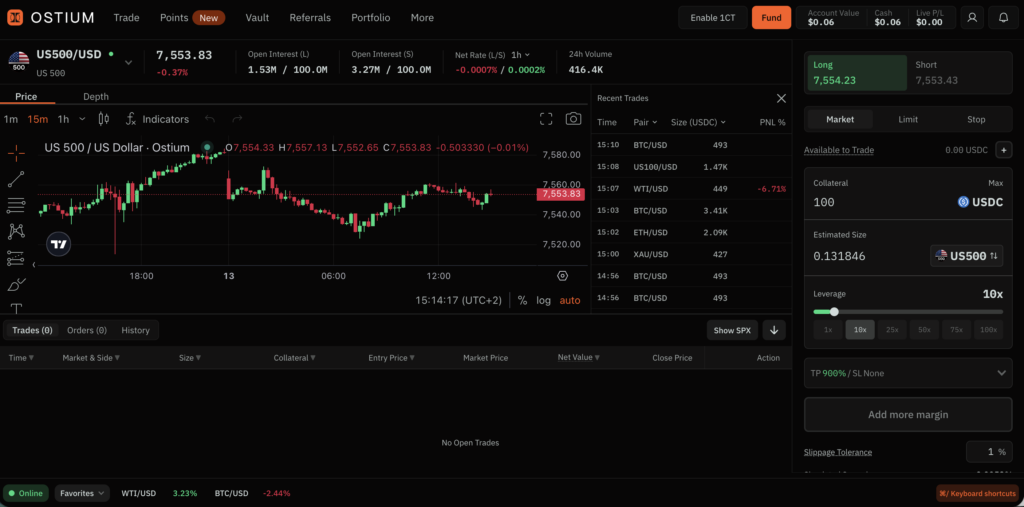
Ostium offers wallet-based access to global markets.
It is designed for traders who want more than crypto-only perpetuals.
Instead of opening separate accounts for crypto, forex, commodities and equities, a user can connect a wallet and trade synthetic price exposure from one interface.
Ostium may support:
Crypto markets.
Forex pairs.
Commodities.
Stock indices.
Selected equities.
ETFs.
This makes Ostium especially interesting for macro traders.
A user can express views such as:
Bitcoin strength.
Ethereum weakness.
Dollar strength.
Gold breakout.
Oil volatility.
S&P-style index direction.
Nasdaq-style tech exposure.
Single-stock momentum where available.
The benefit is convenience and access.
The risk is that each market behaves differently.
Bitcoin, gold, EUR/USD and Tesla do not trade the same way.
They have different volatility, hours, liquidity behavior, spreads and news drivers.
Ostium is best used by traders who match the market to their knowledge.
Connect Wallet
Ostium is not a traditional broker login.
It is wallet-based.
To start:
Go to Ostium.
Connect a supported wallet.
Confirm the network.
Check USDC balance.
Check gas balance.
Open the trading interface.
A safe setup uses a separate trading wallet.
Do not connect your main cold storage wallet.
Do not keep your full portfolio in the wallet used for leveraged trading.
Do not connect the same wallet to every DeFi app.
A dedicated wallet limits damage if something goes wrong.
Before signing anything, check:
The URL.
The wallet.
The network.
The transaction type.
The asset approval.
The collateral amount.
The gas fee.
A clean wallet process is not optional.
On-chain trading makes the user responsible for every signature.
Choose a Macro Market
Ostium is powerful because it lets users trade multiple market categories.
Crypto
Crypto markets are open 24/7.
They can move violently.
Best beginner examples may include BTC and ETH.
Use low leverage.
Forex
Forex markets track currency pairs.
Examples may include EUR/USD, GBP/USD and USD/JPY.
Forex may have lower percentage moves than crypto, but higher leverage can make it just as dangerous.
Commodities
Commodities include assets such as gold, silver, oil or metals where supported.
They are affected by inflation, rates, geopolitics, inventory data and macro cycles.
Indices
Indices track broader equity market exposure.
They may follow traditional market hours or futures-linked schedules.
Macro data and central bank expectations can move them quickly.
Stocks and ETFs
Single stocks and ETFs can have specific market hours, earnings risk and overnight gaps.
A stock perpetual is not the same as holding the actual stock.
It is synthetic price exposure.
A beginner should not trade all categories at once.
Pick one.
Study it.
Learn the fee and market-hour behavior.
Then expand.
Collateral
Ostium uses USDC collateral.
Collateral is the amount you commit to the trade.
It is the margin behind the position.
The position size is collateral multiplied by leverage.
Example:
100 USDC collateral.
20x leverage.
2,000 USDC notional exposure.
The trade behaves like a 2,000 USDC position, not a 100 USDC position.
That is why small moves can create large changes in equity.
Before entering, check:
Collateral amount.
Leverage.
Notional size.
Opening fee.
Spread.
Rollover cost.
Liquidation price.
Stop loss.
Take profit.
Market hours.
The correct order is:
Decide how much you are willing to lose.
Choose the stop loss.
Choose the position size.
Then choose leverage.
Do not start with leverage.
Leverage is the last input, not the first.
Leverage
Leverage is useful only when the trader already has a plan.
It is dangerous when used to make a weak idea feel exciting.
Ostium can offer high leverage on some markets, but the maximum is not a target.
A realistic 2027 leverage framework:
1x to 3x while learning.
3x to 5x for cautious setups.
5x to 10x for experienced users.
Above 10x only with tight execution and proven discipline.
Very high leverage only for specialists.
The question is not:
Can this trade make money?
The question is:
Can this trade survive normal market movement before reaching my invalidation level?
If the answer is no, the leverage is too high.
A trade should be sized so that the stop loss triggers before liquidation becomes the main exit.
Risk Controls
Ostium provides trading controls, but the trader must use them correctly.
Stop loss
A stop loss defines the point where the trade idea is wrong.
Use it before the trade becomes a liquidation.
Take profit
A take profit defines the target.
Use it to reduce emotional decision-making.
Low collateral sizing
Do not risk a large part of your wallet on one trade.
The platform cannot fix poor position sizing.
Market-hours awareness
Traditional assets may not behave like crypto.
Some markets close.
Some orders may queue.
Some positions may carry overnight risk.
Rollover cost awareness
Holding leveraged positions can create ongoing costs.
A trade that looks good on entry may become weak if held too long.
Separate wallets
Use one wallet for trading.
Use another for long-term holdings.
Trade journal
Track every position.
A journal turns mistakes into data.
Without a journal, trading becomes memory and emotion.
Liquidation
Liquidation is what happens when the market moves too far against the position.
The higher the leverage, the closer the liquidation level.
Liquidation is not just a worst-case scenario.
It is a sign that the trade was allowed to reach the danger zone.
Before opening, ask:
Where is liquidation?
Where is my stop loss?
Is stop loss safely before liquidation?
Is the market volatile?
Could a normal wick hit liquidation?
Am I trading during news?
Am I holding through market close?
Do I understand rollover costs?
A professional trader plans exits before entries.
A beginner often does the opposite.
On Ostium, that difference matters.
Fees and Costs
Ostium trading costs may include:
Opening fees.
Bid-ask spread.
Price impact.
Rollover fees.
Gas fees.
Stop or limit execution conditions.
Market-hours related execution differences.
Fees matter more with leverage because they apply to position exposure and can reduce net returns.
A small target with high leverage and poor spread can be a bad trade even if direction is right.
Before confirming a trade, review:
Total notional size.
Fee estimate.
Spread.
Rollover cost.
Market hours.
Take-profit distance.
Stop-loss distance.
Liquidation distance.
A good trade has enough expected reward to justify the total cost.
Step-by-Step Ostium Trading Flow
Step 1: Open Ostium
Go to Ostium.
Step 2: Connect wallet
Use a supported wallet and network.
Step 3: Add USDC
Make sure the wallet has USDC collateral and gas.
Step 4: Choose market
Select crypto, forex, commodities, indices, stocks or ETFs.
Step 5: Choose direction
Long if you expect price to rise.
Short if you expect price to fall.
Step 6: Enter collateral
Start small.
Step 7: Set leverage
Use lower leverage while learning.
Step 8: Review position size
Collateral multiplied by leverage equals exposure.
Step 9: Check costs
Review spread, fees and rollover.
Step 10: Check liquidation
Make sure liquidation is not too close.
Step 11: Set stop loss and take profit
Define the trade before confirming.
Step 12: Confirm wallet transaction
Read the wallet prompt carefully.
Step 13: Monitor or close
Manage the position until it closes manually or through your rules.
Best Use Cases for Ostium
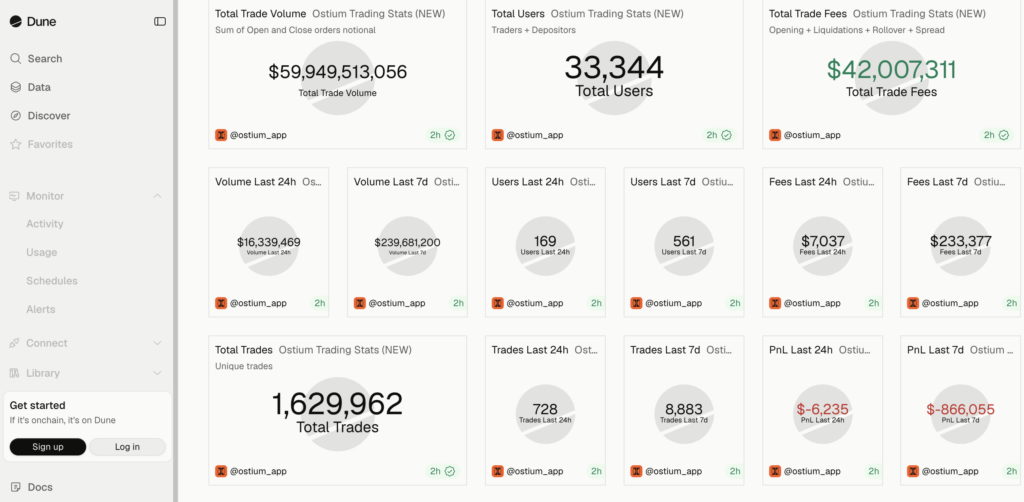
Ostium is best for:
On-chain macro traders.
Crypto traders who want forex or commodities exposure.
Users who want wallet-based leverage.
Traders who understand collateral and liquidation.
Users who want USDC settlement.
DeFi users who do not want a traditional broker.
Traders with strict stop-loss discipline.
Ostium is not ideal for:
Beginners who do not understand leverage.
Users who cannot manage wallets safely.
People who trade emotionally.
Anyone using emergency funds.
Traders who refuse to use stop losses.
Users who treat high leverage as a shortcut.
Ostium is a serious tool.
It should be used seriously.
Final Verdict
Ostium is one of the most compelling on-chain macro trading platforms for 2027.
Use Ostium if you want decentralized access to crypto, forex, commodities, indices, stocks and ETFs using USDC collateral from a wallet.
Do not use Ostium if you do not understand leverage.
The best 2027 setup is:
Separate trading wallet.
Small USDC collateral.
One market at a time.
Low leverage.
Defined stop loss.
Defined take profit.
Checked liquidation price.
Checked fees and market hours.
Written trade journal.
Ostium lets crypto traders access global markets.
Risk management decides whether that access becomes a strategy or a liquidation event.
FAQ
What is Ostium?
Ostium is an on-chain trading platform that lets users trade synthetic perpetual instruments across crypto, forex, commodities, indices, stocks and ETFs.
How do I trade on Ostium?
Connect a wallet, add USDC collateral, choose a market, select long or short, set leverage, add risk controls and confirm the trade.
What markets can I trade on Ostium?
Ostium supports markets across crypto, forex, commodities, indices, stocks and ETFs, depending on current platform availability.
What collateral does Ostium use?
Ostium uses USDC collateral on the supported network.
Is Ostium decentralized?
Ostium is an on-chain, non-custodial trading platform, so users trade through connected wallets and smart contracts.
Is Ostium good for macro trading?
Yes. Ostium is especially useful for users who want wallet-based exposure to macro markets such as forex, commodities and indices.
What is leverage on Ostium?
Leverage multiplies exposure. A 100 USDC trade at 10x creates roughly 1,000 USDC of notional exposure.
What is liquidation?
Liquidation happens when a leveraged trade moves too far against the position and the collateral can no longer support the loss.
Should I use stop loss on Ostium?
Yes. A stop loss is one of the most important controls for avoiding liquidation.
What is the biggest mistake on Ostium?
The biggest mistake is using too much leverage without checking liquidation, stop loss, market hours, fees and position size.
18+ Educational Disclaimer
This article is for educational purposes only and does not constitute financial advice, investment advice, trading advice, tax advice, legal advice or a recommendation to use Ostium, leverage, perpetuals, forex, commodities, stocks, indices, ETFs, crypto derivatives or any trading strategy. Leveraged trading is high risk and can result in the loss of your entire collateral. Risks include liquidation, price volatility, smart contract risk, oracle risk, wallet errors, wrong network use, gas fees, failed transactions, stop-loss execution risk, slippage, spreads, rollover fees, market-hours risk, platform changes, regulatory changes and user error. Crypto and leveraged trading are intended for adults aged 18 and over.