
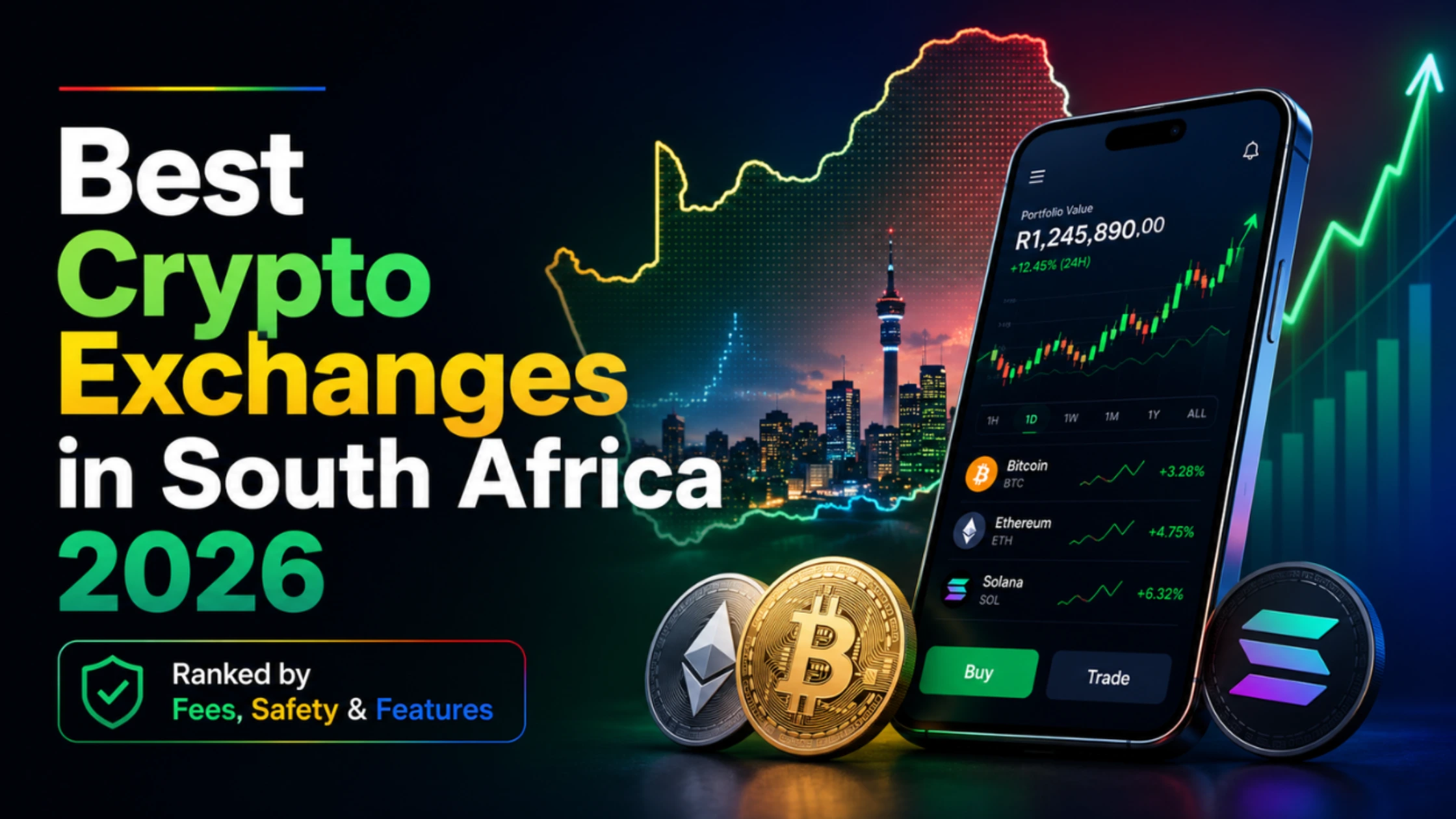
Compare the best crypto exchanges in South Africa for 2027, including VALR, Luno, Bybit, OKX, MEXC and Kraken. Learn which platform is best for rand deposits, beginners, futures trading, altcoins, safety and lower fees.
The best crypto exchange in South Africa depends on what you want to do.
For most South Africans, the smartest setup is not one exchange. It is a two-part system.
Use a local exchange like VALR or Luno to deposit and withdraw rand.
Then use a global exchange like Bybit, OKX, MEXC or Kraken for deeper liquidity, more coins, advanced trading tools, futures, staking, bots or lower spreads.
South Africa is now one of the more regulated crypto markets in Africa. The FSCA began licensing crypto asset service providers after declaring crypto assets financial products under South African financial law. That makes platform choice more important than ever, especially for users who care about rand withdrawals, tax records, security and long-term account access.
Quick Answer: Best Crypto Exchanges in South Africa
Best overall South African crypto exchange:
VALR
Best for rand deposits, rand withdrawals, active South African traders and users who want a strong local exchange with global-style features.
Best beginner crypto exchange in South Africa:
Luno
Best for new users who want a simple app, easy rand deposits and a clean way to buy Bitcoin or Ethereum.
Best exchange for advanced traders:
Bybit
Best for futures, copy trading, liquidity, launch campaigns and a more complete active-trader experience.
Best exchange for Web3 and global crypto access:
OKX
Best for users who want a strong exchange plus a Web3 wallet, DeFi access and global trading tools.
Best exchange for altcoin hunters:
MEXC
Best for finding newer tokens, meme coins and smaller altcoins before they appear on larger mainstream platforms.
Best exchange for security-focused global users:
Kraken
Best for users who prioritize reputation, compliance, security standards and transparent trading.
Why South Africans Need the Right Crypto Exchange
Buying crypto in South Africa is different from buying crypto in the United States, Europe or Asia.
South African users usually care about five things.
Can I deposit rand easily?
Can I withdraw back to my South African bank account?
Are the fees reasonable?
Can I access enough coins and trading tools?
Will the platform still be reliable when the market gets volatile?
That is why many South African crypto investors eventually use more than one platform.
A local platform helps with fiat access. A global platform helps with liquidity, altcoins, derivatives, automation and advanced execution.
This is especially important during a bull market. When prices move quickly, weak exchanges show their limitations. Apps freeze. Spreads widen. Withdrawal queues grow. Support slows down. New users panic. Experienced traders already have their exchange stack ready before the rush arrives.
The right exchange is not just where you buy crypto. It is part of your risk management system.
Best Platform for Rand Deposits: VALR
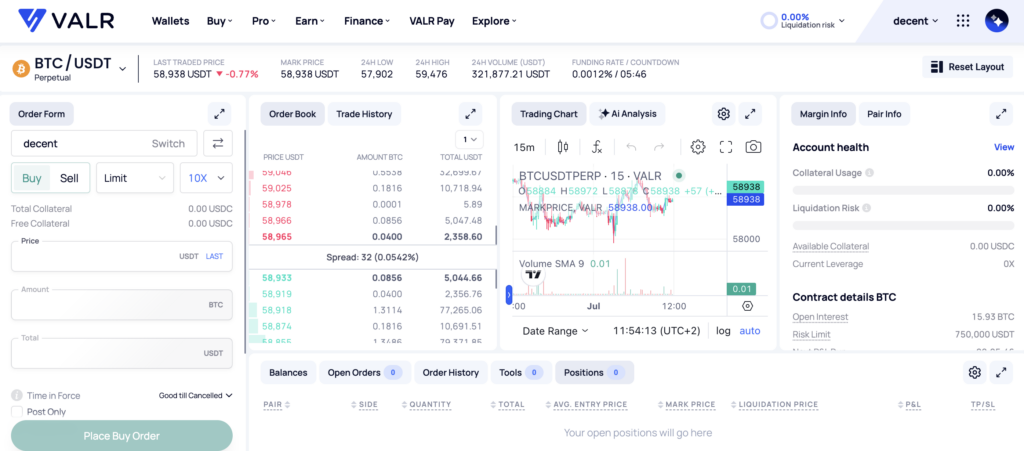
VALR is one of the strongest choices for South Africans who want a local exchange with serious trading functionality.
VALR supports ZAR deposits and withdrawals, offers crypto trading across many assets, and positions itself as South Africa’s leading crypto platform. Its website lists VALR as a licensed financial services provider with FSP number 53308.
VALR is particularly useful if you want to move between rand, Bitcoin, Ethereum, stablecoins and global exchanges.
For many South African traders, VALR works best as the main fiat gateway.
You deposit rand into VALR.
You buy BTC, ETH, USDT or USDC.
You either hold locally, trade locally or send crypto to a global exchange such as Bybit, OKX, MEXC or Kraken.
VALR’s fee page says ZAR deposits via EFT are free, crypto deposits are free, and card deposits carry a higher fee. VALR also states that individual clients receive 30 free normal ZAR withdrawals per month.
Best for:
South Africans who want a strong local exchange for rand deposits, withdrawals, trading and stablecoin access.
Use VALR here:
Open a VALR account and use referral code VAZP2TAW.
Best Beginner Platform: Luno
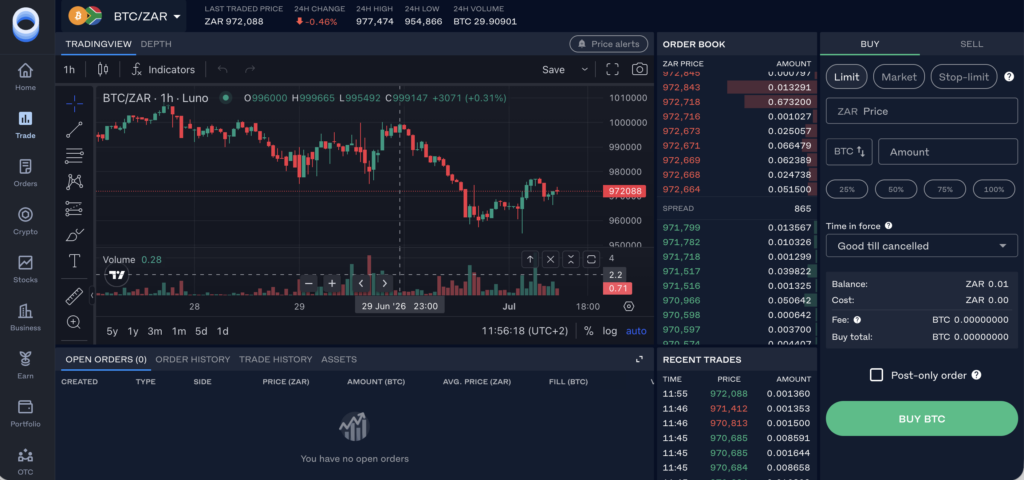
Luno remains one of the easiest crypto apps for South Africans who are buying Bitcoin or Ethereum for the first time.
It is clean, simple and familiar. That matters for beginners.
A new crypto user does not need 200 futures contracts, advanced order types and ten different wallet networks on day one. They need a simple way to deposit rand, buy Bitcoin, understand what they own and avoid obvious mistakes.
Luno’s South African website lists Luno as an authorised financial services provider with FSP number 53314.
Luno’s local fee page says South African users can deposit by bank transfer for free, while instant deposit options carry fees.
That makes Luno a good entry point for people who want simplicity over complexity.
The trade-off is that Luno is not the best platform for serious altcoin hunting, futures trading or advanced crypto strategies. It is best used as a beginner on-ramp or simple long-term buying app.
Best for:
First-time buyers, conservative users, Bitcoin beginners and South Africans who want an easy app.
Use Luno here:
Open a Luno account and use reward code MJV6YD.
Best Advanced Trading Platform: Bybit
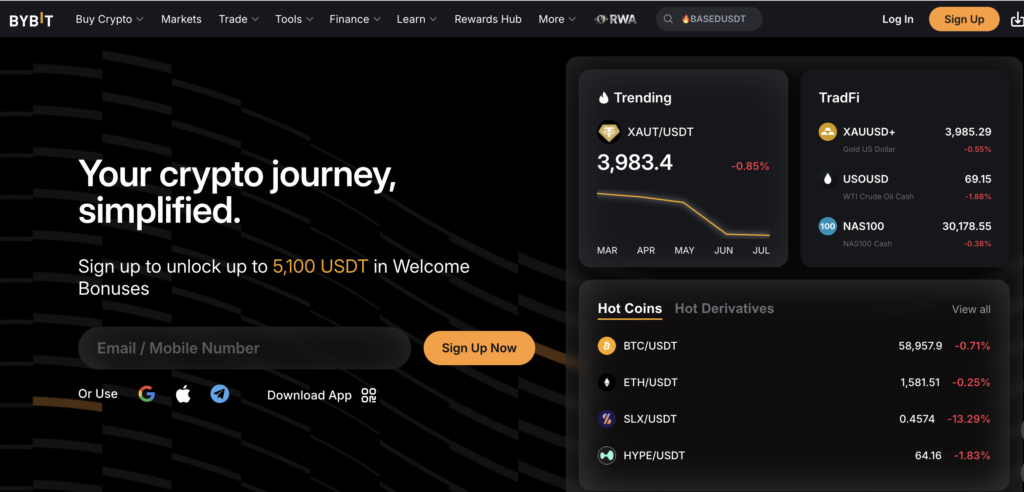
Bybit is one of the strongest global options for South Africans who want more than simple spot buying.
It is built for active traders.
Bybit is popular for futures, copy trading, launch campaigns, trading competitions, liquidity and a more complete trader dashboard. It is not the simplest platform for a total beginner, but it becomes extremely useful once you understand spot trading, stablecoins, risk management and order types.
For South Africans, Bybit often works best as the second platform in the stack.
Use VALR or Luno for rand access.
Then use Bybit for global liquidity, futures, copy trading and more active strategies.
The key warning is leverage. Futures trading can destroy beginners quickly. If you use Bybit, start with spot trading, small position sizes and strict risk limits before experimenting with futures.
Best for:
Advanced users, futures traders, copy trading users, active altcoin traders and those who want global crypto market access.
Use Bybit here:
Open a Bybit account and use referral code 46164.
Best Web3 and Global Crypto Platform: OKX

OKX is a strong choice for users who want both a centralized exchange and a gateway into Web3.
It is useful for spot trading, derivatives, DeFi exploration, wallet access and global crypto market exposure.
OKX is especially appealing to users who want more than a basic exchange app. Its Web3 wallet and ecosystem tools make it relevant for traders who want to move between centralized exchange trading and on-chain activity.
That said, South African users should always check product availability, verification requirements and local compliance before relying on any global exchange as their main trading venue.
OKX’s public fee pages note that fees can vary by region and user tier, so users should check their own account before assuming a fixed rate.
Best for:
Web3 users, DeFi explorers, active traders and users who want a large global exchange with more advanced tools.
Use OKX here:
Open an OKX account and use referral code 2136301.
Best Altcoin Exchange: MEXC
MEXC is one of the best options for South African traders who are hunting smaller altcoins, newer listings and meme coins.
The main advantage is token access.
Many coins appear on MEXC before they appear on larger, more conservative platforms. That makes it attractive during bull markets, when traders are searching for the next AI coin, meme coin, DeFi token, RWA project or early narrative leader.
The main risk is also token access.
More listings means more opportunity, but also more low-quality assets. New traders should not assume that a coin is safe simply because it is listed on an exchange. Liquidity, unlocks, tokenomics, contract risk and market maker activity still matter.
MEXC is best used by users who already understand volatility.
For South Africans, a practical setup is to deposit rand into VALR, buy USDT, then transfer a limited amount to MEXC for altcoin trading.
Never send your entire portfolio to an altcoin exchange just because one coin looks exciting.
Best for:
Altcoin hunters, meme coin traders, early narrative traders and users looking for a wider token selection.
Use MEXC here:
Open a MEXC account and use referral code 16yJL.
Best Security-Focused Global Exchange: Kraken
Kraken is one of the strongest options for users who care about reputation, security and transparent trading.
It is not always the flashiest platform. That is part of the appeal.
Kraken is often preferred by users who want a more conservative global exchange, strong security practices, transparent fees and a more traditional approach to crypto trading.
Kraken’s licensing and regulation page lists several regulated entities internationally, including European licensing under Ireland’s Central Bank for certain services.
For South Africans, Kraken is useful as a global exchange option, especially for users who want exposure to major assets, deeper markets and a security-first brand.
It may not be the best platform for meme coin hunters or high-leverage traders, but it is a strong choice for investors who care about trust.
Best for:
Security-focused users, larger investors, long-term holders and traders who prefer conservative infrastructure.
Use Kraken here:
Open a Kraken account and use referral code QjZ0L3.
Best Platforms for Rand Deposits and Global Crypto Trading
The best exchange stack for South Africans usually looks like this:
Beginner stack:
Use Luno to buy Bitcoin or Ethereum. Move long-term holdings to a hardware wallet when your balance becomes meaningful.
Best local trading stack:
Use VALR for rand deposits, local trading, stablecoin access and withdrawals.
Advanced trader stack:
Use VALR for rand on-ramp and Bybit for futures, liquidity and active trading.
Altcoin hunter stack:
Use VALR for rand deposits, then MEXC for newer tokens and smaller altcoins.
Web3 stack:
Use OKX for exchange trading and Web3 access, with a hardware wallet for serious long-term storage.
Security-first stack:
Use Kraken for global trading and a hardware wallet for long-term custody.
How to Compare Crypto Exchanges in South Africa
Do not choose an exchange because of hype.
Choose based on your actual use case.
1. Rand deposits and withdrawals
South Africans should start by checking whether the platform supports ZAR deposits and withdrawals.
If it does not, you may need to buy crypto locally first, then transfer stablecoins or Bitcoin to a global platform.
This is why VALR and Luno are so useful.
They solve the rand problem.
2. Fees and spreads
A low trading fee does not always mean a cheap trade.
You must compare:
Deposit fees
Trading fees
Spreads
Withdrawal fees
Network fees
FX conversion costs
Card fees
Instant deposit fees
A platform with a low trading fee can still be expensive if the spread is wide or the withdrawal fee is high.
3. Liquidity
Liquidity matters when you trade larger amounts.
A beginner buying R500 of Bitcoin may not notice much difference.
A trader moving R100,000 into a smaller altcoin will notice immediately.
Weak liquidity creates slippage. Slippage is an invisible fee.
4. Safety and regulation
South Africa’s crypto market is now more regulated than it was in previous cycles. That is good for users, but it does not remove all risk.
Crypto exchanges are still businesses. They can freeze accounts, change rules, suffer outages, restrict products or become unavailable in certain regions.
Use strong passwords, app-based 2FA, withdrawal whitelists and hardware wallets for long-term storage.
5. Product range
Different exchanges serve different users.
Luno is simple.
VALR is strong for South African rand access.
Bybit is strong for active traders.
OKX is strong for Web3 and global tools.
MEXC is strong for altcoins.
Kraken is strong for trust-focused users.
Best Beginner Route for South Africans
If you are new to crypto, do not start with leverage, meme coins or complex DeFi strategies.
Start simple.
Step 1: Open a Luno account or VALR account.
Step 2: Deposit a small amount of rand by EFT.
Step 3: Buy Bitcoin or Ethereum first.
Step 4: Learn how deposits, withdrawals, fees and wallet addresses work.
Step 5: Once your balance grows, consider a hardware wallet for long-term storage.
Step 6: Only explore Bybit, OKX or MEXC after you understand basic crypto transfers.
A beginner’s goal is not to maximize profit on day one.
The first goal is to avoid permanent mistakes.
Best Advanced Trader Route for South Africans
If you are already comfortable with wallets, stablecoins and exchange transfers, a more advanced setup makes sense.
Step 1: Use VALR as your rand gateway.
Step 2: Buy USDT, USDC, BTC or ETH.
Step 3: Transfer only your trading allocation to Bybit, OKX or MEXC.
Step 4: Keep long-term holdings separate from trading capital.
Step 5: Track every deposit, trade and withdrawal for tax purposes.
Step 6: Use Kraken if your priority is a more conservative global trading environment.
Step 7: Use a hardware wallet for assets you do not plan to trade actively.
The biggest mistake advanced traders make is treating all capital the same.
Your trading capital, long-term holdings, tax reserve and emergency cash should not sit in one account.
Common Mistakes South African Crypto Traders Make
Mistake 1: Using only one exchange
One exchange is convenient, but it creates platform risk.
If the app goes down during volatility, you are stuck.
A better setup is one local rand gateway, one global trading venue and one self-custody wallet.
Mistake 2: Ignoring withdrawal fees
Many users compare only trading fees.
That is incomplete.
Always check what it costs to withdraw stablecoins, Bitcoin, Ethereum or altcoins before moving money.
Mistake 3: Sending crypto on the wrong network
This is one of the most common beginner errors.
USDT on Ethereum is not the same as USDT on Tron, Solana, BNB Chain or Arbitrum.
Always match the sending network and receiving network.
Send a small test transaction first.
Mistake 4: Starting with futures
Futures are not beginner products.
Leverage magnifies losses. Liquidation can happen quickly. A good exchange does not make a bad risk strategy safe.
Use spot markets first.
Mistake 5: Leaving long-term holdings on exchanges
Exchanges are useful for trading.
They are not ideal for storing your entire net worth.
Once your holdings become meaningful, learn self-custody and consider a hardware wallet.
Mistake 6: Not keeping tax records
South African crypto users should keep clean records of deposits, withdrawals, trades, swaps and disposals.
Use tools like Koinly or CoinLedger early, not after hundreds of trades.
Best Overall Choice
For most South Africans, the best overall exchange setup is:
VALR for rand deposits and withdrawals.
Bybit for active global trading.
MEXC for altcoin discovery.
Kraken for a more security-focused global option.
Luno for the simplest beginner experience.
OKX for Web3 users and global crypto access.
There is no single perfect exchange.
There is only the right tool for the job.
FAQ
What is the best crypto exchange in South Africa?
For most South Africans, VALR is the best overall local exchange because it offers rand deposits, rand withdrawals and a strong local trading experience. Beginners may prefer Luno, while advanced traders may prefer Bybit, OKX, MEXC or Kraken.
Which crypto exchange is best for beginners in South Africa?
Luno is one of the easiest choices for beginners because the app is simple and supports local South African users. VALR is better for beginners who want more trading features as they grow.
Which crypto exchange is best for advanced South African traders?
Bybit is one of the best choices for advanced traders because it offers strong liquidity, futures, copy trading and a full active-trader experience. OKX is also strong for Web3 and global trading tools.
Which exchange is best for buying altcoins?
MEXC is one of the strongest options for altcoin hunters because it often lists smaller and newer tokens earlier than many larger platforms.
Can South Africans use global crypto exchanges?
Many South Africans use global exchanges, but product access, verification requirements and availability can change. Always check the platform’s current terms, local rules and your own account status before depositing funds.
Should I keep my crypto on an exchange?
Only keep active trading funds on an exchange. Long-term holdings are usually safer in self-custody, especially with a hardware wallet. Exchanges are useful, but they still carry counterparty risk.
What is the safest crypto exchange for South Africans?
There is no risk-free exchange. Kraken is often preferred by security-focused global users, while VALR and Luno are strong local options for South Africans who want rand access.
What is the best way to start with crypto in South Africa?
The simplest route is to open a Luno or VALR account, deposit a small amount of rand, buy Bitcoin or Ethereum, and learn how wallets and withdrawals work before trading altcoins or futures.
18+ Educational Disclaimer
This article is for educational purposes only and does not constitute financial advice, investment advice, tax advice or a recommendation to buy or sell any crypto asset. Crypto assets are volatile and you can lose money. Always do your own research, use secure account settings, understand the risks of each platform, and speak to a qualified professional if you need financial or tax guidance. Crypto trading and investing are intended for adults aged 18 and over.





